







Kagi on price chart
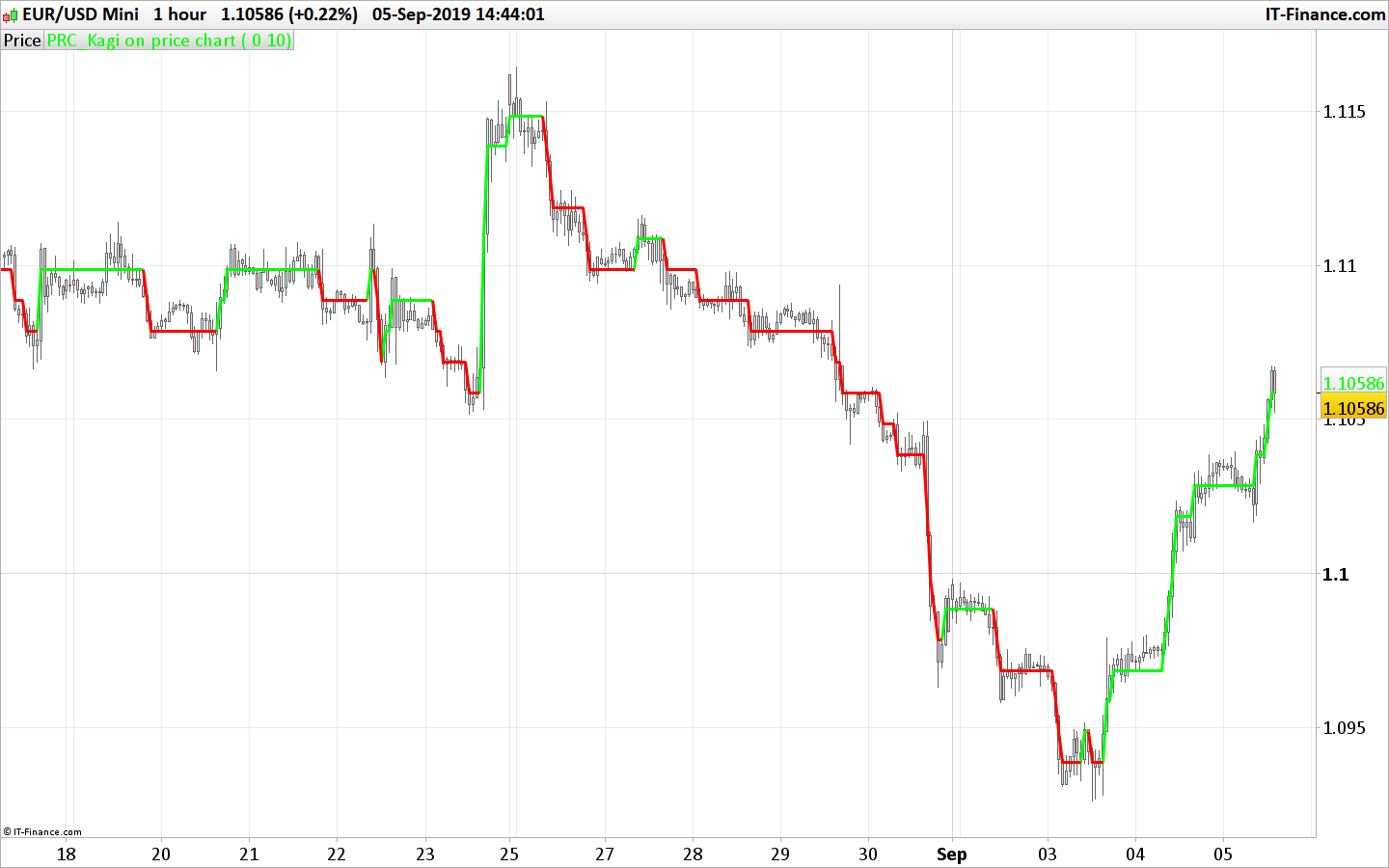
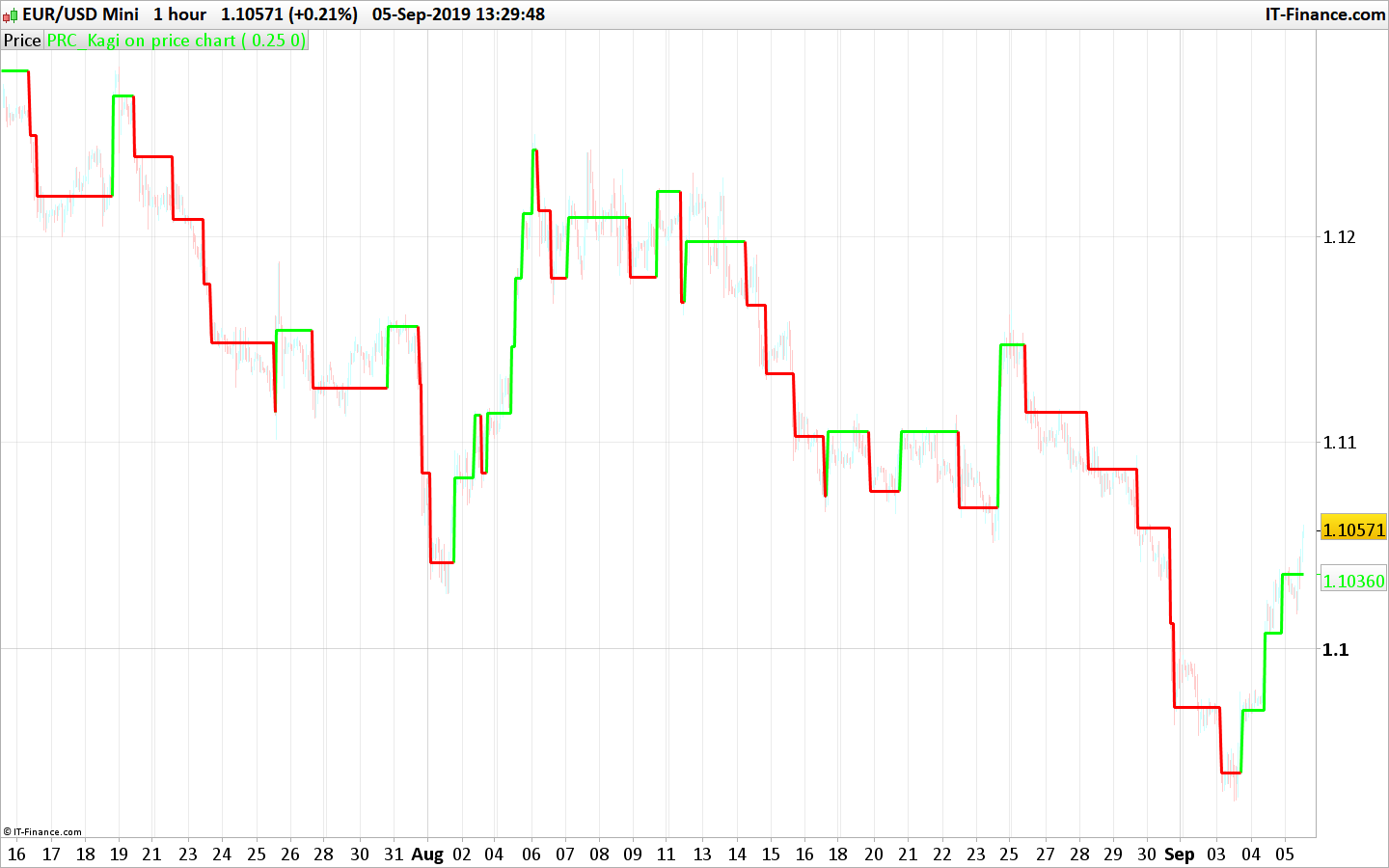
Kagi is a type of graphic representation that comes from Asia. This type of price chart is distinguished by the fact that one draws a Kagi type graph taking into account only the price. Indeed, even if time is represented on the abscissa axis, the time scale is not linear. This type of chart is convenient to follow the trend.
The horizontal lines have no real meaning, their role is to give continuity to the price. These horizontal lines are called inflection lines.
Two variables stand out with the Kagi, the color and the sense of the lines. These two variables depend on the direction of the market:
- The line is again in the same direction and the same color as the previous line when prices go in the same direction.
- The color remains the same, but the direction of the line is opposite when the prices exert a reversal of a fixed amount in advance (we speak of threshold of reversal).
- The color and the direction of the line change when there is a break of a lower or higher observed in the past.
There are two methods of using Kagi:
- We buy when there is a turnaround and sell when there is a downturn. In other words, color changes are buying and selling signals.
- We expect confirmation of two or three breaks higher or lower after a change of color to switch to the long or short order.
In this indicator you can choose which type of reversal you want: a percentage amount of price , or a fix points/pips amount. Set one of the reversal setting to 0 will deactivate it to use the other one.
//PRC_Kagi on price chart | indicator
//05.09.2019
//Nicolas @ www.prorealcode.com
//Sharing ProRealTime knowledge

// --- settings
// select one of the two possible setting (0=don't use)
ReversalAmountPercent = 1.5 //amount of price percent to inverse Kagi trend
ReversalAmountPoints = 0 //amount of points to inverse Kagi trend
// --- end of settings

once kagi=close


if ReversalAmountPercent>0 then
 //percent retracement
 pup = (close-kagi)/kagi
 pdn = (kagi-close)/kagi
 InvDec = 1/0.1
 //bullish reversal
 if pup>=ReversalAmountPercent/100 then
  coeff = abs(pup/ReversalAmountPercent)*100
  coeff = round(InvDec*coeff-0.5)/InvDec
  kagi=kagi+(kagi*(ReversalAmountPercent/100)*coeff)
  r=0
  g=255
 endif
 //bearish reversal
 if pdn>=ReversalAmountPercent/100 then
  coeff = abs(pdn/ReversalAmountPercent)*100
  coeff = round(InvDec*coeff-0.5)/InvDec
  kagi=kagi-(kagi*(ReversalAmountPercent/100)*coeff)
  r=255
  g=0
 endif
endif

if ReversalAmountPoints>0 then
 //points retracement
 pup = close-kagi
 pdn = kagi-close
 InvDec = 1
 //bullish reversal
 if pup>=ReversalAmountPoints*pointsize then
  coeff = (pup/pointsize)/ReversalAmountPoints
  coeff = round(InvDec*coeff-0.5)/InvDec
  kagi=kagi+(ReversalAmountPoints*pointsize)*coeff
  r=0
  g=255
 endif
 //bearish reversal
 if pdn>=ReversalAmountPoints*pointsize then
  coeff = (pdn/pointsize)/ReversalAmountPoints
  coeff = round(InvDec*coeff-0.5)/InvDec
  kagi=kagi-(ReversalAmountPoints*pointsize)*coeff
  r=255
  g=0
 endif
endif

RETURN Kagi coloured(r,g,0) style(line,3)
Comments
You must be logged in to post a comment.

Bonjour Nicolas j'ai chargé le fichier ITF mais il ne semble pas fonctionner : il crée un indicateur grisé sous le graphique avec une ligne au milieu, mais pas de tracé sur le graphique lui même. J'utilise la dernière version de PRT : peut-être n'est il pas adapté pour cette version ? Si c'est le cas, existe-t-il une version actualisée ? Avec mes remerciements
Merci pour la réponse Nicolas. C'est bien ce que j'ai fait mais ça ne fonctionne toujours pas. J'ai mis 1.5 comme valeur sur la ligne 38 et 0 sur la ligne 15 pour prioriser les points et essayé sur UT 2mn et 15mn. Peut être le problème vient il de là où de l'UT choisie ? J'ai dernier version de PRT

Hallo Nicolas, I have tested the pre-mentioned concept, and had to change the concept : 1. buy when Kagi is greater then the previous Kagi AND ( for a higher timeframe Kagi is greater then previous Kagi or Kagi is equal to previous Kagi ). Vice versa for selling. I used time frames of 3 minutes and 6 minutes and 2 minutes and 4 minutes 2. buying between 8 and 15 hr CET, no more then 2 opening transactions per day, regardless in the market with a position or not 3. add a trailing stop, which is the exit strategy and a stop-loss to protect significant losses. 4. I varied with the ReversalAmountPercent and the trailing stop, the smaller timeframes, the greater the reversal% seems to be for best results. Good and relative steady profits seems to appear for the indices, it seems not to work with currencies. Disadvantages of the strategy is that the trades are for a long time in the market (interest costs for ETFs) and only a few trades are generated ( +/- 40 in a year) , which reduces reliability significantly. But overall promising ! Kind regards, Jan
"There are two methods of using Kagi: We buy when there is a turnaround and sell when there is a downturn. In other words, color changes are buying and selling signals." I will give it a try to develop a trading strategy based upon the advice above for buying and selling, I do this for the DAX index, and I will use 5 minutes, and with confirmation of the higher MTF of 10 minutes, For example coded as Buying when the Kagi in 5 min MTF is minimal equal to the previous bar (turning point) and the Kagi in the 10 min MTF is minimal equal to the previous 10 min bar and smaller then the 5 min Kagi (confirmation), with opening only in morning hours. See if that will deliver profitable trades. Or the other way around, for example coded as Buying when the Kagi in 10 min MTF is minimal equal to the previous bar (turning point) and the Kagi in the 5 min MTF is minimal equal to the previous 5 min bar and the 5 min Kagi > 10 min Kagi (confirmation), with opening only in morning hours. See if that will deliver profitable trades.


Veramente ottimo, era quello che cercavo, si potrebbe modificare inserendo come variazione atr? Grazie