







Tushar Chande's DMI (with RSX)
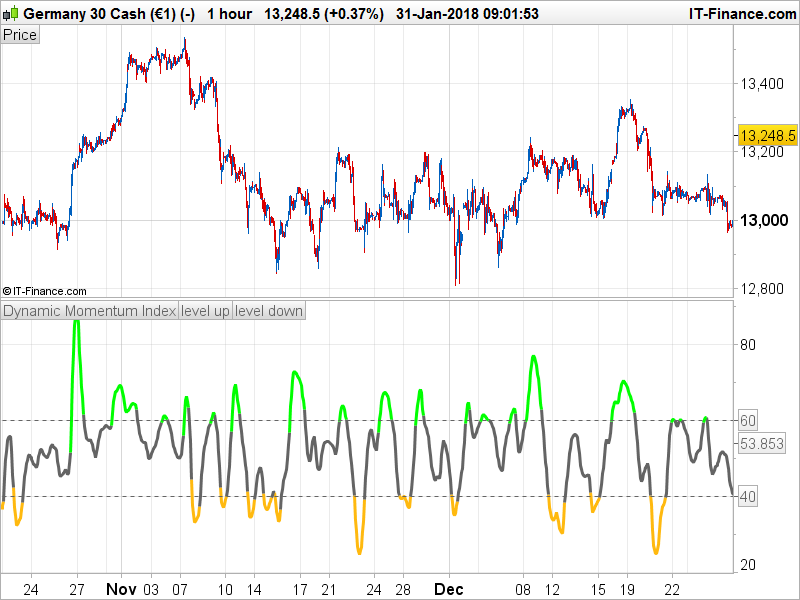
An indicator used in technical analysis that determines the overbought and oversold conditions of a particular asset. This indicator is very similar to the Relative Strength Index (RSI). The main difference between the two is that the RSI uses a fixed number of time periods (usually 14), while the Dynamic Momentum Index uses different time periods as volatility changes.
This indicator is interpreted in the same manner as the RSI where the readings below 30 are deemed to be oversold and more than 70 levels are deemed to be overbought. The number of time periods used in the dynamic momentum index decreases as the volatility of the underlying asset increases, making this indicator more sensitive to price changes than the RSI. This version has an additional smoothing in an RSX usage form for calculating the original RSI pitch. It has been added to make it a little more readable. The DMI Chande is less smooth than this original version and can raise more false signals. Using the RSX instead of RSI not add any lag at all, so we can say that using an RSX instead of RSI could be classified as “1% improvement” rule – which is sure it not be worse than the original Chande’s DMI.
(description found on internet). Indicator translated from Metatrader5 version by a request in forum.
Settings explanation:
_ MAStdDevMode : moving average type for smoothing the ATR value used to get the volatility of the current instrument
_ DmiLowerLimit & DmiUpperLimit : bounds for DMI periods (DMI calculated period can’t be less or more than these 2 limits)
//PRC_DMI of RSX | indicator
//31.01.18
//Nicolas @ www.prorealcode.com
//Sharing ProRealTime knowledge
//translated from MT5 code
//https://www.prorealcode.com/topic/tushar-chandes-dmi-conversion-code-mq5-to-prorealtime/

// --- settings
StdDevPeriod    =  5        // Period of Standard Deviation
MAStdDevPeriod  =  8        // Period of smoothing
MAStdDevMode    =  0        // Mode of smoothing MA
DMIPeriod       = 15        // Dynamic Momentum Index Period
DmiLowerLimit   = 10        // Dynamic Periods Lower Bound
DmiUpperLimit   = 50        // Dynamic Periods Upper Bound
LevelUp         = 60        // Lower level
LevelDown       = 40        // Upper level
// --- end of settings

if barindex>DMIperiod then
SD = STD[StdDevPeriod](customclose)
ASD = Average[MAStdDevPeriod,MAStdDevMode](SD)

RSIterm = max(1,ROUND(DMIPeriod / (SD/ASD)))
RSIterm = Max(Min(RSIterm,DmiUpperLimit),DmiLowerLimit)

//RSI calculation
plus = summation[max(1,round(RSIterm))](customclose-customclose[1]>0)
minus = summation[max(1,round(RSIterm))](customclose-customclose[1]<0)

//plus
pow = 1
per = RSIterm

if barindex>per then
beta = 0.45*(per-1)/(0.45*(per-1)+2)
if pow=1 then
alpha = beta
elsif pow=2 then
alpha = beta*beta
elsif pow=3 then
alpha = beta*beta*beta
elsif pow=4 then
alpha = beta*beta*beta*beta
elsif pow=5 then
alpha = beta*beta*beta*beta*beta
else
alpha = beta
endif

tmp0 = (1-alpha)*plus + alpha*tmp0[1]
tmp1 = (plus - tmp0[0])*(1-beta) + beta*tmp1[1]
tmp2 = tmp0[0] + tmp1[0]
tmp3 = (tmp2[0] - tmp4[1])*((1-alpha)*(1-alpha)) + (alpha*alpha)*tmp3[1]
tmp4 = tmp4[1] + tmp3[0]
avgplus = tmp4

ftmp0 = (1-alpha)*minus + alpha*ftmp0[1]
ftmp1 = (minus - ftmp0[0])*(1-beta) + beta*ftmp1[1]
ftmp2 = ftmp0[0] + ftmp1[0]
ftmp3 = (ftmp2[0] - ftmp4[1])*((1-alpha)*(1-alpha)) + (alpha*alpha)*ftmp3[1]
ftmp4 = ftmp4[1] + ftmp3[0]
avgminus = ftmp4

endif

RS = avgplus/avgminus
DMIRSX = 100 - 100 / ( 1 + RS )

r=100
g=100
b=100
if DMIRSX>LevelUp then
r=0
g=255
b=0
elsif DMIRSX<LevelDown then
r=255
g=185
b=15
endif
endif

return DMIRSX coloured(r,g,b) style(line,3) as "Dynamic Momentum Index", levelup coloured(100,100,100) style(dottedline) as "level up", leveldown coloured(100,100,100) style(dottedline) as "level down"
Comments
You must be logged in to post a comment.

PFA below a revised version: //PRC_DMI of RSX | indicator //31.01.18 //Nicolas @ www.prorealcode.com //Sharing ProRealTime knowledge //translated from MT5 code //https://www.prorealcode.com/topic/tushar-chandes-dmi-conversion-code-mq5-to-prorealtime/ // --- settings StdDevPeriod = 5 // Period of Standard Deviation MAStdDevPeriod = 8 // Period of smoothing MAStdDevMode = 0 // Mode of smoothing MA DMIPeriod = 15 // Dynamic Momentum Index Period DmiLowerLimit = 10 // Dynamic Periods Lower Bound DmiUpperLimit = 50 // Dynamic Periods Upper Bound LevelUp = 60 // Lower level LevelDown = 40 // Upper level // --- end of settings if barindex>DMIperiod then SD = STD[StdDevPeriod](customclose) ASD = Average[MAStdDevPeriod,MAStdDevMode](SD) RSIterm = max(1,ROUND(DMIPeriod / (SD/ASD))) RSIterm = Max(Min(RSIterm,DmiUpperLimit),DmiLowerLimit) //RSI calculation plus = summation[max(1,round(RSIterm))](customclose-customclose[1]>0) minus = summation[max(1,round(RSIterm))](customclose-customclose[1]per then beta = 0.45*(per-1)/(0.45*(per-1)+2) if pow=1 then alpha = beta elsif pow=2 then alpha = beta*beta elsif pow=3 then alpha = beta*beta*beta elsif pow=4 then alpha = beta*beta*beta*beta elsif pow=5 then alpha = beta*beta*beta*beta*beta else alpha = beta endif tmp0 = (1-alpha)*plus + alpha*tmp0[1] tmp1 = (plus - tmp0[0])*(1-beta) + beta*tmp1[1] tmp2 = tmp0[0] + tmp1[0] tmp3 = (tmp2[0] - tmp4[1])*((1-alpha)*(1-alpha)) + (alpha*alpha)*tmp3[1] tmp4 = tmp4[1] + tmp3[0] avgplus = tmp4 ftmp0 = (1-alpha)*minus + alpha*ftmp0[1] ftmp1 = (minus - ftmp0[0])*(1-beta) + beta*ftmp1[1] ftmp2 = ftmp0[0] + ftmp1[0] ftmp3 = (ftmp2[0] - ftmp4[1])*((1-alpha)*(1-alpha)) + (alpha*alpha)*ftmp3[1] ftmp4 = ftmp4[1] + ftmp3[0] avgminus = ftmp4 endif RS = avgplus/avgminus DMIRSX = 100 - 100 / ( 1 + RS ) r=100 g=100 b=100 if DMIRSX>LevelUp then r=0 g=255 b=0 elsif DMIRSX<LevelDown then r=255 g=185 b=15 endif endif return DMIRSX coloured(r,g,b) style(line,3) as "Dynamic Momentum Index", levelup coloured(100,100,100) style(dottedline) as "level up", leveldown coloured(100,100,100) style(dottedline) as "level down"

Bonjour Nicolas, Lorsque j'importe l'indicateur via l'itf et que je l'attache au graphique, il apparait ce message "Erreur dans l'indicateur : PRC_DMI of RSX (5 8 0 15 10 50 60 40) --- Un parametre de type entier positif est attendu avec SUMMATION". Pourrais-tu m'eclairer à ce sujet stp ? Je suis sur la v11 de prt. Merci à toi, Cordialement, Romain

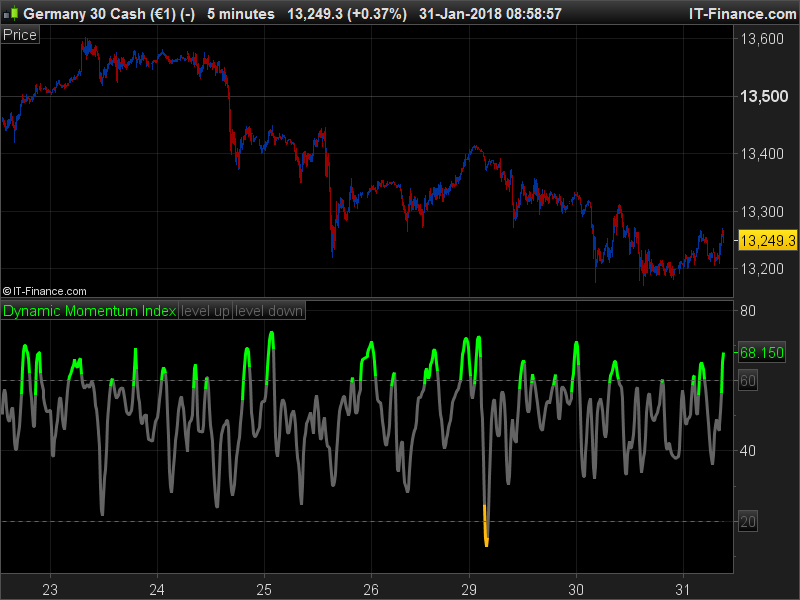
Thanks Nicolas Still a problem in line 29 Please take a look. thanks again Alex