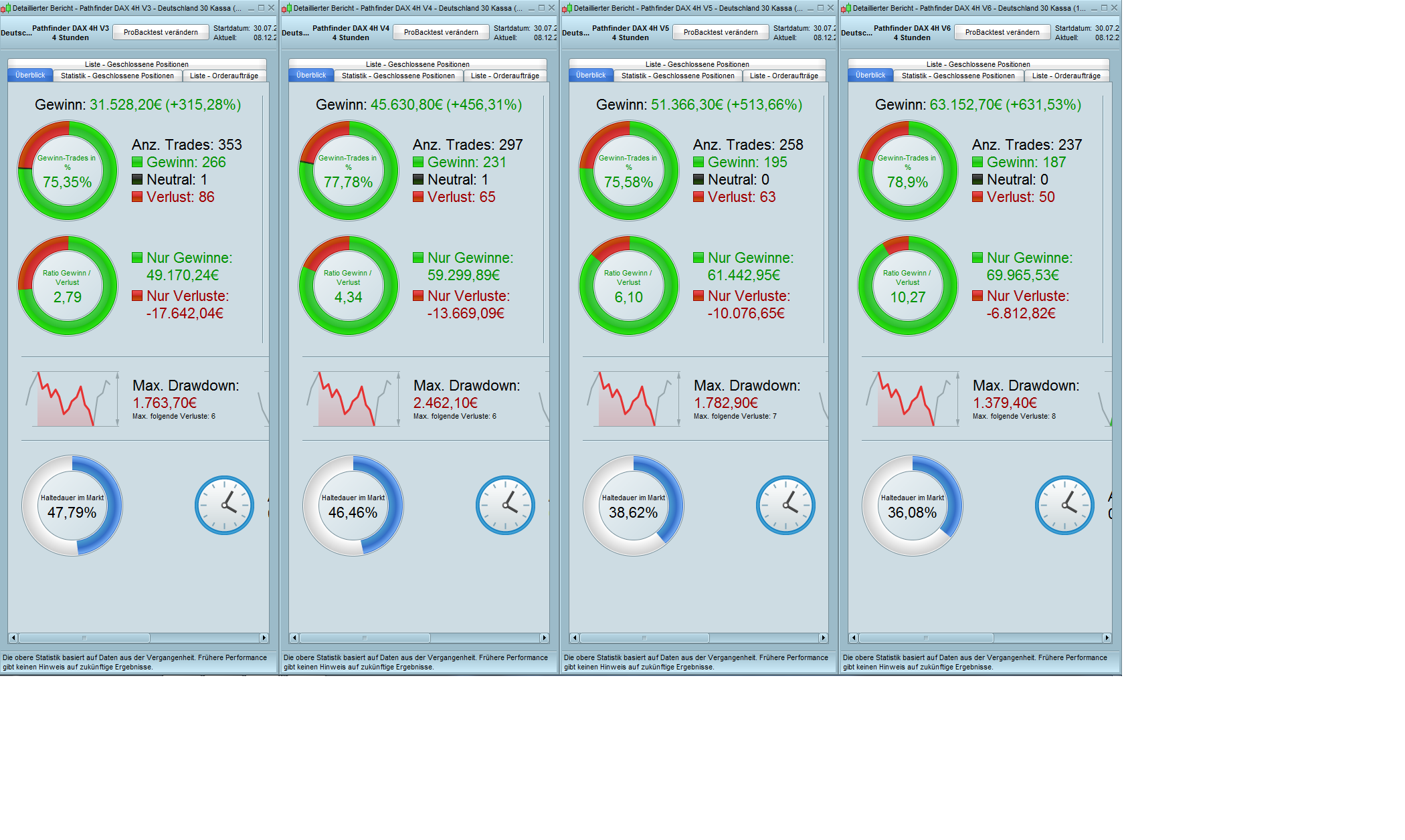
The only reason I ask is that backtesting v3 on DAX30 shows awsome results compared to v4…
Hi Mark,
the DAX daily version trade only the strongest signal based on daily cross over/under (less signals but higher quality). The DAX 1D consider all 6 breakout signals and has higher profits but also a higher drawdown. I developed the versions based on daily data to have something for a quick check whether the instrument is suitable for the Pathfinder breakout algorithm or not. The test is done in minutes and if profitable I will look deeper and invest more time to create a H4 or H1 version.
best, Reiner
Adam, as requested here is the code of the last H4 version V6 from today
// Pathfinder Trading System based on ProRealTime 10.2
// Breakout system triggered by previous daily, weekly and monthly high/low crossings with smart position management
// Version 6
// Instrument: DAX mini 4H, 9-21 CET, 2 points spread, account size 10.000 Euro, from August 2010

// ProOrder code parameter
DEFPARAM CUMULATEORDERS = true  // cumulate orders if not turned off
DEFPARAM PRELOADBARS = 10000

// define intraday trading window
ONCE startTime = 90000
ONCE endTime = 210000

// define instrument signalline with help of multiple smoothed averages
ONCE periodFirstMA = 5
ONCE periodSecondMA = 10
ONCE periodThirdMA = 3

// define filter parameter
ONCE periodLongMA = 300
ONCE periodShortMA = 50

// define position and money management parameter
ONCE positionSize = 1

Capital = 10000
Risk = 5 // in %
equity = Capital + StrategyProfit
maxRisk = round(equity * Risk / 100)

ONCE stopLossLong = 5.5 // in %
ONCE stopLossShort = 3.25 // in %
ONCE takeProfitLong = 3.25 // in %
ONCE takeProfitShort = 3.25 // in %

maxPositionSizeLong = MAX(15, abs(round(maxRisk / (close * stopLossLong / 100) / PointValue) * pipsize))
maxPositionSizeShort = MAX(15, abs(round(maxRisk / (close * stopLossShort / 100) / PointValue) * pipsize))

ONCE trailingStartLong = 2 // in %
ONCE trailingStartShort = 0.75 // in %
ONCE trailingStepLong = 0.2 // in %
ONCE trailingStepShort = 0.4 // in %

ONCE maxCandlesLongWithProfit = 16  // take long profit latest after 16 candles
ONCE maxCandlesShortWithProfit = 15  // take short profit latest after 15 candles
ONCE maxCandlesLongWithoutProfit = 30  // limit long loss latest after 30 candles
ONCE maxCandlesShortWithoutProfit = 12  // limit short loss latest after 12 candles

// define saisonal position multiplier for each month 1-15 / 16-31 (>0 - long / <0 - short / 0 no trade)
ONCE January1 = 3
ONCE January2 = 0
ONCE February1 = 3
ONCE February2 = 3
ONCE March1 = 3
ONCE March2 = 2
ONCE April1 = 3
ONCE April2 = 3
ONCE May1 = 1
ONCE May2 = 1
ONCE June1 = 2
ONCE June2 = 2
ONCE July1 = 3
ONCE July2 = 1
ONCE August1 = 1
ONCE August2 = 1
ONCE September1 = 3
ONCE September2 = 0
ONCE October1 = 3
ONCE October2 = 2
ONCE November1 = 2
ONCE November2 = 3
ONCE December1 = 3
ONCE December2 = 2

// calculate daily high/low (include sunday values if available)
dailyHigh = DHigh(1)
dailyLow = DLow(1)

// calculate weekly high/low
If DayOfWeek < DayOfWeek[1] then
weeklyHigh = Highest[BarIndex - lastWeekBarIndex](dailyHigh)
lastWeekBarIndex = BarIndex
ENDIF

// calculate monthly high/low
If Month[1] <> Month[2] then
//If Month <> Month[1] then
monthlyHigh = Highest[BarIndex - lastMonthBarIndex](dailyHigh)
monthlyLow = Lowest[BarIndex - lastMonthBarIndex](dailyLow)
lastMonthBarIndex = BarIndex
ENDIF

// calculate instrument signalline with multiple smoothed averages
firstMA = WilderAverage[periodFirstMA](close)
secondMA = TimeSeriesAverage[periodSecondMA](firstMA)
signalline = TimeSeriesAverage[periodThirdMA](secondMA)

// save position before trading window is open
If Time < startTime then
startPositionLong = COUNTOFLONGSHARES
startPositionShort = COUNTOFSHORTSHARES
EndIF

// trade only in defined trading window
IF Time >= startTime AND Time <= endTime THEN

// set saisonal multiplier
currentDayOfTheMonth = Date - ((CurrentYear * 10000) + CurrentMonth * 100)
midOfMonth = 15
IF CurrentMonth = 1 THEN
IF currentDayOfTheMonth <= midOfMonth THEN
saisonalPatternMultiplier = January1
ELSE
saisonalPatternMultiplier = January2
ENDIF
ELSIF CurrentMonth = 2 THEN
IF currentDayOfTheMonth <= midOfMonth THEN
saisonalPatternMultiplier = February1
ELSE
saisonalPatternMultiplier = February2
ENDIF
ELSIF CurrentMonth = 3 THEN
IF currentDayOfTheMonth <= midOfMonth THEN
saisonalPatternMultiplier = March1
ELSE
saisonalPatternMultiplier = March2
ENDIF
ELSIF CurrentMonth = 4 THEN
IF currentDayOfTheMonth <= midOfMonth THEN
saisonalPatternMultiplier = April1
ELSE
saisonalPatternMultiplier = April2
ENDIF
ELSIF CurrentMonth = 5 THEN
IF currentDayOfTheMonth <= midOfMonth THEN
saisonalPatternMultiplier = May1
ELSE
saisonalPatternMultiplier = May2
ENDIF
ELSIF CurrentMonth = 6 THEN
IF currentDayOfTheMonth <= midOfMonth THEN
saisonalPatternMultiplier = June1
ELSE
saisonalPatternMultiplier = June2
ENDIF
ELSIF CurrentMonth = 7 THEN
IF currentDayOfTheMonth <= midOfMonth THEN
saisonalPatternMultiplier = July1
ELSE
saisonalPatternMultiplier = July2
ENDIF
ELSIF CurrentMonth = 8 THEN
IF currentDayOfTheMonth <= midOfMonth THEN
saisonalPatternMultiplier = August1
ELSE
saisonalPatternMultiplier = August2
ENDIF
ELSIF CurrentMonth = 9 THEN
IF currentDayOfTheMonth <= midOfMonth THEN
saisonalPatternMultiplier = September1
ELSE
saisonalPatternMultiplier = September2
ENDIF
ELSIF CurrentMonth = 10 THEN
IF currentDayOfTheMonth <= midOfMonth THEN
saisonalPatternMultiplier = October1
ELSE
saisonalPatternMultiplier = October2
ENDIF
ELSIF CurrentMonth = 11 THEN
IF currentDayOfTheMonth <= midOfMonth THEN
saisonalPatternMultiplier = November1
ELSE
saisonalPatternMultiplier = November2
ENDIF
ELSIF CurrentMonth = 12 THEN
IF currentDayOfTheMonth <= midOfMonth THEN
saisonalPatternMultiplier = December1
ELSE
saisonalPatternMultiplier = December2
ENDIF
ENDIF

// define trading filters
// 1. use fast and slow averages as filter because not every breakout is profitable
f1 = close > Average[periodLongMA](close)
f2 = close < Average[periodLongMA](close)
f3 = close > Average[periodShortMA](close)

// 2. check if position already reduced in trading window as additonal filter criteria
alreadyReducedLongPosition = COUNTOFLONGSHARES  < startPositionLong
alreadyReducedShortPosition = COUNTOFSHORTSHARES < startPositionShort

// long position conditions
l1 = signalline CROSSES OVER monthlyHigh
l2 = signalline CROSSES OVER weeklyHigh
l3 = signalline CROSSES OVER dailyHigh
l4 = signalline CROSSES OVER monthlyLow

// short position conditions
s1 = signalline CROSSES UNDER monthlyHigh
s2 = signalline CROSSES UNDER dailyLow

// long entry with order cumulation
IF ( (l1 OR l4 OR l2 OR (l3 AND f2)) AND NOT alreadyReducedLongPosition) THEN

// check saisonal booster setup and max position size
IF saisonalPatternMultiplier > 0 THEN
IF (COUNTOFPOSITION + (positionSize * saisonalPatternMultiplier)) <= maxPositionSizeLong THEN
BUY positionSize * saisonalPatternMultiplier CONTRACT AT MARKET
ENDIF
ELSIF saisonalPatternMultiplier <> 0 THEN
IF (COUNTOFPOSITION + positionSize) <= maxPositionSizeLong THEN
BUY positionSize CONTRACT AT MARKET
ENDIF
ENDIF

stopLoss = stopLossLong
takeProfit = takeProfitLong

ENDIF

// short entry without order cumulation
IF NOT SHORTONMARKET AND ( (s1 AND f3) OR  (s2 AND f1) ) AND NOT alreadyReducedShortPosition THEN

// check saisonal booster setup and max position size
IF saisonalPatternMultiplier < 0 THEN
IF (COUNTOFPOSITION + (positionSize * ABS(saisonalPatternMultiplier))) <= maxPositionSizeShort THEN
SELLSHORT positionSize * ABS(saisonalPatternMultiplier) CONTRACT AT MARKET
ENDIF
ELSIF saisonalPatternMultiplier <> 0 THEN
IF (COUNTOFPOSITION + positionSize) <= maxPositionSizeLong THEN
SELLSHORT positionSize CONTRACT AT MARKET
ENDIF
ENDIF

stopLoss = stopLossShort
takeProfit = takeProfitShort

ENDIF

// stop and profit management
posProfit = (((close - positionprice) * pointvalue) * countofposition) / pipsize

numberCandles = (BarIndex - TradeIndex)

m1 = posProfit > 0 AND numberCandles >= maxCandlesLongWithProfit
m2 = posProfit > 0 AND numberCandles >= maxCandlesShortWithProfit
m3 = posProfit < 0 AND numberCandles >= maxCandlesLongWithoutProfit
m4 = posProfit < 0 AND numberCandles >= maxCandlesShortWithoutProfit

// take profit after max candles
IF LONGONMARKET AND (m1 OR m3) THEN
SELL AT MARKET
ENDIF
IF SHORTONMARKET AND (m2 OR m4) THEN
EXITSHORT AT MARKET
ENDIF

// trailing stop function (convert % to pips)
trailingStartLongInPoints = tradeprice(1) * trailingStartLong / 100
trailingStartShortInPoints = tradeprice(1) * trailingStartShort / 100
trailingStepLongInPoints = tradeprice(1) * trailingStepLong / 100
trailingStepShortInPoints = tradeprice(1) * trailingStepShort / 100

// reset the stoploss value
IF NOT ONMARKET THEN
newSL = 0
ENDIF

// manage long positions
IF LONGONMARKET THEN
// first move (breakeven)
IF newSL = 0 AND close - tradeprice(1) >= trailingStartLongInPoints * pipsize THEN
newSL = tradeprice(1) + trailingStepLongInPoints * pipsize
stopLoss = stopLossLong * 0.1
takeProfit = takeProfitLong * 2
ENDIF
// next moves
IF newSL > 0 AND close - newSL >= trailingStepLongInPoints * pipsize THEN
newSL = newSL + trailingStepLongInPoints * pipsize
ENDIF
ENDIF

// manage short positions
IF SHORTONMARKET THEN
// first move (breakeven)
IF newSL = 0 AND tradeprice(1) - close >= trailingStartShortInPoints * pipsize THEN
newSL = tradeprice(1) - trailingStepShortInPoints * pipsize
ENDIF
// next moves
IF newSL > 0 AND newSL - close >= trailingStepShortInPoints * pipsize THEN
newSL = newSL - trailingStepShortInPoints * pipsize
ENDIF
ENDIF

// stop order to exit the positions
IF newSL > 0 THEN
IF LONGONMARKET THEN
SELL AT newSL STOP
ENDIF
IF SHORTONMARKET THEN
EXITSHORT AT newSL STOP
ENDIF
ENDIF

// superordinate stop and take profit
SET STOP %LOSS stopLoss
SET TARGET %PROFIT takeProfit

ENDIF
 Alco
AlcoParticipant
Senior
Hello Reiner,
First I will thank you for this great system. If I run a backtest with the latest version (v6) from 9 aug 2012 – 8 dec 2016 and looked at the losing trades, I came to the conclusion that if you separate the month in four, you probably get better results.
Im not a programmer, so I don’t know to do that.
The results of losing trades if you split the month in 4
1 – 7 5 losing trades 5,95%
8 – 15 8 losing trades 6,54%
16 – 23 13 losing trades 11,32%
24 – 31 5 losing trades 1,6%
So, if I look back in 4,5 years history, it’s probably better to adapt the seasonal booster for those weeks, or do not trade in week 3.
Alco
Hi Simon,
the current Pathfinder DAX version is V6. http://www.prorealcode.com/topic/pathfinder-trading-system/page/25/#post-17954
Please find attached a comparision of the results from V3 to V6. Pathfinder was created for the DAX and I have no clue if it works with DFB.
@UK guys: please advise to answer Simons question if Pathfinder works with a DAX DFB – Thanks
best, Reiner
Yes, works all good. Just adjust start and finish times back 1 hour.
Hello everyone!
Thank you Reiner for this great system. It works very well for me so far.
I have been programing my own trading systems for about 7 months so i´m still learning a lot.
But there is one thing i don´t understand with your system.
It says in the code that it is active between 09:00 – 21:00 but when i have done the same thing in my own trading systems that i have programmed it has ended open positions after the time has ended.
But your system can keep positions open for days, even after 21:00
So my question is what does the timeframe do more exactly in your code?
Viktor
Hi Reiner,
Do we set the timezone in platform options to CET (UTC +01:00)?
Thank You.
Hi Viktor. It sounds like you have incorporated a timecondition correct. However it does not close position. A simple example I often use my self is this. Trades will only be open between 09:00 and 17:00, and all trades will be closed after 22:00
defparam flatafter=220000


//===========Trade hours =============
IF (Time >= 09000 AND Time <= 170000) then
Tradetime=1
 else
Tradetime=0
endif

// enter Long Position
IF  <longcondition> and Tradetime THEN
BUY 1 CONTRACT AT MARKET
ENDIF

// enter short Position
IF <shortCondition> and Tradetime THEN
SELLSHORT 1 CONTRACT AT MARKET
ENDIF
AlcoParticipant
Senior
Could someone make the v6 version with months seperate in 4 instead of 2? i would really appreciate it.
Kind regards,
Alco
@viktor
If you have general questions about coding, please open a specific topic for each of them, in order to keep this topic clear and dedicated to Reiner’s strategy.
@Choo Jen-Sin
Please update your country into your profile. Thank you.
Hi Alco,
Thanks for your contribution and welcome. I checked your idea and will deliver an adapted Pathfinder version tomorrow. Is some work to optimize 48 variables :-).
best, Reiner
Hi Reiner. I a couple of question for you brilliant work. In advance my apologies if the subject already has been mentioned but 385 reply in this thread I might have overlooked a few things 🙂
First DAX V6 is the one I looked deeper into, but you published V6b2 before the V6? With all the versions it could be hard to track changes, so why a ver 6b2 before a clean V6? It just the order in me that what this to be at least a V6.5 or am I missing something? Anyway a suggestion would be to make a matrix with the changes up through the version on various instrument as well and post it as perhaps a sticky non reply-able post(Nicolas is this possible for the only mortals?), and yes I know it would probably be very time consuming, but very informative. It sure would be nice to have
About the order cumulation- it only for Long position and not for Short. But looking at the DAX Seasonality chart it could be profitable in to implement cumulation of short in the saisonal position multiplier.
- January2
- February2
- March1
- August1
- August2
- September2
- September1
- October1
It just a quick look at the DAX Seasonality chart and I know it will overlap of some of the high multiplier for Long, for eksample in September1
Could this be an idea, or is it already tried?
Cheers Kasper
Hi Choo Jen-Sin,
Welcome – could you please set your location code in your profile to check where do come from. Usually it’s sufficient when you adjust the two variables:
ONCE startTime = 90000
ONCE endTime = 210000
best, Reiner
Just a thought but splitting the months in to 4 will surely become over curve fitted..?