







Deviation-Scaled Moving Average - DSMA
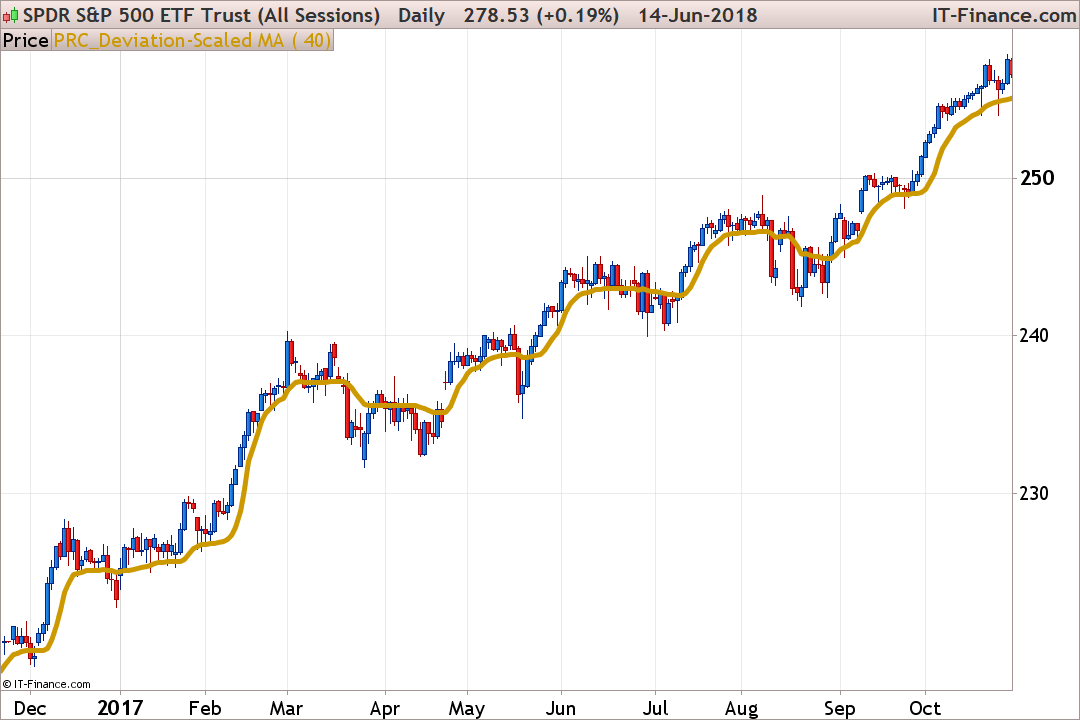
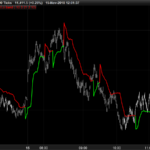
Here is the new DSMA moving average made my John Ehlers and featured in the July 2018 issue of TASC magazine.
The DSMA is an adaptive moving average that features rapid adaptation to volatility in price movement.
It accomplishes this adaptation by modifying the alpha term of an EMA byt he amplitude of an oscillator scaled in standard deviations from the mean. The DSMA’s responsiveness can be changed by using different values for the input parameter period.
John Ehlers
//PRC_Deviation Scaled Moving Average | indicator
//15.06.2018
//Nicolas @ www.prorealcode.com
//Sharing ProRealTime knowledge

// --- settings
Period = 40
// --- end of settings

If barindex>Period Then
 //Smooth with a Super Smoother
 a1 = exp(-1.414*3.14159 / (.5*Period))
 b1 = 2*a1*Cos(1.414*180 / (.5*Period))
 c2 = b1
 c3 = -a1*a1
 c1 = 1 - c2 - c3
 //Produce Nominal zero mean with zeros in the transfer response
 //at DC and Nyquist with no spectral distortion
 //Nominally whitens the spectrum because of 6 dB per octave
 //rolloff
 Zeros = Close - Close[2]
 //SuperSmoother Filter
 Filt = c1*(Zeros + Zeros[1]) / 2 + c2*Filt[1] + c3*Filt[2]
 //Compute Standard Deviation
 RMS = 0
 For count = 0 to Period - 1 do
  RMS = RMS + Filt[count]*Filt[count]
 next
 RMS = SqRt(RMS / Period)
 //Rescale Filt in terms of Standard Deviations
 ScaledFilt = Filt / RMS
 alpha1 = Abs(ScaledFilt)*5 / Period
 DSMA = alpha1*Close + (1 - alpha1)*DSMA[1]
endif

return DSMA
Comments
You must be logged in to post a comment.

Hi Nicolas, do you have the MT4 version of the indicator? I am not sure if these kind of questions are welcome, if not appologies in advance. Thank you.


@JohnScher, with regards to your question of can a strategy be derived from this, that is an open-ended question. Obviously, a strategy can be derived from this as with anything else?! And with regards to is this just another MA, yes it is. And just like any other MA it has it's place among all the others SMA, EMA, Wilders, DEMA, ZEMA, etc. Perhaps you can read the article in TASC, where the merits of the indicator is explained? I personally use and experiment with all different kinds of indicators and methods to create strategies. I love concepts such as 'zero lag' indicators or exponentially calculated Bollinger Bands or in this case std deviation calculated MA's! I am actually planning to use this to create deviation scaled exponentially calculated bollinger band.

Hello, Nicolas. Nice work from you! Thank you very much. Really! Is there a strategy that can be derived from this? e.g. buying at crosses over selling at crosses under the yellow line? Are there any results for such a strategy - possibly in combination with other strategies? cause I think it's just another average more on the tableau. What can he do more than other averages? Has Ehlers tested that? Are there any results? Published? I'm sorry, the criticism, sometimes I'm just tired of "always the same thing". Friendly greetings
Cool. Thanks for the response.