Hello
To discuss about the screener
https://www.prorealcode.com/prorealtime-market-screeners/startup-all-time-low-obvolume-weinstein-wyckoff/
The idea is to find a startup bottom by screening volume activity.
Even with this code modification, sometime the condition
//ATL All time low identification
ATL = lowest[BarIndex](low)
//for i = 1 to barindex
// If low[i]<ATL or ATL=0 then
// ATL=Low
// else
// ATL=ATL[1]
// Endif
//Next
//High volume activity
myOBV = OBV(close)
avgOBV=average[20](myOBV)
stdevOBV=2*std[20](myOBV)
BollUp = avgOBV+stdevOBV
//ATL zone and volume activity
c1=close<2*ATL
c2=myOBV>BollUP
screener[ c1 and c2 ]
It is best to talk about screeners in the screener forum. 🙂
Topic moved from ‘General Discussion’ forum.
Firstly, try this small modification to be sure ProScreener isn’t stopping on the first barindex:
//ATL All time low identification
ATL = lowest[max(1,BarIndex)](low)
//High volume activity
myOBV = OBV(close)
avgOBV=average[20](myOBV)
stdevOBV=2*std[20](myOBV)
BollUp = avgOBV+stdevOBV
//ATL zone and volume activity
c1=close<2*ATL
c2=myOBV>BollUP
screener[ c1 and c2 ]
Hello,
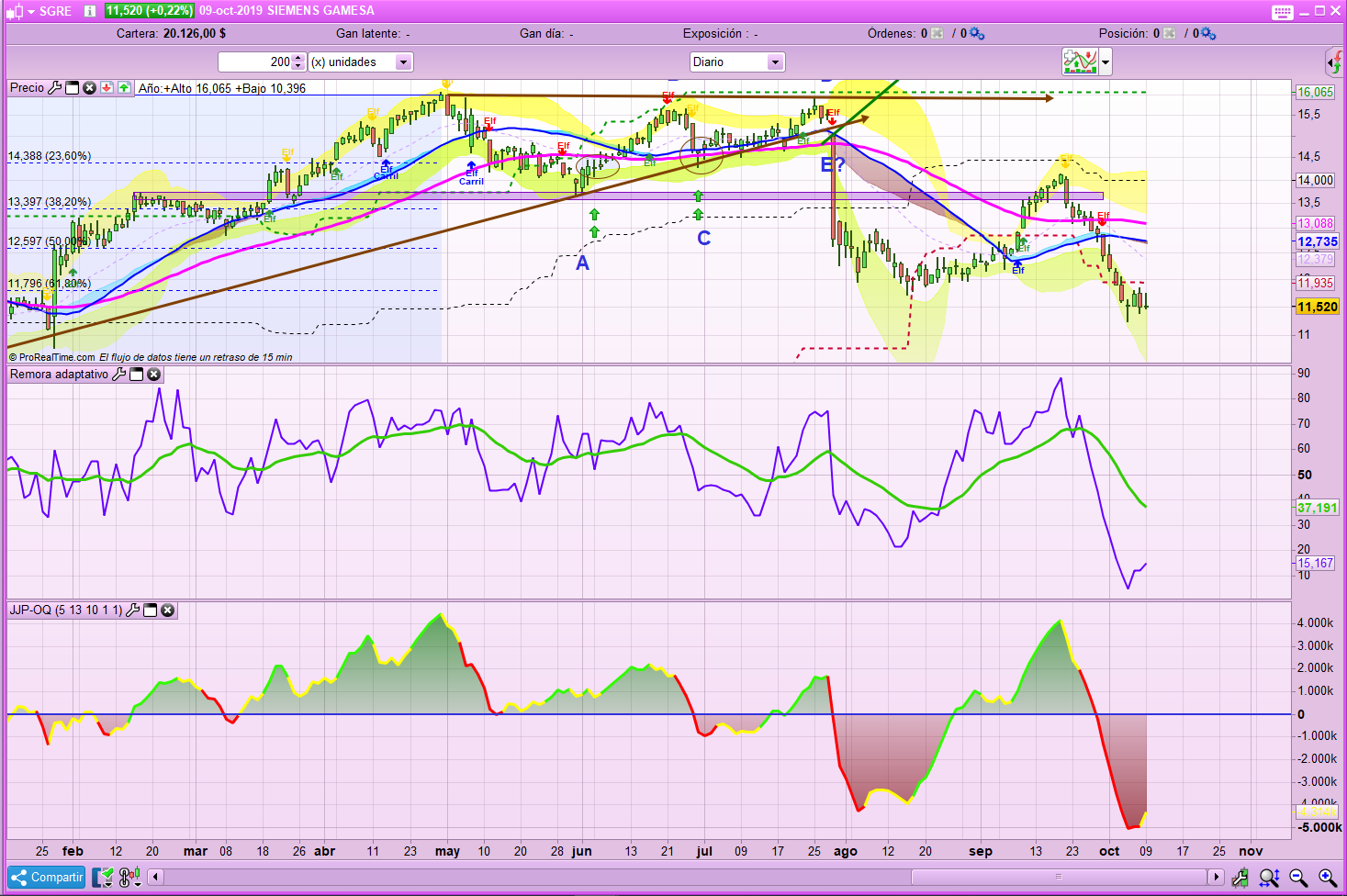
The idea that I applied to evaluate the actions is based on the application of a macd to the Obv, with a configuration (10,20,10), and on the obv macd I apply some bolliguer bands. In this way the possible changes are very well detected.
Is there a minimum time period to consider an accumulation phase as valid?
Hello,
The idea that I applied to evaluate the actions is based on the application of a macd to the Obv, with a configuration (10,20,10), and on the obv macd I apply some bolliguer bands. In this way the possible changes are very well detected.
Hi JJ Tec could you share a graph , that I can see and understand your point?
Is there a minimum time period to consider an accumulation phase as valid?
Hi @Nicolas
There is no minimum of time period, it can be very fast or very slow.
For the code modication, this test give the same result , the problem doesn’t come from the BarIndex
//ATL All time low identification
ATL = lowest[max(1,BarIndex)](low)
I’d like to help but your first post is truncated, so I still don’t know what is the problem? 🙂
The idea I have is to apply the Chaikin flow calculation formula, to the OBV, but using as periods 10 and 20. One of the problems I see in the OBV is that it counts the volume based on the closing price, but I think that It is more appropriate to adjust the sum based on whether the price is above 50% of the total range. On the other hand, the volume may lead to a mistake, so perhaps, capitalization should be used (closing * volume).
I need help, what would be the code of the OBV indicator?
When the second day’s price closes above the prior day’s close,
OBV=Previous OBV+Current trading volume
If prices close lower on the second day,
OBV=Previous OBV−Current trading volume
But what code would it be?
That could be coded like this: (not tested)
//When the second day’s price closes above the prior day’s close,
if close>close[1] then
OBV=OBV+volume
else
//If prices close lower on the second day,
OBV=OBV−volume
endif
return OBV
Thanks
But I don’t understand, do we need to recalculate the OBV or can we use the function already programmed by prorealtime?
The problem comes that screener indicates stocks that are not between ATL and 2 ATL.
And I don’t understand where the problem comes from