Hi Nicolas, thank you for responding to my query in post https://www.prorealcode.com/prorealtime-indicators/variable-moving-average-vma/
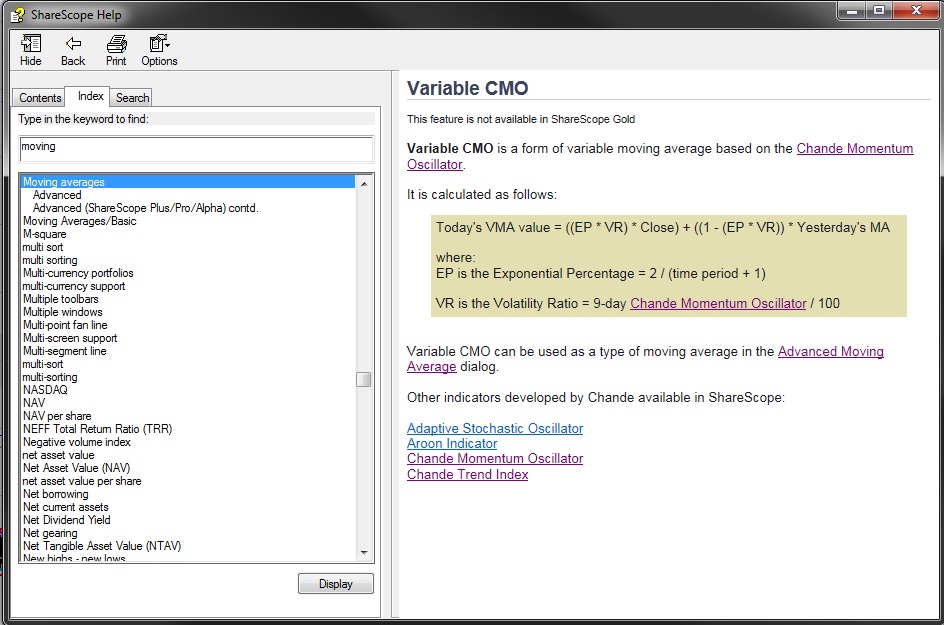
Please would you translate the Sharescope formula to use in ProRealTime. The formula is:
Today’s VMA value = ((EP * VR) * Close) + ((1 – (EP * VR)) * Yesterday’s MA
where:
EP is the Exponential Percentage = 2 / (time period + 1)
VR is the Volatility Ratio = 9-day Chande Momentum Oscillator / 100
Thank you in advance
Paul
Do you have an example applied to a security please? As I could make comparison while developing it. Thank you.
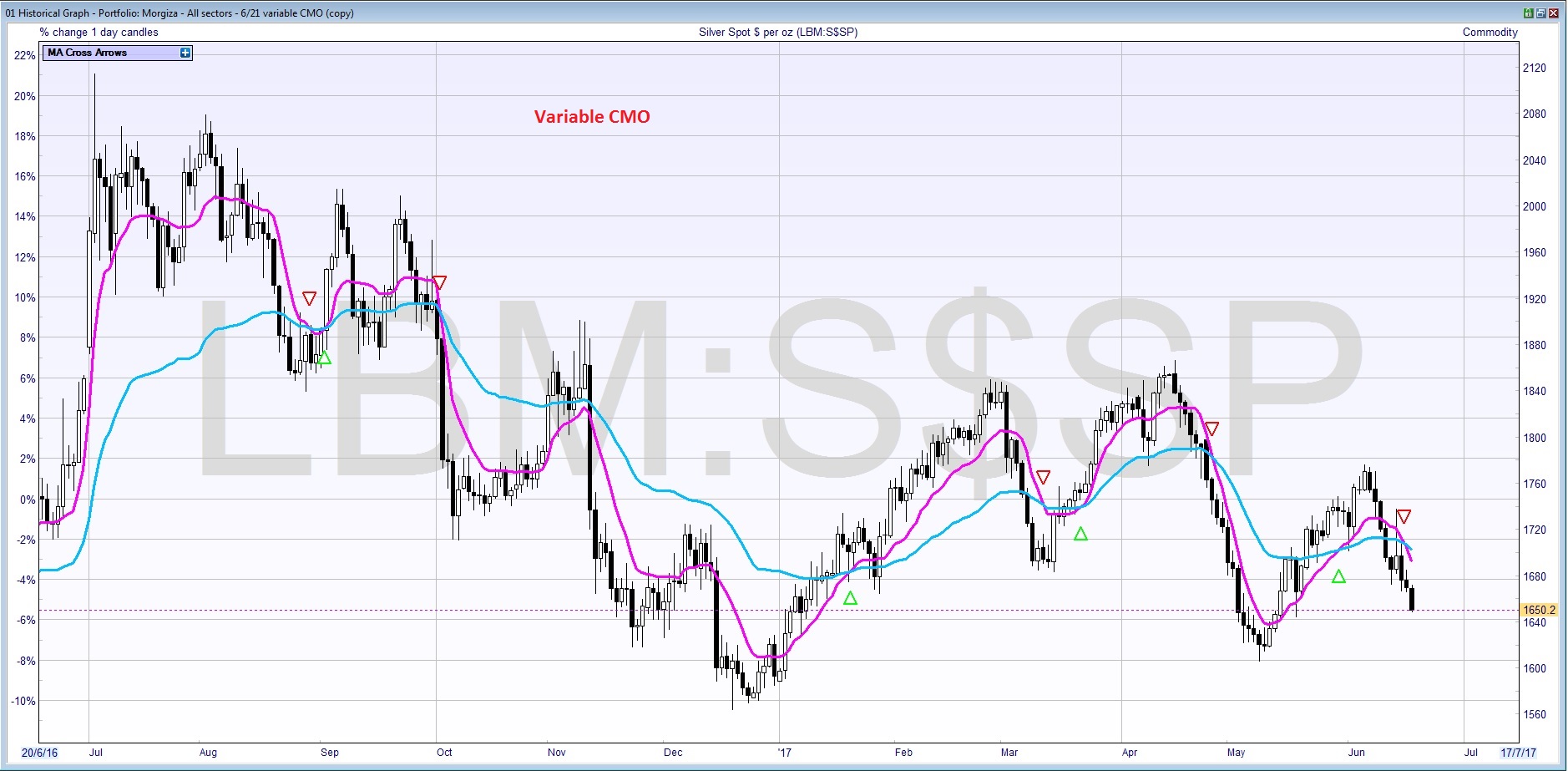
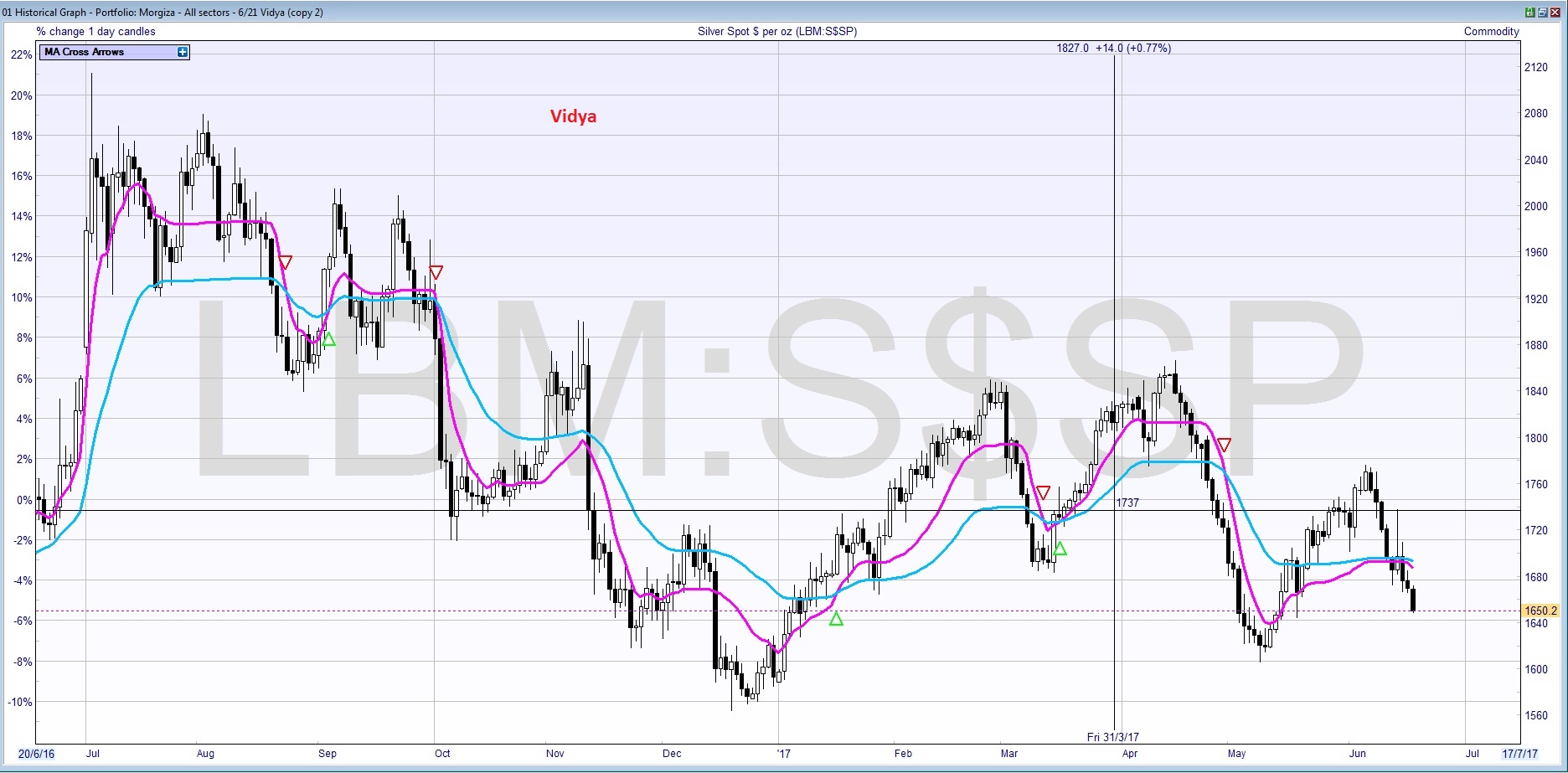
Thanks Nicolas. Here’s Silver Spot, daily bars, 1 year 20/06/2016 to 20/06/2017, 6 and 21 period moving averages. Quite volatile so a good example I think. Somewhat similar in result to Vidya (Sharescope version). I’ve attached both VCMO and Vidya charts. Thank you.
Thanks. I tried many things and still didn’t find how they calculate what they call “volatility ratio” as 9-day Chande Momentum Oscillator / 100
Got odd results actually..
Thanks Nicolas. The following is from Sharescope:
“The Chande Momentum Oscillator (CMO), developed by Tushar Chande, compares the size of recent positive and negative price changes over a period set by the user. The CMO tries to show ‘pure momentum’ by using unsmoothed data for both up and down days (other oscillators tend to use only up or down day data). This means that short-term price movements are not hidden and the oscillator provides a direct measurement of momentum. The indicator range is +100 to -100, and generally, the CMO has an overbought level of +50 and an oversold level of -50.
The calculation for CMO is:
(U – D / U + D) * 100
Where:
U = the sum of the differences between each up day’s close and its previous day’s close in the period.
D = the sum of the differences between each down day’s close and its previous day’s close in the period. Where a difference is negative, it should still be used as a positive number in the calculation (e.g. -1 would appear as 1 in the calculation).
Up days are where the current day’s close is higher than the previous close. Down days occur when the current day’s close is lower than the previous close. Days where the price is unchanged are ignored.”
I’m not sure if this helps? Thanks for your efforts!
Paul
Thank you Morgiza, the Chande Momentum Oscillator (CMO) is already a function of prorealtime, this is not the problem here, in fact the “9-day ..” can lead to many different interpretation and it is somehow hard to understand what it means .. 9 the number? day.. of what? – is minus? what period for CMO? .. I still did not find any useful information on the web, this indicator seems only available in ShareScope platform.
Thanks Nicolas. I assume whenever they mention ‘day’ it can also mean ‘period’. They tend to talk about all formulae in terms of days. Thanks. Paul
They also called this formula the Volatility Ratio, but I think there are also many different type of indicators called “Volatility Ratio” .. I’m still searching through their documentation.
Thanks Nicolas, I’m now on holiday in Minorca! I’ll catch up with you when I get back beginning of July. Thank you very much for your efforts! Take care.