Buongiorno,
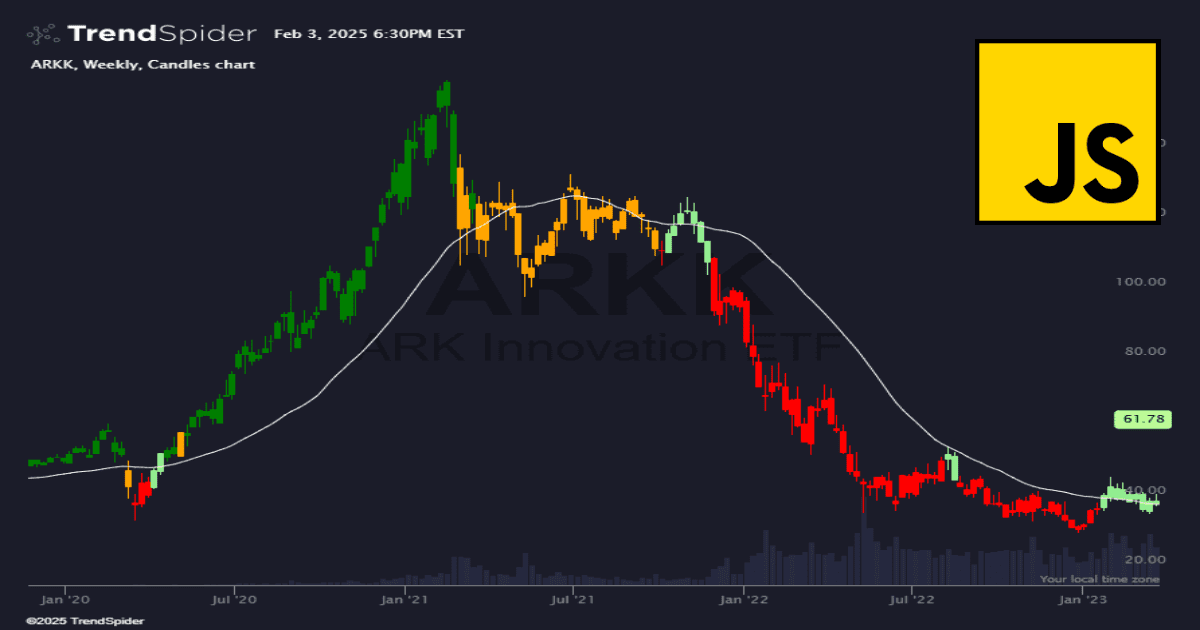
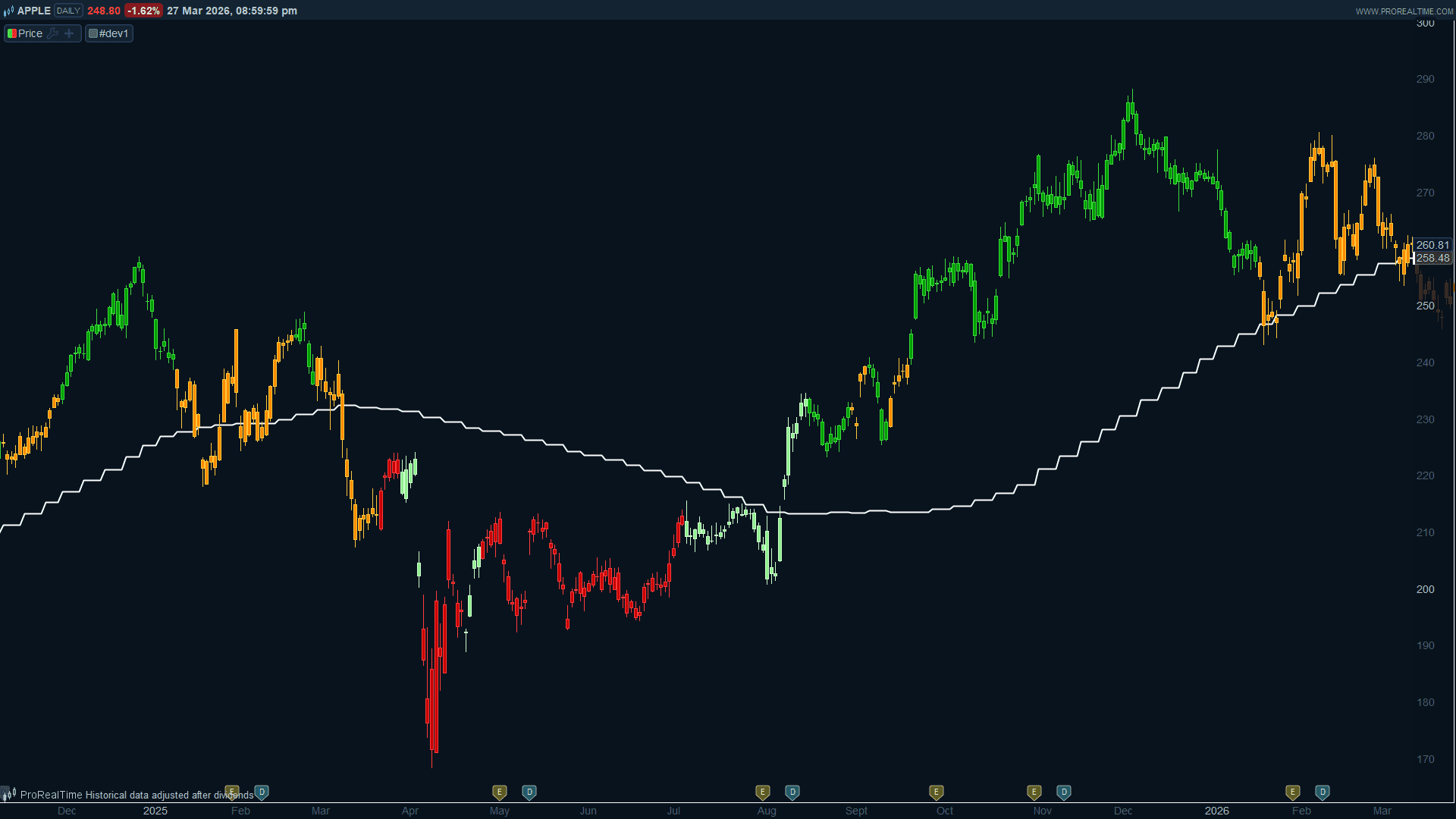
qualcuno può aiutarmi nel creare un indicatore che indichi i vari stage di Weinstein colorando le candele del prezzo in maniera differente come nel modello di Trendspider? Grazie!
il codice di Trendspider è il seguente:
// This script had been cloned from “Weinstein Stage Analysis” at 27 Jan 2025, 16:14
describe_indicator(‘Weinstein Stage Analysis’);
// This is an experimental implementation of Weinstein Stage Analysis for candle coloring.
// Please note that this is an interpretation and may not perfectly align with all aspects of the analysis.
const smaLength = input.number(‘MA Length’, 30, { min: 1 });
const withinRangePercent = input.number(‘Within Range %’, 5, { min: 0, max: 25 });
// Allow user to select the moving average type
const maType = input.select(‘MA Type’, ‘sma’, constants.ma_types);
const computeMA = indicators[maType];
// Allow user to adjust candle colors
const stage2Color = input.color(‘Stage 2 Color’, ‘green’);
const stage3Color = input.color(‘Stage 3 Color’, ‘orange’);
const stage4Color = input.color(‘Stage 4 Color’, ‘red’);
const stage1Color = input.color(‘Stage 1 Color’, ‘lightgreen’);
// Fetch weekly data
const weeklyData = await request.history(current.ticker, ‘W’);
assert(!weeklyData.error, Error fetching weekly data: ${weeklyData.error});
const weeklyMA = computeMA(weeklyData.close, smaLength);
const withinRange = mult(weeklyMA, withinRangePercent / 100);
let currentTrend = ”;
const myColors = for_every(
weeklyData.open, weeklyData.close, shift(weeklyData.open, 1), shift(weeklyData.close, 1), weeklyMA, shift(weeklyMA, 1), withinRange,
(_open, _close, _pOpen, _pClose, _ma, _pMa, _withinRange, _prevColor) => {
const myBodyLow = Math.min(_open, _close);
const myBodyHigh = Math.max(_open, _close);
if (myBodyLow > _ma + _withinRange && _pMa < _ma) {
currentTrend = ‘upward’;
return stage2Color;
}
if (myBodyHigh < _ma – _withinRange && _pMa > _ma) {
currentTrend = ‘downward’;
return stage4Color;
}
if (currentTrend == ‘upward’) {
return stage3Color;
}
if (currentTrend == ‘downward’) {
return stage1Color;
}
return _prevColor || null;
}
);
// Map weekly colors to the chart’s time frame
const myMappedColors = interpolate_sparse_series(land_points_onto_series(weeklyData.time, myColors, time, ‘le’), ‘constant’);
color_candles(myMappedColors);
// Paint the weekly MA for reference
const myMappedMA = land_points_onto_series(weeklyData.time, weeklyMA, time, ‘le’);
const myInterpolatedMA = interpolate_sparse_series(myMappedMA, ‘linear’);
paint(myInterpolatedMA, { name: Weekly ${maType.toUpperCase()}, color: ‘white’ });
// Create signals based on candle colors
const myGreenSignal = for_every(myMappedColors, _color => _color === stage2Color ? 1 : 0);
const myOrangeSignal = for_every(myMappedColors, _color => _color === stage3Color ? 1 : 0);
const myRedSignal = for_every(myMappedColors, _color => _color === stage4Color ? 1 : 0);
const myLightGreenSignal = for_every(myMappedColors, _color => _color === stage1Color ? 1 : 0);
register_signal(myGreenSignal, ‘Stage 2’);
register_signal(myOrangeSignal, ‘Stage 3’);
register_signal(myRedSignal, ‘Stage 4’);
register_signal(myLightGreenSignal, ‘Stage 1’);