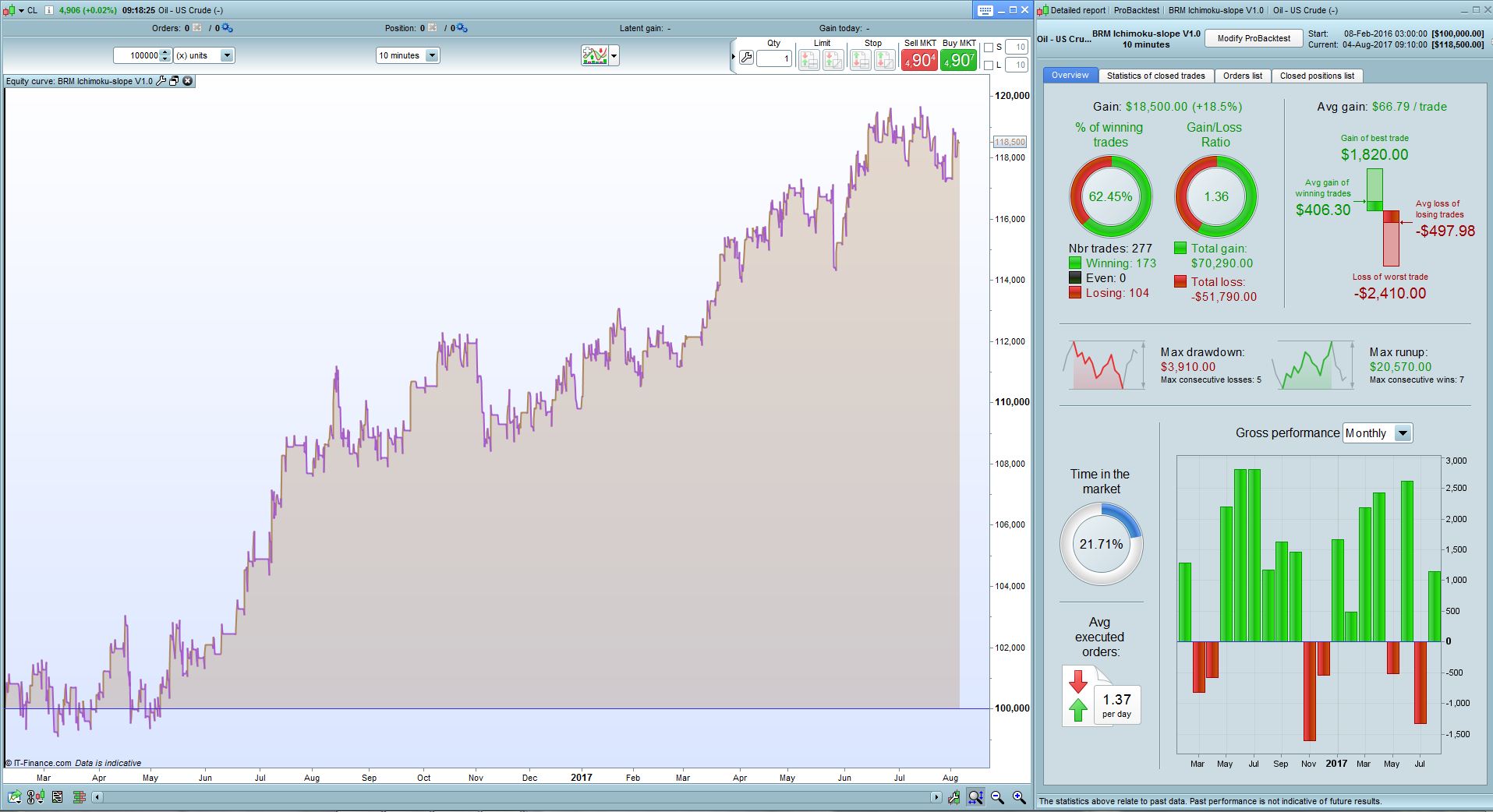
@bmentink, with regards to the RSI Divergence check and ADX volatility check. It could be that we used different versions of CL or time frames (or any other factor). I will paste the version of the code I used as soon as I can access my platform again (there seems to be technical difficulties at IG). However you can try to optimize the variables yourself, as I can guarantee you it works. With regards to my suggestion regarding SSpanA/B your code would not be compatible with the suggested formulation as you are focusing on the Kumo Break, which is 26 periods back from the leading edge. The leading edge is almost used in a similar fashion to the Kumo Twist, however looking at the leading edges of the cloud and not the Tenkansen and Kijunsen. Thus if calculated the way I suggested, the Kumo break would be determined at SSpanA[26].
Hi folks, with which program do I have to open the strategy to be able to test them themselves? I get only very funny characters when I open it with Word, am still new in the forum.
Mfg Jessar
Hi Jessar,
Both of us are quiet new here but the following link might help you : https://www.prorealcode.com/import-export-prorealtime-code-platform/
I use import button, and the files are located on your download section on Windows…Then import…Very easy.
Thank you trägheit, it is realy easy 🙂
I get this code simply not set so I get good results, I make something wrong or I just do not understand it?
@jessar the code was configured/set for a specific market (in this case CL) and time frame. If you use it on another Market or Time frame you would need to optomize/set the different variables using the backtest engine of Prorealtime.
I can make it synonymous unfortunately with the program does not set this code on EurJpy positively, one must also adjust the ichimoku anew? Lg 10min eurjpy
@juanj Still waiting for your version of the code…. 🙂 🙂
@bmentink apologies. I forgot about your request to post the code. Here it is along with my result on CL (US Crude on 10min with spread set to 2.8):
// IchiMoku/EMA Slope trading system ... by Bernard Mentink
// Version 1.0
// If you make improvements. Please Change the version number above and the strategy filename, (So we can keep track)
// I will keep my copies under "git" versioning.

defparam cumulateorders = false
DEFPARAM Preloadbars = 200

// ---------------------------------- Variables ----------------------------------------
BOK = 0
NbrContracts = 1
SlopeThreshold =  3.9 // From back/forward testing optimization
TGL = 32            // also from back/forward testing, note TGL and TGS the same,
TGS= TGL              // we don't want to bias for the current market (bull/bear) - because it could change at any time.
ATR = AverageTrueRange[5](close) //Average TRue Range calculated over the last x periods
TP = ATR*9 //Profit Target
SL = ATR*7 //Stoploss

// ---------------------------------- Indicators --------------------------------------

// Ichimoku
Tenkansen = (highest[9](high)+lowest[9](low))/2
Kijunsen = (highest[26](high)+lowest[26](low))/2
SSpanA = (tenkansen[26]+kijunsen[26])/2
SSpanB = (highest[52](high[26])+lowest[52](low[26]))/2
Chikou = close[26]


// This indicator calculates linear regression slope of moving average input, > 0 positive slope, <0 negative
// calculated on last 2 bars
length = 2
SumBars = Length * (Length-1) * 0.5
SumSqrBars = (Length-1) * Length * (2 * Length-1) / 6

if(barindex>Length) then
Sum1 = 0
SumY=0
MA = DEMA(close)

for i=0 to Length-1 do
Sum1 = Sum1+(i*MA[i])
SumY = SumY+(MA[i])
next

Sum2 = SumBars * SumY

Num1 = Length * Sum1 - Sum2
Num2 = SumBars * SumBars - Length * SumSqrBars
endif

RegSlope = Num1/Num2
myslope = RegSlope / close * 10000 // Scale slope to instrument.


// ---------------------------------- The code ---------------------------------------

// This is the meat, The key I think is in the slope. Adding the slope code improved the profitability greatly.
// Looking at the Chikou also helped keep us in the proper trend.
// Note carefully the comparisons are different depending on bull/bear of the Kumo.

// Our Ichimoku conditions broken down:
// Short
cs1 = close < SSpanA and close[1] > SSpanA[1]
cs2 = close < Kijunsen and close < Chikou
cs3 = mySlope > -SlopeThreshold
cs4 = mySlope < -SlopeThreshold
cs5 = close < SSpanB and close[1] > SSpanB[1]

// Long
cl1 = close > SSpanB and close[1] < SSpanB[1]
cl2 = close > Kijunsen and close > Chikou
cl3 = mySlope < SlopeThreshold
cl4 = mySlope > SlopeThreshold
cl5 = close > SSpanA and close[1] < SSpanA[1]


// Ichimoku logic
IF SSpanB > SSpanA THEN
// BREAK OUT KUMO down
if cs1 and cs2 and cs3 then
BOK = -1
else
// BREAK OUT KUMO up
if cl1 and cl2 and cl3 then
BOK = 1
endif
endif
else
// BREAK OUT KUMO up
if cl5 and cl2 and cl4 then
BOK = 1
else
// BREAK OUT KUMO down
if cs5 and cs2 and cs4 then
BOK = -1
endif
endif
ENDIF

// ------------------------------- Additional Criteria -----------------------------------

R = RSI[25](close) //RSI Period to determine momentum

If R > R[26] Then
If close < close[26] Then
BDIV = 1 //Possible Bearish Divergence Present
SDIV = 0
EndIf
EndIf

If R < R[26] Then
If close > close[26] Then
SDIV = 1 //Possible Bullish Divergence Present
BDIV = 0
EndIf
EndIf

AX = ADX[19] > 15
// ---------------------------------- Market Stuff --------------------------------------

if BOK=-1 and BDIV = 0 and AX then
sellshort NbrContracts contract at market
endif

if BOK=1 and SDIV = 0 and AX then
buy NbrContracts  contract at market
endif

// ---------------------------------- Stops ----------------------------------------------

//TRAILING STOP
if not onmarket then
MAXPRICE = 0
MINPRICE = close
EXITPRICE = 0
ENDIF

if longonmarket then
MAXPRICE = MAX(MAXPRICE,close)
if MAXPRICE-tradeprice(1)>=TGL*pointsize then
EXITPRICE = MAXPRICE-TGL*pointsize
ENDIF
ENDIF

if shortonmarket then
MINPRICE = MIN(MINPRICE,close)
if tradeprice(1)-MINPRICE>=TGS*pointsize then
EXITPRICE = MINPRICE+TGS*pointsize
ENDIF
ENDIF

if onmarket and EXITPRICE>0 then
EXITSHORT AT EXITPRICE STOP
SELL AT EXITPRICE STOP
ENDIF

// Mostly as a safety stop, although it creats greater profits on a ranging market, good to optimize the "970" for the instrument.
// We still need a better stop if market moves against us shortly after entry and before the trailing stop comes into play.
set stop ploss SL
set target pprofit TP
Note this only inludes the RSI Divergence and ADX checks not the leading edge check for SSpanA/B as that requires slightly more of a re-write.
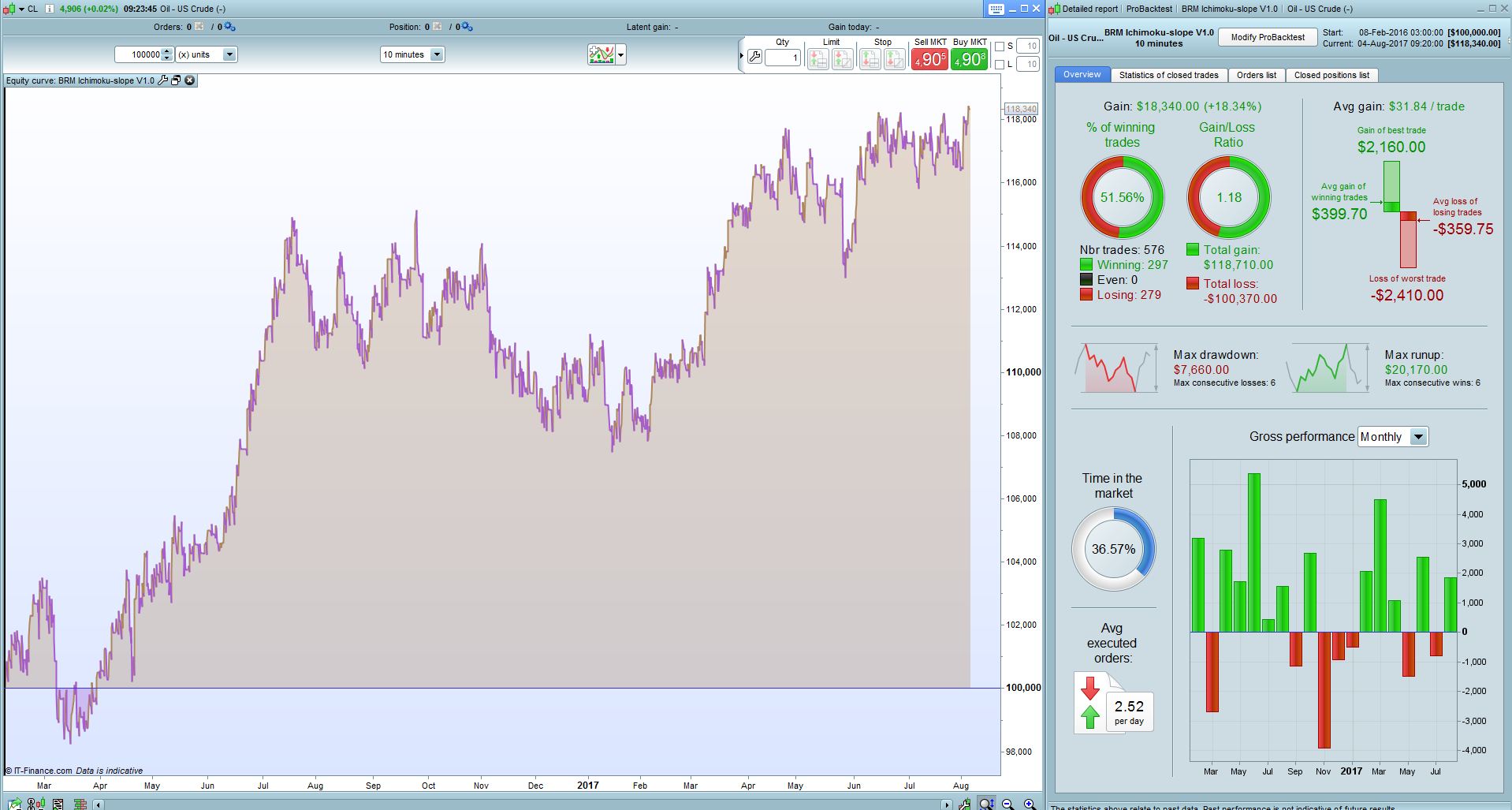
And maybe just for comparison, here is my result without the RSI Divergence and ADX checks, using the original code.