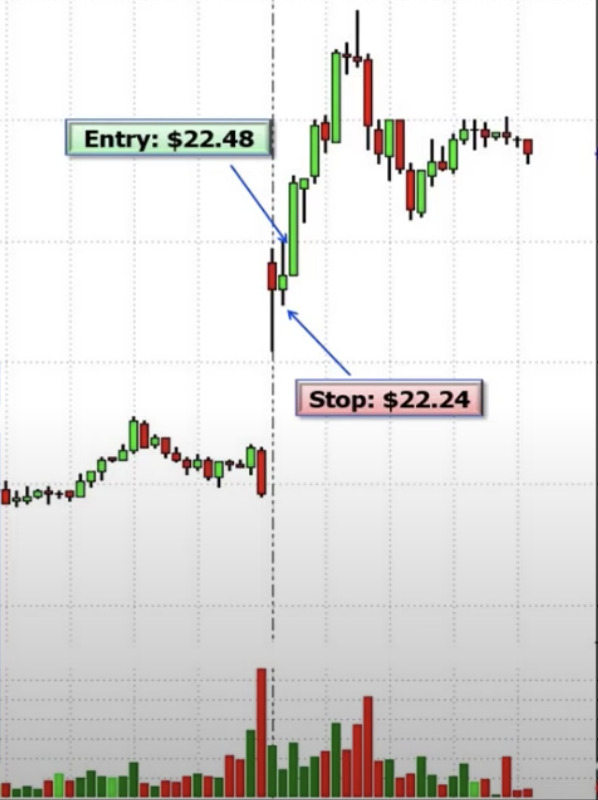
Yes, I added a picture.
So, the stock is open up with a gap, and it takes out yesterdays high. This is very important. So this strategy only works on stocks.
Then, the 3 bar play is only “used” on the first bars, so the code should not execute later.
In the picture you also se that the stoploss is set below candle 2.
One problem, is that we want to enter as soon as candle 3 takes out candle 2, i guess this is not possible, we can only enter on candle close? right?
Did this makes it more clear @robertogozzi?
Do not use the “@” sign unless many peiople are discussing and it’s very difficult to know what post is aimed to who.
I will study it and will let you know as soon as possible.
So you need a strategy, not a screener?
Moreover, I coded the indicator and screener having only the screenshot as a reference fior the 4 patterns, I did not watch the video.
Actually the guy on the video talks about the first bar (the IGNITION bar) as a wide range bar, no matter the colour as long as it breaks (with just either OPEN or CLOSE, or with HIGH?) the resistance level (which I did not check).
So, what pattern do you want to trade?
And what about resuistance/support level to be broken by those patterns, how do you want them to be detected?
Hi all,
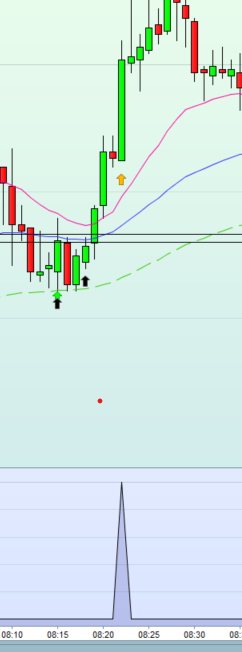
The issue at the start of the thread is that the code is a literal interpretation of the picture provided, if you go back to the original video by Jerad Wesley from Live Traders he is describing a set of conditions. I have coded a indicator for the three bar play going long or short, the point is that an entry is made as soon as the current candle breaks above the pervious two candles, and it tends to go in a rush. so if you are wanting to use it as a screener you will need lightning reflexes on lower time frames. it should work fine on longer time frames. The code is for an indicator but I believe the conversion should be simple enough
Body      = abs(close - open)
a=0

ThreeBarPlayLong =  Body[2]>Body[3]And Close[2] > open[2] And close[1] < open[1]And close > open And ((High[2]-low[2]) > ((High[1]-low[1]) *2)) And High[2]>=high[1] and Low > low[2] And Close > High[1] And Close > High[2]

ThreeBarPlayShort = Body[2]>Body[3]And Close[2] < open[2] And close[1] > open[1]And close < open And ((High[2]-low[2]) > ((High[1]-low[1]) *2)) And low[2]<=low[1]   And High < High[2] And Close < low[1] And Close < low[2]


if ThreeBarPlayLong Then
a=1
endif
If ThreebarPlayShort Then
a=-1
Endif

Return A
Enjoy!
Oh, and while we are on the subject, if you want to put a fabulous golden arrow onto your chart just check out this code
// code for three bar plays

Body      = abs(close - open)
a=0

ThreeBarPlayLong =  Body[2]>Body[3]And Close[2] > open[2] And close[1] < open[1]And close > open And ((High[2]-low[2]) > ((High[1]-low[1]) *2)) And High[2]>=high[1] and Low > low[2] And Close > High[1] And Close > High[2]

ThreeBarPlayShort = Body[2]>Body[3]And Close[2] < open[2] And close[1] > open[1]And close < open And ((High[2]-low[2]) > ((High[1]-low[1]) *2)) And low[2]<=low[1]   And High < High[2] And Close < low[1] And Close < low[2]


IF  ThreeBarPlayLong THEN
DRAWARROWUP(barindex,low-3)coloured(252, 186, 3)
ENDIF

IF ThreeBarPlayShort  THEN
DRAWARROWDOWN(barindex,high+3)coloured(252, 186, 3)
ENDIF


Return
Use only the SELECT FILE button to attach files.
Embedding them in your posts will slow down the forum.
Thank you 🙂
Hi,
Can someone support to turn this on to a screener?
Thanks in advanced,
Fredrik
There you go:
Body      = abs(close - open)
a=0

ThreeBarPlayLong =  Body[2]>Body[3]And Close[2] > open[2] And close[1] < open[1]And close > open And ((High[2]-low[2]) > ((High[1]-low[1]) *2)) And High[2]>=high[1] and Low > low[2] And Close > High[1] And Close > High[2]

ThreeBarPlayShort = Body[2]>Body[3]And Close[2] < open[2] And close[1] > open[1]And close < open And ((High[2]-low[2]) > ((High[1]-low[1]) *2)) And low[2]<=low[1]   And High < High[2] And Close < low[1] And Close < low[2]

if ThreeBarPlayLong Then
a=1
endif
If ThreebarPlayShort Then
a=2
Endif

Screener[A](A as “1=Long,2=Short”)
Screeners do not allow negative numbers, so I replaced -1 with 2.