







Vdubus Pattern: XABCD reversal patterns
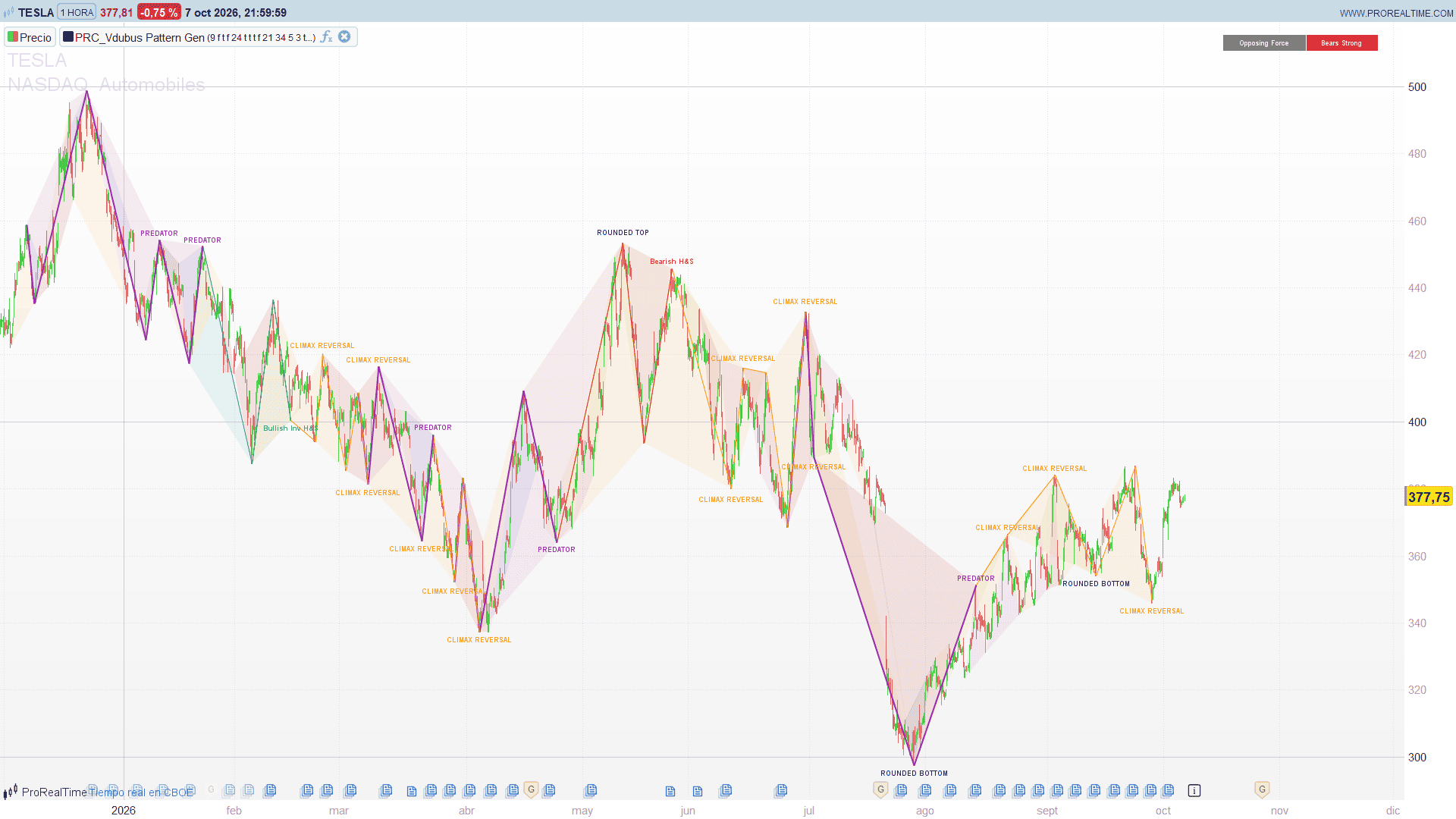
Introduction
Most pattern tools look only at price: they find five swing points that fit a shape and call it a reversal. The weak point is obvious. A head and shoulders or a harmonic shape tells you where price has been, not whether the move behind it is running out of energy.
Vdubus Pattern Gen V2 checks both. It builds the last five swing points of the market as an X-A-B-C-D structure and only marks a reversal when the momentum behind those swings agrees: the MACD histogram has to show the right sequence of peaks or troughs. It runs on two scales at once, a fast structure for entry geometry and a slow one for the macro context, and it classifies every confirmed setup into one of four families: standard reversal, climax reversal, rounded top or bottom, and the hidden “predator” pattern.
Theory Behind the Indicator
Two structure scales
Swing highs and lows are confirmed pivots: a bar whose high (or low) is the extreme of the bars on both sides. The fast scale uses 9 bars on each side, the slow scale 24. Each scale keeps its own sequence of pivots, highs and lows in the order they were confirmed. Every time a new pivot appears, the last five of that scale become X, A, B, C and D, with D the newest.
Momentum physics
Momentum is measured with the MACD histogram (21, 34, 5 by default, smoother than the classic 12, 26, 9). The indicator records the pivots of the histogram itself, 3 bars on each side, and reads the last three or four of them on the side that matters: histogram peaks for bearish setups, troughs for bullish ones.
- Standard reversal: three momentum peaks, each one lower than (or equal to) the previous. This is the classic divergence: price keeps pushing, the force behind it fades. For bullish setups, three rising troughs.
- Climax reversal: the middle peak is the highest of the three and the last one falls. Momentum spiked and is now collapsing, the signature of a blow-off or a trap.
- Rounded top or bottom: four momentum peaks in a row, each lower than the one before (four rising troughs for a rounded bottom). A slow, steady loss of drive rather than a sharp turn.
- Predator (hidden): no classic divergence, D has not exceeded X, and momentum on the last peak is higher than on the previous one (lower trough for bullish). Price is failing to make progress even though momentum pushed harder.
Shape filter
Standard reversals also have to pass a shape filter. The indicator measures the AB leg as a fraction of XA and tags the structure:
- Head and shoulders: B (the head) lies beyond both X and D. For bullish setups this is the inverse head and shoulders.
- Harmonic names: Gartley, Bat, Butterfly, Crab and Deep, using the AB/XA ratio within a tolerance (0.15 by default) and a fixed XD extension of 1.27. With that extension, a structure whose AB/XA is close to 0.786 is a Butterfly and any other is a Deep pattern.
By default only head and shoulders shapes are shown for the standard family; each harmonic name can be switched on separately. Climax, rounded and predator setups do not depend on the shape filter.
Key Features at a Glance
- Two independent structure scales (fast and slow), each with its own lines, fills and labels switches.
- Four reversal families validated by MACD histogram pivots.
- Head and shoulders and five harmonic names as a shape filter for standard reversals.
- XABCD drawn as four legs, with the XAB and BCD triangles shaded.
- Optional target box from D to the previous structural high or low (point C).
- Optional “Opposing Force” panel telling which side carries the stronger last momentum pivot.
- Only the most recent 500 lines, 500 labels and 500 boxes are kept, so long histories stay readable.
How to Read the Indicator
- Red: bearish standard reversal. Green: bullish standard reversal. Orange: climax reversal. Navy label: rounded top or bottom. Purple, thicker lines: predator pattern.
- The label sits on point D, above it for bearish setups and below it for bullish ones. D is the pivot that completes the pattern; the signal itself appears when that pivot is confirmed, 9 bars later on the fast scale and 24 on the slow one.
- The shaded triangles show the two halves of the structure. A large XAB triangle followed by a small BCD one means the second push covered less ground.
- With the target box on, the box spans from D to the level of C, the previous structural extreme inside the pattern: the first natural objective once the reversal starts.
- The panel compares the last momentum trough with the last momentum peak. “Bulls Strong” means the last bullish momentum swing was larger in size than the last bearish one.
Practical Applications
- Context and timing: read the slow structure for the direction of the next swing and use the fast fills, drawn without lines by default, to time the entry inside it.
- Filtering divergences: a momentum divergence alone appears often. Requiring a head and shoulders or a harmonic shape on top of it keeps only the setups where price structure and momentum agree.
- Spotting traps: climax reversals mark exhausted bursts. When one appears against the slow structure trend, it is often a good place to avoid chasing the move.
- Hidden pressure: predator patterns flag swings where momentum improves but price cannot follow, a common precursor of a deeper move in the direction of D.
Indicator Configuration
Fast structure:
- fastDepth (default: 9): bars on each side of a fast pivot.
- showFastLines (default: 0): draw the XABCD legs of the fast structure.
- showFastFills (default: 1): shade the fast XAB and BCD triangles.
- showFastLbl (default: 0): label the fast patterns.
Slow structure:
- slowDepth (default: 24): bars on each side of a slow pivot.
- showSlowLines (default: 1), showSlowFills (default: 1), showSlowLbl (default: 1): same switches for the slow structure.
Targets and momentum:
- showTgtBox (default: 0): draw the target box from D to the level of C.
- fastLen (default: 21), slowLen (default: 34), sigLen (default: 5): MACD lengths.
- momLookback (default: 3): bars on each side of a momentum pivot.
Pattern filters:
- showStandard, showClimax, showRounded, showPred (default: 1): show each reversal family.
- showGartley, showBat, showButterfly, showCrab, showDeep (default: 0): allow each harmonic name in the standard family.
- showHS (default: 1): allow head and shoulders shapes.
- errTol (default: 0.15): tolerance of the harmonic ratios, from 0.01 to 0.5.
Dashboard:
- showDash (default: 0): show the “Opposing Force” panel in the top right corner.
- textSize (default: 1): 1 small, 2 normal, 3 large.
- maxObjects (default: 500): most recent lines, labels and boxes kept on the chart.
Code
//---------------------------------------------------------------
// PRC_Vdubus Pattern Gen
// version = 0
// 08.10.2026
// Iván González @ www.prorealcode.com
// Author: Bespoke_Analysis_Engine
// Sharing ProRealTime knowledge
//--------------------------------------------------------------------//
defparam drawonlastbaronly = true
//---------------------------------------------------------------
// SETTINGS
//---------------------------------------------------------------
// Fast structure (entry geometry)
fastDepth = 9             // fast pattern scale (pivot length)
showFastLines = 0
showFastFills = 1
showFastLbl = 0
// Slow structure (macro context)
slowDepth = 24            // slow pattern scale (pivot length)
showSlowLines = 1
showSlowFills = 1
showSlowLbl = 1
// Target projections
showTgtBox = 0            // box from the pattern end (D) to the previous structural high/low (C)
// Momentum physics (MACD histogram)
fastLen = 21
slowLen = 34
sigLen = 5
momLookback = 3           // momentum pivot lookback
// Pattern filters
showStandard = 1          // standard reversals
showClimax = 1            // climax reversals (trap)
showRounded = 1           // rounded tops / bottoms
showPred = 1              // predator (hidden)
// Harmonic shape selectors
showGartley = 0
showBat = 0
showButterfly = 0
showCrab = 0
showDeep = 0              // deep / shark
showHS = 1                // head and shoulders
errTol = 0.15             // harmonic tolerance (0.01 to 0.5)
// Confluence dashboard
showDash = 0
textSize = 1              // 1 = Small, 2 = Normal, 3 = Large
// Object budget: like the original, only the most recent 500 lines,
// 500 labels and 500 boxes stay on the chart (fill edges count as lines)
maxObjects = 500
//---------------------------------------------------------------
// MOMENTUM: MACD HISTOGRAM AND ITS PIVOTS
//---------------------------------------------------------------
emaFast = exponentialaverage[fastLen](close)
emaSlow = exponentialaverage[slowLen](close)
macdL = emaFast - emaSlow
sigLine = exponentialaverage[sigLen](macdL)
histL = macdL - sigLine

// Momentum pivots are stored with a counter that is a plain variable:
// it is rewound on every tick, so a pivot that appears and disappears
// inside the live bar is simply overwritten by the next one.
once nWH = 0
once nWL = 0
lb = momLookback
momWarm = slowLen + sigLen + 2 * lb
IF barindex >= momWarm THEN
   IF histL[lb] > highest[lb](histL)[lb + 1] AND histL[lb] >= highest[lb](histL) THEN
      nWH = nWH + 1
      $wHv[nWH] = histL[lb]
   ENDIF
   IF lowest[lb](histL)[lb + 1] > histL[lb] AND lowest[lb](histL) >= histL[lb] THEN
      nWL = nWL + 1
      $wLv[nWL] = histL[lb]
   ENDIF
ENDIF

// Momentum validation (bearish side reads the histogram highs)
stdBear = 0
climBear = 0
rndBear = 0
predBear = 0
IF nWH >= 2 THEN
   IF $wHv[nWH] > $wHv[nWH - 1] THEN
      predBear = 1
   ENDIF
ENDIF
IF nWH >= 3 THEN
   h1 = $wHv[nWH - 2]
   h2 = $wHv[nWH - 1]
   h3 = $wHv[nWH]
   IF h1 > h2 AND h2 >= h3 THEN
      stdBear = 1
   ENDIF
   IF h2 >= h1 AND h2 > h3 THEN
      climBear = 1
   ENDIF
ENDIF
IF nWH >= 4 THEN
   IF $wHv[nWH - 3] > $wHv[nWH - 2] AND $wHv[nWH - 2] > $wHv[nWH - 1] AND $wHv[nWH - 1] > $wHv[nWH] THEN
      rndBear = 1
   ENDIF
ENDIF

// Momentum validation (bullish side reads the histogram lows)
stdBull = 0
climBull = 0
rndBull = 0
predBull = 0
IF nWL >= 2 THEN
   IF $wLv[nWL - 1] > $wLv[nWL] THEN
      predBull = 1
   ENDIF
ENDIF
IF nWL >= 3 THEN
   l1 = $wLv[nWL - 2]
   l2 = $wLv[nWL - 1]
   l3 = $wLv[nWL]
   IF l2 > l1 AND l3 >= l2 THEN
      stdBull = 1
   ENDIF
   IF l1 >= l2 AND l3 > l2 THEN
      climBull = 1
   ENDIF
ENDIF
IF nWL >= 4 THEN
   IF $wLv[nWL - 2] > $wLv[nWL - 3] AND $wLv[nWL - 1] > $wLv[nWL - 2] AND $wLv[nWL] > $wLv[nWL - 1] THEN
      rndBull = 1
   ENDIF
ENDIF
//---------------------------------------------------------------
// PRICE STRUCTURE PIVOTS (fast and slow)
//---------------------------------------------------------------
fd = fastDepth
sd = slowDepth
fPH = 0
fPL = 0
sPH = 0
sPL = 0
IF barindex >= 2 * fd THEN
   IF high[fd] > highest[fd](high)[fd + 1] AND high[fd] >= highest[fd](high) THEN
      fPH = 1
   ENDIF
   IF lowest[fd](low)[fd + 1] > low[fd] AND lowest[fd](low) >= low[fd] THEN
      fPL = 1
   ENDIF
ENDIF
IF barindex >= 2 * sd THEN
   IF high[sd] > highest[sd](high)[sd + 1] AND high[sd] >= highest[sd](high) THEN
      sPH = 1
   ENDIF
   IF lowest[sd](low)[sd + 1] > low[sd] AND lowest[sd](low) >= low[sd] THEN
      sPL = 1
   ENDIF
ENDIF

// label offset from the pattern end
IF barindex >= 14 THEN
   atrOff = averagetruerange[14](close) * 0.5
ELSE
   atrOff = (high - low) * 0.5
ENDIF
//---------------------------------------------------------------
// PATTERN ENGINE
// engK = 1 fast structure, engK = 2 slow structure
// sideK = 1 pivot high (bearish), sideK = 2 pivot low (bullish)
// Pivots of both engines share one array: slot 2*n+engK.
//---------------------------------------------------------------
once nF = 0
once nS = 0
once nK = 0
FOR engK = 1 TO 2 DO
   IF engK = 1 THEN
      nZ = nF
      dep = fd
      eLbl = showFastLbl
   ELSE
      nZ = nS
      dep = sd
      eLbl = showSlowLbl
   ENDIF
   FOR sideK = 1 TO 2 DO
      isPiv = 0
      pv = 0
      IF engK = 1 AND sideK = 1 AND fPH THEN
         isPiv = 1
         pv = high[fd]
      ELSIF engK = 1 AND sideK = 2 AND fPL THEN
         isPiv = 1
         pv = low[fd]
      ELSIF engK = 2 AND sideK = 1 AND sPH THEN
         isPiv = 1
         pv = high[sd]
      ELSIF engK = 2 AND sideK = 2 AND sPL THEN
         isPiv = 1
         pv = low[sd]
      ENDIF
      IF isPiv THEN
         nZ = nZ + 1
         $zP[2 * nZ + engK] = pv
         $zL[2 * nZ + engK] = barindex - dep
         IF nZ >= 5 THEN
            // D = newest pivot, X = fifth newest
            yD = $zP[2 * nZ + engK]
            yC = $zP[2 * (nZ - 1) + engK]
            yB = $zP[2 * (nZ - 2) + engK]
            yA = $zP[2 * (nZ - 3) + engK]
            yX = $zP[2 * (nZ - 4) + engK]
            xD = $zL[2 * nZ + engK]
            xC = $zL[2 * (nZ - 1) + engK]
            xB = $zL[2 * (nZ - 2) + engK]
            xA = $zL[2 * (nZ - 3) + engK]
            xX = $zL[2 * (nZ - 4) + engK]
            IF sideK = 1 THEN
               sg = 1
               mStd = stdBear
               mClim = climBear
               mRnd = rndBear
               mPred = predBear
            ELSE
               sg = -1
               mStd = stdBull
               mClim = climBull
               mRnd = rndBull
               mPred = predBull
            ENDIF
            // harmonic ratios (the original always evaluates XD at 1.27)
            xaLen = abs(yA - yX)
            abLen = abs(yB - yA)
            IF xaLen = 0 THEN
               xbR = 0
            ELSE
               xbR = abLen / xaLen
            ENDIF
            xdR = 1.27
            IF errTol > abs(xbR - 0.618) AND errTol > abs(xdR - 0.786) THEN
               hName = 1
            ELSIF xbR >= 0.382 - errTol AND 0.5 + errTol >= xbR AND errTol > abs(xdR - 0.886) THEN
               hName = 2
            ELSIF errTol > abs(xbR - 0.786) AND xdR >= 1.27 - errTol AND 1.618 + errTol >= xdR THEN
               hName = 3
            ELSIF xbR >= 0.382 - errTol AND 0.618 + errTol >= xbR AND errTol > abs(xdR - 1.618) THEN
               hName = 4
            ELSIF xdR > 1.0 THEN
               hName = 5
            ELSE
               hName = 6
            ENDIF
            // head and shoulders: B is the head, beyond X and D
            isHS = 0
            IF showHS AND sg * (yB - yX) > 0 AND sg * (yB - yD) > 0 THEN
               isHS = 1
            ENDIF
            shouldDraw = 0
            IF isHS THEN
               shouldDraw = 1
            ELSIF hName = 1 AND showGartley THEN
               shouldDraw = 1
            ELSIF hName = 2 AND showBat THEN
               shouldDraw = 1
            ELSIF hName = 3 AND showButterfly THEN
               shouldDraw = 1
            ELSIF hName = 4 AND showCrab THEN
               shouldDraw = 1
            ELSIF hName = 5 AND showDeep THEN
               shouldDraw = 1
            ELSIF hName = 6 THEN
               shouldDraw = 1
            ENDIF
            // record types, in the original order:
            // 1 standard, 2 climax, 3 rounded (label only), 4 predator
            FOR recK = 1 TO 4 DO
               doRec = 0
               nmCode = 0
               IF recK = 1 AND showStandard AND mStd AND shouldDraw THEN
                  doRec = 1
                  IF isHS THEN
                     nmCode = 7
                  ELSE
                     nmCode = hName
                  ENDIF
               ELSIF recK = 2 AND showClimax AND mClim THEN
                  doRec = 1
               ELSIF recK = 3 AND showRounded AND mRnd AND eLbl THEN
                  doRec = 1
               ELSIF recK = 4 AND showPred AND mStd = 0 AND sg * (yX - yD) > 0 AND mPred THEN
                  doRec = 1
               ENDIF
               IF doRec THEN
                  nK = nK + 1
                  $kT[nK] = recK
                  $kN[nK] = nmCode
                  $kB[nK] = sideK - 1
                  $kE[nK] = engK
                  $kO[nK] = atrOff
                  $kX0[nK] = xX
                  $kX1[nK] = xA
                  $kX2[nK] = xB
                  $kX3[nK] = xC
                  $kX4[nK] = xD
                  $kY0[nK] = yX
                  $kY1[nK] = yA
                  $kY2[nK] = yB
                  $kY3[nK] = yC
                  $kY4[nK] = yD
               ENDIF
            NEXT
         ENDIF
      ENDIF
   NEXT
   IF engK = 1 THEN
      nF = nZ
   ELSE
      nS = nZ
   ENDIF
NEXT
//---------------------------------------------------------------
// DRAWING (newest first, within the object budget)
//---------------------------------------------------------------
IF islastbarupdate THEN
   lineCnt = 0
   lblCnt = 0
   boxCnt = 0
   lineFull = 0
   lblFull = 0
   boxFull = 0
   IF nK >= 1 THEN
      FOR k = nK DOWNTO 1 DO
         kT = $kT[k]
         kN = $kN[k]
         kBull = $kB[k]
         IF $kE[k] = 1 THEN
            doLn = showFastLines
            doFl = showFastFills
            doLb = showFastLbl
         ELSE
            doLn = showSlowLines
            doFl = showSlowFills
            doLb = showSlowLbl
         ENDIF
         // colours: standard red / green, climax orange, rounded navy, predator purple
         IF kT = 1 AND kBull THEN
            cR = 8
            cG = 153
            cB = 129
         ELSIF kT = 1 THEN
            cR = 242
            cG = 54
            cB = 69
         ELSIF kT = 2 THEN
            cR = 255
            cG = 152
            cB = 0
         ELSIF kT = 3 THEN
            cR = 49
            cG = 27
            cB = 146
         ELSE
            cR = 156
            cG = 39
            cB = 176
         ENDIF
         x0 = $kX0[k]
         x1 = $kX1[k]
         x2 = $kX2[k]
         x3 = $kX3[k]
         x4 = $kX4[k]
         y0 = $kY0[k]
         y1 = $kY1[k]
         y2 = $kY2[k]
         y3 = $kY3[k]
         y4 = $kY4[k]
         isStruct = 1
         IF kT = 3 THEN
            isStruct = 0
         ENDIF
         // lines and fills (fill edges are invisible lines in the original)
         IF isStruct THEN
            need = 4 * doLn + 4 * doFl
            IF need > 0 AND lineFull = 0 THEN
               IF lineCnt + need > maxObjects THEN
                  lineFull = 1
               ELSE
                  lineCnt = lineCnt + need
                  IF doLn AND kT = 4 THEN
                     DRAWSEGMENT(x0, y0, x1, y1) COLOURED(cR, cG, cB, 255) STYLE(line, 2)
                     DRAWSEGMENT(x1, y1, x2, y2) COLOURED(cR, cG, cB, 255) STYLE(line, 2)
                     DRAWSEGMENT(x2, y2, x3, y3) COLOURED(cR, cG, cB, 255) STYLE(line, 2)
                     DRAWSEGMENT(x3, y3, x4, y4) COLOURED(cR, cG, cB, 255) STYLE(line, 2)
                  ELSIF doLn THEN
                     DRAWSEGMENT(x0, y0, x1, y1) COLOURED(cR, cG, cB, 255) STYLE(line, 1)
                     DRAWSEGMENT(x1, y1, x2, y2) COLOURED(cR, cG, cB, 255) STYLE(line, 1)
                     DRAWSEGMENT(x2, y2, x3, y3) COLOURED(cR, cG, cB, 255) STYLE(line, 1)
                     DRAWSEGMENT(x3, y3, x4, y4) COLOURED(cR, cG, cB, 255) STYLE(line, 1)
                  ENDIF
                  IF doFl THEN
                     DRAWTRIANGLE(x0, y0, x1, y1, x2, y2) COLOURED(cR, cG, cB, 0) FILLCOLOR(cR, cG, cB, 20)
                     DRAWTRIANGLE(x2, y2, x3, y3, x4, y4) COLOURED(cR, cG, cB, 0) FILLCOLOR(cR, cG, cB, 20)
                  ENDIF
               ENDIF
            ENDIF
            // target box: from D to the previous structural high / low (C)
            IF showTgtBox AND boxFull = 0 THEN
               IF boxCnt >= maxObjects THEN
                  boxFull = 1
               ELSE
                  boxCnt = boxCnt + 1
                  DRAWRECTANGLE(x4, y3, x4 + 20, y4) COLOURED(cR, cG, cB, 51) FILLCOLOR(cR, cG, cB, 13)
               ENDIF
            ENDIF
         ENDIF
         // labels (rounded patterns are only recorded when labels are on)
         IF (kT = 3 OR doLb) AND lblFull = 0 THEN
            IF lblCnt >= maxObjects THEN
               lblFull = 1
            ELSE
               lblCnt = lblCnt + 1
               IF kBull THEN
                  ly = y4 - $kO[k]
               ELSE
                  ly = y4 + $kO[k]
               ENDIF
               IF kT = 1 AND kBull THEN
                  IF kN = 7 THEN
                     DRAWTEXT("Bullish Inv H&S", x4, ly, SansSerif, Bold, 9) COLOURED(cR, cG, cB)
                  ELSIF kN = 1 THEN
                     DRAWTEXT("Bullish Gartley", x4, ly, SansSerif, Bold, 9) COLOURED(cR, cG, cB)
                  ELSIF kN = 2 THEN
                     DRAWTEXT("Bullish Bat", x4, ly, SansSerif, Bold, 9) COLOURED(cR, cG, cB)
                  ELSIF kN = 3 THEN
                     DRAWTEXT("Bullish Butterfly", x4, ly, SansSerif, Bold, 9) COLOURED(cR, cG, cB)
                  ELSIF kN = 4 THEN
                     DRAWTEXT("Bullish Crab", x4, ly, SansSerif, Bold, 9) COLOURED(cR, cG, cB)
                  ELSIF kN = 5 THEN
                     DRAWTEXT("Bullish Deep Pattern", x4, ly, SansSerif, Bold, 9) COLOURED(cR, cG, cB)
                  ELSE
                     DRAWTEXT("Bullish Retracement", x4, ly, SansSerif, Bold, 9) COLOURED(cR, cG, cB)
                  ENDIF
               ELSIF kT = 1 THEN
                  IF kN = 7 THEN
                     DRAWTEXT("Bearish H&S", x4, ly, SansSerif, Bold, 9) COLOURED(cR, cG, cB)
                  ELSIF kN = 1 THEN
                     DRAWTEXT("Bearish Gartley", x4, ly, SansSerif, Bold, 9) COLOURED(cR, cG, cB)
                  ELSIF kN = 2 THEN
                     DRAWTEXT("Bearish Bat", x4, ly, SansSerif, Bold, 9) COLOURED(cR, cG, cB)
                  ELSIF kN = 3 THEN
                     DRAWTEXT("Bearish Butterfly", x4, ly, SansSerif, Bold, 9) COLOURED(cR, cG, cB)
                  ELSIF kN = 4 THEN
                     DRAWTEXT("Bearish Crab", x4, ly, SansSerif, Bold, 9) COLOURED(cR, cG, cB)
                  ELSIF kN = 5 THEN
                     DRAWTEXT("Bearish Deep Pattern", x4, ly, SansSerif, Bold, 9) COLOURED(cR, cG, cB)
                  ELSE
                     DRAWTEXT("Bearish Retracement", x4, ly, SansSerif, Bold, 9) COLOURED(cR, cG, cB)
                  ENDIF
               ELSIF kT = 2 THEN
                  DRAWTEXT("CLIMAX REVERSAL", x4, ly, SansSerif, Bold, 9) COLOURED(cR, cG, cB)
               ELSIF kT = 3 AND kBull THEN
                  DRAWTEXT("ROUNDED BOTTOM", x4, ly, SansSerif, Bold, 9) COLOURED(cR, cG, cB)
               ELSIF kT = 3 THEN
                  DRAWTEXT("ROUNDED TOP", x4, ly, SansSerif, Bold, 9) COLOURED(cR, cG, cB)
               ELSE
                  DRAWTEXT("PREDATOR", x4, ly, SansSerif, Bold, 9) COLOURED(cR, cG, cB)
               ENDIF
            ENDIF
         ENDIF
         IF lineFull AND lblFull AND (boxFull OR showTgtBox = 0) THEN
            BREAK
         ENDIF
      NEXT
   ENDIF
   //------------------------------------------------------------
   // CONFLUENCE DASHBOARD: which side carries the stronger last
   // momentum pivot
   //------------------------------------------------------------
   IF showDash THEN
      lastBull = 0
      lastBear = 0
      IF nWL >= 1 THEN
         lastBull = $wLv[nWL]
      ENDIF
      IF nWH >= 1 THEN
         lastBear = $wHv[nWH]
      ENDIF
      IF abs(lastBull) > abs(lastBear) THEN
         bullStrong = 1
         sR = 8
         sG = 153
         sB = 129
      ELSE
         bullStrong = 0
         sR = 242
         sG = 54
         sB = 69
      ENDIF
      IF textSize = 3 THEN
         sc = 1.4
      ELSIF textSize = 2 THEN
         sc = 1.2
      ELSE
         sc = 1
      ENDIF
      w0 = round(110 * sc)
      w1 = round(95 * sc)
      rowH = round(22 * sc)
      // fixed in the top right corner, measured in pixels from that corner and
      // shifted left so the price scale does not cover the right cell
      xIn = 0 - 100
      xMid = xIn - w1
      xOut = xMid - w0
      yA0 = 0 - 15
      yA1 = yA0 - rowH
      cx0 = round((xOut + xMid) / 2)
      cx1 = round((xMid + xIn) / 2)
      cy = round((yA0 + yA1) / 2)
      DRAWRECTANGLE(xOut, yA0, xMid, yA1) ANCHOR(TOPRIGHT, XSHIFT, YSHIFT) COLOURED(255, 255, 255, 255) FILLCOLOR(0, 0, 0, 127)
      DRAWRECTANGLE(xMid, yA0, xIn, yA1) ANCHOR(TOPRIGHT, XSHIFT, YSHIFT) COLOURED(255, 255, 255, 255) FILLCOLOR(sR, sG, sB, 255)
      // the font size has to be a literal, hence one branch per size
      IF textSize = 3 THEN
         DRAWTEXT("Opposing Force", cx0, cy, SansSerif, Standard, 13) ANCHOR(TOPRIGHT, XSHIFT, YSHIFT) COLOURED(255, 255, 255)
         IF bullStrong THEN
            DRAWTEXT("Bulls Strong", cx1, cy, SansSerif, Standard, 13) ANCHOR(TOPRIGHT, XSHIFT, YSHIFT) COLOURED(255, 255, 255)
         ELSE
            DRAWTEXT("Bears Strong", cx1, cy, SansSerif, Standard, 13) ANCHOR(TOPRIGHT, XSHIFT, YSHIFT) COLOURED(255, 255, 255)
         ENDIF
      ELSIF textSize = 2 THEN
         DRAWTEXT("Opposing Force", cx0, cy, SansSerif, Standard, 11) ANCHOR(TOPRIGHT, XSHIFT, YSHIFT) COLOURED(255, 255, 255)
         IF bullStrong THEN
            DRAWTEXT("Bulls Strong", cx1, cy, SansSerif, Standard, 11) ANCHOR(TOPRIGHT, XSHIFT, YSHIFT) COLOURED(255, 255, 255)
         ELSE
            DRAWTEXT("Bears Strong", cx1, cy, SansSerif, Standard, 11) ANCHOR(TOPRIGHT, XSHIFT, YSHIFT) COLOURED(255, 255, 255)
         ENDIF
      ELSE
         DRAWTEXT("Opposing Force", cx0, cy, SansSerif, Standard, 9) ANCHOR(TOPRIGHT, XSHIFT, YSHIFT) COLOURED(255, 255, 255)
         IF bullStrong THEN
            DRAWTEXT("Bulls Strong", cx1, cy, SansSerif, Standard, 9) ANCHOR(TOPRIGHT, XSHIFT, YSHIFT) COLOURED(255, 255, 255)
         ELSE
            DRAWTEXT("Bears Strong", cx1, cy, SansSerif, Standard, 9) ANCHOR(TOPRIGHT, XSHIFT, YSHIFT) COLOURED(255, 255, 255)
         ENDIF
      ENDIF
   ENDIF
ENDIF
RETURN
![Price Acceptance Reversal Planner [AGPro Series]](https://www.prorealcode.com/wp-content/uploads/2026/05/NASDAQ-5-minutes-150x150.png)