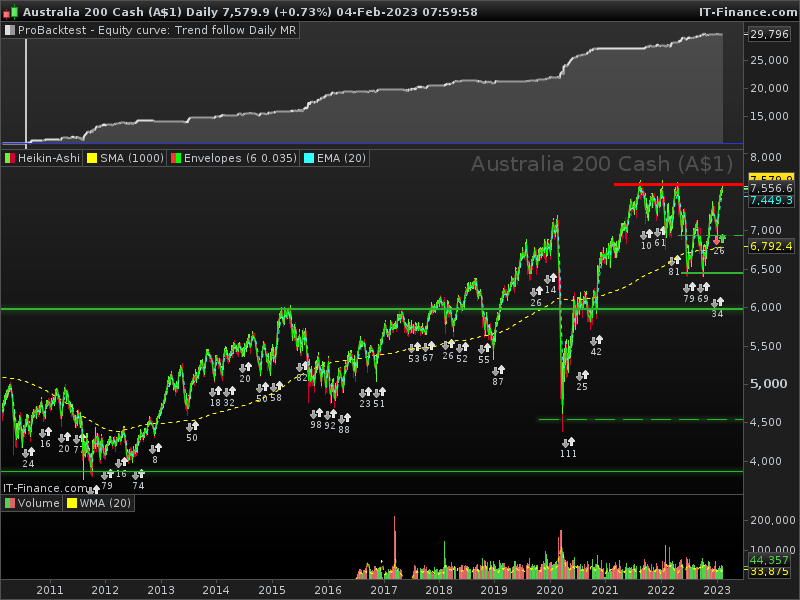
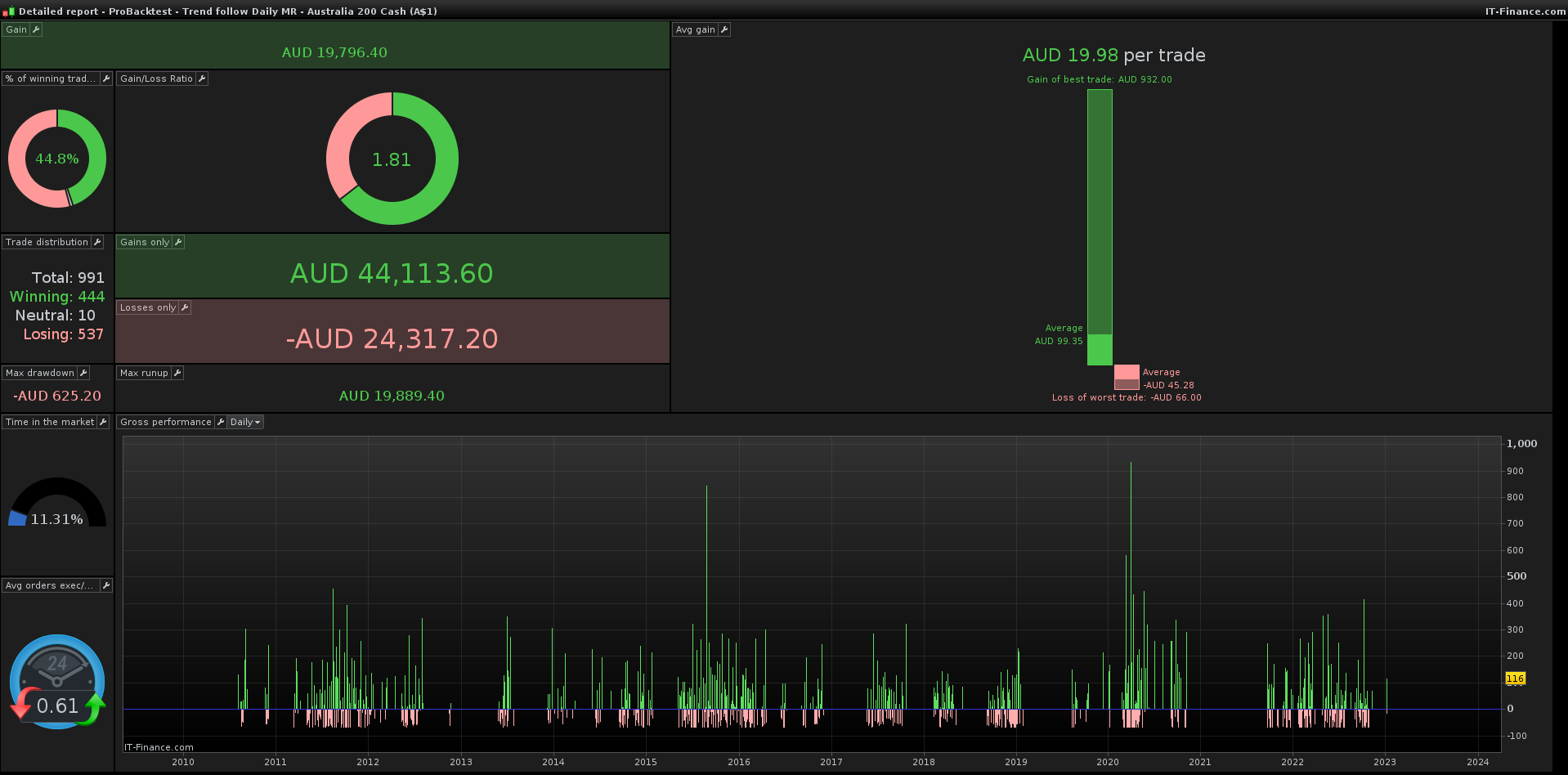
Interesting to see this old post coming alive again!
Back then I wrote about fear & greed earlier in this thread and how they drive anomalies in the market. Someone mentioned the ability to distinguish between markets driven by trend/momentum/break-out on the one hand and mean reversion on the other. In a way that is correct, although they tend to exist simultaneously in the same market.
One observation is that counterintuitively fear drives anomalies in trend/momentum in bull markets. Not fear of loss, but FOMO, Fear Of Missing Out.
Greed drives markets in bear markets. Or rather the derivative of greed, ie forced liquidations. When you run out of money you have to liquidate irrespective of market prices. Why would you run out of money? The answer is greed. That is, if we disregard the unfortunate people who never understood financial risk in the first place, but they could be considered greedy as well. Greed makes people lazy and/or complacent and they then skip the not so fun part of trading, that is using size that won’t make you instantly rich, but will keep you in the game.
Now all that sounds good but how to make money out of it?
I come back to my initial post. Find profitable patterns that repeat themselves by searching for them in market regimes. You could define a market regime a day after a day where the market close was more that 1.5 times ATR above the market open. Does the market follow through on the following day with more buying? Or do sellers step in, take profit and push prices down again? This could of course depend on other factors, such as is the market trading above its 200d MA. There are lots of ways to look at the market. Keep in mind that most market performance appears in clusters. You’ll see long periods where the market goes sideways and there is very little opportunity to make money. Then you’ll see an intensive period where most of the action takes place within a short time frame. If you are not ready to take opportunity when it presents itself, then you’ll struggle to make money. That’s one reason why it is very comfortable to leave the waiting to a computer!
One thing that has not been mentioned in this thread is money- or risk-management.
Remember that trading profit is ALWAYS determined by the combination of the win/loss rate and average $win/average $loss.
One can be very profitable with a 50% win rate as long as the average win is greater than the average loss.
Conversely, one can be very profitable with a 30% win rate if the average $ win is more than 2,33 times larger than the average loss.
Applying the same methodology, if you make money on 80 % of your trades (your win/loss rate), then you will be profitable as long as your average loss is less than 4x your average win.
We tend to disregard that trading is all about identifying situations when your expected profit is positive (without too large risk of going broke).
I find it helpful to think in terms of either 50% probability of getting it right and then identifying situations where expected R is greater than 2. Expected R is simply the profit if you hit the TP relative to the loss if you hit the SL.
The other way around I find it helpful to think in terms of my SL an TP are equidistant from entry, ie my expected win is as large as my expected loss. I then try to identify situations where probabilities are higher than 75% of having a winning trade.
I find it a lot easier to identify situations based on 50/50 win-rate and a R of 2, than the other way around, ie where R is 1 but win rate is above 75%. But they make the same amount of money given the same number of trades.
I hope I have been able to provide some help or at least some inspiration for your creativity.