ProRealCode - Trading & Coding with ProRealTime™
Hello,
Je me suis mis récemment à Prorealcode et en fouinant dans la bibliothèque, j’ai découvert cet indicateur qui date un peu mais semble donner des signaux d’achat potentiellement intéressants (merci Léo!).
https://www.prorealcode.com/prorealtime-indicators/double-top-double-bottom-detector/
NB: le screener associé fourni par Léo ne donne pas du tout les mêmes signaux… 🙁
J’essaie de transformer l’indicateur en screener et le résultat n’est pas très concluant (je m’y prends sûrement mal!).
1- Serait-il possible de détecter chaque soir les valeurs (actions, ETF…) pour lesquelles l’indicateur a dessiné une flèche ascendante pour la dernière séance de cotation ?
2- Serait-il possible de détecter chaque soir les valeurs (actions, ETF…) pour lesquelles l’indicateur a dessiné une flèche ascendante lors d’une des x dernières séances de cotation ? (x, variable en paramètre)
J’ai mis en commentaire les instructions de dessin et au lieu de dessiner une flèche “up”, j’initialise une varaible “CondBuyOk=1” que je passe au screener.
Ca marche pôôô. 🙁
Je n’ai pas le résultat attendu.
Voici ci-dessous mon essai de screener…
Merci par avance à toute personne pouvant m’aider.
Je ne demande pas forcément que l’on me donne le poisson tout cuit, je suis prêt à apprendre à le pêcher mais il me faut quelques pistes ! 😉
(un tuto du genre “Comment transformer un indicateur complexe en screener”) 🙂
Bon, si un expert a la solution en 10 minutes, je suis preneur, ça me permettra de dormir un peu plus ! :))
@+
Steve
//LOCALS MINIMUMS AND MAXIMUMS USING LEO MOVING AVERAGE
//Autor: LEO
//VARIABLES TO BE OPTIMIZED
PERIOD=20 //Period for analysis
Kdouble=0.2 //Factor for defining what is double top or bottom
//-----------
CondBuyOK=0
//Leo Moving Average, formula: LMA= WMA+(WMA-SMA)
LMA=2*weightedaverage[period](close)-average[period](close)
//Smoothed curve of Leo Moving Average
IF BARINDEX > period THEN
smoothLMA=weightedaverage[period](LMA)
ELSE
smoothLMA=undefined
ENDIF
// << Storage of minimums and maximums >>
once mintemp=low
//once posmintemp=10
once posmintemp=1
once maxtemp=high
once posmaxtemp=1
IF BARINDEX>2 THEN
// the value 0.75 is to ensure that the donchian channel is faster than the curves analysis (this value to be checked)
IF low < lowest[round(0.75*period)](low[1]) THEN
mintemp=low //minimum temporal
posmintemp=BARINDEX //postition of minimum temporal
ENDIF
IF high > highest[round(0.75*period)](high[1]) then
maxtemp=high //maximum temporal
posmaxtemp=BARINDEX //position maximum temporal
ENDIF
ENDIF
// << Detecting and locating a local minimums >>
// Where the LMA is crossing the smoothed LMA, there is a maximum or minimum nearby
// If there is a new local min/max, the preivus one is stored in de varible B... (before)
once LEVMIN=low
once POSLEVMIN=1
once LEVMAX=high
once POSLEVMAX=1
once bullcross=0
once bearcross=0
IF BARINDEX > PERIOD THEN //For avoid computer errors
bullcross=LMA crosses over smoothLMA
bearcross=LMA crosses under smoothLMA
ENDIF
IF bullcross THEN
BLEVMIN=LEVMIN //previus local minimum is saved
BPOSLEVMIN=POSLEVMIN
LEVMIN=mintemp
POSLEVMIN=posmintemp
support=LEVMIN
//DRAWARROWUP(POSLEVMIN,LEVMIN) coloured(0,0,0,30)
//DRAWARROWUP(POSLEVMIN,LEVMIN) coloured(85,255,0)
CondBuyOK=1
ENDIF
// --> Detecting and locating a local maximum
IF bearcross THEN
BLEVMAX=LEVMAX //previus local maximum is saved
BPOSLEVMAX=POSLEVMAX
LEVMAX=maxtemp
POSLEVMAX=posmaxtemp
resistance=LEVMAX
//DRAWARROWDOWN(POSLEVMAX,LEVMAX) coloured(0,0,0,30)
//DRAWARROWDOWN(POSLEVMAX,LEVMAX) coloured(255,85,0)
ENDIF
support=min(low,support)
resistance=max(high,resistance)
// << DETECTING DOUBLE TOP OR BOTTOMS >>
once WidthDoubleTop = high-low
once WidthDoubleBottom = high-low
//--> Double bottoms
//looking for the top between two local minimums
IF bullcross THEN
doublebottomtop=high[BARINDEX-POSLEVMIN+1] // we start looking for the top in between two local minimums
//POSdoublebottomtop=BARINDEX-POSLEVMIN+1
FOR i = (BARINDEX-POSLEVMIN+1) to (BARINDEX-BPOSLEVMIN-1) DO
IF high[i] > doublebottomtop THEN
doublebottomtop=high[i]
//POSdoublebottomtop=BARINDEX-i
ENDIF
NEXT
WidthDoubleBottom = doublebottomtop-(BLEVMIN+LEVMIN)/2 // (top betwen local minimums) - (average of the las two local minimums)
IF abs(BLEVMIN-LEVMIN) < Kdouble*WidthDoubleBottom THEN
// <<<<<<< HERE WE HAVE A DOUBLE BOTTOM FOR TRADING >>>>>
//DRAWTRIANGLE(POSLEVMIN,LEVMIN,POSdoublebottomtop,doublebottomtop,BPOSLEVMIN,BLEVMIN) COLOURED(0,255,0,200)
ENDIF
ENDIF
//--> Double tops
//looking for the bottom between two local maximums
IF bearcross THEN
doubletopbottom=low[BARINDEX-POSLEVMAX+1]
//POSdoubletopbottom=BARINDEX-POSLEVMAX+1
FOR i = (BARINDEX-POSLEVMAX+1) to (BARINDEX-BPOSLEVMAX-1) DO
IF low[i] < doubletopbottom THEN
doubletopbottom=low[i]
//POSdoubletopbottom=BARINDEX-i
ENDIF
NEXT
WidthDoubleTop=(BLEVMAX+LEVMAX)/2 -doubletopbottom
IF abs(BLEVMAX-LEVMAX) < Kdouble*WidthDoubleTop THEN
// <<<<<<< HERE WE HAVE A DOUBLE TOP FOR TRADING >>>>>
//DRAWTRIANGLE(POSdoubletopbottom,doubletopbottom,POSLEVMAX,LEVMAX,BPOSLEVMAX,BLEVMAX) COLOURED(255,0,0,200)
ENDIF
ENDIF
SCREENER [CondBuyOk]
//RETURN LMA AS "Leo Moving Average", support as "support", resistance as "resistance", smoothLMA as "smooth LMA" //, lowest[round(0.75*period)](low[1]), highest[round(0.75*period)](high[1])

Salut, le meilleur moyen de débugguer un screener (même s’il vient d’un indicateur) c’est de visualiser les conditions dans… un indicateur.
Quand il screen tu ne vois pas ce qu’il fait, tu vois juste une liste, et en plus s’y superpose le risque de l’erreur humaine dans l’interprétation de la justesse de la liste. Alors qu’en visualisant les conditions, tu empêches le doute au contraire tu crées des indices, qui l’un après l’autre permettent de tirer sur le fil des indices jusqu’à que ça marche.
Donc d’abord: visualiser en indicateur condbuyok= 0 ou 1, puis (ou en même temps) visualiser en return ce qui joue dans condbuyok càd apparemment bullcross (qui permet d’entrer dans le if ou pas qui met condbuyok à vrai), s’il y a des anomalies avec bullcross, visualiser ce qui fait bouger bullcross (apparemment lma et smoothlma) etc…
C’est le genre d’approche “apprendre à pêcher” que tu as demandé, et qui permet de débugguer, comme mise en place dans ce topic qui a permis à l’auteur de résoudre un bug après l’autre: https://www.prorealcode.com/topic/screener-indicateurs-multiples/
Hello Noobywan,
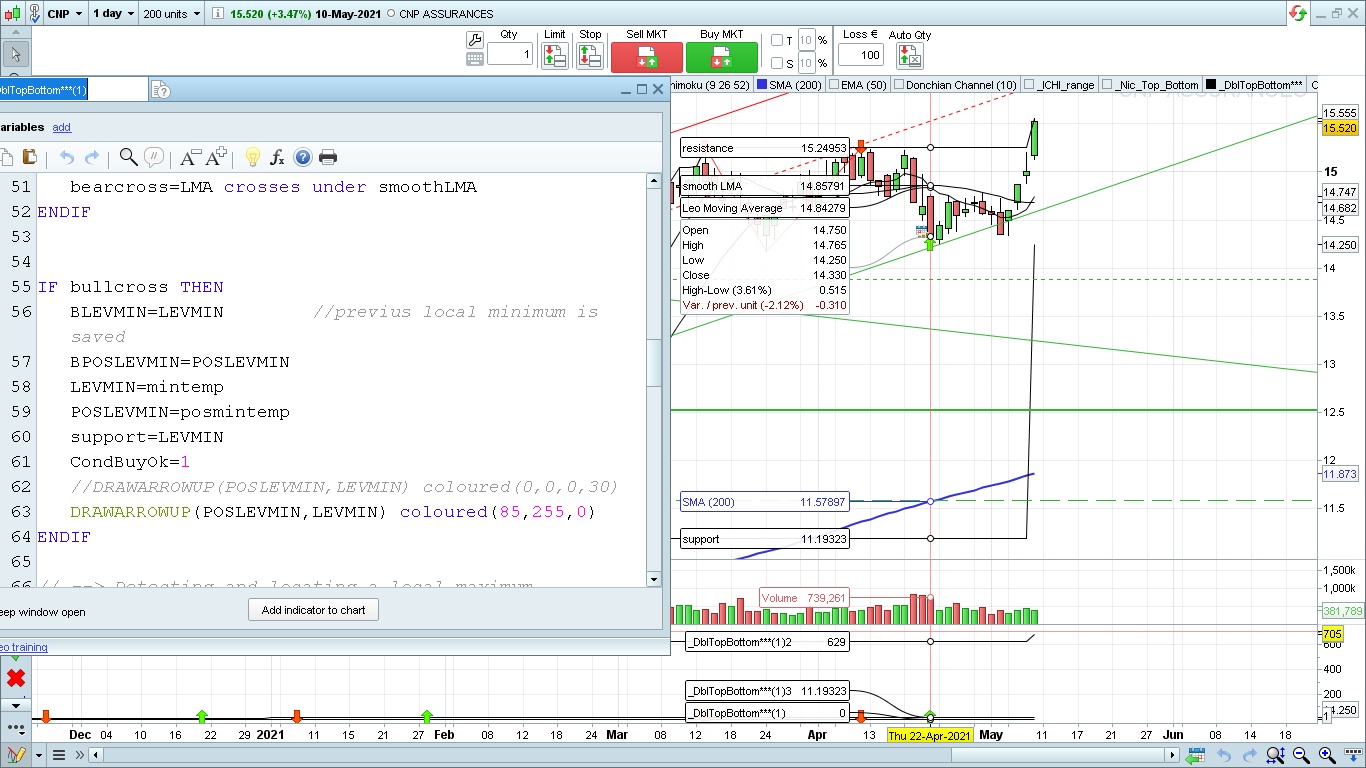
J’ai suivi tes bons conseils et le résultat obtenu me laisse perplexe (cf. PJ 01).
Actions effectuées:
– duplication de l’indicateur d’origine (auteur Léo)
– en début de script ajout de “CondBuyOk=0”
– ajout de “CondBuyOk=1” juste avant de dessiner le flèche verte montante
IF bullcross THEN
...
CondBuyOk=1
DRAWARROWUP(POSLEVMIN,LEVMIN) coloured(85,255,0)
ENDIF
– renvoie des 3 variables à étudier
RETURN CondBuyOk,POSLEVMIN,LEVMIN
Comme tu le vois sur la copie d’écran 01, une flèche verte est dessinée alors que “CondBuyOk=0”!?!
Je pige pas…
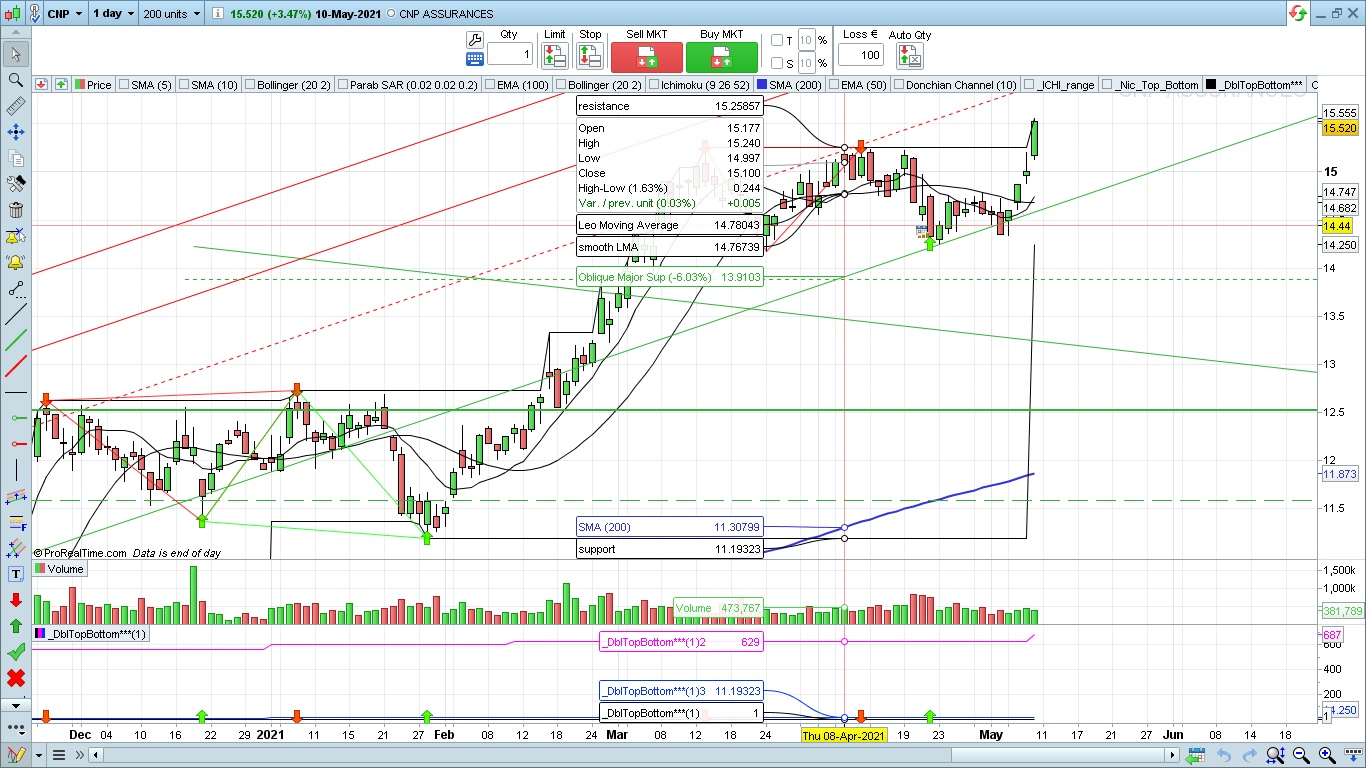
Par contre, on voit bien (PJ 02) que “CondBuyOk=1” quand les 2 moyennes de l’indicateur se croisent, conformément à la condition:
bullcross=LMA crosses over smoothLMA
La logique de fonctionnement du bouzin m’échappe …
Pourrais-tu (ou tout expert de ProRealCode) m’éclairer STP sur le sujet ?
Merci.
@+
Steve
Le script complet modifié:
//LOCALS MINIMUMS AND MAXIMUMS USING LEO MOVING AVERAGE
//Autor: LEO
//VARIABLES TO BE OPTIMIZED
PERIOD=20 //Period for analysis
Kdouble=0.2 //Factor for defining what is double top or bottom
//-----------
CondBuyOk=0
//Leo Moving Average, formula: LMA= WMA+(WMA-SMA)
LMA=2*weightedaverage[period](close)-average[period](close)
//Smoothed curve of Leo Moving Average
IF BARINDEX > period THEN
smoothLMA=weightedaverage[period](LMA)
ELSE
smoothLMA=undefined
ENDIF
// << Storage of minimums and maximums >>
once mintemp=low
once posmintemp=10
once maxtemp=high
once posmaxtemp=1
IF BARINDEX>2 THEN
// the value 0.75 is to ensure that the donchian channel is faster than the curves analysis (this value to be checked)
IF low < lowest[round(0.75*period)](low[1]) THEN
mintemp=low //minimum temporal
posmintemp=BARINDEX //postition of minimum temporal
ENDIF
IF high > highest[round(0.75*period)](high[1]) then
maxtemp=high //maximum temporal
posmaxtemp=BARINDEX //position maximum temporal
ENDIF
ENDIF
// << Detecting and locating a local minimums >>
// Where the LMA is crossing the smoothed LMA, there is a maximum or minimum nearby
// If there is a new local min/max, the preivus one is stored in de varible B... (before)
once LEVMIN=low
once POSLEVMIN=1
once LEVMAX=high
once POSLEVMAX=1
once bullcross=0
once bearcross=0
IF BARINDEX > PERIOD THEN //For avoid computer errors
bullcross=LMA crosses over smoothLMA
bearcross=LMA crosses under smoothLMA
ENDIF
IF bullcross THEN
BLEVMIN=LEVMIN //previus local minimum is saved
BPOSLEVMIN=POSLEVMIN
LEVMIN=mintemp
POSLEVMIN=posmintemp
support=LEVMIN
CondBuyOk=1
//DRAWARROWUP(POSLEVMIN,LEVMIN) coloured(0,0,0,30)
DRAWARROWUP(POSLEVMIN,LEVMIN) coloured(85,255,0)
ENDIF
// --> Detecting and locating a local maximum
IF bearcross THEN
BLEVMAX=LEVMAX //previus local maximum is saved
BPOSLEVMAX=POSLEVMAX
LEVMAX=maxtemp
POSLEVMAX=posmaxtemp
resistance=LEVMAX
//DRAWARROWDOWN(POSLEVMAX,LEVMAX) coloured(0,0,0,30)
DRAWARROWDOWN(POSLEVMAX,LEVMAX) coloured(255,85,0)
ENDIF
support=min(low,support)
resistance=max(high,resistance)
// << DETECTING DOUBLE TOP OR BOTTOMS >>
once WidthDoubleTop = high-low
once WidthDoubleBottom = high-low
//--> Double bottoms
//looking for the top between two local minimums
IF bullcross THEN
doublebottomtop=high[BARINDEX-POSLEVMIN+1] // we start looking for the top in between two local minimums
POSdoublebottomtop=BARINDEX-POSLEVMIN+1
FOR i = (BARINDEX-POSLEVMIN+1) to (BARINDEX-BPOSLEVMIN-1) DO
IF high[i] > doublebottomtop THEN
doublebottomtop=high[i]
POSdoublebottomtop=BARINDEX-i
ENDIF
NEXT
WidthDoubleBottom = doublebottomtop-(BLEVMIN+LEVMIN)/2 // (top betwen local minimums) - (average of the las two local minimums)
IF abs(BLEVMIN-LEVMIN) < Kdouble*WidthDoubleBottom THEN
// <<<<<<< HERE WE HAVE A DOUBLE BOTTOM FOR TRADING >>>>>
DRAWTRIANGLE(POSLEVMIN,LEVMIN,POSdoublebottomtop,doublebottomtop,BPOSLEVMIN,BLEVMIN) COLOURED(0,255,0,200)
ENDIF
ENDIF
//--> Double tops
//looking for the bottom between two local maximums
IF bearcross THEN
doubletopbottom=low[BARINDEX-POSLEVMAX+1]
POSdoubletopbottom=BARINDEX-POSLEVMAX+1
FOR i = (BARINDEX-POSLEVMAX+1) to (BARINDEX-BPOSLEVMAX-1) DO
IF low[i] < doubletopbottom THEN
doubletopbottom=low[i]
POSdoubletopbottom=BARINDEX-i
ENDIF
NEXT
WidthDoubleTop=(BLEVMAX+LEVMAX)/2 -doubletopbottom
IF abs(BLEVMAX-LEVMAX) < Kdouble*WidthDoubleTop THEN
// <<<<<<< HERE WE HAVE A DOUBLE TOP FOR TRADING >>>>>
DRAWTRIANGLE(POSdoubletopbottom,doubletopbottom,POSLEVMAX,LEVMAX,BPOSLEVMAX,BLEVMAX) COLOURED(255,0,0,200)
ENDIF
ENDIF
RETURN CondBuyOk,POSLEVMIN,LEVMIN
//RETURN LMA AS "Leo Moving Average", support as "support", resistance as "resistance", smoothLMA as "smooth LMA" //, lowest[round(0.75*period)](low[1]), highest[round(0.75*period)](high[1])

Salut, ma première réaction pré-café, c’est que comme ton drawarrowup n’est pas forcément avec une abscisse sur barindex courant (il est mis sur poslevmin, lui même venant de posmintemps, lui-même défini en ligne 31 dans un autre bloc if-endif), alors ça me dit que la flèche verte n’est pas forcément dessinée sur la même barre que celle où buycondok=1, donc la PJ 1 ne suffit pas à conclure à une incohérence sauf ^à être sûr que c’est la lecture du code à cette barre là qui a mis la flèche là, mais comme il y a un autre bullcross que la PJ2 (celui de la dernière barre), il faudrait voir si ce n’est pas un buycondok=1 de la dernière barre qui déclenche la flèche verte en arrière dans l’historique en PJ1.
Hello,
Oui, effectivement, mon 1er essai était trop simpliste… 🙁
Je me suis plongé dans le code cet après-midi pour comprendre cet indicateur et ça vallait le coup.
Voici ma dernière version d’adaptation de l’indicateur de Léo en screener.
Le résultat est plutôt satisfaisant. 🙂
En tête de script, j’ai ajouté la variable LgHisto qui définit la pronfondeur de recherche d’apparition d’une flèche “up” ou “down”.
J’ai testé sur des actions France, Euro, US, crypto en daily, ça semble bien marcher, c’est même un peu trop beau ! 😉
Ca ne ramène rien en “daily” sur les cryptos mais ça doit être normal (?).
Je n’ai pas pu tester avec des UT inférieures au jour (version de démo).
Voilà, je laisse les experts du forum jouer avec ce screener et me dire ce qu’ils en pensent (pertinence des “signaux”, failles, améliorations possibles…).
Par avance, merci.
@+
Steve
NB: le bouton “insertion code PRT” n’est plus dispo en mode “Visual”, il faut passer par “Text” ?!?
//LOCALS MINIMUMS AND MAXIMUMS USING LEO MOVING AVERAGE
//Autor of indicator: LEO
//Screener adaptation : Steve_
//VARIABLES TO BE OPTIMIZED
PERIOD=20 //Period for analysis
Kdouble=0.2 //Factor for defining what is double top or bottom
// Arrow up/down must appear during last LgHisto UT
LgHisto=5
//-----------
CondBuyOK=0
//Leo Moving Average, formula: LMA= WMA+(WMA-SMA)
LMA=2*weightedaverage[period](close)-average[period](close)
//Smoothed curve of Leo Moving Average
IF BARINDEX > period THEN
smoothLMA=weightedaverage[period](LMA)
ELSE
smoothLMA=undefined
ENDIF
// << Storage of minimums and maximums >>
once mintemp=low
//once posmintemp=10
once posmintemp=1
once maxtemp=high
once posmaxtemp=1
IF BARINDEX>2 THEN
// the value 0.75 is to ensure that the donchian channel is faster than the curves analysis (this value to be checked)
IF low < lowest[round(0.75*period)](low[1]) THEN
mintemp=low //minimum temporal
posmintemp=BARINDEX //postition of minimum temporal
ENDIF
IF high > highest[round(0.75*period)](high[1]) then
maxtemp=high //maximum temporal
posmaxtemp=BARINDEX //position maximum temporal
ENDIF
ENDIF
// << Detecting and locating a local minimums >>
// Where the LMA is crossing the smoothed LMA, there is a maximum or minimum nearby
// If there is a new local min/max, the preivus one is stored in de varible B... (before)
once LEVMIN=low
once POSLEVMIN=1
once LEVMAX=high
once POSLEVMAX=1
once bullcross=0
once bearcross=0
IF BARINDEX > PERIOD THEN //For avoid computer errors
bullcross=LMA crosses over smoothLMA
bearcross=LMA crosses under smoothLMA
ENDIF
IF bullcross THEN
BLEVMIN=LEVMIN //previus local minimum is saved
BPOSLEVMIN=POSLEVMIN
LEVMIN=mintemp
POSLEVMIN=posmintemp
support=LEVMIN
//DRAWARROWUP(POSLEVMIN,LEVMIN) coloured(0,0,0,30)
//DRAWARROWUP(POSLEVMIN,LEVMIN) coloured(85,255,0)
//CondBuyOK=1
ENDIF
// --> Detecting and locating a local maximum
IF bearcross THEN
BLEVMAX=LEVMAX //previus local maximum is saved
BPOSLEVMAX=POSLEVMAX
LEVMAX=maxtemp
POSLEVMAX=posmaxtemp
resistance=LEVMAX
//DRAWARROWDOWN(POSLEVMAX,LEVMAX) coloured(0,0,0,30)
//DRAWARROWDOWN(POSLEVMAX,LEVMAX) coloured(255,85,0)
ENDIF
support=min(low,support)
resistance=max(high,resistance)
// << DETECTING DOUBLE TOP OR BOTTOMS >>
once WidthDoubleTop = high-low
once WidthDoubleBottom = high-low
//--> Double bottoms
//looking for the top between two local minimums
IF bullcross THEN
doublebottomtop=high[BARINDEX-POSLEVMIN+1] // we start looking for the top in between two local minimums
//POSdoublebottomtop=BARINDEX-POSLEVMIN+1
FOR i = (BARINDEX-POSLEVMIN+1) to (BARINDEX-BPOSLEVMIN-1) DO
IF high[i] > doublebottomtop THEN
doublebottomtop=high[i]
//POSdoublebottomtop=BARINDEX-i
ENDIF
NEXT
WidthDoubleBottom = doublebottomtop-(BLEVMIN+LEVMIN)/2 // (top betwen local minimums) - (average of the las two local minimums)
IF abs(BLEVMIN-LEVMIN) < Kdouble*WidthDoubleBottom THEN
// <<<<<<< HERE WE HAVE A DOUBLE BOTTOM FOR TRADING >>>>>
//DRAWTRIANGLE(POSLEVMIN,LEVMIN,POSdoublebottomtop,doublebottomtop,BPOSLEVMIN,BLEVMIN) COLOURED(0,255,0,200)
ENDIF
ENDIF
//--> Double tops
//looking for the bottom between two local maximums
IF bearcross THEN
doubletopbottom=low[BARINDEX-POSLEVMAX+1]
//POSdoubletopbottom=BARINDEX-POSLEVMAX+1
FOR i = (BARINDEX-POSLEVMAX+1) to (BARINDEX-BPOSLEVMAX-1) DO
IF low[i] < doubletopbottom THEN
doubletopbottom=low[i]
//POSdoubletopbottom=BARINDEX-i
ENDIF
NEXT
WidthDoubleTop=(BLEVMAX+LEVMAX)/2 -doubletopbottom
IF abs(BLEVMAX-LEVMAX) < Kdouble*WidthDoubleTop THEN
// <<<<<<< HERE WE HAVE A DOUBLE TOP FOR TRADING >>>>>
//DRAWTRIANGLE(POSdoubletopbottom,doubletopbottom,POSLEVMAX,LEVMAX,BPOSLEVMAX,BLEVMAX) COLOURED(255,0,0,200)
ENDIF
ENDIF
// Arrow up position
PosFlUp=BARINDEX-POSLEVMIN
// Arrow down position
PosFlDwn=BARINDEX-POSLEVMAX
// We screen arrows appeared during the last LgHisto UT
CondBuyOk=(PosFlUp < LgHisto)
CondSellOk=(PosFlDwn < LgHisto)
// To check results only
PosFl=posflup * 1000 + PosFlDwn
SCREENER[CondBuyOk OR CondSellOk]( PosFl as "Pos.Up , Down")
//RETURN LMA AS "Leo Moving Average", support as "support", resistance as "resistance", smoothLMA as "smooth LMA" //, lowest[round(0.75*period)](low[1]), highest[round(0.75*period)](high[1])

Hello,
Voici une dernière version plus “présentable”, nettoyée de toutes les portions de code de l’indicateur (dessins flèches, triangles…), inutiles au screener.
Ca semble OK, je n’ai rien supprimé de trop, j’ai les mêmes résultats que la version précédente. 🙂
Bref, je laisse les experts du forum jouer avec ce screener et me dire ce qu’ils en pensent (pertinence des “signaux”, failles, améliorations possibles…).
Par avance, merci.
@+
Steve
//LOCALS MINIMUMS AND MAXIMUMS USING LEO MOVING AVERAGE
//Autor of indicator: LEO
//Screener adaptation : Steve_
//VARIABLES TO BE OPTIMIZED
Period=20 //Period for analysis
// We screen arrows up/down appearing during last LgHisto timeframes
LgHisto=5
//-----------
// Buy/sell conditions
CondBuyOK=0
CondSellOk=0
//Leo Moving Average, formula: LMA= WMA+(WMA-SMA)
LMA = 2 * weightedaverage[period](close) - average[period](close)
//Smoothed curve of Leo Moving Average
// BARINDEX : index de la barre courante (0 à n), n=200 par défaut ?
IF BARINDEX > period THEN
smoothLMA = weightedaverage[period](LMA)
ELSE
smoothLMA = undefined
ENDIF
// << Storage of minimums and maximums >>
once posmintemp=10
once posmaxtemp=1
IF BARINDEX > 2 THEN
// the value 0.75 is to ensure that the donchian channel is faster than the curves analysis (this value to be checked)
IF low < lowest[round(0.75*period)](low[1]) THEN
posmintemp=BARINDEX //postition of minimum temporal
ENDIF
IF high > highest[round(0.75*period)](high[1]) then
posmaxtemp=BARINDEX //position maximum temporal
ENDIF
ENDIF
// << Detecting and locating a local minimums >>
// Where the LMA is crossing the smoothed LMA, there is a maximum or minimum nearby
// If there is a new local min/max, the previous one is stored in de varible B... (before)
once POSLEVMIN=1
once POSLEVMAX=1
once bullcross=0
once bearcross=0
IF BARINDEX > period THEN // To avoid computer errors
bullcross = LMA crosses over smoothLMA
bearcross = LMA crosses under smoothLMA
ENDIF
// --> Locating a local minimum
IF bullcross THEN
POSLEVMIN = posmintemp
ENDIF
// --> Locating a local maximum
IF bearcross THEN
POSLEVMAX = posmaxtemp
ENDIF
// Arrow up position
PosFlUp = BARINDEX - POSLEVMIN
// Arrow down position
PosFlDwn = BARINDEX - POSLEVMAX
// We screen arrows appeared during the last LgHisto timeframes
CondBuyOk = (PosFlUp < LgHisto)
CondSellOk = (PosFlDwn < LgHisto)
// To check results only
PosFl = posflup * 1000 + PosFlDwn
SCREENER[CondBuyOk OR CondSellOk]( PosFl as "Pos.Up , Down")
Transformer un iindicateur complexe en screener
This topic contains 5 replies,
has 2 voices, and was last updated by steve_
4 years, 10 months ago.
| Forum: | ProScreener : Scanners de Marché & Détection |
| Language: | French |
| Started: | 05/09/2021 |
| Status: | Active |
| Attachments: | 2 files |
The information collected on this form is stored in a computer file by ProRealCode to create and access your ProRealCode profile. This data is kept in a secure database for the duration of the member's membership. They will be kept as long as you use our services and will be automatically deleted after 3 years of inactivity. Your personal data is used to create your private profile on ProRealCode. This data is maintained by SAS ProRealCode, 407 rue Freycinet, 59151 Arleux, France. If you subscribe to our newsletters, your email address is provided to our service provider "MailChimp" located in the United States, with whom we have signed a confidentiality agreement. This company is also compliant with the EU/Swiss Privacy Shield, and the GDPR. For any request for correction or deletion concerning your data, you can directly contact the ProRealCode team by email at privacy@prorealcode.com If you would like to lodge a complaint regarding the use of your personal data, you can contact your data protection supervisory authority.