buongiorno a tutti
se possibile avere un sistema automatico che apra e chiuda posizioni dopo 3 candele consecutive dello stesso colore, cioè:
long dopo 3 candele rosse consecutive con minimi crescenti e stop loss, da definire, sotto il minimo dell’ultima candela
short dopo 3 candele verdi consecutive con massimi crescenti e stop loss, da definire, sopra il massimo dell’ultima candela.
il TF lo si sceglie come si vuole.
Grazie per la vostra gentile collaborazione
Quelle rosse con MINIMI CRESCENTI o decrescenti?
Per la chiusura attende che si verifichino le condizioni opposte, se entra dopo 3 candele ROSSE esce quando ve ne saranno 3 VERDI e viceversa?
no, per la chiusura del trade pensavo a un trailing stop che ho trovato in bibblioteca
da ottimizzare assieme allo stop loss
Grazie
set stop ploss X
//trailing stop
trailingstop = Y
//resetting variables when no trades are on market
if not onmarket then
MAXPRICE = 0
MINPRICE = close
priceexit = 0
endif
//case SHORT order
if shortonmarket then
MINPRICE = MIN(MINPRICE,close) //saving the MFE of the current trade
if tradeprice(1)-MINPRICE>=trailingstop*pointsize then //if the MFE is higher than the trailingstop then
priceexit = MINPRICE+trailingstop*pointsize //set the exit price at the MFE + trailing stop price level
endif
endif
//case LONG order
if longonmarket then
MAXPRICE = MAX(MAXPRICE,close) //saving the MFE of the current trade
if MAXPRICE-tradeprice(1)>=trailingstop*pointsize then //if the MFE is higher than the trailingstop then
priceexit = MAXPRICE-trailingstop*pointsize //set the exit price at the MFE - trailing stop price level
endif
endif
//exit on trailing stop price levels
if onmarket and priceexit>0 then
EXITSHORT AT priceexit STOP
SELL AT priceexit STOP
endif
Eccola:
ONCE CandleNum = 3
Bullish        = summation[CandleNum](close > open) = CandleNum
Bearish        = summation[CandleNum](close < open) = CandleNum
HigherHIGHs    = (summation[CandleNum - 1](high > high[1]) = (CandleNum - 1))
LowerLOWs      = (summation[CandleNum - 1](low < low[1])   = (CandleNum - 1))
IF Bearish AND LowerLOWs AND Not OnMarket THEN
   BUY 1 CONTRACT AT MARKET
   Sl = max(10,(close - low) / pipsize)
   Tp = Sl * 3
ENDIF
IF Bullish AND HigherHIGHs AND Not OnMarket THEN
   SELLSHORT 1 CONTRACT AT MARKET
   Sl = max(10,(high - close) / pipsize)
   Tp = Sl * 1.5
ENDIF
SET STOP   pLOSS   Sl
SET TARGET pPROFIT Tp
Alle righe 8 e 13 ho messo la funzione MAX con un numero di pips minimi (tu metti la cifra che vuoi), perché può capitare che CLOSE possa essere uguale a LOW o HIGH, nel qual caso lo SL sarebbe = 0, come pure il TP, quindi entrerebbe a mercato SENZA più uscire, oppure uscendo in MARGIN CALL.
In fondo bast che aggiungi il codice del trailing stop ed è fatta. Il TP puoi anche toglierlo, se vuoi.
salve Roberto
cortesemente puoi provarlo anche tu perchè mi sembra che qualcovsa non vada.
Ho testato il sistema non a TF temporali, ma a quantita’ di TICKS, con candele da 50, 100, 200, ecc.
e la posizione resta aperta per diverse candele successive sino a quando non scatta lo stop loss.
Grazie
ONCE CandleNum = 3
Bullish        = summation[CandleNum](close > open) = CandleNum
Bearish        = summation[CandleNum](close < open) = CandleNum
HigherHIGHs    = (summation[CandleNum - 1](high > high[1]) = (CandleNum - 1))
LowerLOWs      = (summation[CandleNum - 1](low < low[1])   = (CandleNum - 1))
IF Bearish AND LowerLOWs AND Not OnMarket THEN
BUY 1 CONTRACT AT MARKET
Sl = max(X,(close - low) / pipsize)

ENDIF
IF Bullish AND HigherHIGHs AND Not OnMarket THEN
SELLSHORT 1 CONTRACT AT MARKET
Sl = max(X,(high - close) / pipsize)

ENDIF
SET STOP   pLOSS   Sl

//trailing stop
trailingstop = Y
//resetting variables when no trades are on market
if not onmarket then
MAXPRICE = 0
MINPRICE = close
priceexit = 0
endif
//case SHORT order
if shortonmarket then
MINPRICE = MIN(MINPRICE,close) //saving the MFE of the current trade
if tradeprice(1)-MINPRICE>=trailingstop*pointsize then //if the MFE is higher than the trailingstop then
priceexit = MINPRICE+trailingstop*pointsize //set the exit price at the MFE + trailing stop price level
endif
endif
//case LONG order
if longonmarket then
MAXPRICE = MAX(MAXPRICE,close) //saving the MFE of the current trade
if MAXPRICE-tradeprice(1)>=trailingstop*pointsize then //if the MFE is higher than the trailingstop then
priceexit = MAXPRICE-trailingstop*pointsize //set the exit price at the MFE - trailing stop price level
endif
endif
//exit on trailing stop price levels
if onmarket and priceexit>0 then
EXITSHORT AT priceexit STOP
SELL AT priceexit STOP
endif
Certo, non hai messo nessun Target Profit!
ONCE CandleNum = C
Bullish        = summation[CandleNum](close > open) = CandleNum
Bearish        = summation[CandleNum](close < open) = CandleNum
HigherHIGHs    = (summation[CandleNum - 1](high > high[1]) = (CandleNum - 1))
LowerLOWs      = (summation[CandleNum - 1](low < low[1])   = (CandleNum - 1))
IF Bearish AND LowerLOWs AND Not OnMarket THEN
BUY 1 CONTRACT AT MARKET
Sl = max(S,(close - low) / pipsize)
Tp = Sl * M
ENDIF
IF Bullish AND HigherHIGHs AND Not OnMarket THEN
SELLSHORT 1 CONTRACT AT MARKET
Sl = max(S,(high - close) / pipsize)
Tp = Sl * M
ENDIF
SET STOP   pLOSS   Sl
SET TARGET pPROFIT Tp
//trailing stop
trailingstop = T
//resetting variables when no trades are on market
if not onmarket then
MAXPRICE = 0
MINPRICE = close
priceexit = 0
endif
//case SHORT order
if shortonmarket then
MINPRICE = MIN(MINPRICE,close) //saving the MFE of the current trade
if tradeprice(1)-MINPRICE>=trailingstop*pointsize then //if the MFE is higher than the trailingstop then
priceexit = MINPRICE+trailingstop*pointsize //set the exit price at the MFE + trailing stop price level
endif
endif
//case LONG order
if longonmarket then
MAXPRICE = MAX(MAXPRICE,close) //saving the MFE of the current trade
if MAXPRICE-tradeprice(1)>=trailingstop*pointsize then //if the MFE is higher than the trailingstop then
priceexit = MAXPRICE-trailingstop*pointsize //set the exit price at the MFE - trailing stop price level
endif
endif
//exit on trailing stop price levels
if onmarket and priceexit>0 then
EXITSHORT AT priceexit STOP
SELL AT priceexit STOP
endif
ciao Roberto
il TS finale, secondo me
da ottimizzare le variabili
C da 1 a 5 passo 1
S da 5 a 200 passo 5
M da 1 a 5 passo 1
T da 1 a 10 passo 1, oppure da 5 a 50 passo 5, oppure da 10 a 100 passo 10, ecc.
Mi dai un tuo parere?
Grazie
Devi dirmi indicarmi te i valori per te ottimali, purtroppo non ho il tempo per fare prove di ottimizzazione.
buongiorno, ciao Roberto
una domanda da neofita:
dopo l’ottimizzazione si attiva subito il TS?
oppure si deve aspettare la chiusura della posizione ancora aperta nella simulazione?
mi spiego meglio:
ottimizzate le variabili del TS inserisco i valori e se non ci sono posizioni aperte attivo il TS, ma se c’è una posizione aperta devo attendere che si chiuda?
Secondo me, se attivo con posizione aperta, viene compromesso il risultato finale, perchè non conforme con lo storico parziale esaminato, da inizio a fine periodo preso in esame.
Forse bisogna inserire una riga o piu’ di codice, affinche’ il TS si attivi in automatico dopo la chiusura del trade precedente?
Grazie
Se per attivare intendi esguire la strategia non in backtest, ma realmente (su conto demo o reale) puoi eseguirla quando vuoi, basta che la esegui con ProOrder in autotrading. Le due cose possono coesistere, anzi, puoi tenere anche più strategie aperte contemporaneamente in backtest.
Ad ogni modo interrompare il backtest non falsa niente, quando vuoi lo fai ripartire ed ottieni gli stessi risultati (salvo nel frattempo siano scomparse entrate vecchie ed apparse quelle nuove). Ogni backtest può sempre essere falsato, perché tra dieci giorni, come ho detto, alcune delle prime operazioni possono essere scomparse ed altre nuove apparse.
Lo scopo del backtest è darti l’idea della bontà, o meno, della strategia, non sostituire esattamente quello che accade nella realtà.
ONCE CandleNum = 4
Bullish        = summation[CandleNum](close > open) = CandleNum
Bearish        = summation[CandleNum](close < open) = CandleNum
HigherHIGHs    = (summation[CandleNum - 1](high > high[1]) = (CandleNum - 1))
LowerLOWs      = (summation[CandleNum - 1](low < low[1])   = (CandleNum - 1))
IF Bearish AND LowerLOWs AND Not OnMarket THEN
BUY 1 CONTRACT AT MARKET
Sl = max(20,(close - low) / pipsize)
Tp = Sl * 3
ENDIF
IF Bullish AND HigherHIGHs AND Not OnMarket THEN
SELLSHORT 1 CONTRACT AT MARKET
Sl = max(20,(high - close) / pipsize)
Tp = Sl * 3
ENDIF
SET STOP   pLOSS   Sl
SET TARGET pPROFIT Tp
//trailing stop
trailingstop = 10
//resetting variables when no trades are on market
if not onmarket then
MAXPRICE = 0
MINPRICE = close
priceexit = 0
endif
//case SHORT order
if shortonmarket then
MINPRICE = MIN(MINPRICE,close) //saving the MFE of the current trade
if tradeprice(1)-MINPRICE>=trailingstop*pointsize then //if the MFE is higher than the trailingstop then
priceexit = MINPRICE+trailingstop*pointsize //set the exit price at the MFE + trailing stop price level
endif
endif
//case LONG order
if longonmarket then
MAXPRICE = MAX(MAXPRICE,close) //saving the MFE of the current trade
if MAXPRICE-tradeprice(1)>=trailingstop*pointsize then //if the MFE is higher than the trailingstop then
priceexit = MAXPRICE-trailingstop*pointsize //set the exit price at the MFE - trailing stop price level
endif
endif
//exit on trailing stop price levels
if onmarket and priceexit>0 then
EXITSHORT AT priceexit STOP
SELL AT priceexit STOP
endif
Innanziutto grazie peril codice.Ho provato a inserire le variabili usando un timeframe a 1 minuto ma analizzando il grafico ho notato e non ho capito alcune cose
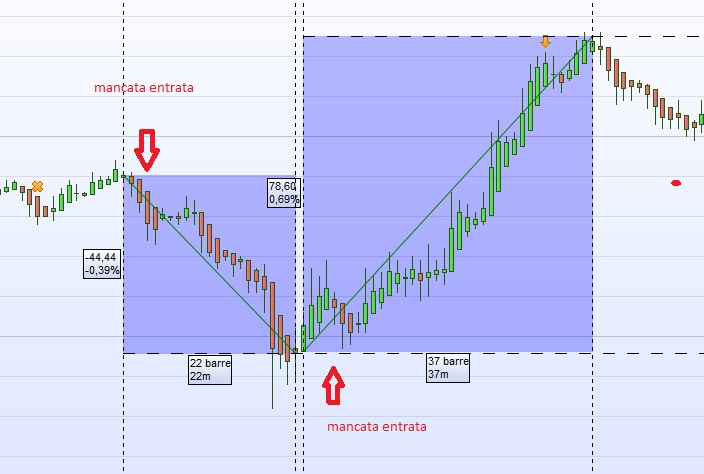
Nello screen 1 c’è una mancata entrata short con discesa di 45 pips e una mancata entrata long di circa 80 pips e addirittura una entrata short durante la fase rialzista.
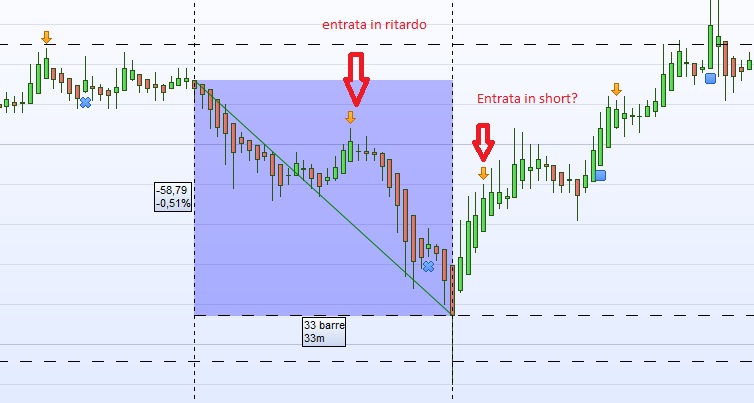
Nello screen 2 un’entrata short in ritardo e un’entrata short nella fase rialzista.
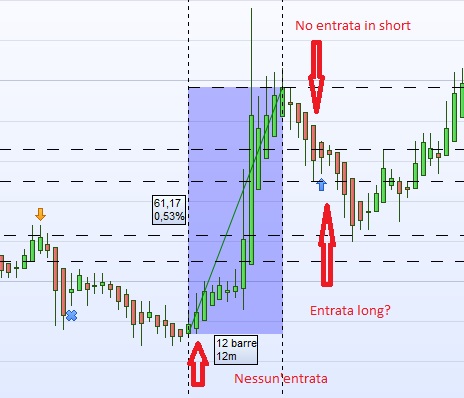
Nello screen 3 una mancata entrata long mancata entrata short e un’entrata long nella fase ribassista.
Qualcuno mi può gentilmente aiutare a correggere questo codice ? mi interessa molto
Grazie
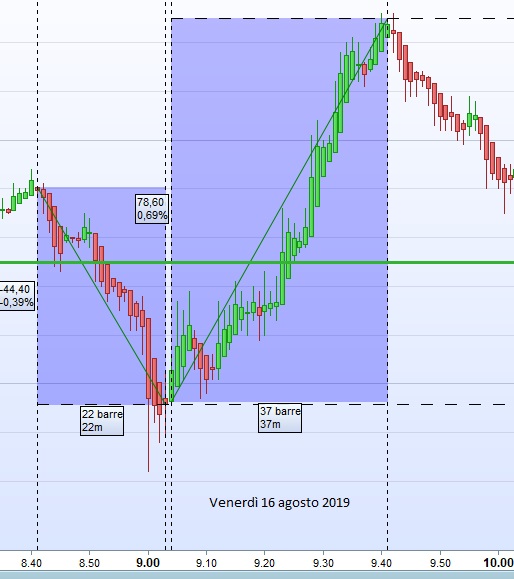
Per verificare le operazioni serve la data e l’ora della candela d’entrata.
Questo è il rimo screenshoot con gli orari