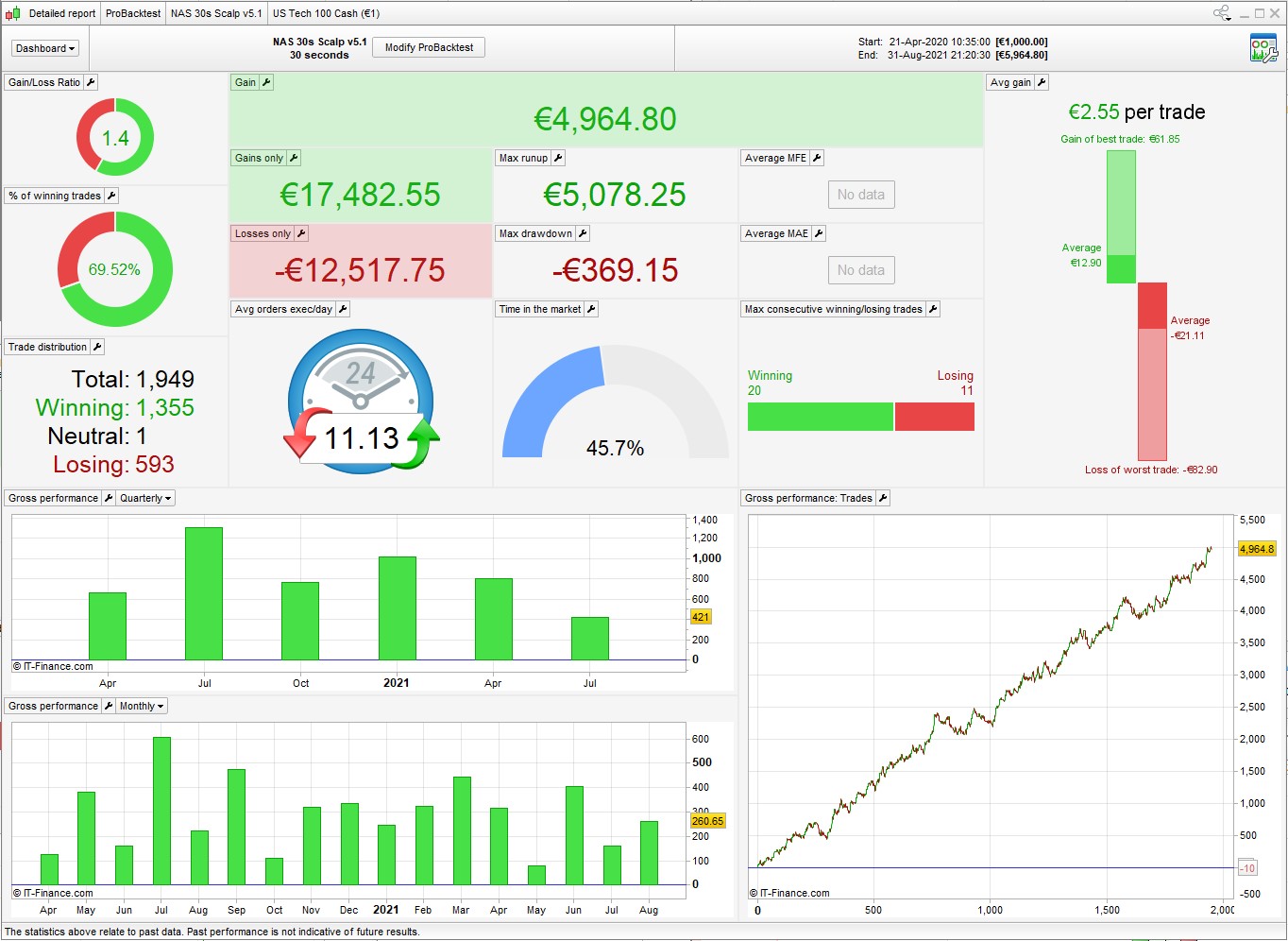
Here’s a new algo I’ve had on forward testing for a while (US Tech 100), so far consistent with the BT results. It’s all on moving averages and more or less approximates what I do in manual trading, except where I normally work on a 1min chart, this drops down to 30sec to make up for the 1 candle delay at the entry.
FOR:
Very nice histogram, as good as it gets.
High number of trades in the BT (4 0r 5 per day)
Low drawdown
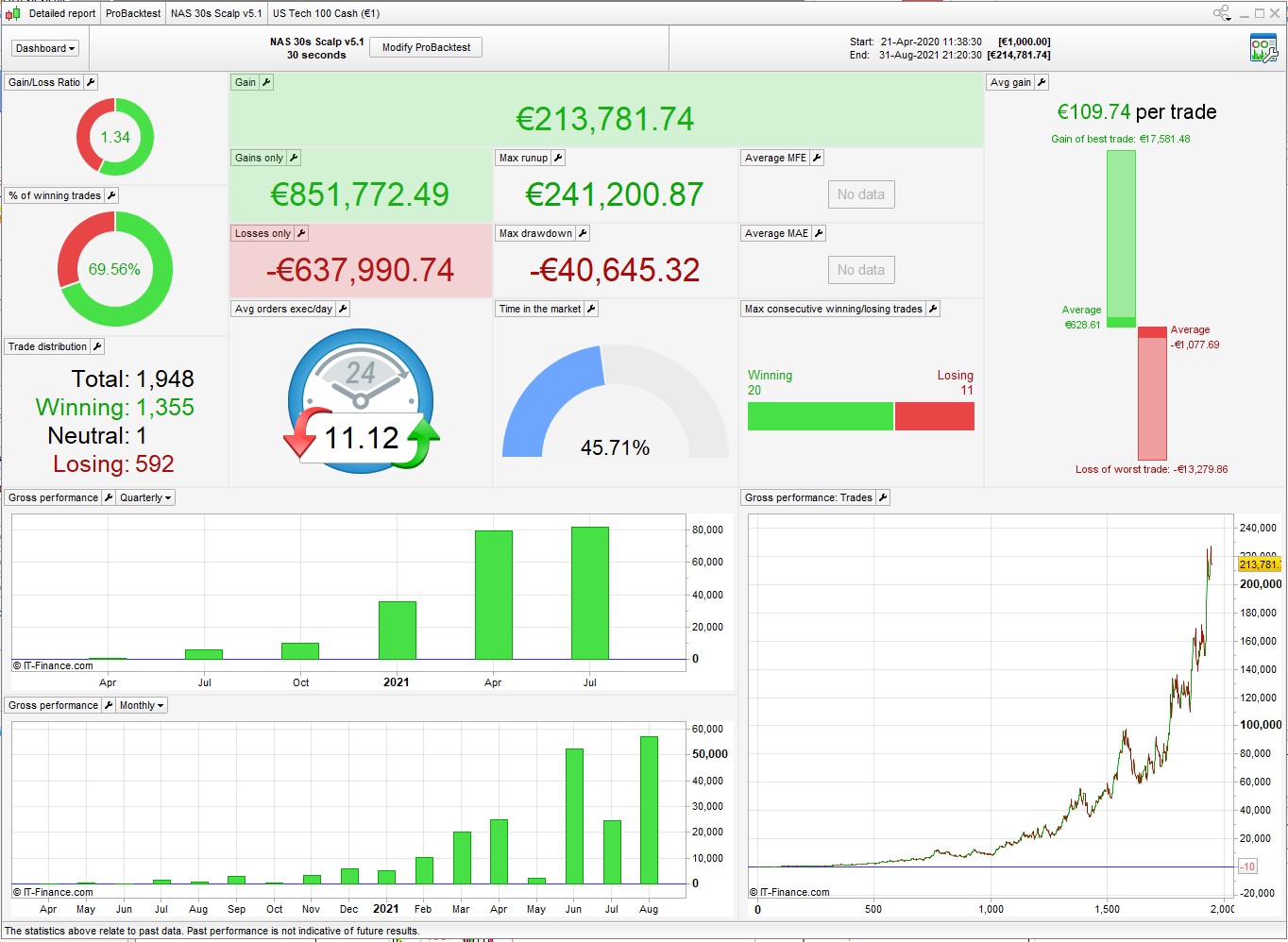
Spectacular ‘potential returns’ when MM is active (2nd pic – haha, dream on…🤣)
Against:
Very short BT, 17 months – assume it’s curve-fit to that period and would need regular reworking
Possibly over-optimized (???)
Stoploss is > Target profit, meaning that loss of worst trade is also > Gain of best trade – not good but unavoidable.
Very low gain per trade, easily eroded with slippage or at times of higher spread.
No WF, as I prefer to do out-of-sample testing in demo (closer to real trading conditions)
***Requires lengthy forward testing before going live***
As with most things in life – could be a winner, could crash and burn … who knows? Be sure to adjust the Tradetime for your time zone.
// Definition of code parameters
DEFPARAM CumulateOrders = false // Cumulating positions deactivated
DEFPARAM preloadbars = 10000
//MONEY MANAGEMENT II
MM = 0 // = 0 for optimization
if MM = 0 then
positionsize = 0.5
ENDIF
if MM then
MinSize = 0.5 // IG minimum position size allowed
MaxSize = 2000 // IG tier 2 margin limit
ProfitAccrued = 0 // when restarting strategy, enter profit or loss to date in instrument currency
DD = 370  //MinSize drawdown in instrument currency
Multiplier = 3 //drawdown multiplier
if ProfitAccrued + StrategyProfit >= DD*2 then
Multiplier = 2
endif
Capital = DD * Multiplier
Equity = Capital + ProfitAccrued + StrategyProfit
PositionSize = Max(MinSize, Equity * (MinSize/Capital))
if positionsize > MaxSize then
positionsize = MaxSize
endif
PositionSize = Round(PositionSize*100)
PositionSize = PositionSize/100
ENDIF

once tradetype = 1 // [1] long/short [2]long [3]short
once closeonreversal = 0

DLS =(Date >= 20100314 and date <=20100328) or (Date >= 20101031 and date <=20101107) or (Date >= 20110313 and date <=20110327) or (Date >= 20111030 and date <=20111106) or (Date >= 20120311 and date <=20120325) or (Date >= 20121028 and date <=20121104) or (Date >= 20130310 and date <=20130331) or (Date >= 20131027 and date <=20131103) or (Date >= 20140309 and date <=20140330) or (Date >= 20141026 and date <=20141102) or (Date >= 20150308 and date <=20150329) or (Date >= 20151025 and date <=20151101) or (Date >= 20160313 and date <=20160327) or (Date >= 20161030 and date <=20161106) or (Date >= 20170312 and date <=20170326) or (Date >= 20171030 and date <=20171105) or (Date >= 20180311 and date <=20180325) or (Date >= 20181028 and date <=20181104) or (Date >= 20190310 and date <=20190331) or (Date >= 20191027 and date <=20191103) or (Date >= 20200308 and date <=20200329) or (Date >= 20201025 and date <=20201101) or (Date >= 20210314 and date <=20210328) or (Date >= 20211031 and date <=20211107) or (Date >= 20220313 and date <=20220327) or (Date >= 20221030 and date <=20221106) or (Date >= 20230312 and date <=20230326) or (Date >= 20231029 and date <=20231105) or (Date >= 20240310 and date <=20240331) or (Date >= 20241027 and date <=20241103)
If DLS then
Tradetime = time >=133000 and time <200000//UK time
elsif not DLS then
Tradetime = time >=143000 and time <210000//UK time
endif

TIMEFRAME(15 minutes)
ma = average[a,t](typicalprice)
cb1 = ma > ma[1]
mb = average[p2,t2](typicalprice)
cs1 = mb < mb[1]

TIMEFRAME(5 minutes)
mc = average[a3,t3](typicalprice)
cb2 = (mc > ma)
cb3 = mc > mc[1]

md = average[a4,t4](typicalprice)
cs2 = (md < mb)
cs3 = md < md[1]

TIMEFRAME(default)
me = average[a5,t5](typicalprice)
cb4 = me > me[1] and me[1] < me[2]
mf = average[a6,t6](typicalprice)
cs4 = mf < mf[1] and mf[1] > mf[2]

CB = Tradetime and (cb1 or cb2) and cb3 and cb4
CS = Tradetime and (cs1 or cs2) and cs3 and cs4

// Conditions to enter long positions
if tradetype=1 or tradetype=2 then
IF not longonmarket and CB THEN
BUY positionsize CONTRACT AT MARKET
SET STOP %LOSS sl
SET TARGET %PROFIT tp
ENDIF
ENDIF

if tradetype=2 and longonmarket and closeonreversal and CS then
sell at market
endif

// Conditions to enter short positions
if tradetype=1 or tradetype=3 then
IF not shortonmarket and CS THEN
sellshort positionsize CONTRACT AT MARKET
SET STOP %LOSS sls
SET TARGET %PROFIT tps
ENDIF
ENDIF

if tradetype=3 and shortonmarket and closeonreversal and CB then
exitshort at market
endif

//% Break even (high/low)
once breakeven =1
if breakeven then
breakevenPC = be // long
breakevenPCS = bes // short
PointsToKeep = pk
startBreakeven = tradeprice(1)*(breakevenPC/100)
startBreakevenS = tradeprice(1)*(breakevenPCS/100)

//reset the breakevenLevel when no trade are on market
if breakeven>0 then
IF NOT ONMARKET THEN
breakevenLevel=0
ENDIF
// --- BUY SIDE ---
//test if the price have moved favourably of "startBreakeven" points already
IF LONGONMARKET AND high-tradeprice(1)>=startBreakeven*pipsize THEN
//calculate the breakevenLevel
breakevenLevel = tradeprice(1)+PointsToKeep*pipsize
ENDIF

//place the new stop orders on market at breakevenLevel
IF breakevenLevel>0 THEN
SELL AT breakevenLevel STOP
ENDIF
// --- end of BUY SIDE ---

IF SHORTONMARKET AND tradeprice(1)-low>=startBreakevenS*pipsize THEN
//calculate the breakevenLevel
breakevenLevel = tradeprice(1)-PointsToKeep*pipsize
ENDIF
//place the new stop orders on market at breakevenLevel
IF breakevenLevel>0 THEN
EXITSHORT AT breakevenLevel STOP
ENDIF
endif
endif

// trailing atr stop
once trailingstopATR  = 1
if trailingstopATR then
//====================
once tsincrements = tsi // set to 0 to ignore tsincrements
once tsminatrdist = tsm

once tsatrperiod    = tsa // ts atr parameter
once tsminstop      = 4 // ts minimum stop distance

tssensitivity = 2 // 1 = close 2 = High/Low 3 = Low/High 4 = typicalprice (not use once)
//====================
if barindex=tradeindex then
trailingstoplong     = tsl // ts atr distance
trailingstopshort    = tss // ts atr distance
else
if longonmarket then
if tsnewsl>0 then
if trailingstoplong>tsminatrdist then
if tsnewsl>tsnewsl[1] then
trailingstoplong=trailingstoplong
else
trailingstoplong=trailingstoplong-tsincrements
endif
else
trailingstoplong=tsminatrdist
endif
endif
endif
if shortonmarket then
if tsnewsl>0 then
if trailingstopshort>tsminatrdist then
if tsnewsl<tsnewsl[1] then
trailingstopshort=trailingstopshort
else
trailingstopshort=trailingstopshort-tsincrements
endif
else
trailingstopshort=tsminatrdist
endif
endif
endif
endif
tsatr=averagetruerange[tsatrperiod]((close/10))/1000
//tsatr=averagetruerange[tsatrperiod]((close/1)) // (forex)
tgl=round(tsatr*trailingstoplong)
tgs=round(tsatr*trailingstopshort)
if not onmarket or ((longonmarket and shortonmarket[1]) or (longonmarket[1] and shortonmarket)) then
tsmaxprice=0
tsminprice=close
tsnewsl=0
mypositionpriceatr = 0
endif
positioncountatr = abs(countofposition)
if tsnewsl > 0 then
if positioncountatr > positioncountatr[1] then
if longonmarket then
tsnewsl = max(tsnewsl,positionprice * tsnewsl / mypositionpriceatr)
else
tsnewsl = min(tsnewsl,positionprice * tsnewsl / mypositionpriceatr)
endif
endif
endif
if tssensitivity=1 then
tssensitivitylong=close
tssensitivityshort=close
elsif tssensitivity=2 then
tssensitivitylong=high
tssensitivityshort=low
elsif tssensitivity=3 then
tssensitivitylong=low
tssensitivityshort=high
elsif tssensitivity=4 then
tssensitivitylong=typicalprice
tssensitivityshort=typicalprice
endif
if longonmarket then
tsmaxprice=max(tsmaxprice,tssensitivitylong)
if tsmaxprice-positionprice>=tgl then
if tsmaxprice-positionprice>=tsminstop then
tsnewsl=tsmaxprice-tgl
else
tsnewsl=tsmaxprice-tsminstop
endif
endif
endif
if shortonmarket then
tsminprice=min(tsminprice,tssensitivityshort)
if positionprice-tsminprice>=tgs then
if positionprice-tsminprice>=tsminstop then
tsnewsl=tsminprice+tgs
else
tsnewsl=tsminprice+tsminstop
endif
endif
endif
if longonmarket then
if tsnewsl>0 then
sell at tsnewsl stop
endif
if tsnewsl>0 then
if low crosses under tsnewsl then
sell at market // when stop is rejected
endif
endif
endif
if shortonmarket then
if tsnewsl>0 then
exitshort at tsnewsl stop
endif
if tsnewsl>0 then
if high crosses over tsnewsl then
exitshort at market // when stop is rejected
endif
endif
endif
mypositionpriceatr = positionprice
endif

//===================================
RSIexit = 1 // in profit
if RSIexit then
myrsi=rsi[r](close)
if myrsi<rl and barindex-tradeindex>1 and longonmarket and close>positionprice then
sell at market
endif
if myrsi>rs and barindex-tradeindex>1 and shortonmarket and close<positionprice then
exitshort at market
endif
endif