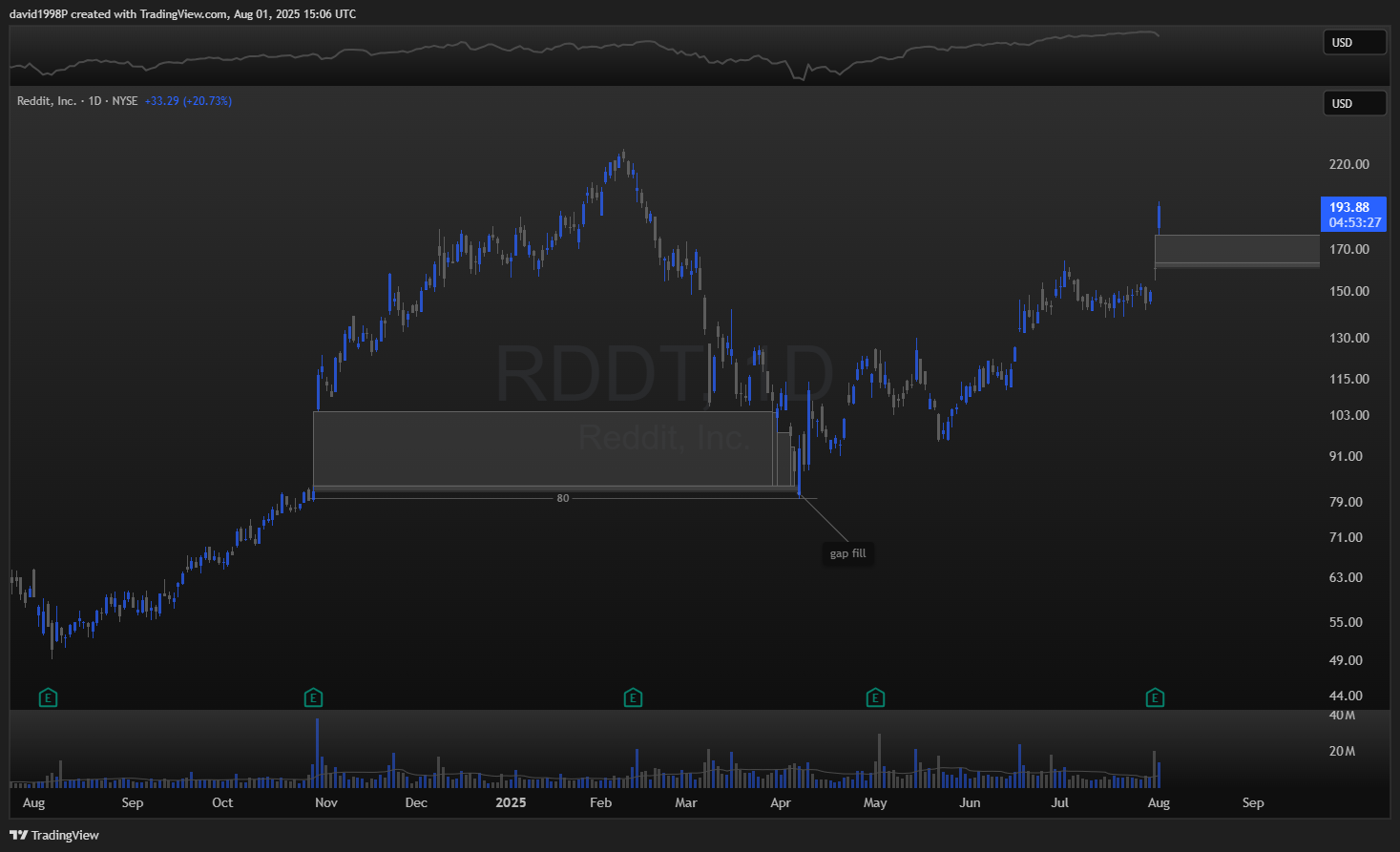
Parameters/inputs:
- close gap partially: (boolean, YES or NO)
- minimal deviation: as volatility multiple
nATR := vol = AverageTrueRange[periodATR] / Close, threshold = x
- limit max gap trail length: (boolean)
- up gaps and down gaps colors
A gap is a visible empty space between two candles.
Mathematically: Close(t−1) ≠ Open(t), where t defines the time when the gapping candle occurs.
If
|Close(t−1) - Open(t)| ≥ x * Vol(t−1)
then the gap is considered significant.
If that empty space gets partially or fully filled between t and t+n, the gap must be updated to reflect the remaining unfilled space on the chart.
Example:
Close(t−1) = 5Open(t) = 10Vol(t−1) = 0.1x = 2
Then:
|5 - 10| = 5
2 * 0.1 * 5 = 1
Since 5 ≥ 1 → gap is significant.
If in t+1 the candle low reaches 8, then the remaining gap is from 5 to 8.
Same applies if, in t, the gapping candle has low < open. That portion is considered filled and must be removed.
General rule:
0 ≤ unfilled space ≤ |Close(t−1) - Open(t)| := gap
Here is the Pine Script version
//@version=6
indicator("Gaps", overlay = true, max_boxes_count = 500)

closeGapsPartially = input.bool(false, "Close Gaps Partially", display = display.data_window)
boxLimitInput = input.int(15, "Max Number of Gaps", minval = 1, maxval = 500, display = display.data_window)
minimalDeviationTooltip = "Specifies the minimal size of detected gaps, as a percentage of the average high-low range for the last 14 bars."
minimalDeviationInput = nz(input.float(30.0, "Minimal Deviation (%)", tooltip = minimalDeviationTooltip, minval=1, maxval=100, display = display.data_window) / 100 * ta.sma(high-low, 14))
limitBoxLengthBoolInput = input.bool(false, "Limit Max Gap Trail Length (bars)", inline = "Length Limit", display = display.data_window)
limitBoxLengthIntInput = input.int(300, "", inline = "Length Limit", minval = 1, display = display.data_window)

groupName = "Border and fill colors"
colorUpBorderInput = input.color(color.green, "Up Gaps", inline = "Gap Up", group = groupName, display = display.data_window)
colorUpBackgroundInput = input.color(color.new(color.green, 85), "", inline = "Gap Up", group = groupName, display = display.data_window)
colorDownBorderInput = input.color(color.red, "Down Gaps", inline = "Gap Down", group = groupName, display = display.data_window)
colorDownBackgroundInput = input.color(color.new(color.red, 85), "", inline = "Gap Down", group = groupName, display = display.data_window)

type AlertInfo
    int countOpenGap
    int countClosedGap

method hasOpenedGap(AlertInfo this) =>
    this.countOpenGap > 0

method hasClosedGap(AlertInfo this) =>
    this.countClosedGap > 0

AlertInfo alertInfo = AlertInfo.new(0, 0)

type Gap
    bool isActive
    bool isBull
    array<box> boxes

method delete(Gap this) =>
    for _box in this.boxes
        _box.delete()

method partialClose(Gap this) =>
    activeBox = this.boxes.last()
    activeBox.set_extend(extend.none)

    top = this.isBull ? activeBox.get_top() : low
    bottom = this.isBull ? high : activeBox.get_bottom()

    this.boxes.push(box.new(
      bar_index,
      top,
      bar_index,
      bottom,
      this.isBull ? colorDownBorderInput : colorUpBorderInput,
      bgcolor = this.isBull ? colorDownBackgroundInput : colorUpBackgroundInput))

method fullClose(Gap this) =>
    alertInfo.countClosedGap += 1
    activeBox = this.boxes.last()
    activeBox.set_extend(extend.none)
    this.isActive := false
    if closeGapsPartially
        activeBox.delete()

method checkForClose(Gap this) =>
    if this.isActive
        activeBox = this.boxes.last()
        top = activeBox.get_top()
        bot = activeBox.get_bottom()
        isBull = this.isBull
        activeBox.set_right(bar_index)

        if (high > bot and isBull) or (low < top and not isBull)
            if closeGapsPartially
                this.partialClose()
            else
                this.fullClose()

        bool forceCloseBoxExceededLengthLimit = (limitBoxLengthBoolInput and bar_index - activeBox.get_left() >= limitBoxLengthIntInput)
        if ((high > top and isBull) or (low < bot and not isBull)) or forceCloseBoxExceededLengthLimit
            this.fullClose()

var allGaps = array.new<Gap>()

isGapDown = high < low[1] and low[1] - high >= minimalDeviationInput
isGapUp = low > high[1] and low - high[1] >= minimalDeviationInput
isGap = isGapDown or isGapUp
boxBorderColor = isGapDown ? colorDownBorderInput : colorUpBorderInput
boxBgcolor = isGapDown ? colorDownBackgroundInput : colorUpBackgroundInput

registerNewGap(bool isGapDown) =>
    alertInfo.countOpenGap += 1

    newBox = box.new(
      bar_index - 1,
      (isGapDown ? low[1] : low),
      bar_index,
      (isGapDown ? high : high[1]),
      border_color = boxBorderColor,
      bgcolor = boxBgcolor,
      extend = extend.right)

    allGaps.push(Gap.new(true, isGapDown, array.from(newBox)))

    if allGaps.size() > boxLimitInput
        allGaps.shift().delete()

for gap in allGaps
    gap.checkForClose()

if isGap
    registerNewGap(isGapDown)

if barstate.islastconfirmedhistory and allGaps.size() == 0
    noGapText = "No gaps found on the current chart. \nThe cause could be that some exchanges align the open of new bars on the close of the previous one, resulting in charts with no gaps. Alternatively, your Minimal Deviation might be too high."
    var infoTable = table.new(position.bottom_right, 1, 1)
    table.cell(infoTable, 0, 0, text = noGapText, text_color = chart.bg_color, bgcolor = chart.fg_color)

alertcondition(alertInfo.hasOpenedGap(), "New Gap Appeared", "A new gap has appeared.")
alertcondition(alertInfo.hasClosedGap(), "Gap Closed", "A gap was closed.")
Note: The version we want is slightly different — it detects gaps using Close(t−1) instead of High(t−1) which is more accurate.