 JS
JSParticipant
Veteran
@GraHal, what is the effect of contango when taking a short position…?
yeah… and what about effect of backwardation, on longs, on shorts? what is the amount bacwardation for ig cfd-futures? cant wait for the answers…
Short positions benefit from the decaying / reducing contango over the life of the Future Contract.
So if one’s trades are approx 50/50 Longs and Shorts, then contango become a ‘swings and roundabouts’ scenario.
justisan wrote: what is the amount bacwardation for ig cfd-futures?
If you ever see a Future Price that is less than the (equivalent) Spot Price then screenshot it and we would then have proof and a figure for backwardation.
JSParticipant
Veteran
So if you go 50/50 long and short, does contango roughly net out to zero…?
Yes, but Long and Short periods held would need to average out roughly the same.
JSParticipant
Veteran
So, nothing to do with loans from IBKR or anyone else…
So we have Contango and Cost of Carry. And we have Backwardation. Now, before e.g. Grahal thinks that both are the same, dig out your best AI and find out. On top of that, blame me of suggesting (in yesterday’s post) that both are the same. The effect would be the same, but the reason of existence is very different. For that, answer justisan’s question first. 🙂
Meanwhile now AI-up what Back Adjustment is. Haha. The fun ? in PRT-IB we deal with it every hour of the day. But assumed that AI will cough up for you what it means, did we realize that it is there in everything we see (with Futures) ? maybe not so much ?
Then again answer JS’s question : Contango and Long vs Short. No wait … Cost and Carry and Long vs Short. Ah, got it. Backwardation then ? oops. Try Back Adjustment first.
Futures are complex products, they say. And what develops in this thread is not part of that (says me). Unless we start to pull out elements like in the last posts.
I think I said it in this thread, recently. Don’t start with cattle or chicken. Or look up what happened to oil back in 2020 (Corona). Futures can be dangerous products. Best is to practice with equities (S&P and such) and lose some money only.
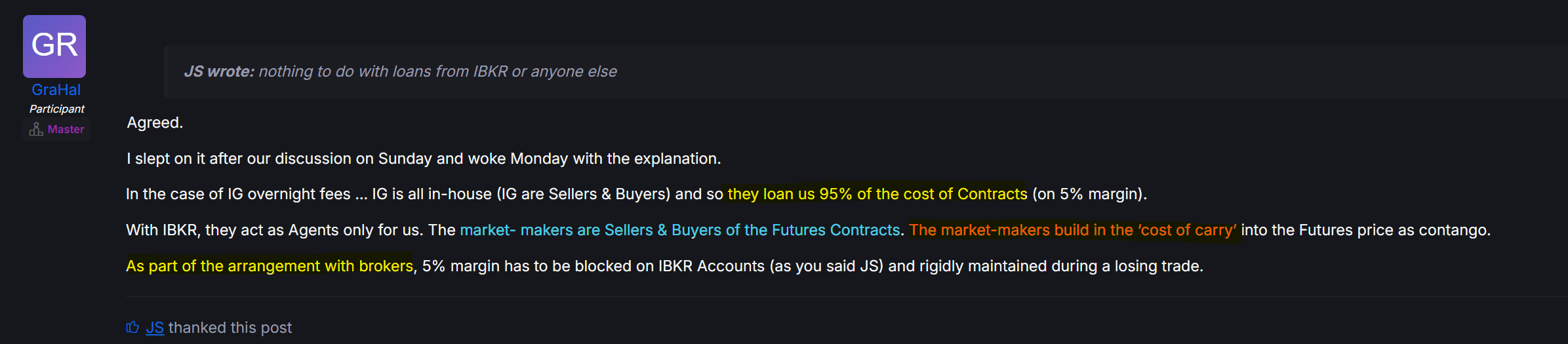
JS wrote: nothing to do with loans from IBKR or anyone else
Agreed.
I slept on it after our discussion on Sunday and woke Monday with the explanation.
In the case of IG overnight fees … IG is all in-house (IG are Sellers & Buyers) and so they loan us 95% of the cost of Contracts (on 5% margin).
With IBKR, they act as Agents only for us. The market- makers are Sellers & Buyers of the Futures Contracts. The market-makers build in the ‘cost of carry’ into the Futures price as contango.
As part of the arrangement with brokers, 5% margin has to be blocked on IBKR Accounts (as you said JS) and rigidly maintained during a losing trade.
JSParticipant
Veteran
Yeah, that’s how it works… probably the caffeine 😉
Now after 6 spoons / 3 cups of coffee (4th imminent :D) … my take on backwardation.
We likely not need to concern ourselves as I’ve never seen anybody on here saying they trade futures in commodities (pork bellies, corn etc, oil maybe yes?).
If a commodity is in short supply (war, drought etc) and the need today / now is crucial then the spot price can be higher than the future price, hence backwardation.
I see multiple misunderstandings above but I would get tired to come with explanations, and anyway everybody can read all relevant contents on www directly or extract all those info with some ai chatbot. in the end what counts is the effect, here in particular related to cost of keeping a position overnight in cfd (original topic of this thread) versus futures, and here cfd positions are systematically at substantial cost disadvantage which cumulate to massive amounts over time, one can easily lose 10-20-30% of the long term performance, depending on how frequently and for how long positions are held overnight, which in the end means that when trading exact same systems with cfd if one is working generally profitable, one will make money much slower, and if one is generally losing, one will lose faster.
jebus’ findings are real and impressive, few years ago I was figuring out something similar, and we also had some conversation with JS related to the topic / cost of carry, link below, where I was comming up with simple realistic example/calculation in relation to “overnight financing for cfd” vs “cost of carry for futures”.
My Algo journey 5 years deep
justisan wrote: multiple misunderstandings
Please briefly bullet point 3 (no need for explanation) … we can then fully educate ourselves.
GraHal wrote: justisan wrote: multiple misunderstandings Please briefly bullet point 3 (no need for explanation) … we can then fully educate ourselves.
I marked several statements. a comment on the cfd-related one, so first one marked: cfd broker running a b-book or hybrid one does not loan 95% of the contact value to its clients. he might not loan even a single cent, but here the fantastic part for the broker comes: he acts as if he would be loaning those 95% and charges relevant market interest rate + heavy “handling fee” on top if positions are kept overnight.
regarding last marked statement: it’s not clear whose arrangement with brokers you mean, to me it sounds (and sure I might misunderstand you) like you mean market maker’s arrangement with brokers – and if you mean that, then that is not the case, there are no such arrangements between them, margin is not a requirement comming from market makers, but from clearing house, and market makers also need to fulfill margin requirements.
cheers
justisan
IG
For the record I just did a double check on the IG Jun 26 (in-house) US30 Future vs DFB (Daily Funded Bet) :
- Future is +300 ish above DFB price.
- Future spread is 7.8
- DFB spread is 3.6
For info:
Future is 1USD per point
DFB is £1 per point.
IBKR (from below, it looks like a contango of 600 to 700??)
Just (13:15 on 24 Mar 26) got below off CoPilot for IBKR:
Based on market data as of March 24, 2026, here are the approximate prices for the US30 (Dow Jones Industrial Average) futures and spot.
- June 2026 US30 Future (YMM26): The E-mini Dow Jones Industrial Average Futures for June 2026 are trading around 46,200–46,420 USD.
- Spot Price (US30): The spot price, often traded as a CFD (e.g., Wall St 30), is approximately 45,500–45,800 USD