Machine Learning in ProOrder ProRealTime

Viewing 15 posts - 346 through 360 (of 455 total)
  • Author
    Posts
  • #128620 quote
    GraHal
    Participant
    Master

    1.  Moreover generally the parameter where the best we obtain with a backtest and changing the valuex will result in choosing a worst combinaison of values
    2.  And to conclude determining that a valuex of 12 the 4 april doesn’t mean it will be the best value for the 12 april for example

    Surely you have sort of answered your own question 1 with the bold text in question 2?

    It may be that the System you are experimenting with has variable values (arrived at via normal optimisation / WF etc) that are at their best ever value?

    If the Heuristics are used in a System where a variable optimum value can changes every day or so (like the Renkos we have been using on this Topic) then  the Heurisitic on the fly optimisation can improve results.

    #128621 quote
    juanj
    Participant
    Master

    Also important to note that each discovery session is determined by ‘MaxIncrement’ (number of increments to try). After this the strategy then tests the newly discovered best values for a number of trades as defined by ‘Reps’. It then compares the results to the previous discovery session and overall best values to see whether progress was made.

    Unfortunately determining true market cycles is extremely challenging and for now the heuristics (i.e. discovery through ‘trial and error’) is my best shot at dynamic optimization.

    Bard thanked this post
    #128628 quote
    zilliq
    Participant
    Master

    Also important to note that each discovery session is determined by ‘MaxIncrement’ (number of increments to try). After this the strategy then tests the newly discovered best values for a number of trades as defined by ‘Reps’. It then compares the results to the previous discovery session and overall best values to see whether progress was made.

    Unfortunately determining true market cycles is extremely challenging and for now the heuristics (i.e. discovery through ‘trial and error’) is my best shot at dynamic optimization.

    the strategy then tests the newly discovered best values for a number of trades as defined by ‘Reps

    It’s like a forward test in live, right  ? But with the risk it getting worst with losing trades with the new values ?

    #128638 quote
    Paul
    Participant
    Master

    @juanj a while back we discussed about the importance of MFA/MAE ratio.

    If you had a stoploss of 500points and a target of 50 points, takes the current way of calculation parameters into account that if the trade goes -450 before it reached 50 points it wasn’t very good entry or does it see as a positive trade and parameters which could be used again?


    @Bard

    “Unfortunately SET STOP PTRAILING does not use tick by tick data and so gives false results.” That’s a bunch of time wasted. Knew there was something off but not exactly what.

    Atleast v4 ts had this covered. I thought the order would be rejected, but as it stands it was accepted today and having good results.

    Bard thanked this post
    #128641 quote
    Paul
    Participant
    Master

    An other idea came to mind.

    instead of  use ML for parameters, what about using the optimistation results and group the first 10 rows with parameters.

    Then ML can take out of those 10 row which set of parameters will be the best. Especially on a short timeframe (1s-10s), a few days later again optimisation can be made and the best set of parameters added to the first group, so you buildup data for ML which covers more market scenarios.

    Baloney or interesting?

    GraHal thanked this post
    #128643 quote
    zilliq
    Participant
    Master

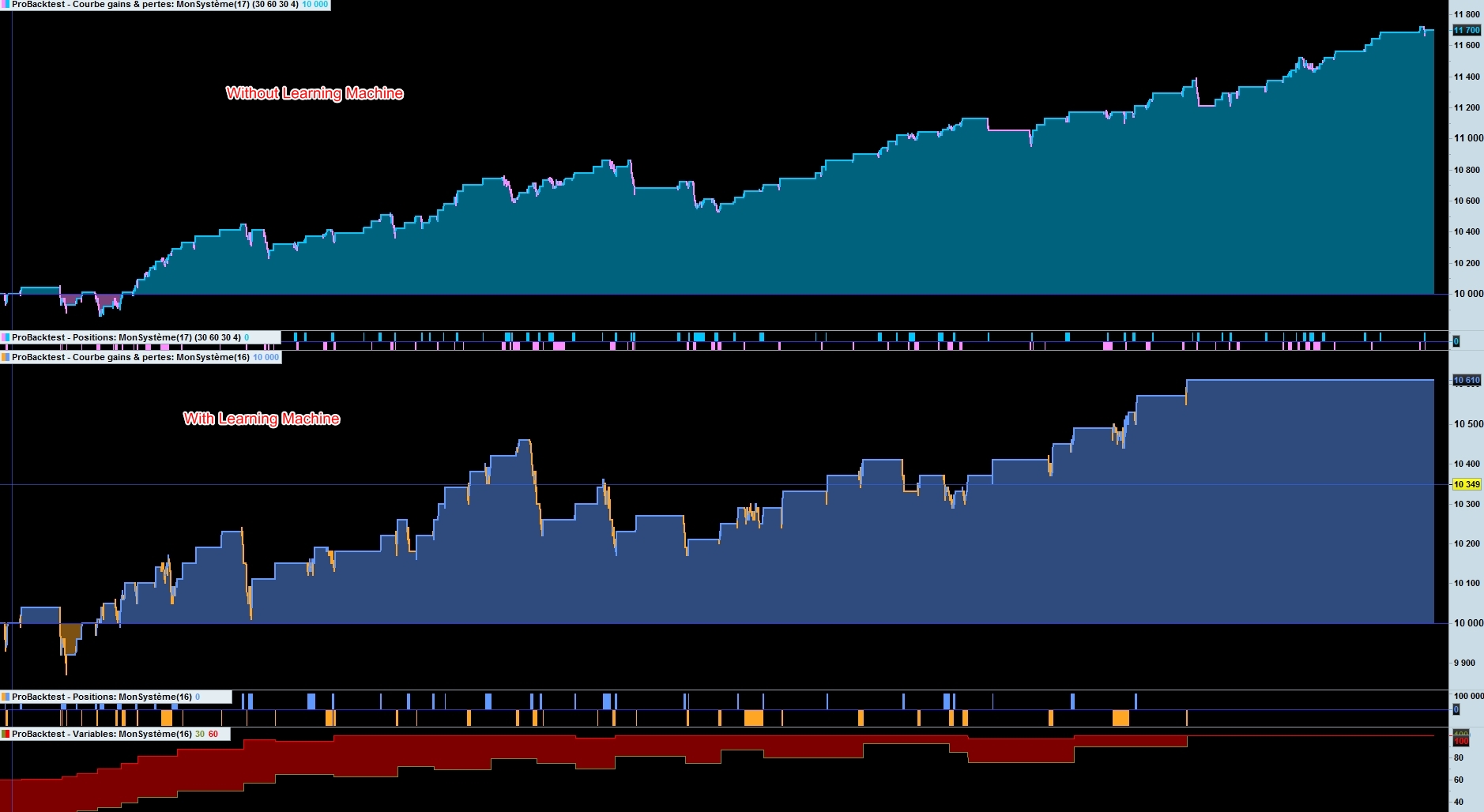
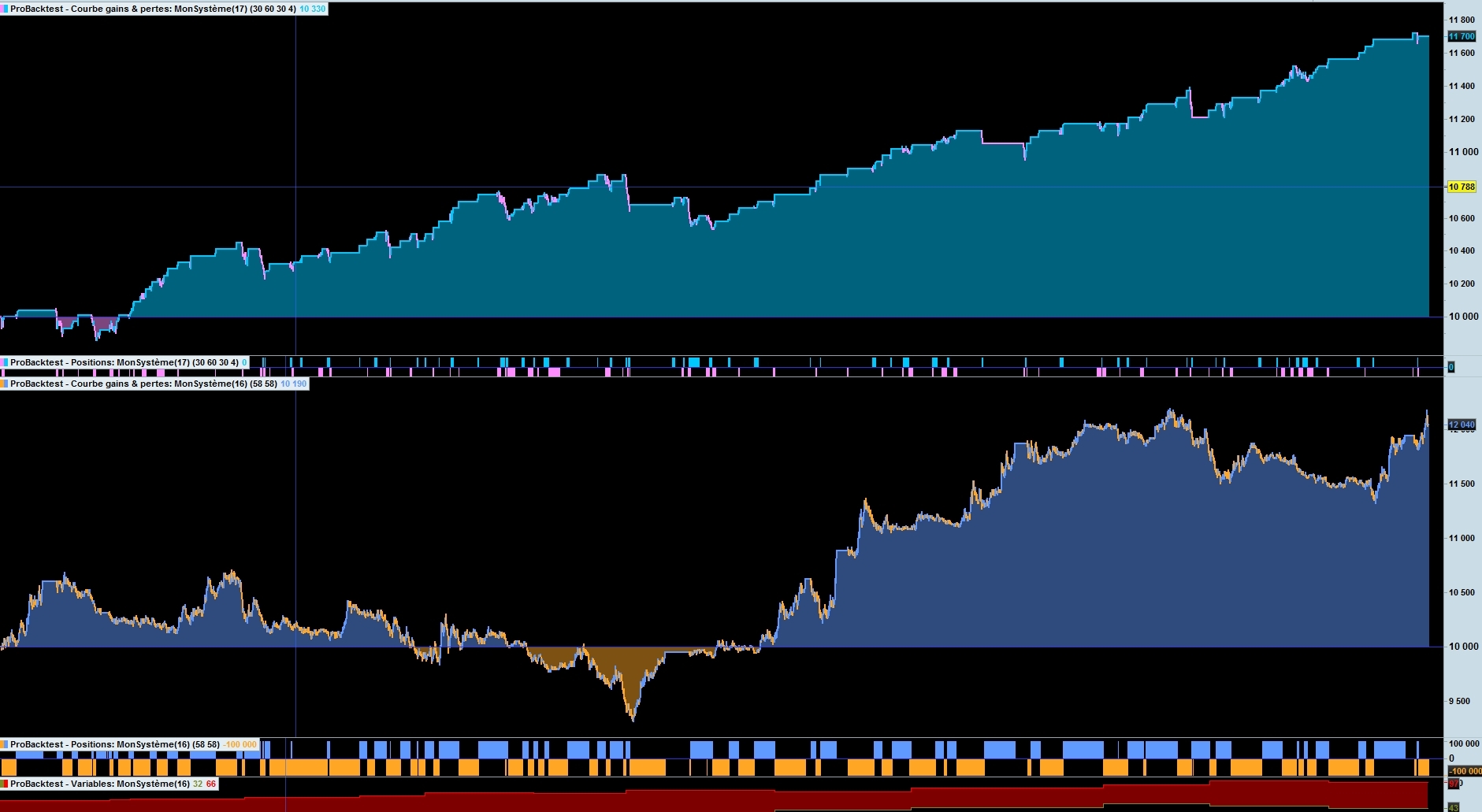
    To continue, because it’s an intersting topic (Thanks @juanj and all contributors), I made a test

    I use a very simple code

    // Définition des paramètres du code
    DEFPARAM CumulateOrders = False // Cumul des positions désactivé
    
    // Conditions pour ouvrir une position acheteuse
    indicator1 = ExponentialAverage[a](close)
    indicator2 = ExponentialAverage[b](close)
    c1 = (indicator1 CROSSES OVER indicator2)
    indicator3 = WilderAverage[c](close)
    c2 = (close > indicator3)
    
    IF c1 AND c2 THEN
    BUY 1 SHARES AT MARKET
    ENDIF
    
    // Conditions pour ouvrir une position en vente à découvert
    indicator4 = ExponentialAverage[a](close)
    indicator5 = ExponentialAverage[b](close)
    c3 = (indicator4 CROSSES UNDER indicator5)
    indicator6 = WilderAverage[c](close)
    c4 = (close < indicator6)
    
    IF c3 AND c4 THEN
    SELLSHORT 1 SHARES AT MARKET
    ENDIF
    
    // Stops et objectifs
    SET TARGET pPROFIT d
    SET STOP pLOSS 2*d


    On EUR/USD 1 minute. I do a backtest and obtain the “best” value who are a=30 b=60 c=30 d=4

    I put these values in the Learning machine in Starting Value as you can see below with min/max as the values aroud these values on the backtest

    defparam cumulateorders = false
    //////////////////////////////////////////////////////////////
    StartingValue = 30
    ResetPeriod = 3 //Specify no of months after which to reset optimization
    Increment = 1
    MaxIncrement = 20 //Limit of no of increments either up or down
    Reps = 3 //Number of trades to use for analysis
    MinValue = 10 //Minimum allowed value
    MaxValue = 100 //Maximum allowed value
    //////////////////////////////////////////////////////////////
    StartingValue2 = 60
    ResetPeriod2 = 3 //Specify no of months after which to reset optimization
    Increment2 = 1
    MaxIncrement2 = 20 //Limit of no of increments either up or down
    Reps2 = 3 //Number of trades to use for analysis
    MinValue2 = 20 //Minimum allowed value
    MaxValue2 = 100 //Maximum allowed value
    //////////////////////////////////////////////////////////////
    //period1=7
    //period2=14
     
    HeuristicsCycleLimit = 2
    once HeuristicsCycle = 0
    once HeuristicsAlgo1 = 1
    once HeuristicsAlgo2 = 0
    If HeuristicsCycle >= HeuristicsCycleLimit  Then
    If HeuristicsAlgo1 = 1 Then
    HeuristicsAlgo2 = 1
    HeuristicsAlgo1 = 0
    ElsIf HeuristicsAlgo2 = 1 Then
    HeuristicsAlgo1 = 1
    HeuristicsAlgo2 = 0
    EndIf
    HeuristicsCycle = 0
    EndIf
    //
    //If HeuristicsAlgo1 = 1 Then
     
    //Heuristics Algorithm 1 Start
     
    If (onmarket[1] = 1 and onmarket = 0) or (longonmarket[1] = 1 and longonmarket and countoflongshares < countoflongshares[1]) or (longonmarket[1] = 1 and longonmarket and countoflongshares > countoflongshares[1]) or (shortonmarket[1] = 1 and shortonmarket and countofshortshares < countofshortshares[1]) or (shortonmarket[1] = 1 and shortonmarket and countofshortshares > countofshortshares[1]) or (longonmarket[1] and shortonmarket) or (shortonmarket[1] and longonmarket) Then
    optimize = optimize + 1
    EndIf
    
    If monthinit = 1 or monthinit = 3 or monthinit = 5 or monthinit = 7 or monthinit = 8 or monthinit = 10 or monthinit = 12 Then
    MonthDays = 31
    ElsIf monthinit = 4 or monthinit = 6 or monthinit = 9 or monthinit = 11 Then
    MonthDays = 30
    ElsIf monthinit = 2 Then
    If (yearinit/4 = round(yearinit/4)) or (yearinit/400 = round(yearinit/400)) Then //haha not sure how exactly to do this
    MonthDays = 29 //leap year
    Else
    MonthDays = 28
    EndIf
    EndIf
     
    If (month = monthinit and day = dayinit + ResetPeriod) or (month = monthinit + 1 and (day + (MonthDays - dayinit)) >= ResetPeriod) Then
    ValueX = StartingValue
    WinCountB = 0
    StratAvgB = 0
    BestA = 0
    BestB = 0
    dayinit = day
    monthinit = month
    yearinit = year
    EndIf
     
    once ValueX = StartingValue
    once PIncPos = 1 //Positive Increment Position
    once NIncPos = 1 //Neative Increment Position
    once Optimize = 0 ////Initialize Heuristicks Engine Counter (Must be Incremented at Position Start or Exit)
    once Mode = 1 //Switches between negative and positive increments
    //once WinCountB = 3 //Initialize Best Win Count
    //GRAPH WinCountB coloured (0,0,0) AS "WinCountB"
    //once StratAvgB = 4353 //Initialize Best Avg Strategy Profit
    //GRAPH StratAvgB coloured (0,0,0) AS "StratAvgB"
     
    If Optimize = Reps Then
    WinCountA = 0 //Initialize current Win Count
    StratAvgA = 0 //Initialize current Avg Strategy Profit
    HeuristicsCycle = HeuristicsCycle + 1
     
    For i = 1 to Reps Do
    If positionperf(i) > 0 Then
    WinCountA = WinCountA + 1 //Increment Current WinCount
    EndIf
    //StratAvgA = StratAvgA + (((PositionPerf(i)*countofposition[i]*100000)*-1)*-1)
    StratAvgA = StratAvgA + (((PositionPerf(i)*pointvalue)*countofposition[i])/pipsize)
    
    Next
    StratAvgA = StratAvgA/Reps //Calculate Current Avg Strategy Profit
    //Graph (PositionPerf(1)*countofposition[1]*100000)*-1 as "PosPerf1"
    //Graph (PositionPerf(2)*countofposition[2]*100000)*-1 as "PosPerf2"
    //Graph StratAvgA*-1 as "StratAvgA"
    //once BestA = 300
    //GRAPH BestA coloured (0,0,0) AS "BestA"
    If StratAvgA >= StratAvgB Then
    StratAvgB = StratAvgA //Update Best Strategy Profit
    BestA = ValueX
    EndIf
    //once BestB = 300
    //GRAPH BestB coloured (0,0,0) AS "BestB"
    If WinCountA >= WinCountB Then
    WinCountB = WinCountA  //Update Best Win Count
    BestB = ValueX
    EndIf
     
    If WinCountA > WinCountB and StratAvgA > StratAvgB Then
    Mode = 0
    ElsIf WinCountA < WinCountB and StratAvgA < StratAvgB and Mode = 1 Then
    ValueX = ValueX - (Increment*NIncPos)
    NIncPos = NIncPos + 1
    Mode = 2
    ElsIf WinCountA >= WinCountB or StratAvgA >= StratAvgB and Mode = 1 Then
    ValueX = ValueX + (Increment*PIncPos)
    PIncPos = PIncPos + 1
    Mode = 1
    ElsIf WinCountA < WinCountB and StratAvgA < StratAvgB and Mode = 2 Then
    ValueX = ValueX + (Increment*PIncPos)
    PIncPos = PIncPos + 1
    Mode = 1
    ElsIf WinCountA >= WinCountB or StratAvgA >= StratAvgB and Mode = 2 Then
    ValueX = ValueX - (Increment*NIncPos)
    NIncPos = NIncPos + 1
    Mode = 2
    EndIf
     
    If NIncPos > MaxIncrement or PIncPos > MaxIncrement Then
    If BestA = BestB Then
    ValueX = BestA
    Else
    If reps >= 10 Then
    WeightedScore = 10
    Else
    WeightedScore = round((reps/100)*100)
    EndIf
    ValueX = round(((BestA*(20-WeightedScore)) + (BestB*WeightedScore))/20) //Lower Reps = Less weight assigned to Win%
    EndIf
    NIncPos = 1
    PIncPos = 1
    ElsIf ValueX > MaxValue Then
    ValueX = MaxValue
    ElsIf ValueX < MinValue Then
    ValueX = MinValue
    EndIF
     
    Optimize = 0
    EndIf
     
    // Heuristics Algorithm 1 End
     
    //ElsIf HeuristicsAlgo2 = 1 Then
     
    //Heuristics Algorithm 2 Start
     
    If (onmarket[1] = 1 and onmarket = 0) or (longonmarket[1] = 1 and longonmarket and countoflongshares < countoflongshares[1]) or (longonmarket[1] = 1 and longonmarket and countoflongshares > countoflongshares[1]) or (shortonmarket[1] = 1 and shortonmarket and countofshortshares < countofshortshares[1]) or (shortonmarket[1] = 1 and shortonmarket and countofshortshares > countofshortshares[1]) or (longonmarket[1] and shortonmarket) or (shortonmarket[1] and longonmarket) Then
    optimize2 = optimize2 + 1
    EndIf
    
    If monthinit2 = 1 or monthinit2 = 3 or monthinit2 = 5 or monthinit2 = 7 or monthinit2 = 8 or monthinit2 = 10 or monthinit2 = 12 Then
    MonthDays2 = 31
    ElsIf monthinit2 = 4 or monthinit2 = 6 or monthinit2 = 9 or monthinit2 = 11 Then
    MonthDays2 = 30
    ElsIf monthinit2 = 2 Then
    If (yearinit2/4 = round(yearinit2/4)) or (yearinit2/400 = round(yearinit2/400)) Then //haha not sure how exactly to do this
    MonthDays2 = 29 //leap year
    Else
    MonthDays2 = 28
    EndIf
    EndIf
     
    If (month = monthinit2 and day = dayinit2 + ResetPeriod2) or (month = monthinit2 + 1 and (day + (MonthDays2 - dayinit2)) >= ResetPeriod2) Then
    ValueY = StartingValue2
    WinCountB2 = 0
    StratAvgB2 = 0
    BestA2 = 0
    BestB2 = 0
    dayinit2 = day
    monthinit2 = month
    yearinit2 = year
    EndIf
     
    once ValueY = StartingValue2
    once PIncPos2 = 1 //Positive Increment Position
    once NIncPos2 = 1 //Neative Increment Position
    once Optimize2 = 0 ////Initialize Heuristicks Engine Counter (Must be Incremented at Position Start or Exit)
    once Mode2 = 1 //Switches between negative and positive increments
    //once WinCountB2 = 3 //Initialize Best Win Count
    //GRAPH WinCountB2 coloured (0,0,0) AS "WinCountB2"
    //once StratAvgB2 = 4353 //Initialize Best Avg Strategy Profit
    //GRAPH StratAvgB2 coloured (0,0,0) AS "StratAvgB2"
     
    If Optimize2 = Reps2 Then
    WinCountA2 = 0 //Initialize current Win Count
    StratAvgA2 = 0 //Initialize current Avg Strategy Profit
    HeuristicsCycle = HeuristicsCycle + 1
     
    For i2 = 1 to Reps2 Do
    If positionperf(i) > 0 Then
    WinCountA2 = WinCountA2 + 1 //Increment Current WinCount
    EndIf
    //StratAvgA2 = StratAvgA2 + (((PositionPerf(i)*countofposition[i]*100000)*-1)*-1)
    StratAvgA2 = StratAvgA2 + (((PositionPerf(i)*pointvalue)*countofposition[i])/pipsize)
    Next
    StratAvgA2 = StratAvgA2/Reps2 //Calculate Current Avg Strategy Profit
    //Graph (PositionPerf(1)*countofposition[1]*100000)*-1 as "PosPerf1-2"
    //Graph (PositionPerf(2)*countofposition[2]*100000)*-1 as "PosPerf2-2"
    //Graph StratAvgA2*-1 as "StratAvgA2"
    //once BestA2 = 300
    //GRAPH BestA2 coloured (0,0,0) AS "BestA2"
    If StratAvgA2 >= StratAvgB2 Then
    StratAvgB2 = StratAvgA2 //Update Best Strategy Profit
    BestA2 = ValueY
    EndIf
    //once BestB2 = 300
    //GRAPH BestB2 coloured (0,0,0) AS "BestB2"
    If WinCountA2 >= WinCountB2 Then
    WinCountB2 = WinCountA2  //Update Best Win Count
    BestB2 = ValueY
    EndIf
     
    If WinCountA2 > WinCountB2 and StratAvgA2 > StratAvgB2 Then
    Mode = 0
    ElsIf WinCountA2 < WinCountB2 and StratAvgA2 < StratAvgB2 and Mode2 = 1 Then
    ValueY = ValueY - (Increment2*NIncPos2)
    NIncPos2 = NIncPos2 + 1
    Mode2 = 2
    ElsIf WinCountA2 >= WinCountB2 or StratAvgA2 >= StratAvgB2 and Mode2 = 1 Then
    ValueY = ValueY + (Increment2*PIncPos2)
    PIncPos2 = PIncPos2 + 1
    Mode = 1
    ElsIf WinCountA2 < WinCountB2 and StratAvgA2 < StratAvgB2 and Mode2 = 2 Then
    ValueY = ValueY + (Increment2*PIncPos2)
    PIncPos2 = PIncPos2 + 1
    Mode2 = 1
    ElsIf WinCountA2 >= WinCountB2 or StratAvgA2 >= StratAvgB2 and Mode2 = 2 Then
    ValueY = ValueY - (Increment2*NIncPos2)
    NIncPos2 = NIncPos2 + 1
    Mode2 = 2
    EndIf
     
    If NIncPos2 > MaxIncrement2 or PIncPos2 > MaxIncrement2 Then
    If BestA2 = BestB2 Then
    ValueY = BestA
    Else
    If reps2 >= 10 Then
    WeightedScore2 = 10
    Else
    WeightedScore2 = round((reps2/100)*100)
    EndIf
    ValueY = round(((BestA2*(20-WeightedScore2)) + (BestB2*WeightedScore2))/20) //Lower Reps = Less weight assigned to Win%
    EndIf
    NIncPos2 = 1
    PIncPos2 = 1
    ElsIf ValueY > MaxValue2 Then
    ValueY = MaxValue2
    ElsIf ValueY < MinValue2 Then
    ValueY = MinValue2
    EndIF
     
    Optimize2 = 0
    EndIf
     
    // Heuristics Algorithm 2 End
     
    //EndIf
     
    //c1=average[valuex](close)
    //c2=average[valuey](close)
     
    //
    //condbuy =c1 crosses over c2 and rsi[14](close)<70
    //condsell=c1 crosses under c2 and rsi[14](close)>30
     
    //
    //if condbuy then
    //buy at market
    //endif
    //if condsell then
    //sellshort at market
    //endif
     
    //pp=positionperf(0)*100
     
    //if pp<-0.125 then
    //sell at market
    //exitshort at market
    //endif
     
    //set stop %loss 0.5 // exit sooner on performance criteria above
    //set target %profit 0.25
     
    graph valuex coloured(121,141,35,255) 
    graph valuey coloured(255,0,0,255)
    //endif
    
    indicator1 = ExponentialAverage[valuex](close)
    indicator2 = ExponentialAverage[valuey](close)
    c1 = (indicator1 CROSSES OVER indicator2)
    
    indicator3 = WilderAverage[30](close)
    
    c2 = (close > indicator3)
    
    IF c1 AND c2 THEN
    BUY 1 SHARES AT MARKET
    ENDIF
    
    // Conditions pour ouvrir une position en vente à découvert
    indicator4 = ExponentialAverage[valuex](close)
    indicator5 = ExponentialAverage[valuey](close)
    c3 = (indicator4 CROSSES UNDER indicator5)
    
    indicator6 = WilderAverage[30](close)
    c4 = (close < indicator6)
    
    IF c3 AND c4 THEN
    SELLSHORT 1 SHARES AT MARKET
    ENDIF
    
    // Stops et objectifs
    SET STOP pLOSS 8
    SET TARGET pPROFIT 4

    And I compare the results on 2 graph. But sadly the results are worst with the learning machine

    Can you test too with this procedure (I think it’s good) on another simple code: Backtest to determine the “best” values to put in starting values and compare

    May be it’s the code or me 🙂 but it’s strange the results are worst

    See U Coders

    #128647 quote
    zilliq
    Participant
    Master

    For playing I do a new backtest with the Learing machine to optimize c and d

    Results are better but without regularity (It remember me when I made tests on pyramid trading there some years)

    See U

    #128650 quote
    GraHal
    Participant
    Master

    Baloney or interesting?

    Paul that is interesting / good blue sky thinking!

    If we are persevering with Renko, do we need to try and start the count for box size at the lowest low for x bars or highest high for x bars etc?

    If the renko starts counting for box size near the top of a good run up and as the renko strategy allows for a count of 2 x box size before it goes Long … then we may be right near the highest high for x bars and bang we have gone long and just around the corner is a fib retrace coming along.

    If we start counting near the lowest low for a Long then we are in with a fighting chance of going into early profit rather than early loss?

    Given the limitations of Renko, we could try the ML on the good old Vectorial … I reckon still a good strategy and coming back into fashion now the madness / high volatility seems over for a while?

    Renko was great when the ups and downs were long and frequent, but markets have quietened loads in the last 2 weeks?

    Just a few thoughts anyway.

    Paul thanked this post
    #128663 quote
    GraHal
    Participant
    Master


    Can you test too with this procedure

    I didn’t test but see below  … your HAlgo2 is using values from HAlgo1 … see the red i’s well they should be i2?

    It got screwed up so I made the i’s into iiiiiiii … cant stop sorry as a trade has just popped !!! 🙂

    For i2 = 1 to Reps2 Do
    If positionperf iiiiii>(<strong>i</strong></span>) > 0 Then
    WinCountA2 = WinCountA2 + 1 //Increment Current WinCount
    EndIf
    //StratAvgA2 = StratAvgA2 + (((PositionPerfiiiiiiiii(<span style="color: #ff0000;" data-mce-style="color: #ff0000;">i</span>)*countofposition[<span style="color: #ff0000;" data-mce-style="color: #ff0000;">i]</span>*100000)*-1)*-1)
    StratAvgA2 = StratAvgA2 + (((PositionPerfiiiiiiiiii(<span style="color: #ff0000;" data-mce-style="color: #ff0000;">i</span>)*pointvalue)*countofposition[<span style="color: #ff0000;" data-mce-style="color: #ff0000;">i</span>])/pipsize)
    Next
    #128666 quote
    Paul
    Participant
    Master

    @GraHal Well both are interesting! With renko what you said about fib.retracement is spot on. Still it’s too early to give up on renko, especially with two boxsizes!

    But I say, there’s a difference when to trade the dji. Focus on 8-15(30) to take trades and close at 17.30 or 18. Trading renko when the market is open, results go down. I’am still experimenting but that’s what it looks to me and you have stability with the spread. Also reducing the stoploss is key.

    I’ve been running vectorial, optimised for 5s timeframe! Nice backtest, not so nice results live though. 🙂 Not even with ML included!

    Probably I will give my idea from above a shot. Gathering parameters from optimisation results, group them and then use ML.

    GraHal thanked this post
    #128677 quote
    Bard
    Participant
    Master

    Cheers for the pointer, I knew those equity curves “on tbt” sometimes looked very improbable! I was actually thinking of experimenting with non ML Kase Dev Stops (posted earlier) or Kaufman’s Volatility Stops. This is totally needed now. Might even be worth setting the ML algo on them too (for a Renko ML2 boxsize and stop loss std deviation amount before the stop licks in or lookback period). I will post if I find anything that reliably improves profitability. I think Paul’s v4 Trailing Stop (TS) might offer a solution. I’m going to look at that version later.

    With the myriad of opportunities for testing and not enough hours in the day, might be best to really hone in and use the most efficient and predictive indicators/chart patterns and ML those.
    Still working on applying ML2 to Renko Boxsizes and the Take Profit amount… with soon to be added different stop losses, ha ha.

    Not sure yet if it’s best to keep it very simple with just a singe ML system or better to have two ML’s. Still working on that too.

    At least v4 ts had this covered.

    Paul this is next on my to do list, after clarifying if it’s better to have just an ML1 or an ML2 on the Ehler’s Oscillator, and on Renko’s.
    Is the current definition of the Renko that we’ve been using the best definition or did you get better results with a switch between the 3 different types?

    GraHal thanked this post
    #128684 quote
    Bard
    Participant
    Master

    Re: Renko boxsize GraHal: ( ps/ why can’t I get this comment to say GraHal wrote: )

    If we start counting near the lowest low for a Long then we are in with a fighting chance of going into early profit rather than early loss?

    How trend dependent is the success of a Renko system if it still makes money in flat markets? Did you see that the Renko system still made profits in flat markets, I showed you how it made money in a flat period for the Dow in Nov 2016 (before the US election). The trailing stop was largish at 100 so the results are not to be totally dismissed like they should be if the stop is 10 ticks, now that we know the trailing stop doesn’t work with tbt testing. I actually can’t wait to open PRT and see how the Kase Dev Stop and Kaufman Volatility Stop fair.

    Maybe Finning’s idea of an ATR related boxsize would work too? If somebody could get my code to work!? https://www.prorealcode.com/topic/machine-learning-in-proorder/page/19/#post-128100

    #128685 quote
    juanj
    Participant
    Master

    Also note that to set starting values to the algorithm all the commented out code which have a ‘once’ as well as a ‘Graph’ command on the line directly below it has to be activated. i.e. once BestA = 300 etc.

    I used it to graph and then set the final values generated by the algorithm as the starting values when using the strategy on a live system

    #128692 quote
    zilliq
    Participant
    Master

    Can you test too with this procedure

    I didn’t test but see below … your HAlgo2 is using values from HAlgo1 … see the red i’s well they should be i2?

    It got screwed up so I made the i’s into iiiiiiii … cant stop sorry as a trade has just popped !!! 🙂

    Thanks Grahal,

    I made the correction (as the rep was the same the results was the same)

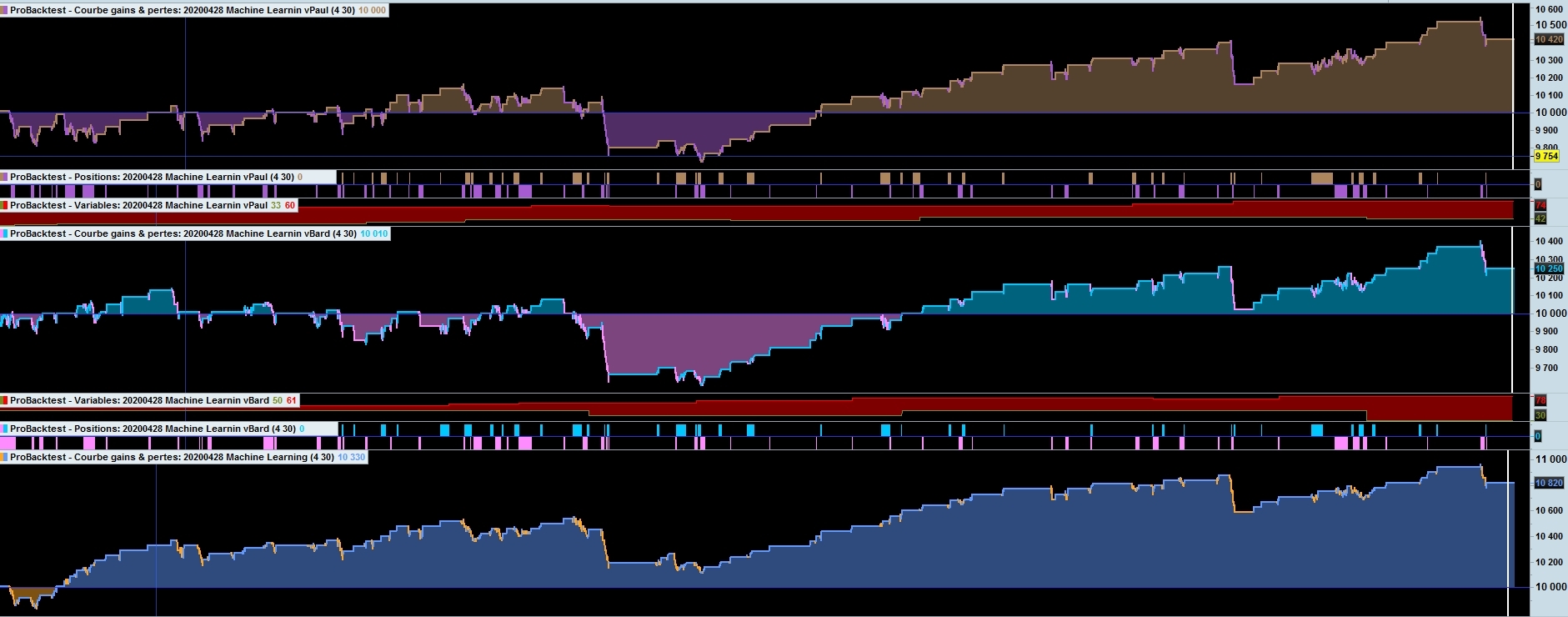
    And I compare your version on page 3, Paul version on pp 20 and Brad version on pp 22 and the results with the same value (4;30) and same code are quite different …

    #128701 quote
    GraHal
    Participant
    Master

    why can’t I get this comment to say GraHal wrote

    Because you need to select the text you want to Quote THEN select the word Quote on the toolbar  … see the red arrowhead on attached.

    I’m glad that’s sorted, but no worries … we got there in the end!? 🙂 🙂

    Bard thanked this post
Viewing 15 posts - 346 through 360 (of 455 total)
  • You must be logged in to reply to this topic.

Machine Learning in ProOrder ProRealTime


ProOrder support

New Reply
Author
author-avatar
juanj @juanj Participant
Summary

This topic contains 454 replies,
has 32 voices, and was last updated by Khaled
4 years ago.

Topic Details
Forum: ProOrder support
Language: English
Started: 08/06/2017
Status: Active
Attachments: 207 files
Logo Logo
Loading...