




More from ProRealCode
ProRealCode - Trading & Coding with ProRealTime™
The ProRealTime™ community on the web! Officially sharing ProRealTime knowledge to Worldwide users since 2015!



Yang-Zhang volatility estimator
February 12, 2016, 1:56 PM
Indicators
2 Comments
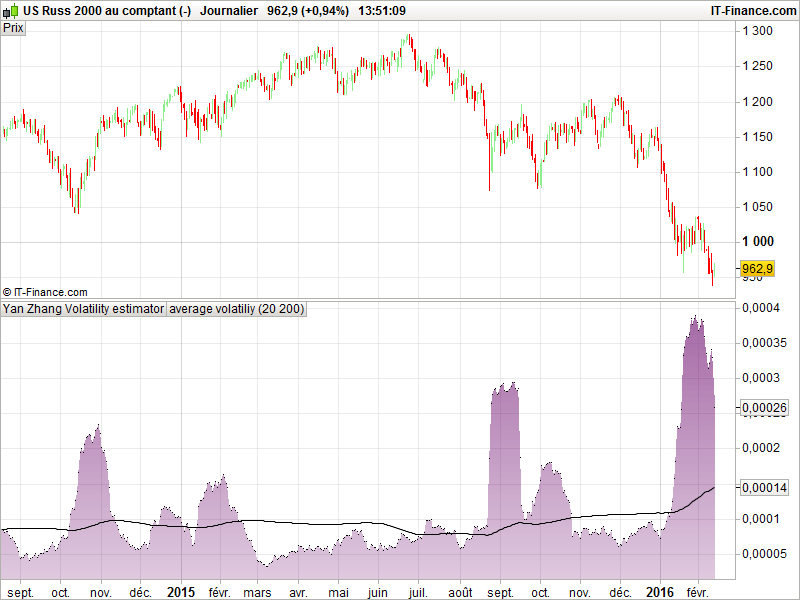
For those interested in options pricing and volatility indicator, here is one that draw recent volatility based on High, Low, Open and Close prices.
For more explanation see this paper : http://atmif.com/papers/range.pdf
//parameters
// n = 20
// averageP = 200

No = log( open ) - log( close[1] )  // normalized open
Nu = log( high ) - log( open )             // normalized high
Nd = log( low ) - log( open )              // normalized low
Nc = log( close ) - log( open )            // normalized close

Vrs = 1 / n * Summation[n]( Nu * ( Nu - Nc ) + Nd * ( Nd - Nc ))  // RS volatility estimator

Noavg = 1 / n * Summation[n](No)
Vo = 1 / ( n - 1 ) * Summation[n]( SQUARE( No - Noavg ) )

Ncavg = 1 / n * Summation[n]( Nc )
Vc = 1 / ( n - 1 ) * Summation[n]( SQUARE( Nc - Ncavg ) )

k = 0.34 / ( 1.34 + ( n + 1 ) / ( n - 1 ) )

Vyangzhang = Vo + k * Vc + ( 1 - k ) * Vrs

avg = average[averageP](Vyangzhang)

return Vyangzhang, avg as "average volatiliy"
code adapted from AmiBroker
Download
Filename:
Yan-Zhang-Volatility-estimator.itf
Downloads:
103
New
This author is like an anonymous function, present but not directly identifiable. More details on this code architect as soon as they exit 'incognito' mode.
Author’s Profile
Similar code

Option Expiration DatesIndicators
Waddah Attar ADXxBollingerIndicators
Volatility Switch indicatorIndicators
ATR Volatility Based System Jim BergIndicators
Number of ticks per secondIndicators

Loading...
I think to have annualized view of this historical volatility you will need : Vyangzhang = SQRT(Vo + k * Vc + ( 1 - k ) * Vrs) *SQRT(252)