




More from ProRealCode
ProRealCode - Trading & Coding with ProRealTime™



ABC on Recursive Zigzag
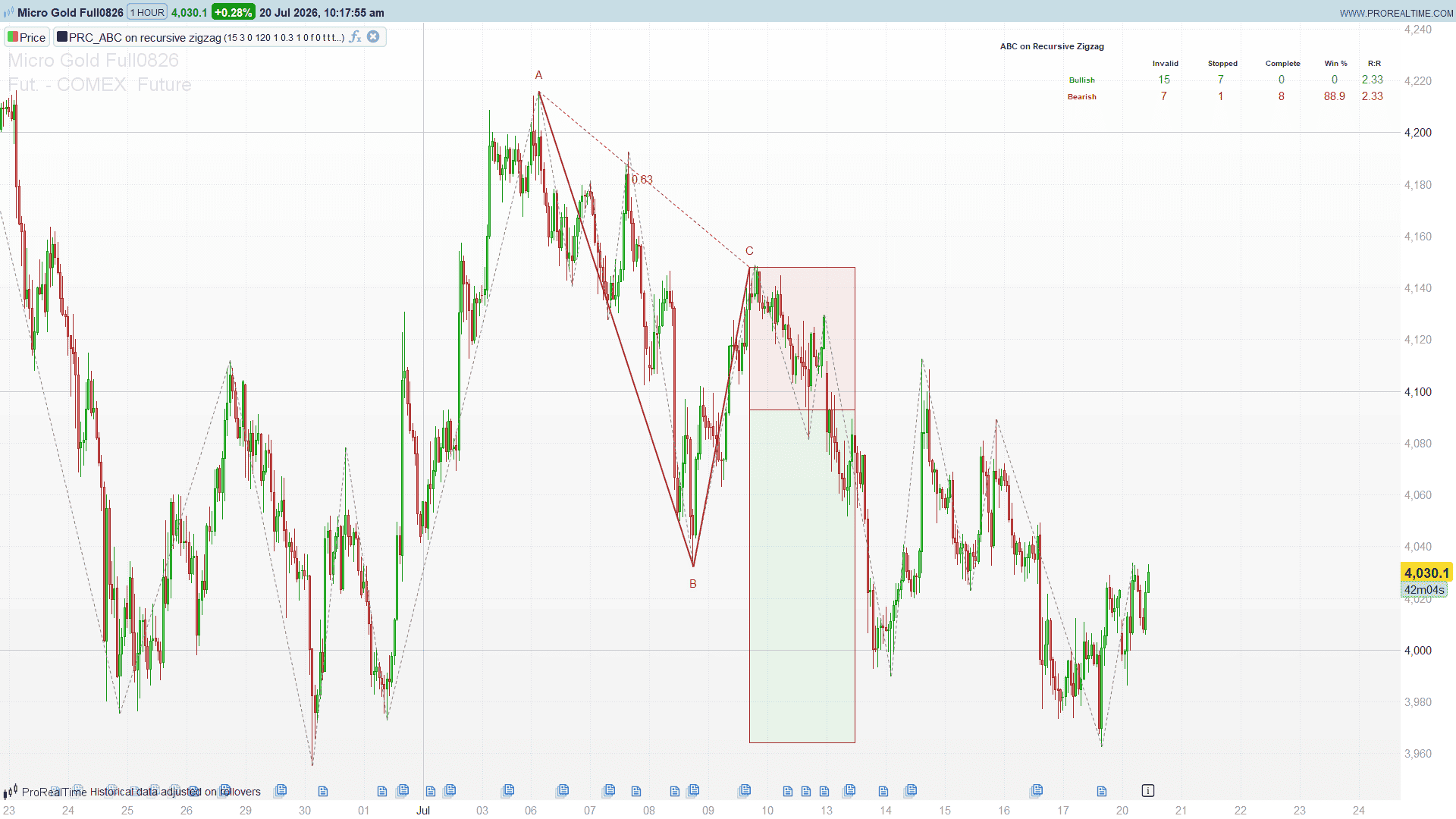
1. Introduction
Most pattern detectors work at a single scale. They pick one pivot lookback, find the swings it produces, and everything larger or smaller than that is invisible. The consequence is familiar: a clean ABC on the 4-hour structure goes unnoticed because the indicator is busy tracking 20-bar noise.
This indicator, adapted to ProBuilder from the “ABC on Recursive Zigzag [Trendoscope]” pinescript, takes a different route. It builds a recursive zigzag: level 0 is an ordinary zigzag, level 1 is the zigzag of level 0’s pivots, level 2 the zigzag of level 1’s, and so on. The same ABC pattern is then searched at every level simultaneously, so small and large structures are detected by one indicator on one chart, without changing a setting.
Each valid pattern projects its entry, stop and target, is tracked bar by bar until it resolves, and feeds a statistics panel that keeps score of what actually happened.
2. How It Works
The recursive zigzag. Level 0 marks a pivot whenever the current bar holds the highest high or lowest low of the last zigzagLength bars. Each higher level is then distilled from the one below it: a pivot survives to the next level only if it is an extreme within its own series, meaning a high must exceed both the previous high and the following high. Consecutive pivots of the same type are collapsed onto the most extreme one, so every level comes out properly alternating.
Pivot classification. Every pivot carries a direction flag that says whether it extended the structure or merely retraced it. A high that exceeds the previous high is a supersession (higher high); a high that fails to is a retracement (lower high). Lows work in mirror. This classification is recomputed at each level, because a pivot can be a higher high on the base zigzag and not on the level above it.
Pattern validation. At each level the last three pivots are read as A, B and C. The pattern is accepted when leg BC retraces between 61.8% and 78.6% of leg AB. An optional filter then restricts which combinations of pivot types are allowed:
- any – no filter
- trend – A retraced, B superseded
- reverse – A superseded, B retraced
- contracting – both A and B retraced
- expanding – both A and B superseded
Trade levels. From point C the indicator projects three levels, using either the ABC extension (the AB impulse) or the BC retracement as the base:
Level(ratio) = C + span x ratio
with span = B - A for the extension mode and span = B - C for the retracement mode. Entry, target and stop each have their own ratio, and a logarithmic mode is available for instruments where proportional moves matter more than absolute ones.
Tracking. A pattern starts as pending. It becomes entered when price reaches the entry level and complete when it reaches the target. It closes as invalid if price breaks the stop before entering, or as stopped if it breaks the stop after entering. Every closed pattern is added to the statistics panel.
3. Reading the Indicator
- Solid A-B and B-C lines: the impulse and its retracement, in green for bullish setups and red for bearish.
- Dotted A-C line: the guide connecting the outer points of the structure.
- Number at the middle of A-C: the measured BC/AB retracement ratio.
- Red box: the risk area, from entry down to stop.
- Green box: the reward area, from entry up to target.
- Grey dotted structures: patterns that have already resolved, kept on the chart as context so the recent history stays readable.
- Top-right panel: invalidated, stopped and completed counts for each direction, plus the win ratio and the theoretical risk-reward of the current settings.
4. Trading Applications
- Multi-scale confluence: when patterns from two different levels point the same way in the same area, the structure is agreeing with itself across scales.
- Ready-made invalidation: the stop level is part of the pattern definition, not an afterthought. A setup that breaks it is removed rather than left on the chart to be rationalised later.
- Setting comparison: the panel makes it easy to see how the entry, target and stop ratios trade off against each other. A tighter entry fills more often but leaves less room; the win ratio and R:R columns show both sides of that trade at once.
- Condition filtering: the trend and reverse modes separate continuation setups from counter-trend ones, which behave very differently on most instruments.
5. Parameters
- zigzagLength (default 13): lookback for the base zigzag. Larger values give fewer and bigger swings.
- maxLevel (default 3): how many recursive levels to scan. In practice the useful ceiling is set by
maxPivots, not by this value. - minLevel (default 0): skip the smallest levels by raising this.
- maxPivots (default 120): how many base pivots feed the scan. This is the real performance lever, and also what limits how many levels can form.
- baseMode (default 1): 1 = ABC extension, 2 = BC retracement.
- entryRatio / targetRatio / stopRatio (0.3 / 1.0 / 0.0): the three projected levels.
stopRatioshould stay at or below zero. - useLogScale (default 0): compute the projections on a logarithmic scale.
- tradeCondition (default 0): 0 any, 1 trend, 2 reverse, 3 contracting, 4 expanding.
- useCloseEntry / useCloseTarget / useCloseStop: track with closing prices instead of intrabar extremes.
- maxPatterns (default 10): how many patterns stay active at once.
- showClosed / maxClosed (1 / 6): keep the last resolved patterns on the chart in grey.
- showZigzag / showBoxes / showStats: toggle the base zigzag, the risk-reward boxes and the panel.
6. A Note on Repainting
The underlying zigzag does not wait for confirmation: a pivot is marked as soon as the current bar holds the extreme of its window, which means the most recent pivot can still move while its bar is forming. This is by design in the original and it is preserved here, but it has a practical consequence worth stating plainly: the newest pattern on the chart is provisional until the swing that defines it is complete. Completed patterns and the statistics panel are unaffected, as they only count structures that have already resolved.
The panel is a running tally over the loaded history, not a backtest. It ignores costs, slippage and the fact that several patterns can overlap. Use it to compare settings against each other, not to validate a strategy.
7. ABC on Recursive Zigzag Code
//-----------------------------------------------------------//
//PRC_ABC on Recursive Zigzag (by Trendoscope)
//version = 0
//20.07.26
//Ivan Gonzalez @ www.prorealcode.com
//Sharing ProRealTime knowledge
//-----------------------------------------------------------//
// Detecta patrones ABC sobre un zigzag recursivo multinivel.
// C debe retroceder entre el 61.8% y el 78.6% de la pata AB.
// Proyecta entrada / stop / objetivo y sigue el estado de cada
// patron hasta su cierre, con panel de estadisticas.
//-----------------------------------------------------------//
defparam drawonlastbaronly = true
//-----Inputs (parametros configurables)---------------------//
zigzagLength = 13 //Longitud del zigzag de nivel 0
maxLevel = 3 //Nivel maximo de zigzag recursivo (0 = solo base)
minLevel = 0 //Nivel minimo a escanear
maxPivots = 120 //Pivotes de nivel 0 usados en el escaneo
baseMode = 1 //1 = ABC Extension, 2 = BC Retracement
entryRatio = 0.3 //Ratio de entrada
targetRatio = 1.0 //Ratio de objetivo
stopRatio = 0.0 //Ratio de stop (<= 0)
useLogScale = 0 //1 = calcular ratios en escala logaritmica
tradeCondition = 0 //0 any, 1 trend, 2 reverse, 3 contracting, 4 expanding
useCloseEntry = 1 //Usar cierre para detectar la entrada
useCloseTarget = 1 //Usar cierre para detectar el objetivo
useCloseStop = 1 //Usar cierre para detectar el stop
maxPatterns = 10 //Patrones activos simultaneos
showClosed = 0 //1 = mantener en gris los ultimos patrones cerrados
maxClosed = 6 //Cuantos patrones cerrados se conservan en pantalla
showZigzag = 0 //1 = dibujar el zigzag de nivel 0
showBoxes = 1 //1 = dibujar las cajas de riesgo/objetivo
showStats = 1 //1 = mostrar el panel de estadisticas
//-----------------------------------------------------------//
//-----Colores (RGB)-----------------------------------------//
rBull = 0 //alcista
gBull = 150
bBull = 80
rBear = 200 //bajista
gBear = 50
bBear = 50
//-----------------------------------------------------------//
//-----NIVEL 0: deteccion de pivotes-------------------------//
// ZigzagLite marca pivote cuando el extremo de la ventana cae
// en la barra actual (highestbars / lowestbars = 0).
newPivot = 0
IF barindex >= zigzagLength THEN
hb = highestbars[zigzagLength](high)
lb = lowestbars[zigzagLength](low)
IF hb = 0 AND lb <> 0 THEN
pvDir = 1
pvVal = high
ELSIF lb = 0 AND hb <> 0 THEN
pvDir = -1
pvVal = low
ELSIF hb = 0 AND lb = 0 THEN
pvDir = prevDir
IF pvDir = 1 THEN
pvVal = high
ELSE
pvVal = low
ENDIF
ELSE
pvDir = 0
pvVal = 0
ENDIF
IF pvDir <> 0 THEN
IF pvDir = 1 THEN
isHi = 1
ELSE
isHi = 0
ENDIF
// Primer pivote: sembrar sin filtro (learning 155)
IF npv = 0 THEN
$zI[0] = barindex
$zP[0] = pvVal
$zH[0] = isHi
npv = 1
newPivot = 1
ELSE
lastH = $zH[npv-1]
IF lastH = isHi THEN
// Misma direccion: extender el pivote vigente si mejora
lastP = $zP[npv-1]
IF isHi = 1 THEN
IF pvVal > lastP THEN
$zI[npv-1] = barindex
$zP[npv-1] = pvVal
newPivot = 1
ENDIF
ELSE
IF pvVal < lastP THEN
$zI[npv-1] = barindex
$zP[npv-1] = pvVal
newPivot = 1
ENDIF
ENDIF
ELSE
// Cambio de direccion: nuevo pivote
$zI[npv] = barindex
$zP[npv] = pvVal
$zH[npv] = isHi
npv = npv + 1
newPivot = 1
ENDIF
ENDIF
prevDir = pvDir
ENDIF
ENDIF
//-----------------------------------------------------------//
//-----ESCANEO MULTINIVEL (solo cuando hay pivote nuevo)-----//
IF newPivot = 1 AND npv >= 4 THEN
// Cargar la ventana de trabajo desde la capa de acumulacion
startK = npv - maxPivots
IF startK < 0 THEN
startK = 0
ENDIF
nw = 0
FOR k = startK TO npv - 1 DO
$wI[nw] = $zI[k]
$wP[nw] = $zP[k]
$wH[nw] = $zH[k]
nw = nw + 1
NEXT
FOR lev = 0 TO maxLevel DO
IF nw >= 4 THEN
// --- dir de cada pivote: +-1 retroceso, +-2 superacion ---
FOR k = 0 TO nw - 1 DO
IF $wH[k] = 1 THEN
$wD[k] = 1
ELSE
$wD[k] = -1
ENDIF
IF k >= 2 THEN
prevSame = $wP[k-2]
IF $wH[k] = 1 THEN
IF $wP[k] > prevSame THEN
$wD[k] = 2
ENDIF
ELSE
IF $wP[k] < prevSame THEN
$wD[k] = -2
ENDIF
ENDIF
ENDIF
NEXT
// --- Candidato ABC: los tres ultimos pivotes ---
IF lev >= minLevel THEN
cK = nw - 1
bK = nw - 2
aK = nw - 3
pA = $wP[aK]
pB = $wP[bK]
pC = $wP[cK]
iA = $wI[aK]
iB = $wI[bK]
iC = $wI[cK]
legAB = abs(pB - pA)
legBC = abs(pC - pB)
abcRatio = 0
IF legAB > 0 THEN
abcRatio = legBC / legAB
ENDIF
// Filtro de retroceso 0.618 - 0.786
ratioOk = 0
IF abcRatio >= 0.618 AND abcRatio <= 0.786 THEN
ratioOk = 1
ENDIF
// Filtro de condicion sobre |dir| de A y B
aDir = abs($wD[aK])
bDir = abs($wD[bK])
condOk = 0
IF tradeCondition = 0 THEN
condOk = 1
ELSIF tradeCondition = 1 AND aDir = 1 AND bDir = 2 THEN
condOk = 1
ELSIF tradeCondition = 2 AND aDir = 2 AND bDir = 1 THEN
condOk = 1
ELSIF tradeCondition = 3 AND aDir = 1 AND bDir = 1 THEN
condOk = 1
ELSIF tradeCondition = 4 AND aDir = 2 AND bDir = 2 THEN
condOk = 1
ENDIF
IF ratioOk = 1 AND condOk = 1 THEN
// Ya registrado? (mismo A y mismo B)
dup = 0
IF npt > 0 THEN
FOR q = 0 TO npt - 1 DO
IF $ptPA[q] = pA AND $ptPB[q] = pB THEN
dup = 1
ENDIF
NEXT
ENDIF
IF dup = 0 THEN
// Direccion: C por debajo de B = patron alcista
IF pB > pC THEN
pDirn = 1
ELSE
pDirn = -1
ENDIF
// --- Niveles de entrada / objetivo / stop ---
IF useLogScale = 1 AND pA > 0 AND pB > 0 AND pC > 0 THEN
lA = log(pA)
lB = log(pB)
lC = log(pC)
IF baseMode = 1 THEN
spanL = lB - lA
eLvl = exp(lC + spanL * entryRatio)
tLvl = exp(lC + spanL * targetRatio)
sLvl = exp(lC + spanL * stopRatio)
ELSE
spanL = lB - lC
eLvl = exp(lC + spanL * entryRatio)
tLvl = exp(lC + spanL * targetRatio)
sLvl = exp(lC + spanL * stopRatio)
ENDIF
ELSE
IF baseMode = 1 THEN
spanP = pB - pA
ELSE
spanP = pB - pC
ENDIF
eLvl = pC + spanP * entryRatio
tLvl = pC + spanP * targetRatio
sLvl = pC + spanP * stopRatio
ENDIF
// Solo se registra si el precio aun no alcanzo la entrada
inEntry = 0
IF close * pDirn < eLvl * pDirn THEN
inEntry = 1
ENDIF
IF inEntry = 1 THEN
// FIFO: si esta lleno, descartar el mas antiguo
IF npt >= maxPatterns AND npt > 0 THEN
FOR q = 0 TO npt - 2 DO
$ptIA[q] = $ptIA[q+1]
$ptPA[q] = $ptPA[q+1]
$ptIB[q] = $ptIB[q+1]
$ptPB[q] = $ptPB[q+1]
$ptIC[q] = $ptIC[q+1]
$ptPC[q] = $ptPC[q+1]
$ptDir[q] = $ptDir[q+1]
$ptEn[q] = $ptEn[q+1]
$ptSt[q] = $ptSt[q+1]
$ptTg[q] = $ptTg[q+1]
$ptStat[q] = $ptStat[q+1]
$ptRt[q] = $ptRt[q+1]
NEXT
npt = npt - 1
ENDIF
$ptIA[npt] = iA
$ptPA[npt] = pA
$ptIB[npt] = iB
$ptPB[npt] = pB
$ptIC[npt] = iC
$ptPC[npt] = pC
$ptDir[npt] = pDirn
$ptEn[npt] = eLvl
$ptSt[npt] = sLvl
$ptTg[npt] = tLvl
$ptStat[npt] = 0
$ptRt[npt] = abcRatio
npt = npt + 1
ENDIF
ENDIF
ENDIF
ENDIF
// --- Construir el zigzag del nivel siguiente ---
// Se conservan los pivotes que son extremo respecto a su
// homologo anterior y posterior; los consecutivos del mismo
// tipo se colapsan quedandose con el mas extremo.
IF lev < maxLevel THEN
nv = 0
FOR k = 0 TO nw - 1 DO
keep = 1
IF k < nw - 1 THEN
IF k >= 2 THEN
prevSame = $wP[k-2]
IF $wH[k] = 1 THEN
IF $wP[k] < prevSame THEN
keep = 0
ENDIF
ELSE
IF $wP[k] > prevSame THEN
keep = 0
ENDIF
ENDIF
ENDIF
IF k + 2 <= nw - 1 THEN
nextSame = $wP[k+2]
IF $wH[k] = 1 THEN
IF $wP[k] < nextSame THEN
keep = 0
ENDIF
ELSE
IF $wP[k] > nextSame THEN
keep = 0
ENDIF
ENDIF
ENDIF
ENDIF
IF keep = 1 THEN
doPush = 1
IF nv > 0 THEN
prevH = $vH[nv-1]
IF prevH = $wH[k] THEN
doPush = 0
prevP = $vP[nv-1]
IF $wH[k] = 1 THEN
IF $wP[k] > prevP THEN
$vP[nv-1] = $wP[k]
$vI[nv-1] = $wI[k]
ENDIF
ELSE
IF $wP[k] < prevP THEN
$vP[nv-1] = $wP[k]
$vI[nv-1] = $wI[k]
ENDIF
ENDIF
ENDIF
ENDIF
IF doPush = 1 THEN
$vI[nv] = $wI[k]
$vP[nv] = $wP[k]
$vH[nv] = $wH[k]
nv = nv + 1
ENDIF
ENDIF
NEXT
// Volcar el nivel construido a la ventana de trabajo
FOR k = 0 TO nv - 1 DO
$wI[k] = $vI[k]
$wP[k] = $vP[k]
$wH[k] = $vH[k]
NEXT
nw = nv
ENDIF
ENDIF
NEXT
ENDIF
//-----------------------------------------------------------//
//-----SEGUIMIENTO DE PATRONES ACTIVOS (cada barra)----------//
IF npt > 0 THEN
nAlive = 0
FOR k = 0 TO npt - 1 DO
pdr = $ptDir[k]
stt = $ptStat[k]
IF useCloseTarget = 1 THEN
vTarget = close
ELSIF pdr > 0 THEN
vTarget = high
ELSE
vTarget = low
ENDIF
IF useCloseStop = 1 THEN
vStop = close
ELSIF pdr > 0 THEN
vStop = low
ELSE
vStop = high
ENDIF
IF useCloseEntry = 1 THEN
vEntry = close
ELSIF pdr > 0 THEN
vEntry = high
ELSE
vEntry = low
ENDIF
// Estado: 0 pendiente, 1 entrada alcanzada, 2 objetivo alcanzado
newStat = stt
IF vEntry * pdr >= $ptEn[k] * pdr THEN
newStat = 1
ENDIF
IF vTarget * pdr >= $ptTg[k] * pdr THEN
newStat = 2
ENDIF
IF newStat < stt THEN
newStat = stt
ENDIF
// Cierre: stop tocado tras entrar, invalidacion antes de entrar,
// u objetivo ya alcanzado
closed = 0
IF newStat > 0 AND vStop * pdr <= $ptSt[k] * pdr THEN
closed = 1
ENDIF
IF newStat = 0 AND close * pdr <= $ptSt[k] * pdr THEN
closed = 1
ENDIF
IF stt = 2 THEN
closed = 1
ENDIF
$ptStat[k] = newStat
IF closed = 1 THEN
// Conservar el patron cerrado para seguir mostrandolo en gris.
// No altera deteccion ni estadisticas: solo evita que el grafico
// quede vacio cuando no hay ningun patron activo.
IF showClosed = 1 AND maxClosed > 0 THEN
IF nhs >= maxClosed THEN
FOR q = 0 TO nhs - 2 DO
$hsIA[q] = $hsIA[q+1]
$hsPA[q] = $hsPA[q+1]
$hsIB[q] = $hsIB[q+1]
$hsPB[q] = $hsPB[q+1]
$hsIC[q] = $hsIC[q+1]
$hsPC[q] = $hsPC[q+1]
$hsRt[q] = $hsRt[q+1]
NEXT
nhs = nhs - 1
ENDIF
$hsIA[nhs] = $ptIA[k]
$hsPA[nhs] = $ptPA[k]
$hsIB[nhs] = $ptIB[k]
$hsPB[nhs] = $ptPB[k]
$hsIC[nhs] = $ptIC[k]
$hsPC[nhs] = $ptPC[k]
$hsRt[nhs] = $ptRt[k]
nhs = nhs + 1
ENDIF
// Registrar en el contador correspondiente
IF pdr > 0 THEN
IF newStat = 0 THEN
bullInvalid = bullInvalid + 1
ELSIF newStat = 1 THEN
bullStopped = bullStopped + 1
ELSE
bullDone = bullDone + 1
ENDIF
ELSE
IF newStat = 0 THEN
bearInvalid = bearInvalid + 1
ELSIF newStat = 1 THEN
bearStopped = bearStopped + 1
ELSE
bearDone = bearDone + 1
ENDIF
ENDIF
ELSE
// Compactar: los vivos se reubican al principio del array
$ptIA[nAlive] = $ptIA[k]
$ptPA[nAlive] = $ptPA[k]
$ptIB[nAlive] = $ptIB[k]
$ptPB[nAlive] = $ptPB[k]
$ptIC[nAlive] = $ptIC[k]
$ptPC[nAlive] = $ptPC[k]
$ptDir[nAlive] = $ptDir[k]
$ptEn[nAlive] = $ptEn[k]
$ptSt[nAlive] = $ptSt[k]
$ptTg[nAlive] = $ptTg[k]
$ptStat[nAlive] = $ptStat[k]
$ptRt[nAlive] = $ptRt[k]
nAlive = nAlive + 1
ENDIF
NEXT
npt = nAlive
ENDIF
//-----------------------------------------------------------//
//-----DIBUJO (solo en la ultima barra)----------------------//
IF islastbarupdate THEN
atrv = averagetruerange[14]
// --- Zigzag de nivel 0 ---
IF showZigzag = 1 AND npv >= 2 THEN
firstK = npv - 30
IF firstK < 1 THEN
firstK = 1
ENDIF
FOR k = firstK TO npv - 1 DO
drawsegment($zI[k-1], $zP[k-1], $zI[k], $zP[k]) coloured(130, 130, 130) style(dottedline, 1)
NEXT
ENDIF
// --- Patrones ya cerrados (contexto historico, en gris) ---
IF showClosed = 1 AND nhs > 0 THEN
FOR k = 0 TO nhs - 1 DO
drawsegment($hsIA[k], $hsPA[k], $hsIB[k], $hsPB[k]) coloured(150, 150, 150) style(dottedline, 1)
drawsegment($hsIB[k], $hsPB[k], $hsIC[k], $hsPC[k]) coloured(150, 150, 150) style(dottedline, 1)
drawtext("A", $hsIA[k], $hsPA[k]) coloured(150, 150, 150)
drawtext("B", $hsIB[k], $hsPB[k]) coloured(150, 150, 150)
drawtext("C", $hsIC[k], $hsPC[k]) coloured(150, 150, 150)
NEXT
ENDIF
// --- Patrones activos ---
IF npt > 0 THEN
FOR k = 0 TO npt - 1 DO
IF $ptDir[k] > 0 THEN
pr = rBull
pg = gBull
pb = bBull
ELSE
pr = rBear
pg = gBear
pb = bBear
ENDIF
xA = $ptIA[k]
yA = $ptPA[k]
xB = $ptIB[k]
yB = $ptPB[k]
xC = $ptIC[k]
yC = $ptPC[k]
// Estructura A-B-C y linea guia A-C
drawsegment(xA, yA, xB, yB) coloured(pr, pg, pb) style(line, 2)
drawsegment(xB, yB, xC, yC) coloured(pr, pg, pb) style(line, 2)
drawsegment(xA, yA, xC, yC) coloured(pr, pg, pb) style(dottedline, 1)
// Etiquetas de los pivotes, desplazadas fuera de la vela
IF yA < yB THEN
offA = 0 - atrv * 0.4
offB = atrv * 0.4
ELSE
offA = atrv * 0.4
offB = 0 - atrv * 0.4
ENDIF
drawtext("A", xA, yA + offA) coloured(pr, pg, pb)
drawtext("B", xB, yB + offB) coloured(pr, pg, pb)
drawtext("C", xC, yC + offA) coloured(pr, pg, pb)
// Ratio de retroceso en el punto medio de A-C
midX = (xA + xC) / 2
midY = (yA + yC) / 2
rtx = round($ptRt[k] * 1000) / 1000
drawtext("#rtx#", midX, midY) coloured(pr, pg, pb)
// Cajas de riesgo y objetivo
IF showBoxes = 1 THEN
barDiff = min((xC - xA) / 2, 490)
IF barDiff < 5 THEN
barDiff = 5
ENDIF
xEnd = xC + barDiff
drawrectangle(xC, $ptEn[k], xEnd, $ptSt[k]) coloured(pr, pg, pb) fillcolor(200, 60, 60, 20)
drawrectangle(xC, $ptEn[k], xEnd, $ptTg[k]) coloured(pr, pg, pb) fillcolor(60, 200, 60, 20)
ENDIF
NEXT
ENDIF
// --- Panel de estadisticas ---
IF showStats = 1 THEN
bullClosed = bullDone + bullStopped
IF bullClosed > 0 THEN
bullWin = bullDone * 100 / bullClosed
ELSE
bullWin = 0
ENDIF
bearClosed = bearDone + bearStopped
IF bearClosed > 0 THEN
bearWin = bearDone * 100 / bearClosed
ELSE
bearWin = 0
ENDIF
riskSpan = entryRatio - stopRatio
IF riskSpan > 0 THEN
rrv = round((targetRatio - entryRatio) / riskSpan * 100) / 100
ELSE
rrv = 0
ENDIF
bwin = round(bullWin * 10) / 10
swin = round(bearWin * 10) / 10
pX = -530
pY = -30
drawtext("ABC on Recursive Zigzag", pX, pY, sansserif, bold, 11) coloured(60, 60, 60) ANCHOR(TOPRIGHT, XSHIFT, YSHIFT)
drawtext("Invalid", pX + 150, pY - 22, sansserif, bold, 10) coloured(60, 60, 60) ANCHOR(TOPRIGHT, XSHIFT, YSHIFT)
drawtext("Stopped", pX + 225, pY - 22, sansserif, bold, 10) coloured(60, 60, 60) ANCHOR(TOPRIGHT, XSHIFT, YSHIFT)
drawtext("Complete", pX + 305, pY - 22, sansserif, bold, 10) coloured(60, 60, 60) ANCHOR(TOPRIGHT, XSHIFT, YSHIFT)
drawtext("Win %", pX + 375, pY - 22, sansserif, bold, 10) coloured(60, 60, 60) ANCHOR(TOPRIGHT, XSHIFT, YSHIFT)
drawtext("R:R", pX + 425, pY - 22, sansserif, bold, 10) coloured(60, 60, 60) ANCHOR(TOPRIGHT, XSHIFT, YSHIFT)
drawtext("Bullish", pX + 40, pY - 44, sansserif, bold, 10) coloured(rBull, gBull, bBull) ANCHOR(TOPRIGHT, XSHIFT, YSHIFT)
drawtext("#bullInvalid#", pX + 150, pY - 44) coloured(rBull, gBull, bBull) ANCHOR(TOPRIGHT, XSHIFT, YSHIFT)
drawtext("#bullStopped#", pX + 225, pY - 44) coloured(rBull, gBull, bBull) ANCHOR(TOPRIGHT, XSHIFT, YSHIFT)
drawtext("#bullDone#", pX + 305, pY - 44) coloured(rBull, gBull, bBull) ANCHOR(TOPRIGHT, XSHIFT, YSHIFT)
drawtext("#bwin#", pX + 375, pY - 44) coloured(rBull, gBull, bBull) ANCHOR(TOPRIGHT, XSHIFT, YSHIFT)
drawtext("#rrv#", pX + 425, pY - 44) coloured(rBull, gBull, bBull) ANCHOR(TOPRIGHT, XSHIFT, YSHIFT)
drawtext("Bearish", pX + 40, pY - 66, sansserif, bold, 10) coloured(rBear, gBear, bBear) ANCHOR(TOPRIGHT, XSHIFT, YSHIFT)
drawtext("#bearInvalid#", pX + 150, pY - 66) coloured(rBear, gBear, bBear) ANCHOR(TOPRIGHT, XSHIFT, YSHIFT)
drawtext("#bearStopped#", pX + 225, pY - 66) coloured(rBear, gBear, bBear) ANCHOR(TOPRIGHT, XSHIFT, YSHIFT)
drawtext("#bearDone#", pX + 305, pY - 66) coloured(rBear, gBear, bBear) ANCHOR(TOPRIGHT, XSHIFT, YSHIFT)
drawtext("#swin#", pX + 375, pY - 66) coloured(rBear, gBear, bBear) ANCHOR(TOPRIGHT, XSHIFT, YSHIFT)
drawtext("#rrv#", pX + 425, pY - 66) coloured(rBear, gBear, bBear) ANCHOR(TOPRIGHT, XSHIFT, YSHIFT)
ENDIF
ENDIF
//-----------------------------------------------------------//
return