



Swing Trading: Definition and Strategy (Complete Guide)
Swing Trading is a medium-term trading strategy adapted to all financial markets and particularly popular with traders. Explanations.
Swing Trading, a very popular medium-term trading strategy
You want to generate additional income through Trading but can’t necessarily allow you to follow your positions in real time: don’t panic, Swing Trading is surely made for you.

The mere idea of spending three hours a day taped in front of your screen at Trader without interruption doesn’t appeal to you, and yet you would like to have active management of your capital rather than passively investing for the long term?
Then it is quite possible that a medium-term strategy such as Swing Trading is perfectly adapted to your expectations!
What is Swing Trading?
Definition of Swing Trading
By definition, Swing Trading is a speculative practice whose objective is to produce a capital gain in the medium term (in a few days or even weeks).
Highly prized by independent traders, swing trading is a way of actively managing one’s financial capital in the same way as shorter-term approaches such as scalping (a few seconds to a few minutes per trade) and day trading (from a few minutes to a few hours).
Adapted to the different financial markets, this Trading strategy can be practiced in the following ways
both in buying (long position) and selling (short position).
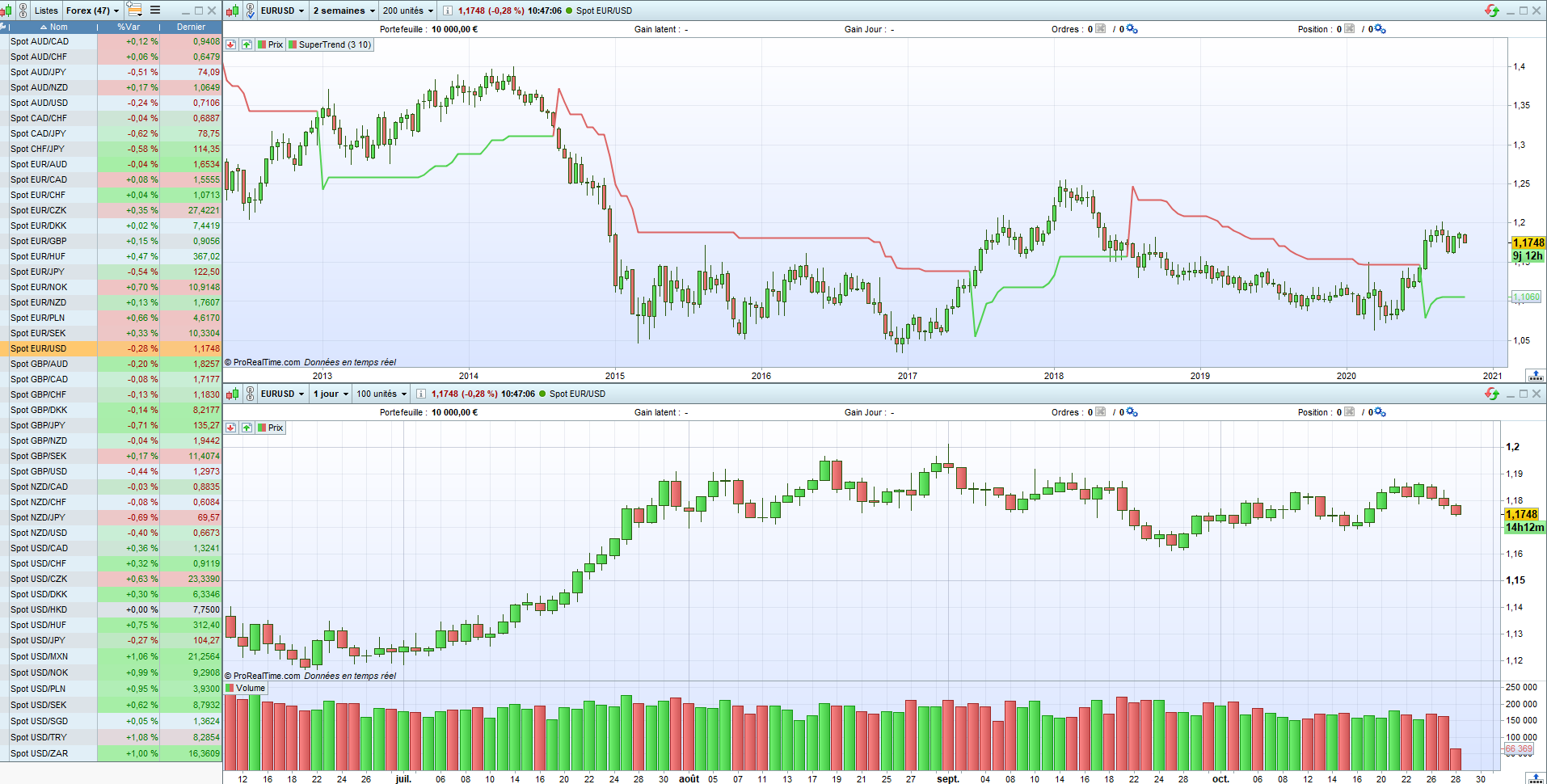
NB: The Swing Trader will often opt for stock charts in “Day” or “Week” time units.
Generate profits with Swing Trading
In English, the term “Swing” defines the strategy behind the practice of Swing Trading, since the Swing Trader optimizes his positions in order to take advantage of stock price oscillations.
Thus, the historical repetition of the cycles of a financial asset over a given period can guide the Trader in his technical analysis. The latter will then take advantage of the volatility of the financial markets to identify the optimal entry point.
If timing is essential for the Swing Trader, it is equally important for him to know how to follow the trend as long as possible in order to maximize the capital gain, and in fine, to optimize his profit/loss ratio.
Why Swing Trading?
Advantages of Swing Trading
The practice of Swing Trading is very popular with Traders all over the world for many reasons:
- requires little time in front of the screen;
- allows you to place your orders more serenely;
- can generate additional income;
- is accessible through current trading platforms and tools;
- is accessible from just a few hundred euros thanks to the leverage effect;
- can be used on all financial markets (FOREX, shares, indices, bonds, commodities…).
The risks of Swing Trading
As with any trading strategy, swing trading involves several risks due to the time spent in the position:
- gap overnight (Trades being passed over several days);
- unanticipated monetary, economic or geopolitical event;
- more costly commissions, particularly in the case of leverage.
Caution, in addition to the specific risks set out above, the risks of loss that are naturally incumbent on the practice of Trading must also be taken into account.
How to trade in Swing Trading?
Swing Trading in 4 steps
There are four steps to good Swing Trading practice for the investor who wants to increase his income while controlling his risk over the long term.
#1: Choosing a financial asset
The first step is the choice of the financial asset on which you are going to trade. This is a complex choice given the number of assets in circulation on the financial markets, but the most liquid, volatile and low commission financial products are generally those preferred by Swing Traders.
#2: Analyze the current trend
There are three main approaches to studying the trend of a stock market asset:
- fundamental analysis
- graphic or technical analysis
- behavioral analysis
Far from being mutually exclusive, these three approaches can be complementary, and the study of economic information (specific to fundamental analysis) can be completed by the judicious choice of a few technical indicators.
#3: Choosing your point of entry
Identifying bullish, bearish or range trends is not enough to take a position in Swing Trading. Knowing how to anticipate corrections and rebounds, as well as trend reinforcements and reversals, can help you avoid heavy capital losses.
#4: Managing risks
Even professional traders register occasional losses. The point is not to avoid them, but to maximize the profits generated by winning trades while limiting capital losses (which are still inevitable).
From this perspective, risk management is a vital notion.
Here are three keys to Money Management that can contribute to your success, not on a whim, but in the long run:
- never take a position without placing a Stop Loss order (in the case of a losing Trade, the latter will automatically be triggered to cut your losses in time) ;
- possibly use Trading algorithms to delegate certain aspects of decision making that are too subject to the instability of human psychology;
- set weekly, monthly, quarterly or even annual profit targets and compare them to your actual results in order to regularly identify areas for improvement.
If for some, technical analysis is sufficient to succeed in Swing Trading, for others, the more global vision provided by fundamental analysis and behavioural analysis is necessary to better understand trend movements and not be surprised. The choice is yours!
As a medium-term speculative practice, Swing Trading has many attractions for the Independent Trader who wishes to round out his month-end; however, remember that your success on the financial markets must always be thought in the long term. Therefore, remain prudent in all circumstances.

