Hi PRT traders,
a post to open a discussion / share some observations on the effects of stop losses and dynamic position sizing. I have built a swing trading system that works across equities, energies, metals, here I’ll use the results on gold as an example but the ideas/thoughts apply to all markets. To give a bit of background, the system uses a library price patterns based of comparing sequences of daily bars and then enters long/short when conditions are met. Stop loss is set as a multiple of the ATR. Positions are held for approx 2 weeks. I’d like to share the following observations and get peoples thoughts on the effect of position sizing and stop loss placement…
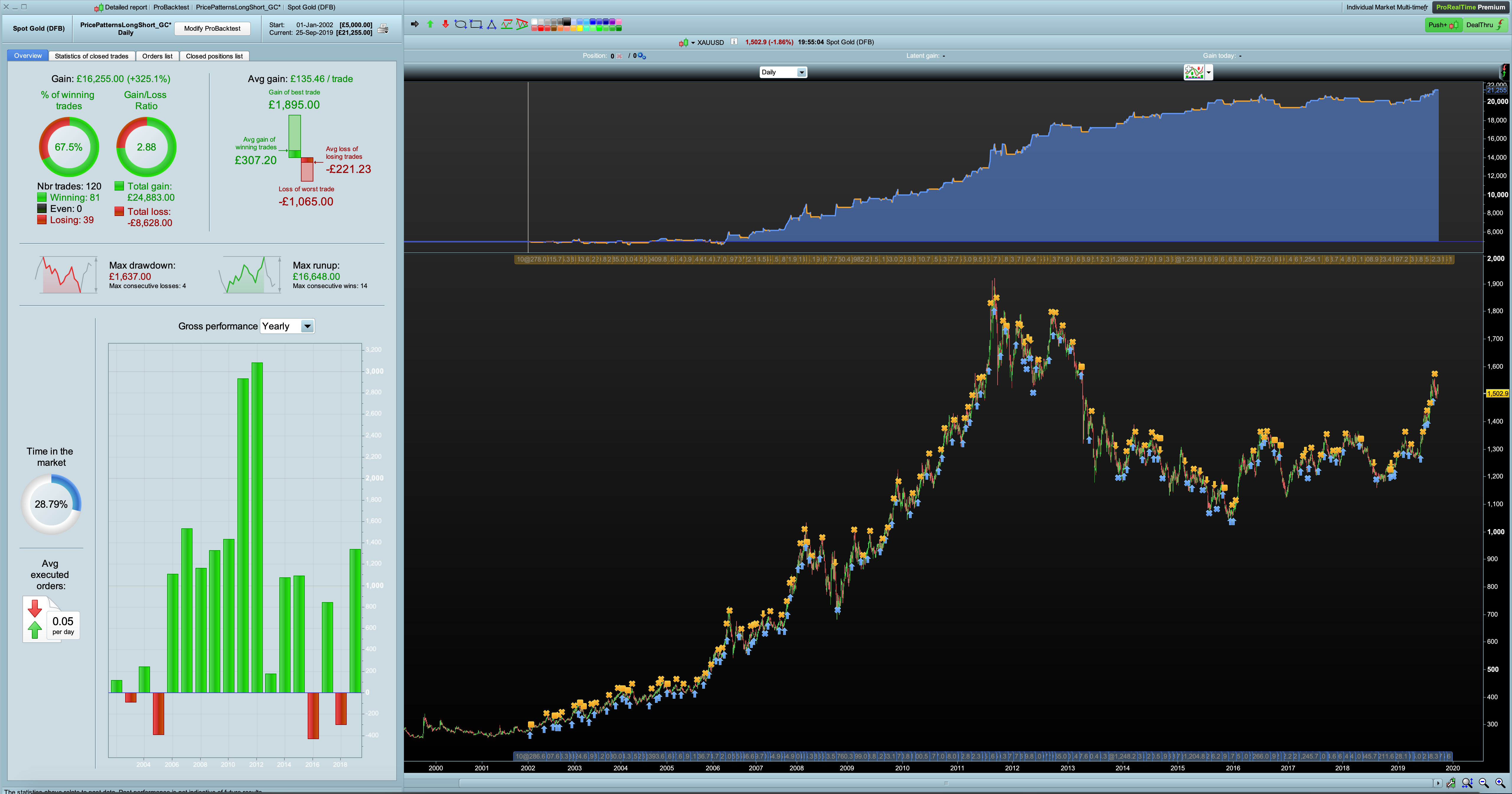
- the simplest system has a stop loss that is 3*ATR away from the entry, positions size is fixed (in this instance £10 per point), and positions are closed after 12 days. The system delivers nice results ~67% win rate, profit factor > 2.5, reasonable drawdown etc (see attached plots)
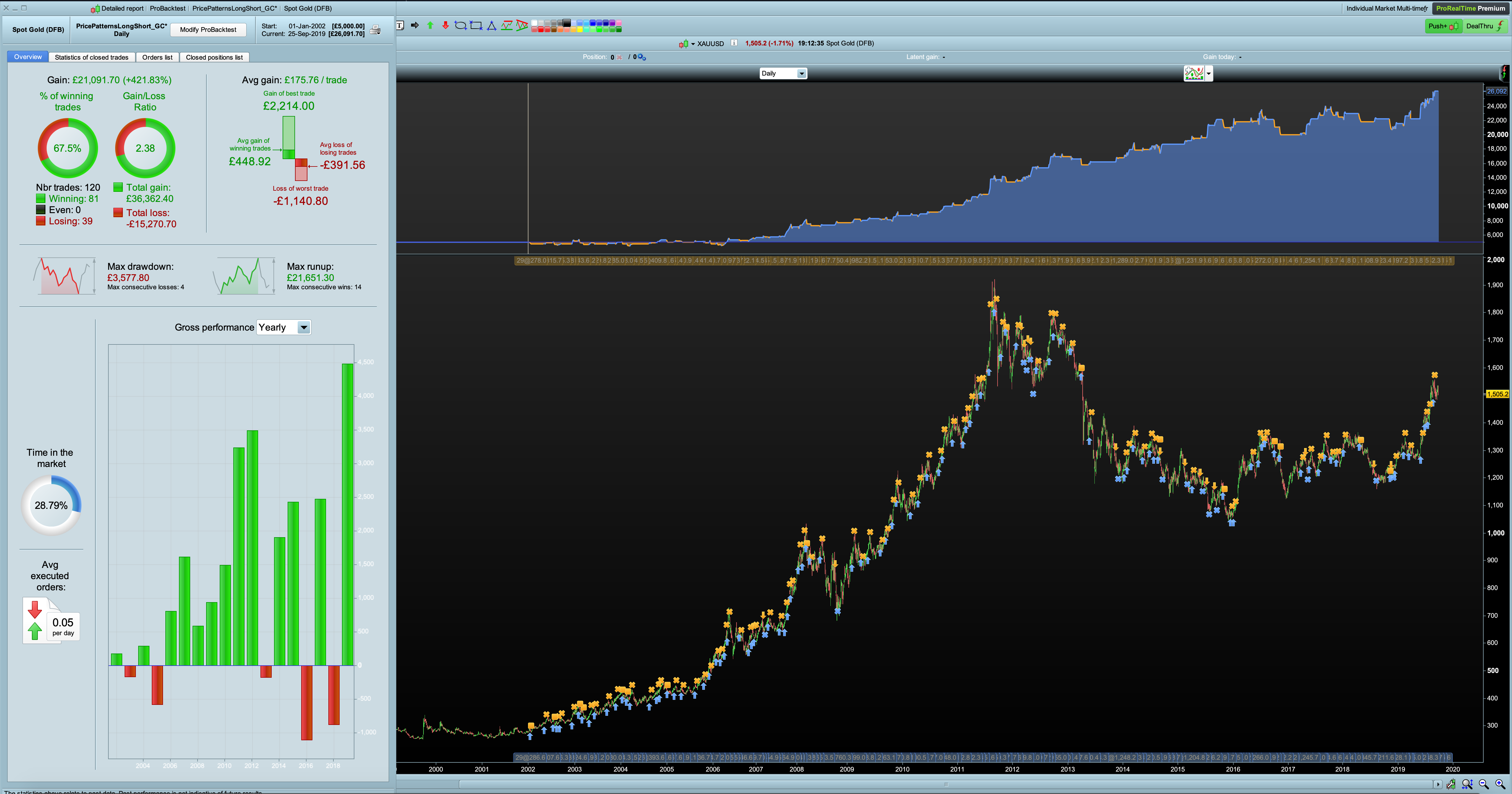
- I then add dynamic position sizing, where the size of the position is proportional to percentage of account equity and the distance to the stop loss. Here we take advantage of compounding. Keeping a 3*ATR stop you can see that we get a significant improvement in overall gain, profit factor goes down a bit, average trade increases.
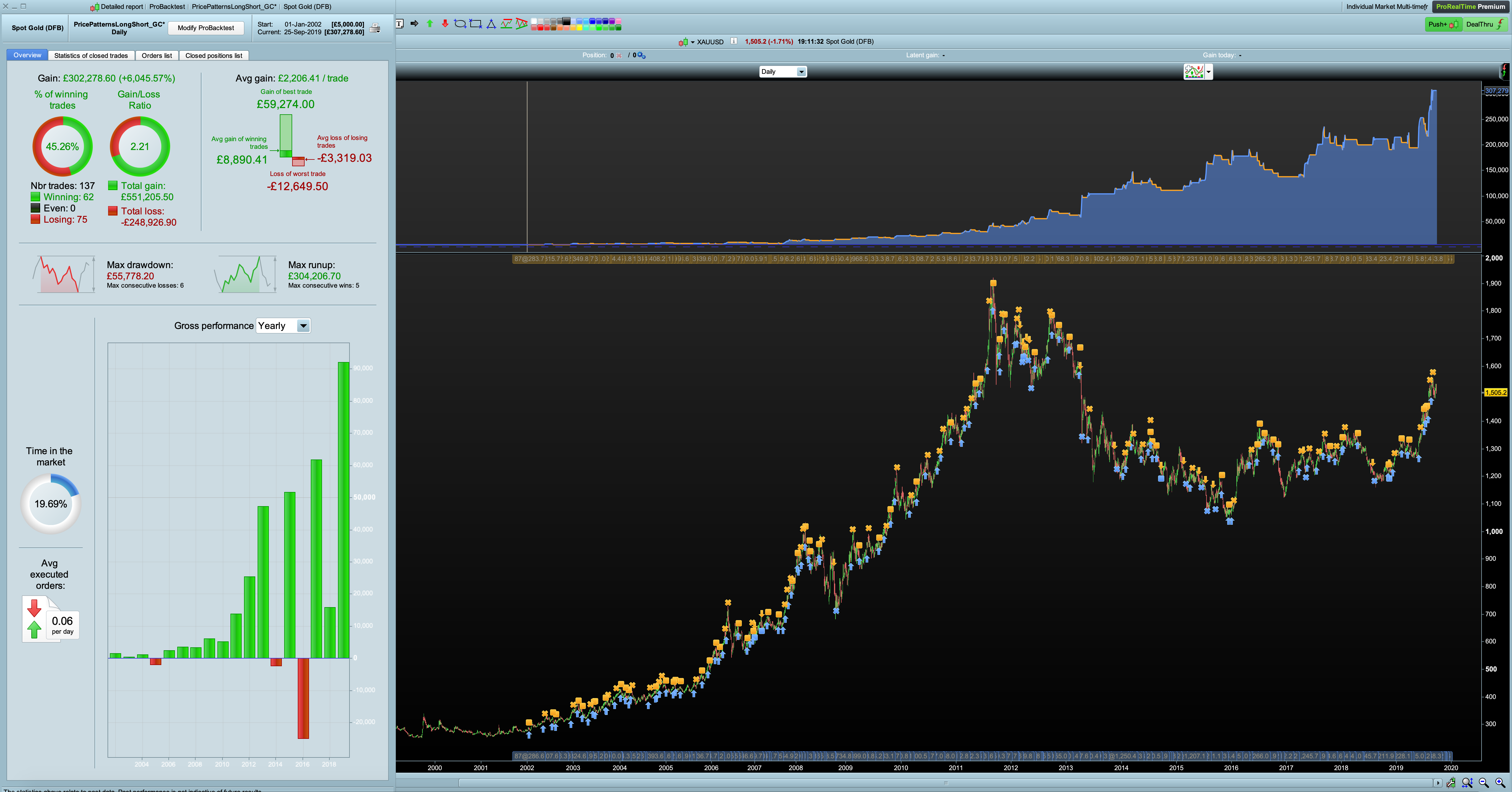
- If I then run an optimisation on the ATR multiple the most profitable model is the one with 1*ATR. You can see that the gain here is huge, an increase from 300% over 10 years to 6000%. However, because we’ve tightened up the stop we drop the win rate to 45% (from 67%) we also drop the profit factor a bit but massively increase the average trade. We also have much more pronounced drawdowns.
Im interested to gain peoples opinion on the various trade offs that are clearly at play here. The system that delivers 6000% is clearly attractive, but so is the smooth equity curve and high win rate of the simple systems. How do you guys balance these kinds of trade offs? I’d be very interested to hear other perspectives here.
All the best,
Thally.
Without going into spesifics of the screenshots youve posted, i want to add my own thoughts as well as what ive learned thru podcasts and books.
In his book “building algorithmic trading systems” Kevin Davey talks about position sizing and from extensive testing on his own(!) systems he has found that the best position sizing is a fixed amount. He argues that because you never know if a trade is going to be profitable or not, its better to not “disturb” the EQ line with huge drops or huge gains, but rather to have a fixed size so that EQ line dont appear so volatile. This will help when putting together a portfolio of strategies that behave somewhat similar and dosnt have huge volatility.
This makes sense in my head. I dont know if the next trade is more certain, or less certain, to be a winning trade, therefor if every position is the same amount of contracts, my edge will show in the EQ line eventually, that is if i have an edge hehe.
You might have a good system, but if you decide to increase position size on say the next 3 trades and they all loose, its going to cost you more then you’d like.
I didnt quite understand ur photos. There has to be a huge important factor your forgetting? I mean how can max DD go from 1.600 -> -> 3.500 -> 55.000, and same with the profits going from “small” to HUGE? Are you adding on a huge amount of contracts? Is that something you can actually afford running? if not i think the answer is clear.
My final thoughts would be to keep things simple and as little complicated as possible. I would definitly work towards an even as possible profit from year to year rather than having huge profits in 1-2 years and small profits in the next 3.
I would always give my vote to the version that stresses the wallet the least.
Thanks for your interesting comments Jebus. Perhaps I didn’t explain the system properly. Here goes..
System 1 just enters a fixed position size throughout the entirety of the back test with a 3ATR stop loss
System 2 uses a money management technique whereby the position size changes depending on (a) the amount of equity in the account and (b) the distance between the stop loss and the entry price. In this case we always risk 1% of equity, but as the equity in the account grows so does our position size. Similarly, under low volatility conditions we also enter larger position sizes because the ATR value will be lower. This system also uses a 3ATR stop-loss
System 3 is the same as system 2, however we have tightened up the stop loss to 1ATR. This has the effect of (a) reducing our win rate from 67% to 45%, but (b) increasing our position size 3 fold. The outcome of this is the massive jump in net profit, but also a concomitant increase in drawdown. The absolute value of the drawdown given in the output of the backtest is a little misleading because it is the percentage drawdown that one needs to compare between systems that have different net profit values.
The large difference between system 1 & 2 vs system 3 by adjusting the money management component of the system was why I wanted to share these results as I found it quite striking the effect that it had and also the relative costs/benefits of making these adjustments.
In your comment you mention that you and others use a fixed position size… doesn’t that mean that you can never capitalise on the effects of compounding? Seems like a missed opportunity to fully exploit the system.
Hi again Thally!
The fixed size (for me) are determined by the account size and risk per trade. I run a portfolio of strategies and im running 1 contract on almost all systems until my account has doubled in size. 1 trade now is risking about 1% of my capital and i want it to stay that way until i can safely double my sizing so that 2 contracts = 1% risk of capital.
But im not increasing size until that happens for every strategy. That being said, i do have some with 1 contract, i do have some with 2 contracts, because i adjust the sizing for 1 trade = risking 1% of my capital.
I think, along with others, that this is the “safest” way to run your systems. With more “safety” comes less risk which leads to less rewards as well. Im all about preserving and not loosing my capital. If i lost it all im done. Would much rather end up “winning less” rather than “loosing too much”. This is my approach and how i like to trade, it fits my style. However im all for doing it differently for different people.
and i would definitely recommend buying the Kevin Davey’s book, he has a whole chapter on this.
I could add that lets say my account size is up by 50%, doesnt that mean i can add more contracts on a couple of system to get 1% risk? and short answer is: no.
If im up 50% and start adding contracts, and then i hit a bad period with many loss, all my 50% gains would be gone before you know it. Then im back at 100% capital, and suddenly 1 trade is risking 2% and shit is starting to hit the fan.
I hope this makes sense to you. I understand that this method might not feel as good to others, as it does to me 🙂