ProRealCode - Trading & Coding with ProRealTime™
Hi
Please see below to code.
//@version=5
indicator(‘SuperTrended Moving Averages’, ‘ST MA’, overlay=true, format=format.price, precision=2, timeframe=”, timeframe_gaps=false)
src = input(close, title=’Source’)
mav = input.string(title=’Moving Average Type’, defval=’EMA’, options=[‘SMA’, ‘EMA’, ‘WMA’, ‘DEMA’, ‘TMA’, ‘VAR’, ‘WWMA’, ‘ZLEMA’, ‘TSF’, ‘HULL’, ‘TILL’])
length = input.int(100, ‘Moving Average Length’, minval=1)
Periods = input(title=’ATR Period’, defval=10)
Multiplier = input.float(title=’ATR Multiplier’, step=0.1, defval=0.5)
changeATR = input(title=’Change ATR Calculation Method ?’, defval=true)
showsignals = input(title=’Show Buy/Sell Signals ?’, defval=false)
highlighting = input(title=’Highlighter On/Off ?’, defval=true)
T3a1 = input.float(0.7, ‘TILLSON T3 Volume Factor’, step=0.1)
Var_Func(src, length) =>
valpha = 2 / (length + 1)
vud1 = src > src[1] ? src – src[1] : 0
vdd1 = src < src[1] ? src[1] – src : 0
vUD = math.sum(vud1, 9)
vDD = math.sum(vdd1, 9)
vCMO = nz((vUD – vDD) / (vUD + vDD))
VAR = 0.0
VAR := nz(valpha * math.abs(vCMO) * src) + (1 – valpha * math.abs(vCMO)) * nz(VAR[1])
VAR
VAR = Var_Func(src, length)
DEMA = 2 * ta.ema(src, length) – ta.ema(ta.ema(src, length), length)
Wwma_Func(src, length) =>
wwalpha = 1 / length
WWMA = 0.0
WWMA := wwalpha * src + (1 – wwalpha) * nz(WWMA[1])
WWMA
WWMA = Wwma_Func(src, length)
Zlema_Func(src, length) =>
zxLag = length / 2 == math.round(length / 2) ? length / 2 : (length – 1) / 2
zxEMAData = src + src – src[zxLag]
ZLEMA = ta.ema(zxEMAData, length)
ZLEMA
ZLEMA = Zlema_Func(src, length)
Tsf_Func(src, length) =>
lrc = ta.linreg(src, length, 0)
lrc1 = ta.linreg(src, length, 1)
lrs = lrc – lrc1
TSF = ta.linreg(src, length, 0) + lrs
TSF
TSF = Tsf_Func(src, length)
HMA = ta.wma(2 * ta.wma(src, length / 2) – ta.wma(src, length), math.round(math.sqrt(length)))
T3e1 = ta.ema(src, length)
T3e2 = ta.ema(T3e1, length)
T3e3 = ta.ema(T3e2, length)
T3e4 = ta.ema(T3e3, length)
T3e5 = ta.ema(T3e4, length)
T3e6 = ta.ema(T3e5, length)
T3c1 = -T3a1 * T3a1 * T3a1
T3c2 = 3 * T3a1 * T3a1 + 3 * T3a1 * T3a1 * T3a1
T3c3 = -6 * T3a1 * T3a1 – 3 * T3a1 – 3 * T3a1 * T3a1 * T3a1
T3c4 = 1 + 3 * T3a1 + T3a1 * T3a1 * T3a1 + 3 * T3a1 * T3a1
T3 = T3c1 * T3e6 + T3c2 * T3e5 + T3c3 * T3e4 + T3c4 * T3e3
getMA(src, length) =>
ma = 0.0
if mav == ‘SMA’
ma := ta.sma(src, length)
ma
if mav == ‘EMA’
ma := ta.ema(src, length)
ma
if mav == ‘WMA’
ma := ta.wma(src, length)
ma
if mav == ‘DEMA’
ma := DEMA
ma
if mav == ‘TMA’
ma := ta.sma(ta.sma(src, math.ceil(length / 2)), math.floor(length / 2) + 1)
ma
if mav == ‘VAR’
ma := VAR
ma
if mav == ‘WWMA’
ma := WWMA
ma
if mav == ‘ZLEMA’
ma := ZLEMA
ma
if mav == ‘TSF’
ma := TSF
ma
if mav == ‘HULL’
ma := HMA
ma
if mav == ‘TILL’
ma := T3
ma
ma
MA = getMA(src, length)
atr2 = ta.sma(ta.tr, Periods)
atr = changeATR ? ta.atr(Periods) : atr2
up = MA – Multiplier * atr
up1 = nz(up[1], up)
up := close[1] > up1 ? math.max(up, up1) : up
dn = MA + Multiplier * atr
dn1 = nz(dn[1], dn)
dn := close[1] < dn1 ? math.min(dn, dn1) : dn
trend = 1
trend := nz(trend[1], trend)
trend := trend == -1 and close > dn1 ? 1 : trend == 1 and close < up1 ? -1 : trend
upPlot = plot(trend == 1 ? up : na, title=’Up Trend’, color=color.new(color.green, 100), linewidth=0, style=plot.style_linebr)
buySignal = trend == 1 and trend[1] == -1
plotshape(buySignal ? up : na, title=’UpTrend Begins’, location=location.absolute, style=shape.circle, size=size.tiny, color=color.new(color.green, 100))
plotshape(buySignal and showsignals ? up : na, title=’Buy’, text=’Buy’, location=location.absolute, style=shape.labelup, size=size.tiny, color=color.new(color.green, 0), textcolor=color.new(color.white, 0))
dnPlot = plot(trend == 1 ? na : dn, title=’Down Trend’, style=plot.style_linebr, linewidth=0, color=color.new(color.red, 100))
sellSignal = trend == -1 and trend[1] == 1
plotshape(sellSignal ? dn : na, title=’DownTrend Begins’, location=location.absolute, style=shape.circle, size=size.tiny, color=color.new(color.red, 100))
plotshape(sellSignal and showsignals ? dn : na, title=’Sell’, text=’Sell’, location=location.absolute, style=shape.labeldown, size=size.tiny, color=color.new(color.red, 0), textcolor=color.new(color.white, 0))
mPlot = plot(ohlc4, title=”, style=plot.style_circles, linewidth=0)
colorup = input.color(defval = color.new(color.green, 60), title = “ColorU”, inline = ‘color’)
colordown = input.color(defval = color.new(color.red, 60), title = “ColorD”, inline = ‘color’)
longFillColor = highlighting ? trend == 1 ? colorup : color.white : color.new(color.white, 100)
shortFillColor = highlighting ? trend == -1 ? colordown : color.white : color.new(color.white, 100)
fill(mPlot, upPlot, title=’UpTrend Highligter’, color=longFillColor)
fill(mPlot, dnPlot, title=’DownTrend Highligter’, color=shortFillColor)
alertcondition(buySignal, title=’SuperTrend Buy’, message=’SuperTrend Buy!’)
alertcondition(sellSignal, title=’SuperTrend Sell’, message=’SuperTrend Sell!’)
changeCond = trend != trend[1]
alertcondition(changeCond, title=’SuperTrend Direction Change’, message=’SuperTrend has changed direction!’)
Cheers

Yes I see the code above thank you.
Hi @AndrewtUK
Hereby the conversion of “Super Trended Moving Averages” from TradingView…
The color fill is not in the code (does not work optimally) but is set in the graph under “color zones”…
Next time, please provide some more information than just pasting the code on the forum… 🙂
src = Close //Data type
mav = 1 //Moving Average Value: 0=SMA, 1=EMA, 2=WMA, 3=DEMA, 4=TMA, 5=VAR, 6=WWMA, 7=ZLEMA, 8=TSF, 9=HMA, 10=T3
length = 100 //Moving Average Length
Periods = 10 //ATR period
Multiplier = 0.5 //ATR Multiplier
T3a1 = 0.7 //Tillson T3 Volume Factor
valpha = 2 / (length+1)
If src > src[1] then //Green candle
vud1 = src - src[1] //Green profit
else
vud1 = 0
EndIf
If src < src[1] then //Red candle
vdd1 = src[1] - src //Red Loss
else
vdd1=0
EndIf
vUD = Summation[9](vud1) //Summation [9] Green profit
vDD = Summation[9](vdd1) //Summation [9] Red Loss
vCMO = ((vUD - vDD) / vUD + vDD) //Cumulative Market Oscillator
Once VAR = 0
VAR = (valpha * Abs(vCMO) * src) + (1 - valpha * Abs(vCMO)) * VAR[1]
xDEMA = 2 * ExponentialAverage[length](src) - ExponentialAverage[length](ExponentialAverage[length](src))
wwalpha = 1 //Length
Once WWMA = 0
WWMA = wwalpha * src + (1 - wwalpha) * WWMA[1]
If (length / 2) = Round(length / 2) then //Check even/odd length for "zero lag"
zxLag = (length / 2)
Else
zxLag = ((length-1) / 2)
EndIf
zxEMAData = src + src - src[zxLag]
xZLEMA = ExponentialAverage[length](zxEMAData) //Zero Lag Exponential Average
lrc = LinearRegression[length](src)
lrc1 = lrc[1]
lrs = lrc - lrc1
TSF = LinearRegression[length](src) + lrs //Time Series Forecast
HMA = WeightedAverage[Round(SQRT(length))](2 * WeightedAverage[length/2](src) - WeightedAverage[length](src)) //Hull Moving Average
T3e1 = ExponentialAverage[length](src)
T3e2 = ExponentialAverage[length](T3e1)
T3e3 = ExponentialAverage[length](T3e2)
T3e4 = ExponentialAverage[length](T3e3)
T3e5 = ExponentialAverage[length](T3e4)
T3e6 = ExponentialAverage[length](T3e5)
T3c1 = -T3a1 * T3a1 * T3a1
T3c2 = 3 * T3a1 * T3a1 + 3 * T3a1 * T3a1 * T3a1
T3c3 = -6 * T3a1 * T3a1 - 3 * T3a1 - 3 * T3a1 * T3a1 * T3a1
T3c4 = 1 + 3 * T3a1 + T3a1 * T3a1 * T3a1 + 3 * T3a1 * T3a1
T3 = T3c1 * T3e6 + T3c2 * T3e5 + T3c3 * T3e4 + T3c4 * T3e3 //T3 Moving Average
Once MA = 0
If mav = 0 then
MA = Average[length,0](src) //SMA
ElsIf mav = 1 then
MA = Average[length,1](src) //EMA
ElsIf mav = 2 then
MA = Average[length,2](src) //WEMA
ElsIf mav = 3 then
MA = xDEMA //DEMA
ElsIf mav = 4 then
MA = Average[Floor(length / 2) + 1](Average[Ceil(length / 2)](src)) //TMA
ElsIf mav = 5 then
MA = VAR //VAR a.k.a. VIDYA Variable Index Dynamic Moving Average
ElsIf mav = 6 then
MA = WWMA //WWMA Welles Wilder's Moving Average
ElsIf mav = 7 then
MA = xZLEMA //ZLEMA Zero Lag Exponential Moving Average
ElsIf mav = 8 then
MA = TSF //TSF Time Series Forecast
ElsIf mav = 9 then
MA = HMA //HMA Hull Moving Average
ElsIf mav = 10 then
MA = T3 //T3 Tillson Moving Average
EndIf
atr = AverageTrueRange[Periods](src)
up = MA - Multiplier * atr
up1 = up[1]
If src[1] > up1 then
up = Max(up, up1)
Else
up = up
EndIf
dn = MA + Multiplier * atr
dn1 = dn[1]
If src[1] < dn1 then
dn = Min(dn, dn1)
else
dn = dn
EndIf
Once trend = 1
If trend = -1 and Close > dn1 then
trend = 1
ElsIf trend = 1 and Close < up1 then
trend = -1
EndIf
If trend = 1 then
upR=0
upG=255
upB=0
upAlpha=0
Else
upR=0
upG=0
upB=0
upAlpha=0
EndIf
//If Close > up then
//ColorBetween(Close,up,0,255,0)
//EndIf
If trend = -1 then
dnR=255
dnG=0
dnB=0
dnAlpha=0
else
dnR=0
dnG=0
dnB=0
dnAlpha=0
EndIf
//If Close < dn then
//ColorBetween(Close,dn,255,0,0)
//EndIf
Return up as "Up Trend" coloured(upR,upG,upB,upAlpha), dn as "Down Trend" coloured(dnR,dnG,dnB, dnAlpha)
Hereby the trading system based on the “Super Trended MA” indicator…
When the trend changes from 1 to -1: SHORT…
When the trend changes from -1 to 1: LONG…
Number of contracts can be adjusted in “PositionSize” now standard 1 contract…
src = Close //Data type
mav = 1 //Moving Average Value: 0=SMA, 1=EMA, 2=WMA, 3=DEMA, 4=TMA, 5=VAR, 6=WWMA, 7=ZLEMA, 8=TSF, 9=HMA, 10=T3
length = 100 //Moving Average Length
Periods = 10 //ATR period
Multiplier = 0.5 //ATR Multiplier
T3a1 = 0.7 //Tillson T3 Volume Factor
valpha = 2 / (length+1)
PositionSize = 1 //Default PositionSize for trading
If src > src[1] then //Green candle
vud1 = src - src[1] //Green profit
else
vud1 = 0
EndIf
If src < src[1] then //Red candle
vdd1 = src[1] - src //Red Loss
else
vdd1=0
EndIf
vUD = Summation[9](vud1) //Summation [9] Green profit
vDD = Summation[9](vdd1) //Summation [9] Red Loss
vCMO = ((vUD - vDD) / vUD + vDD) //Cumulative Market Oscillator
Once VAR = 0
VAR = (valpha * Abs(vCMO) * src) + (1 - valpha * Abs(vCMO)) * VAR[1]
xDEMA = 2 * ExponentialAverage[length](src) - ExponentialAverage[length](ExponentialAverage[length](src))
wwalpha = 1 //Length
Once WWMA = 0
WWMA = wwalpha * src + (1 - wwalpha) * WWMA[1]
If (length / 2) = Round(length / 2) then //Check even/odd length for "zero lag"
zxLag = (length / 2)
Else
zxLag = ((length-1) / 2)
EndIf
zxEMAData = src + src - src[zxLag]
xZLEMA = ExponentialAverage[length](zxEMAData) //Zero Lag Exponential Average
lrc = LinearRegression[length](src)
lrc1 = lrc[1]
lrs = lrc - lrc1
TSF = LinearRegression[length](src) + lrs //Time Series Forecast
HMA = WeightedAverage[Round(SQRT(length))](2 * WeightedAverage[length/2](src) - WeightedAverage[length](src)) //Hull Moving Average
T3e1 = ExponentialAverage[length](src)
T3e2 = ExponentialAverage[length](T3e1)
T3e3 = ExponentialAverage[length](T3e2)
T3e4 = ExponentialAverage[length](T3e3)
T3e5 = ExponentialAverage[length](T3e4)
T3e6 = ExponentialAverage[length](T3e5)
T3c1 = -T3a1 * T3a1 * T3a1
T3c2 = 3 * T3a1 * T3a1 + 3 * T3a1 * T3a1 * T3a1
T3c3 = -6 * T3a1 * T3a1 - 3 * T3a1 - 3 * T3a1 * T3a1 * T3a1
T3c4 = 1 + 3 * T3a1 + T3a1 * T3a1 * T3a1 + 3 * T3a1 * T3a1
T3 = T3c1 * T3e6 + T3c2 * T3e5 + T3c3 * T3e4 + T3c4 * T3e3 //T3 Moving Average
Once MA = 0
If mav = 0 then
MA = Average[length,0](src) //SMA
ElsIf mav = 1 then
MA = Average[length,1](src) //EMA
ElsIf mav = 2 then
MA = Average[length,2](src) //WEMA
ElsIf mav = 3 then
MA = xDEMA //DEMA
ElsIf mav = 4 then
MA = Average[Floor(length / 2) + 1](Average[Ceil(length / 2)](src)) //TMA
ElsIf mav = 5 then
MA = VAR //VAR a.k.a. VIDYA Variable Index Dynamic Moving Average
ElsIf mav = 6 then
MA = WWMA //WWMA Welles Wilder's Moving Average
ElsIf mav = 7 then
MA = xZLEMA //ZLEMA Zero Lag Exponential Moving Average
ElsIf mav = 8 then
MA = TSF //TSF Time Series Forecast
ElsIf mav = 9 then
MA = HMA //HMA Hull Moving Average
ElsIf mav = 10 then
MA = T3 //T3 Tillson Moving Average
EndIf
atr = AverageTrueRange[Periods](src)
up = MA - Multiplier * atr
up1 = up[1]
If src[1] > up1 then
up = Max(up, up1)
Else
up = up
EndIf
dn = MA + Multiplier * atr
dn1 = dn[1]
If src[1] < dn1 then
dn = Min(dn, dn1)
else
dn = dn
EndIf
Once trend = 1
If trend = -1 and Close > dn1 then
trend = 1
ElsIf trend = 1 and Close < up1 then
trend = -1
EndIf
If Trend = 1 and Trend[1] = -1 then
Buy PositionSize contract at Market
EndIf
If Trend = -1 and Trend[1] = 1 then
SellShort PositionSize contract at Market
EndIf
Long Time to run System Code Causes Rejection?I sent in a Technical Report to PRT and got amended code back as below, only thing is the PRT amended code does not take any trades. I found this also (prior to Tech Report submission) … if the variable values used do not take trades then the System does not get Rejected.
length = 30 //Moving Average Length
Periods = 19 //ATR period
Multiplier = 1.1 //ATR Multiplier
So the values above are my values, but gets Rejected.
Code below is PRT amended code after Tech Report. The PRT version code is copied from an email. Would have been easier / more useful had PRT sent the .itf as the code below needs sorting due to line lengths etc.
I have tried everything I can think of and got depressed (temporary! 🙂 ) yesterday over it, so I’m submitting here if anybody has any solution to the Rejection please?
Who knows … if we find why Rejected with this System it may have knock-ons for other Systems which have been Rejected lately for insufficient history??
DEFPARAM CUMULATEORDERS = False
DEFPARAM PRELOADBARS = 10000
src = Close //Data type
mav = 1 //Moving Average
Value: 0=SMA, 1=EMA, 2=WMA, 3=DEMA, 4=TMA, 5=VAR, 6=WWMA, 7=ZLEMA,
8=TSF, 9=HMA, 10=T3 length = 100 //Moving Average Length Periods = 10 //ATR
period Multiplier = 0.5 //ATR Multiplier
T3a1 = 0.7 //Tillson T3 Volume Factor
valpha = 2 / (length+1)
PositionSize = 1 //Default PositionSize for trading
If src > src[1] then //Green candle
vud1 = src - src[1] //Green profit
else
vud1 = 0
EndIf
If src < src[1] then //Red candle
vdd1 = src[1] - src //Red Loss
else
vdd1=0
EndIf
vUD = Summation[9](vud1) //Summation [9] Green profit vDD
= Summation[9](vdd1) //Summation [9] Red Loss
once vCMO=0
if vud <>0 then
vCMO = ((vUD - vDD) / vUD + vDD) //Cumulative Market
Oscillator endif
once VAR=0
if barindex > 10 then
VAR = (valpha * Abs(vCMO) * src) + (1 - valpha *
Abs(vCMO)) *VAR[1] endif
xDEMA = 2 * ExponentialAverage[length](src) -
ExponentialAverage[length](ExponentialAverage[length](src))
wwalpha = 1 //Length
Once WWMA = 0
if barindex >1 then
WWMA = wwalpha * src + (1 - wwalpha) * WWMA[1] endif
If (length / 2) = Round(length / 2) then //Check even/odd
length for "zero lag"
zxLag = (length / 2)
Else
zxLag = ((length-1) / 2)
EndIf
zxEMAData = src + src - src[zxLag]
xZLEMA = ExponentialAverage[length](zxEMAData) //Zero Lag
Exponential Average
lrc = LinearRegression[length](src)
lrc1 = lrc[1]
lrs = lrc - lrc1
TSF = LinearRegression[length](src) + lrs //Time Series
Forecast
HMA = WeightedAverage[Round(SQRT(length))](2 *
WeightedAverage[length/2](src) -
WeightedAverage[length](src)) //Hull Moving Average
T3e1 = ExponentialAverage[length](src)
T3e2 = ExponentialAverage[length](T3e1)
T3e3 = ExponentialAverage[length](T3e2)
T3e4 = ExponentialAverage[length](T3e3)
T3e5 = ExponentialAverage[length](T3e4)
T3e6 = ExponentialAverage[length](T3e5)
T3c1 = -T3a1 * T3a1 * T3a1
T3c2 = 3 * T3a1 * T3a1 + 3 * T3a1 * T3a1 * T3a1
T3c3 = -6 * T3a1 * T3a1 - 3 * T3a1 - 3 * T3a1 * T3a1 *
T3a1
T3c4 = 1 + 3 * T3a1 + T3a1 * T3a1 * T3a1 + 3 * T3a1 *
T3a1
T3 = T3c1 * T3e6 + T3c2 * T3e5 + T3c3 * T3e4 + T3c4 *
T3e3 //T3 Moving Average
Once MA = 0
If mav = 0 then
MA = Average[length,0](src) //SMA
ElsIf mav = 1 then
MA = Average[length,1](src) //EMA
ElsIf mav = 2 then
MA = Average[length,2](src) //WEMA
ElsIf mav = 3 then
MA = xDEMA //DEMA
ElsIf mav = 4 then
MA = Average[Floor(length / 2) + 1](Average[Ceil(length /
2)](src)) //TMA ElsIf mav = 5 then MA = VAR //VAR a.k.a. VIDYA Variable Index
Dynamic Moving Average ElsIf mav = 6 then MA = WWMA //WWMA Welles Wilder's
Moving Average ElsIf mav = 7 then MA = xZLEMA //ZLEMA Zero Lag Exponential
Moving Average ElsIf mav = 8 then MA = TSF //TSF Time Series Forecast ElsIf mav
= 9 then MA = HMA //HMA Hull Moving Average ElsIf mav = 10 then MA = T3 //T3
Tillson Moving Average EndIf
atr = AverageTrueRange[Periods](src)
up = MA - Multiplier * atr
up1 = up[1]
If src[1] > up1 then
up = Max(up, up1)
Else
up = up
EndIf
dn = MA + Multiplier * atr
dn1 = dn[1]
If src[1] < dn1 then
dn = Min(dn, dn1)
else
dn = dn
EndIf
Once trend = 1
If trend = -1 and Close > dn1 then
trend = 1
ElsIf trend = 1 and Close < up1 then
trend = -1
EndIf
If Trend = 1 and Trend[1] = -1 then
Buy PositionSize contract at Market
EndIf
If Trend = -1 and Trend[1] = 1 then
SellShort PositionSize contract at Market EndIf
Hi GraHal,
I only translated the code and didn’t participate in anything else, not “Live/Demo”…
When I start the code in demo I get the same error message (insufficient historical data)…
What strikes me in the statistics of the positions is that the average time between positions is a negative number (e.g. -8 sec / -30 bars)… I don’t know what to make of that but it’s not right…
I think I’ve read something about it on the forum…
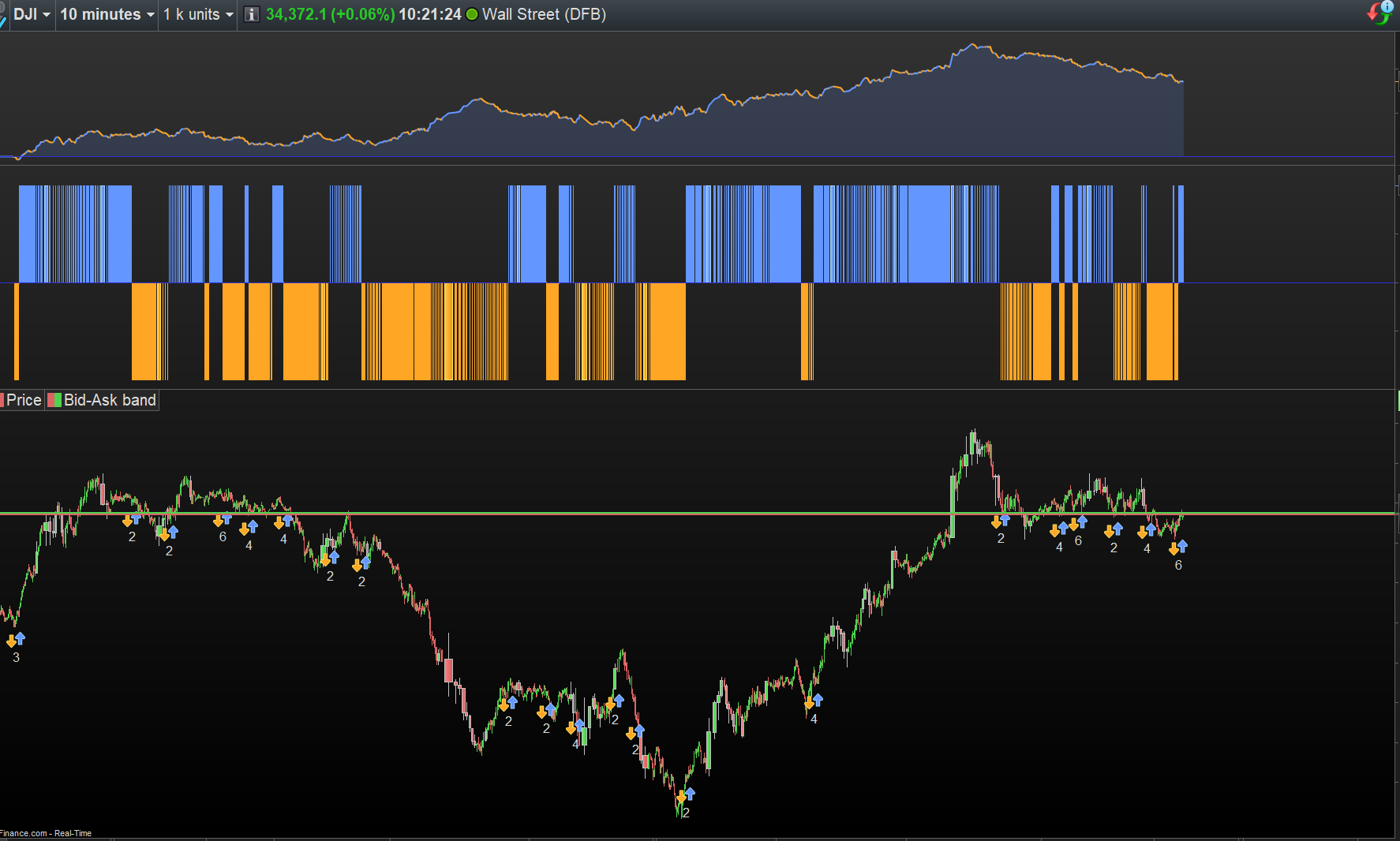
average time between positions is a negative number (e.g. -8 sec / -30 bars)Are you getting above from attached in some way that I can’t see?? 🙂 0 bars is odd though as the Chart is on M10 TF so 30 mins should be 3 bars? The Algo is always onmarket. The 30 mins between trades shown on attached is at the start before it takes any trades. The really odd thing is that the Algo always gets Rejected at the end of the 1st bar when the Algo likely not even opening a trade (as in attached).
Hi,
Below is from a trading system that is “Live”…
As you can see, the average time between positions is zero seconds…
This system is also always on the market and alternates between Long and Short…
Algo always gets Rejected at the end of the 1st bar when the Algo likely not even opening a tradeHahaha after typing above, I thought … sooo what if the System did open a trade at the end of the 1st bar? I added below at top of the code and the System did not get Rejected either on Demo or on Live!! Success at last!!!!! I’ll sleep better tonight!!! Thank You JS for cross-fertilising thoughts and ideas! Onwards & Upwards!!!!
If not onmarket Then
Buy at Market
Endif
Hi,
Nice that it’s been fixed…
I think the problems arise when in a trading system the positions go from long to short at once and vice versa… instead of closing the current position and then reversing…
I have noticed in other systems that if a position is turns directly then the code is not read during the “Open”… So the orders are executed first and only then the code is read…
You can check this when the size of your position is linked to the “StrategyProfit”,
When the position turns directly (i.e. immediately from Long to Short or vice versa) then the “StrategyProfit” is not recalculated so the code is not read when the position is rotated directly…
SuperTrended Moving Averages from Tradingview
This topic contains 9 replies,
has 4 voices, and was last updated by JS
2 years, 6 months ago.
| Forum: | ProBuilder: Indicators & Custom Tools |
| Language: | English |
| Started: | 06/23/2023 |
| Status: | Active |
| Attachments: | 7 files |
The information collected on this form is stored in a computer file by ProRealCode to create and access your ProRealCode profile. This data is kept in a secure database for the duration of the member's membership. They will be kept as long as you use our services and will be automatically deleted after 3 years of inactivity. Your personal data is used to create your private profile on ProRealCode. This data is maintained by SAS ProRealCode, 407 rue Freycinet, 59151 Arleux, France. If you subscribe to our newsletters, your email address is provided to our service provider "MailChimp" located in the United States, with whom we have signed a confidentiality agreement. This company is also compliant with the EU/Swiss Privacy Shield, and the GDPR. For any request for correction or deletion concerning your data, you can directly contact the ProRealCode team by email at privacy@prorealcode.com If you would like to lodge a complaint regarding the use of your personal data, you can contact your data protection supervisory authority.