//---------------------------------------------------------------//
//SuperTrend AI Clustering
//version = 2
//02.06.2025
//Iván González @ www.prorealcode.com
//Sharing ProRealTime knowledge
//---------------------------------------------------------------//
//-----Inputs----------------------------------------------------//
//---------------------------------------------------------------//
//length=10 // ATR length
//minMult=1
//maxMult=5
//step=0.5
//perfAlpha=10 // Performance memory
//fromCluster=1 // 1=best 2=average 3=worst
maxiter=10 // Número máximo de iteraciones de clustering
epsilon=0.0001 // Precisión para simular convergencia
//---------------------------------------------------------------//
//-----Average True Range----------------------------------------//
//---------------------------------------------------------------//
atr=averagetruerange[length](close)
//---------------------------------------------------------------//
//-----Supertrend cálculo múltiple-------------------------------//
//---------------------------------------------------------------//
$holderUpper[0]=(high+low)/2
$holderLower[0]=(high+low)/2
$holderOutput[0]=0
$holderPerf[0]=0
$holderFactor[0]=0
$holderTrend[0]=0
$factors[0]=0

if barindex=0 then
n=0
for i=0 to floor((maxMult-minMult)/step) do
$factors[n+1]=(minMult+i*step)
$holderUpper[n+1]=(high+low)/2
$holderLower[n+1]=(high+low)/2
$holderOutput[n+1]=0
$holderPerf[n+1]=0
$holderFactor[n+1]=0
$holderTrend[n+1]=0
n=n+1
next
endif

k=0
for factor=0 to floor((maxMult-minMult)/step) do
up=(high+low)/2+atr*factor
dn=(high+low)/2-atr*factor

if close > $holderUpper[k] then
$holderTrend[k]=1
elsif close < $holderUpper[k] then
$holderTrend[k]=0
else
$holderTrend[k]=$holderTrend[k]
endif

if close[1]<$holderUpper[k] then
$holderUpper[k]=min(up,$holderUpper[k])
else
$holderUpper[k]=up
endif

if close[1]>$holderLower[k] then
$holderLower[k]=max(dn,$holderLower[k])
else
$holderLower[k]=dn
endif

if (close[1]-$holderOutput[k])>0 then
diff=1
elsif (close[1]-$holderOutput[k])<0 then
diff=-1
else
diff=0
endif

$holderPerf[k]=$holderPerf[max(0,k-1)]+2/(perfAlpha+1)*((close-close[1])*diff-$holderPerf[max(0,k-1)])
if $holderTrend[k]=1 then
$holderOutput[k]=$holderLower[k]
else
$holderOutput[k]=$holderUpper[k]
endif

$holderFactor[k] = $factors[k]

k=k+1
next
//---------------------------------------------------------------//
//-----K-means con convergencia----------------------------------//
//---------------------------------------------------------------//
centroid1 = 0
centroid2 = 0
centroid3 = 0
count = k

FOR i = 0 TO count - 1 DO
IF i < count / 3 THEN
centroid1 = centroid1 + $holderPerf[i]
ELSIF i < 2 * count / 3 THEN
centroid2 = centroid2 + $holderPerf[i]
ELSE
centroid3 = centroid3 + $holderPerf[i]
ENDIF
NEXT

centroid1 = centroid1 / (count / 3)
centroid2 = centroid2 / (count / 3)
centroid3 = centroid3 / (count / 3)

converged = 0
iter = 0

WHILE iter < maxiter AND converged = 0 DO
old1 = centroid1
old2 = centroid2
old3 = centroid3

$cluster1Perf[0] = 0
$cluster2Perf[0] = 0
$cluster3Perf[0] = 0
$cluster1Factors[0] = 0
$cluster2Factors[0] = 0
$cluster3Factors[0] = 0

FOR i = 0 TO count - 1 DO
dist1 = abs($holderPerf[i] - centroid1)
dist2 = abs($holderPerf[i] - centroid2)
dist3 = abs($holderPerf[i] - centroid3)

IF dist1 <= dist2 AND dist1 <= dist3 THEN
$cluster1Perf[$cluster1Perf[0]+1] = $holderPerf[i]
$cluster1Factors[$cluster1Factors[0]+1] = $holderFactor[i]
$cluster1Perf[0] = $cluster1Perf[0] + 1
$cluster1Factors[0] = $cluster1Factors[0] + 1
ELSIF dist2 <= dist1 AND dist2 <= dist3 THEN
$cluster2Perf[$cluster2Perf[0]+1] = $holderPerf[i]
$cluster2Factors[$cluster2Factors[0]+1] = $holderFactor[i]
$cluster2Perf[0] = $cluster2Perf[0] + 1
$cluster2Factors[0] = $cluster2Factors[0] + 1
ELSE
$cluster3Perf[$cluster3Perf[0]+1] = $holderPerf[i]
$cluster3Factors[$cluster3Factors[0]+1] = $holderFactor[i]
$cluster3Perf[0] = $cluster3Perf[0] + 1
$cluster3Factors[0] = $cluster3Factors[0] + 1
ENDIF
NEXT

centroid1 = 0
centroid2 = 0
centroid3 = 0

IF $cluster1Perf[0] > 0 THEN
FOR i = 1 TO $cluster1Perf[0] DO
centroid1 = centroid1 + $cluster1Perf[i]
NEXT
centroid1 = centroid1 / $cluster1Perf[0]
ENDIF
IF $cluster2Perf[0] > 0 THEN
FOR i = 1 TO $cluster2Perf[0] DO
centroid2 = centroid2 + $cluster2Perf[i]
NEXT
centroid2 = centroid2 / $cluster2Perf[0]
ENDIF
IF $cluster3Perf[0] > 0 THEN
FOR i = 1 TO $cluster3Perf[0] DO
centroid3 = centroid3 + $cluster3Perf[i]
NEXT
centroid3 = centroid3 / $cluster3Perf[0]
ENDIF

IF abs(centroid1 - old1) < epsilon AND abs(centroid2 - old2) < epsilon AND abs(centroid3 - old3) < epsilon THEN
converged = 1
ENDIF

iter = iter + 1
WEND
//---------------------------------------------------------------//
//-----Cluster seleccionado y nuevo Supertrend-------------------//
//---------------------------------------------------------------//
finalFactor = 0
finalPerf = 0
perf = 0
fact = 0

IF fromCluster = 1 THEN
// Best
IF centroid1 > max(centroid2, centroid3) THEN
FOR j = 1 TO lastset($cluster1Perf) DO
perf = perf + $cluster1Perf[j]
fact = fact + $cluster1Factors[j]
NEXT
finalFactor = fact / lastset($cluster1Factors)
if lastset($cluster1Perf) > 0 then
finalPerf = perf / lastset($cluster1Perf)
else
finalPerf = 0
endif
ELSIF centroid2 > max(centroid1, centroid3) THEN
FOR j = 1 TO lastset($cluster2Perf) DO
perf = perf + $cluster2Perf[j]
fact = fact + $cluster2Factors[j]
NEXT
finalFactor = fact / lastset($cluster2Factors)
if lastset($cluster2Perf) > 0 then
finalPerf = perf / lastset($cluster2Perf)
else
finalPerf = 0
endif
ELSE
FOR j = 1 TO lastset($cluster3Perf) DO
perf = perf + $cluster3Perf[j]
fact = fact + $cluster3Factors[j]
NEXT
finalFactor = fact / lastset($cluster3Factors)
if lastset($cluster3Perf) > 0 then
finalPerf = perf / lastset($cluster3Perf)
else
finalPerf = 0
endif
ENDIF

ELSIF fromCluster = 2 THEN
// Average
IF centroid1 > centroid2 AND centroid1 < centroid3 THEN
FOR j = 1 TO lastset($cluster1Perf) DO
perf = perf + $cluster1Perf[j]
fact = fact + $cluster1Factors[j]
NEXT
finalFactor = fact / lastset($cluster1Factors)
if lastset($cluster1Perf) > 0 then
finalPerf = perf / lastset($cluster1Perf)
else
finalPerf = 0
endif
ELSIF centroid2 > centroid1 AND centroid2 < centroid3 THEN
FOR j = 1 TO lastset($cluster2Perf) DO
perf = perf + $cluster2Perf[j]
fact = fact + $cluster2Factors[j]
NEXT
finalFactor = fact / lastset($cluster2Factors)
if lastset($cluster2Perf) > 0 then
finalPerf = perf / lastset($cluster2Perf)
else
finalPerf = 0
endif
ELSE
FOR j = 1 TO lastset($cluster3Perf) DO
perf = perf + $cluster3Perf[j]
fact = fact + $cluster3Factors[j]
NEXT
finalFactor = fact / lastset($cluster3Factors)
if lastset($cluster3Perf) > 0 then
finalPerf = perf / lastset($cluster3Perf)
else
finalPerf = 0
endif
ENDIF

ELSIF fromCluster = 3 THEN
// Worst
IF centroid1 < min(centroid2, centroid3) THEN
FOR j = 1 TO lastset($cluster1Perf) DO
perf = perf + $cluster1Perf[j]
fact = fact + $cluster1Factors[j]
NEXT
finalFactor = fact / lastset($cluster1Factors)
if lastset($cluster1Perf) > 0 then
finalPerf = perf / lastset($cluster1Perf)
else
finalPerf = 0
endif
ELSIF centroid2 < min(centroid1, centroid3) THEN
FOR j = 1 TO lastset($cluster2Perf) DO
perf = perf + $cluster2Perf[j]
fact = fact + $cluster2Factors[j]
NEXT
finalFactor = fact / lastset($cluster2Factors)
if lastset($cluster2Perf) > 0 then
finalPerf = perf / lastset($cluster2Perf)
else
finalPerf = 0
endif
ELSE
FOR j = 1 TO lastset($cluster3Perf) DO
perf = perf + $cluster3Perf[j]
fact = fact + $cluster3Factors[j]
NEXT
finalFactor = fact / lastset($cluster3Factors)
if lastset($cluster3Perf) > 0 then
finalPerf = perf / lastset($cluster3Perf)
else
finalPerf = 0
endif
ENDIF
ENDIF
//---------------------------------------------------------------//
//-----Renderizado final del Supertrend--------------------------//
//---------------------------------------------------------------//
newup = (high + low) / 2 + atr * finalFactor
newdown = (high + low) / 2 - atr * finalFactor

if close[1] < newupper then
newupper = min(newup, newupper)
else
newupper = newup
endif

if close[1] > newlower then
newlower = max(newdown, newlower)
else
newlower = newdown
endif

if close > newupper then
newOS = 1
elsif close < newlower then
newOS = 0
else
newOS = newOS
endif

if newOS and newOS[1]=0 then
newST = newlower
r = 0
g = 255
transp=0
elsif newOS then
newST = newlower
r = 0
g = 255
transp=255
elsif newOS=0 and newOS[1] then
newST = newupper
r = 255
g = 0
transp=0
else
newST = newupper
r = 255
g = 0
transp=255
endif
//---------------------------------------------------------------//
return newST style(line,2) coloured(r,g,0,transp)
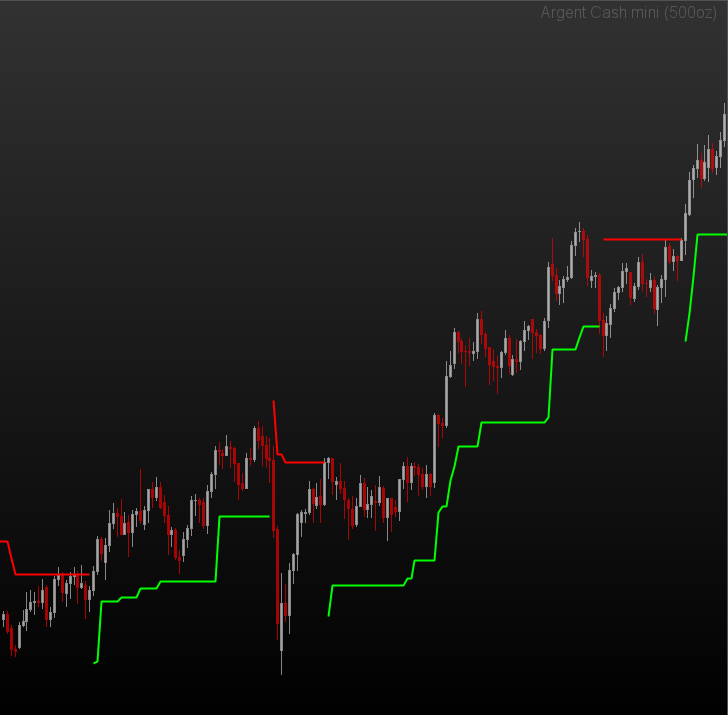
Bonjour, j’aimerai savoir dans ce code comment s’appelle la ligne verte et rouge que l’on voit sur l’image jointe ? Initialement, je suis parti dans l’idée que c’était “newST”, cependant en l’incluant dans un Screener afin de déterminer si la tendance est haussière ou baissière, je me retrouve trop souvent avec des résultats erronés! Pourriez-vous m’indiquer avec exactitude la dénomination de cette ligne dans ce code ? Merci
Bonjour. La ligne verte/rouge est nouvelle. Sa couleur change en fonction des conditions définies entre les lignes 325 et 345. Si vous souhaitez modifier la couleur, par exemple du rouge au vert, vous pouvez insérer le code suivant dans le filtre :
screener[newOS and newOS[1]=0]
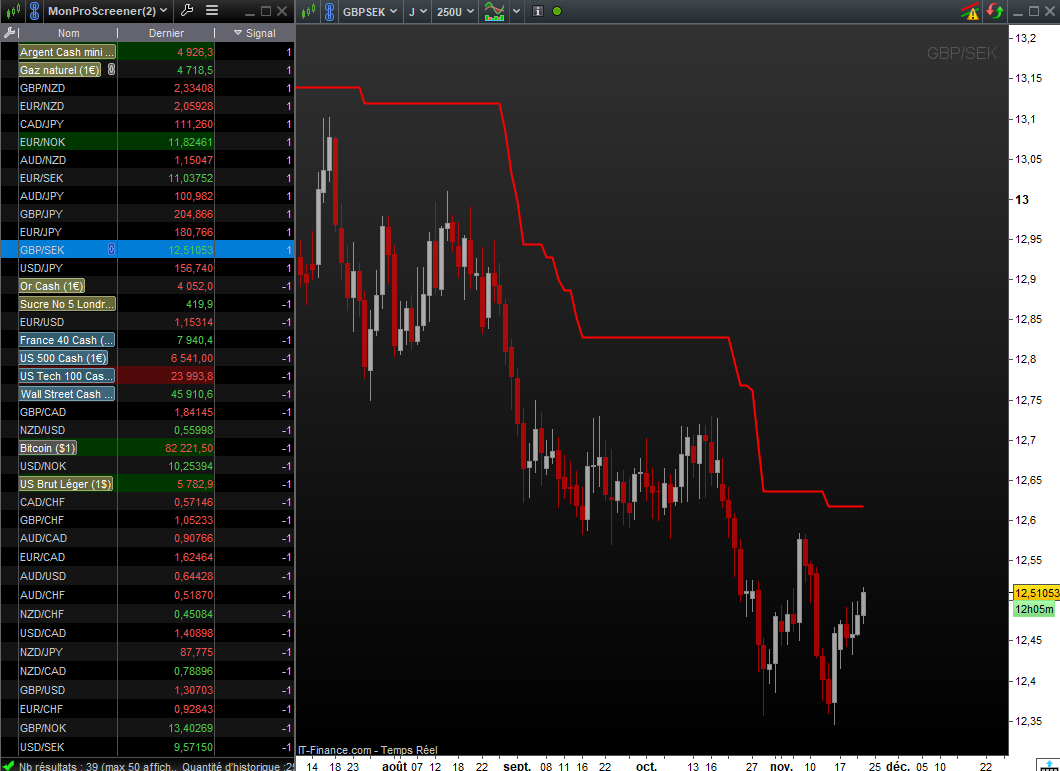
Sur le graphique voici un exemple du problème que je rencontre, la paire GBP/SEK ressort haussière sur le Screener et pourtant la tendance est baissière sur l’indicateur SuperTrendAIClusterin ! Je joins aussi le code afin de trouver ce qui cloche!!!
//"Screener SuperTrendAI"
//////////////////////////////////////////////////////////////////////////////////////////////////////////////////////////////////////

//////////////////////////////////////////////////////////////////////////////////////////////////////////////////////////////////////
//SuperTrend AI Clusterin_V2 | Indicator
//////////////////////////////////////////////////////////////////////////////////////////////////////////////////////////////////////
//Inputs
//////////////////////////////////////////////////////////////////////////////////////////////////////////////////////////////////////
length=10 // ATR length
minMult=1
maxMult=5
step=0.5
perfAlpha=10 // Performance memory
fromCluster=2 // 1=best 2=average 3=worst
maxiter=10 // Número máximo de iteraciones de clustering
epsilon=0.0001 // Precisión para simular convergencia
//////////////////////////////////////////////////////////////////////////////////////////////////////////////////////////////////////
//Average True Range
//////////////////////////////////////////////////////////////////////////////////////////////////////////////////////////////////////
atr=averagetruerange[length](close)
//////////////////////////////////////////////////////////////////////////////////////////////////////////////////////////////////////
//Supertrend cálculo múltiple
//////////////////////////////////////////////////////////////////////////////////////////////////////////////////////////////////////
$holderUpper[0]=(high+low)/2
$holderLower[0]=(high+low)/2
$holderOutput[0]=0
$holderPerf[0]=0
$holderFactor[0]=0
$holderTrend[0]=0
$factors[0]=0

if barindex=0 then
n=0
for i=0 to floor((maxMult-minMult)/step) do
$factors[n+1]=(minMult+i*step)
$holderUpper[n+1]=(high+low)/2
$holderLower[n+1]=(high+low)/2
$holderOutput[n+1]=0
$holderPerf[n+1]=0
$holderFactor[n+1]=0
$holderTrend[n+1]=0
n=n+1
next
endif

k=0
for factor=0 to floor((maxMult-minMult)/step) do
up=(high+low)/2+atr*factor
dn=(high+low)/2-atr*factor

if close > $holderUpper[k] then
$holderTrend[k]=1
elsif close < $holderUpper[k] then
$holderTrend[k]=0
else
$holderTrend[k]=$holderTrend[k]
endif

if close[1]<$holderUpper[k] then
$holderUpper[k]=min(up,$holderUpper[k])
else
$holderUpper[k]=up
endif

if close[1]>$holderLower[k] then
$holderLower[k]=max(dn,$holderLower[k])
else
$holderLower[k]=dn
endif

if (close[1]-$holderOutput[k])>0 then
diff=1
elsif (close[1]-$holderOutput[k])<0 then
diff=-1
else
diff=0
endif

$holderPerf[k]=$holderPerf[max(0,k-1)]+2/(perfAlpha+1)*((close-close[1])*diff-$holderPerf[max(0,k-1)])
if $holderTrend[k]=1 then
$holderOutput[k]=$holderLower[k]
else
$holderOutput[k]=$holderUpper[k]
endif

$holderFactor[k] = $factors[k]

k=k+1
next
//////////////////////////////////////////////////////////////////////////////////////////////////////////////////////////////////////
//K-means con convergencia
//////////////////////////////////////////////////////////////////////////////////////////////////////////////////////////////////////
centroid1 = 0
centroid2 = 0
centroid3 = 0
count = k

FOR i = 0 TO count - 1 DO
IF i < count / 3 THEN
centroid1 = centroid1 + $holderPerf[i]
ELSIF i < 2 * count / 3 THEN
centroid2 = centroid2 + $holderPerf[i]
ELSE
centroid3 = centroid3 + $holderPerf[i]
ENDIF
NEXT

centroid1 = centroid1 / (count / 3)
centroid2 = centroid2 / (count / 3)
centroid3 = centroid3 / (count / 3)

converged = 0
iter = 0

WHILE iter < maxiter AND converged = 0 DO
old1 = centroid1
old2 = centroid2
old3 = centroid3

$cluster1Perf[0] = 0
$cluster2Perf[0] = 0
$cluster3Perf[0] = 0
$cluster1Factors[0] = 0
$cluster2Factors[0] = 0
$cluster3Factors[0] = 0

FOR i = 0 TO count - 1 DO
dist1 = abs($holderPerf[i] - centroid1)
dist2 = abs($holderPerf[i] - centroid2)
dist3 = abs($holderPerf[i] - centroid3)

IF dist1 <= dist2 AND dist1 <= dist3 THEN
$cluster1Perf[$cluster1Perf[0]+1] = $holderPerf[i]
$cluster1Factors[$cluster1Factors[0]+1] = $holderFactor[i]
$cluster1Perf[0] = $cluster1Perf[0] + 1
$cluster1Factors[0] = $cluster1Factors[0] + 1
ELSIF dist2 <= dist1 AND dist2 <= dist3 THEN
$cluster2Perf[$cluster2Perf[0]+1] = $holderPerf[i]
$cluster2Factors[$cluster2Factors[0]+1] = $holderFactor[i]
$cluster2Perf[0] = $cluster2Perf[0] + 1
$cluster2Factors[0] = $cluster2Factors[0] + 1
ELSE
$cluster3Perf[$cluster3Perf[0]+1] = $holderPerf[i]
$cluster3Factors[$cluster3Factors[0]+1] = $holderFactor[i]
$cluster3Perf[0] = $cluster3Perf[0] + 1
$cluster3Factors[0] = $cluster3Factors[0] + 1
ENDIF
NEXT

centroid1 = 0
centroid2 = 0
centroid3 = 0

IF $cluster1Perf[0] > 0 THEN
FOR i = 1 TO $cluster1Perf[0] DO
centroid1 = centroid1 + $cluster1Perf[i]
NEXT
centroid1 = centroid1 / $cluster1Perf[0]
ENDIF
IF $cluster2Perf[0] > 0 THEN
FOR i = 1 TO $cluster2Perf[0] DO
centroid2 = centroid2 + $cluster2Perf[i]
NEXT
centroid2 = centroid2 / $cluster2Perf[0]
ENDIF
IF $cluster3Perf[0] > 0 THEN
FOR i = 1 TO $cluster3Perf[0] DO
centroid3 = centroid3 + $cluster3Perf[i]
NEXT
centroid3 = centroid3 / $cluster3Perf[0]
ENDIF

IF abs(centroid1 - old1) < epsilon AND abs(centroid2 - old2) < epsilon AND abs(centroid3 - old3) < epsilon THEN
converged = 1
ENDIF

iter = iter + 1
WEND
//////////////////////////////////////////////////////////////////////////////////////////////////////////////////////////////////////
//Cluster seleccionado y nuevo Supertrend
//////////////////////////////////////////////////////////////////////////////////////////////////////////////////////////////////////
finalFactor = 0
perf = 0
fact = 0

IF fromCluster = 1 THEN
// Best
IF centroid1 > max(centroid2, centroid3) THEN
FOR j = 1 TO lastset($cluster1Perf) DO
perf = perf + $cluster1Perf[j]
fact = fact + $cluster1Factors[j]
NEXT
finalFactor = fact / lastset($cluster1Factors)

ELSIF centroid2 > max(centroid1, centroid3) THEN
FOR j = 1 TO lastset($cluster2Perf) DO
perf = perf + $cluster2Perf[j]
fact = fact + $cluster2Factors[j]
NEXT
finalFactor = fact / lastset($cluster2Factors)

ELSE
FOR j = 1 TO lastset($cluster3Perf) DO
perf = perf + $cluster3Perf[j]
fact = fact + $cluster3Factors[j]
NEXT
finalFactor = fact / lastset($cluster3Factors)

ENDIF

ELSIF fromCluster = 2 THEN
// Average
IF centroid1 > centroid2 AND centroid1 < centroid3 THEN
FOR j = 1 TO lastset($cluster1Perf) DO
perf = perf + $cluster1Perf[j]
fact = fact + $cluster1Factors[j]
NEXT
finalFactor = fact / lastset($cluster1Factors)

ELSIF centroid2 > centroid1 AND centroid2 < centroid3 THEN
FOR j = 1 TO lastset($cluster2Perf) DO
perf = perf + $cluster2Perf[j]
fact = fact + $cluster2Factors[j]
NEXT
finalFactor = fact / lastset($cluster2Factors)

ELSE
FOR j = 1 TO lastset($cluster3Perf) DO
perf = perf + $cluster3Perf[j]
fact = fact + $cluster3Factors[j]
NEXT
finalFactor = fact / lastset($cluster3Factors)

ENDIF

ELSIF fromCluster = 3 THEN
// Worst
IF centroid1 < min(centroid2, centroid3) THEN
FOR j = 1 TO lastset($cluster1Perf) DO
perf = perf + $cluster1Perf[j]
fact = fact + $cluster1Factors[j]
NEXT
finalFactor = fact / lastset($cluster1Factors)

ELSIF centroid2 < min(centroid1, centroid3) THEN
FOR j = 1 TO lastset($cluster2Perf) DO
perf = perf + $cluster2Perf[j]
fact = fact + $cluster2Factors[j]
NEXT
finalFactor = fact / lastset($cluster2Factors)

ELSE
FOR j = 1 TO lastset($cluster3Perf) DO
perf = perf + $cluster3Perf[j]
fact = fact + $cluster3Factors[j]
NEXT
finalFactor = fact / lastset($cluster3Factors)

ENDIF
ENDIF
//////////////////////////////////////////////////////////////////////////////////////////////////////////////////////////////////////
//Renderizado final del Supertrend
//////////////////////////////////////////////////////////////////////////////////////////////////////////////////////////////////////
newup = (high + low) / 2 + atr * finalFactor
newdown = (high + low) / 2 - atr * finalFactor

if close[1] < newupper then
newupper = min(newup, newupper)
else
newupper = newup
endif

if close[1] > newlower then
newlower = max(newdown, newlower)
else
newlower = newdown
endif

if close > newupper then
newOS = 1
elsif close < newlower then
newOS = 0
else
newOS = newOS
endif

//if newOS and newOS[1]=0 then
//newST = newlower
////r = 0
////g = 255
////transp=0
//elsif newOS then
//newST = newlower
////r = 0
////g = 255
////transp=255
//elsif newOS=0 and newOS[1] then
//newST = newupper
////r = 255
////g = 0
////transp=0
//else
//newST = newupper
////r = 255
////g = 0
////transp=255
//endif
//////////////////////////////////////////////////////////////////////////////////////////////////////////////////////////////////////
if newOS[0]>newOS[1] then
HausseSTAI = 1
endif

if newOS[0]<newOS[1] then
HausseSTAI = 0
endif
//
if newOS[0]<newOS[1] then
BaisseSTAI = -1
endif

if newOS[0]>newOS[1] then
BaisseSTAI = 0
endif
//////////////////////////////////////////////////////////////////////////////////////////////////////////////////////////////////////
//Configuration
//////////////////////////////////////////////////////////////////////////////////////////////////////////////////////////////////////
Up = HausseSTAI
Dw = BaisseSTAI
//////////////////////////////////////////////////////////////////////////////////////////////////////////////////////////////////////

Signal = 0

IF Up THEN
Signal = 1
ENDIF
//////////////////////////////////////////////////////////////////////////////////////////////////////////////////////////////////////
IF Dw THEN
Signal = -1
ENDIF

//////////////////////////////////////////////////////////////////////////////////////////////////////////////////////////////////////
Screener[Up Or Dw](Signal as "Signal")
//////////////////////////////////////////////////////////////////////////////////////////////////////////////////////////////////////
//---------------------------------------------------------------//
//SuperTrend AI Clustering
//version = 2
//02.06.2025
//Iván González @ www.prorealcode.com
//Sharing ProRealTime knowledge
//---------------------------------------------------------------//
//-----Inputs----------------------------------------------------//
//---------------------------------------------------------------//
length=10 // ATR length
minMult=1
maxMult=5
step=0.5
perfAlpha=10 // Performance memory
fromCluster=1 // 1=best 2=average 3=worst
maxiter=10 // Número máximo de iteraciones de clustering
epsilon=0.0001 // Precisión para simular convergencia
//---------------------------------------------------------------//
//-----Average True Range----------------------------------------//
//---------------------------------------------------------------//
atr=averagetruerange[length](close)
//---------------------------------------------------------------//
//-----Supertrend cálculo múltiple-------------------------------//
//---------------------------------------------------------------//
$holderUpper[0]=(high+low)/2
$holderLower[0]=(high+low)/2

k=0
for factor=0 to floor((maxMult-minMult)/step) do
   up=(high+low)/2+atr*factor
   dn=(high+low)/2-atr*factor

   if close > $holderUpper[k] then
      $holderTrend[k]=1
   elsif close < $holderUpper[k] then
      $holderTrend[k]=0
   else
      $holderTrend[k]=$holderTrend[k]
   endif

   if close[1]<$holderUpper[k] then
      $holderUpper[k]=min(up,$holderUpper[k])
   else
      $holderUpper[k]=up
   endif

   if close[1]>$holderLower[k] then
      $holderLower[k]=max(dn,$holderLower[k])
   else
      $holderLower[k]=dn
   endif

   if (close[1]-$holderOutput[k])>0 then
      diff=1
   elsif (close[1]-$holderOutput[k])<0 then
      diff=-1
   else
      diff=0
   endif

   $holderPerf[k]=$holderPerf[max(0,k-1)]+2/(perfAlpha+1)*((close-close[1])*diff-$holderPerf[max(0,k-1)])

   if $holderTrend[k]=1 then
      $holderOutput[k]=$holderLower[k]
   else
      $holderOutput[k]=$holderUpper[k]
   endif

   $holderFactor[k] = (minMult+k*step)

   k=k+1
next
//---------------------------------------------------------------//
//-----K-means con convergencia----------------------------------//
//---------------------------------------------------------------//
centroid1 = 0
centroid2 = 0
centroid3 = 0
count = k

FOR i = 0 TO count - 1 DO
   IF i < count / 3 THEN
      centroid1 = centroid1 + $holderPerf[i]
   ELSIF i < 2 * count / 3 THEN
      centroid2 = centroid2 + $holderPerf[i]
   ELSE
      centroid3 = centroid3 + $holderPerf[i]
   ENDIF
NEXT

centroid1 = centroid1 / (count / 3)
centroid2 = centroid2 / (count / 3)
centroid3 = centroid3 / (count / 3)

converged = 0
iter = 0

WHILE iter < maxiter AND converged = 0 DO
   old1 = centroid1
   old2 = centroid2
   old3 = centroid3

   $cluster1Perf[0] = 0
   $cluster2Perf[0] = 0
   $cluster3Perf[0] = 0
   $cluster1Factors[0] = 0
   $cluster2Factors[0] = 0
   $cluster3Factors[0] = 0

   FOR i = 0 TO count - 1 DO
      dist1 = abs($holderPerf[i] - centroid1)
      dist2 = abs($holderPerf[i] - centroid2)
      dist3 = abs($holderPerf[i] - centroid3)

      IF dist1 <= dist2 AND dist1 <= dist3 THEN
         $cluster1Perf[$cluster1Perf[0]+1] = $holderPerf[i]
         $cluster1Factors[$cluster1Factors[0]+1] = $holderFactor[i]
         $cluster1Perf[0] = $cluster1Perf[0] + 1
         $cluster1Factors[0] = $cluster1Factors[0] + 1
      ELSIF dist2 <= dist1 AND dist2 <= dist3 THEN
         $cluster2Perf[$cluster2Perf[0]+1] = $holderPerf[i]
         $cluster2Factors[$cluster2Factors[0]+1] = $holderFactor[i]
         $cluster2Perf[0] = $cluster2Perf[0] + 1
         $cluster2Factors[0] = $cluster2Factors[0] + 1
      ELSE
         $cluster3Perf[$cluster3Perf[0]+1] = $holderPerf[i]
         $cluster3Factors[$cluster3Factors[0]+1] = $holderFactor[i]
         $cluster3Perf[0] = $cluster3Perf[0] + 1
         $cluster3Factors[0] = $cluster3Factors[0] + 1
      ENDIF
   NEXT

   centroid1 = 0
   centroid2 = 0
   centroid3 = 0

   IF $cluster1Perf[0] > 0 THEN
      FOR i = 1 TO $cluster1Perf[0] DO
         centroid1 = centroid1 + $cluster1Perf[i]
      NEXT
      centroid1 = centroid1 / $cluster1Perf[0]
   ENDIF
   IF $cluster2Perf[0] > 0 THEN
      FOR i = 1 TO $cluster2Perf[0] DO
         centroid2 = centroid2 + $cluster2Perf[i]
      NEXT
      centroid2 = centroid2 / $cluster2Perf[0]
   ENDIF
   IF $cluster3Perf[0] > 0 THEN
      FOR i = 1 TO $cluster3Perf[0] DO
         centroid3 = centroid3 + $cluster3Perf[i]
      NEXT
      centroid3 = centroid3 / $cluster3Perf[0]
   ENDIF

   IF abs(centroid1 - old1) < epsilon AND abs(centroid2 - old2) < epsilon AND abs(centroid3 - old3) < epsilon THEN
      converged = 1
   ENDIF

   iter = iter + 1
WEND
//---------------------------------------------------------------//
//-----Cluster seleccionado y nuevo Supertrend-------------------//
//---------------------------------------------------------------//
finalFactor = 0

perf = 0
fact = 0

IF fromCluster = 1 THEN
   // Best
   IF centroid1 > max(centroid2, centroid3) THEN
      FOR j = 1 TO lastset($cluster1Perf) DO
         perf = perf + $cluster1Perf[j]
         fact = fact + $cluster1Factors[j]
      NEXT
      finalFactor = fact / lastset($cluster1Factors)

   ELSIF centroid2 > max(centroid1, centroid3) THEN
      FOR j = 1 TO lastset($cluster2Perf) DO
         perf = perf + $cluster2Perf[j]
         fact = fact + $cluster2Factors[j]
      NEXT
      finalFactor = fact / lastset($cluster2Factors)

   ELSE
      FOR j = 1 TO lastset($cluster3Perf) DO
         perf = perf + $cluster3Perf[j]
         fact = fact + $cluster3Factors[j]
      NEXT
      finalFactor = fact / lastset($cluster3Factors)

   ENDIF

ELSIF fromCluster = 2 THEN
   // Average
   IF centroid1 > centroid2 AND centroid1 < centroid3 THEN
      FOR j = 1 TO lastset($cluster1Perf) DO
         perf = perf + $cluster1Perf[j]
         fact = fact + $cluster1Factors[j]
      NEXT
      finalFactor = fact / lastset($cluster1Factors)

   ELSIF centroid2 > centroid1 AND centroid2 < centroid3 THEN
      FOR j = 1 TO lastset($cluster2Perf) DO
         perf = perf + $cluster2Perf[j]
         fact = fact + $cluster2Factors[j]
      NEXT
      finalFactor = fact / lastset($cluster2Factors)

   ELSE
      FOR j = 1 TO lastset($cluster3Perf) DO
         perf = perf + $cluster3Perf[j]
         fact = fact + $cluster3Factors[j]
      NEXT
      finalFactor = fact / lastset($cluster3Factors)

   ENDIF

ELSIF fromCluster = 3 THEN
   // Worst
   IF centroid1 < min(centroid2, centroid3) THEN
      FOR j = 1 TO lastset($cluster1Perf) DO
         perf = perf + $cluster1Perf[j]
         fact = fact + $cluster1Factors[j]
      NEXT
      finalFactor = fact / lastset($cluster1Factors)

   ELSIF centroid2 < min(centroid1, centroid3) THEN
      FOR j = 1 TO lastset($cluster2Perf) DO
         perf = perf + $cluster2Perf[j]
         fact = fact + $cluster2Factors[j]
      NEXT
      finalFactor = fact / lastset($cluster2Factors)

   ELSE
      FOR j = 1 TO lastset($cluster3Perf) DO
         perf = perf + $cluster3Perf[j]
         fact = fact + $cluster3Factors[j]
      NEXT
      finalFactor = fact / lastset($cluster3Factors)

   ENDIF
ENDIF
//---------------------------------------------------------------//
//-----Renderizado final del Supertrend--------------------------//
//---------------------------------------------------------------//
newup = (high + low) / 2 + atr * finalFactor
newdown = (high + low) / 2 - atr * finalFactor

if close[1] < newupper then
   newupper = min(newup, newupper)
else
   newupper = newup
endif

if close[1] > newlower then
   newlower = max(newdown, newlower)
else
   newlower = newdown
endif

if close > newupper then
   newOS = 1
elsif close < newlower then
   newOS = 0
else
   newOS = newOS
endif

//---------------------------------
signalUp=(newOS and newOS[1]=0)
signalDn=(newOS=0 and newOS[1]=1)
screener[signalUp or signalDn](signalUp)
@Iván Il ne se passe rien, aucune valeur n’est retournée! Le Screener reste vide!
Je ne peux plus rien faire. Ça me convient pourtant…
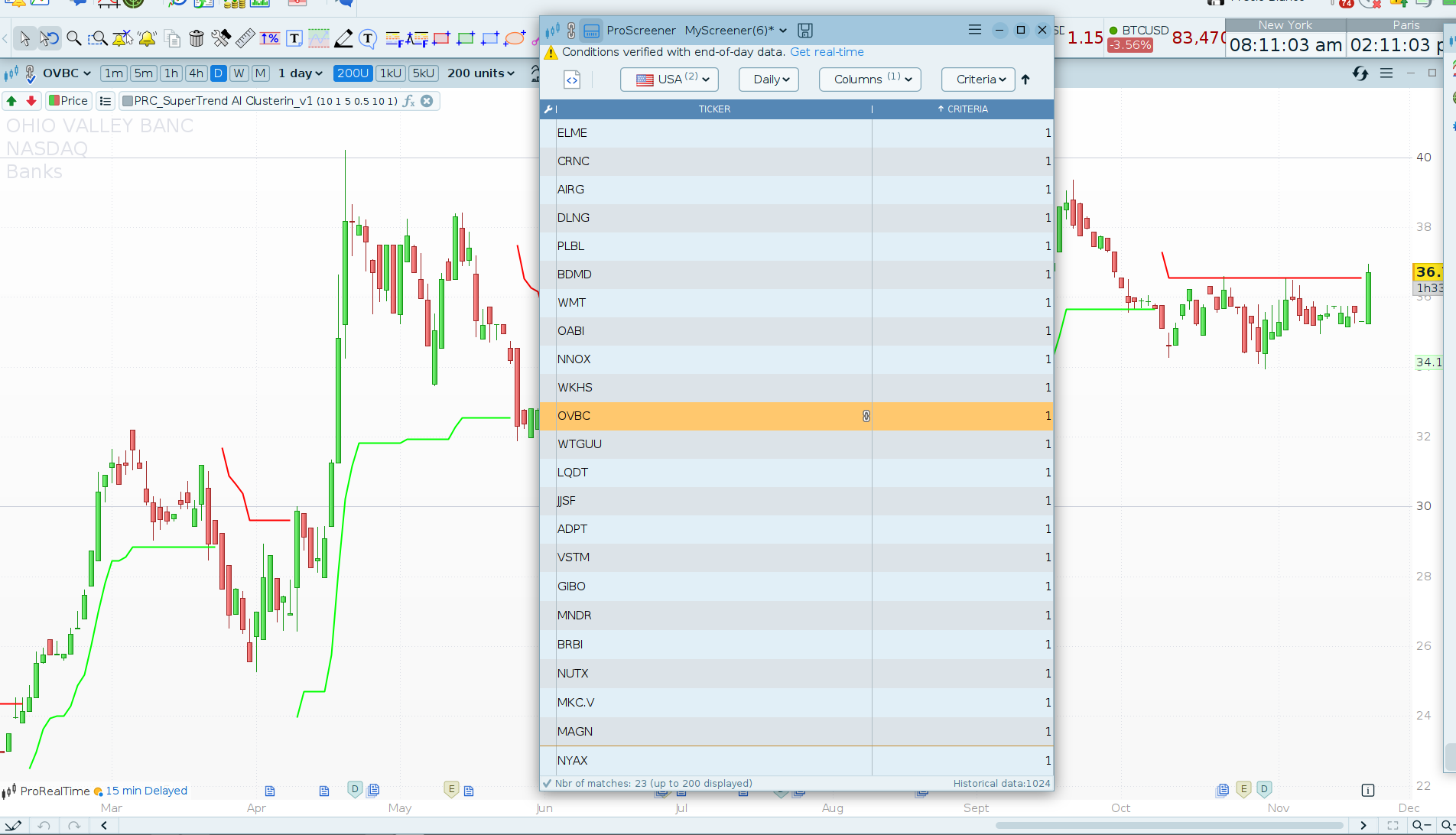
@Iván Je crois que je comprends ! Le code que tu me proposes indique lorsqu’il y a un changement d’une condition baissière vers une condition haussière et inversement. Mais ma demande porte sur le fait d’identifier une tendance haussière ou baissière affirmée dans le temps. Je ne cherche pas identifier un retournement, mais une continuation de tendance !!!
trendUp=newOS=1
trendDn=newOS=0

screener[trendUP or trendDn](newOS)