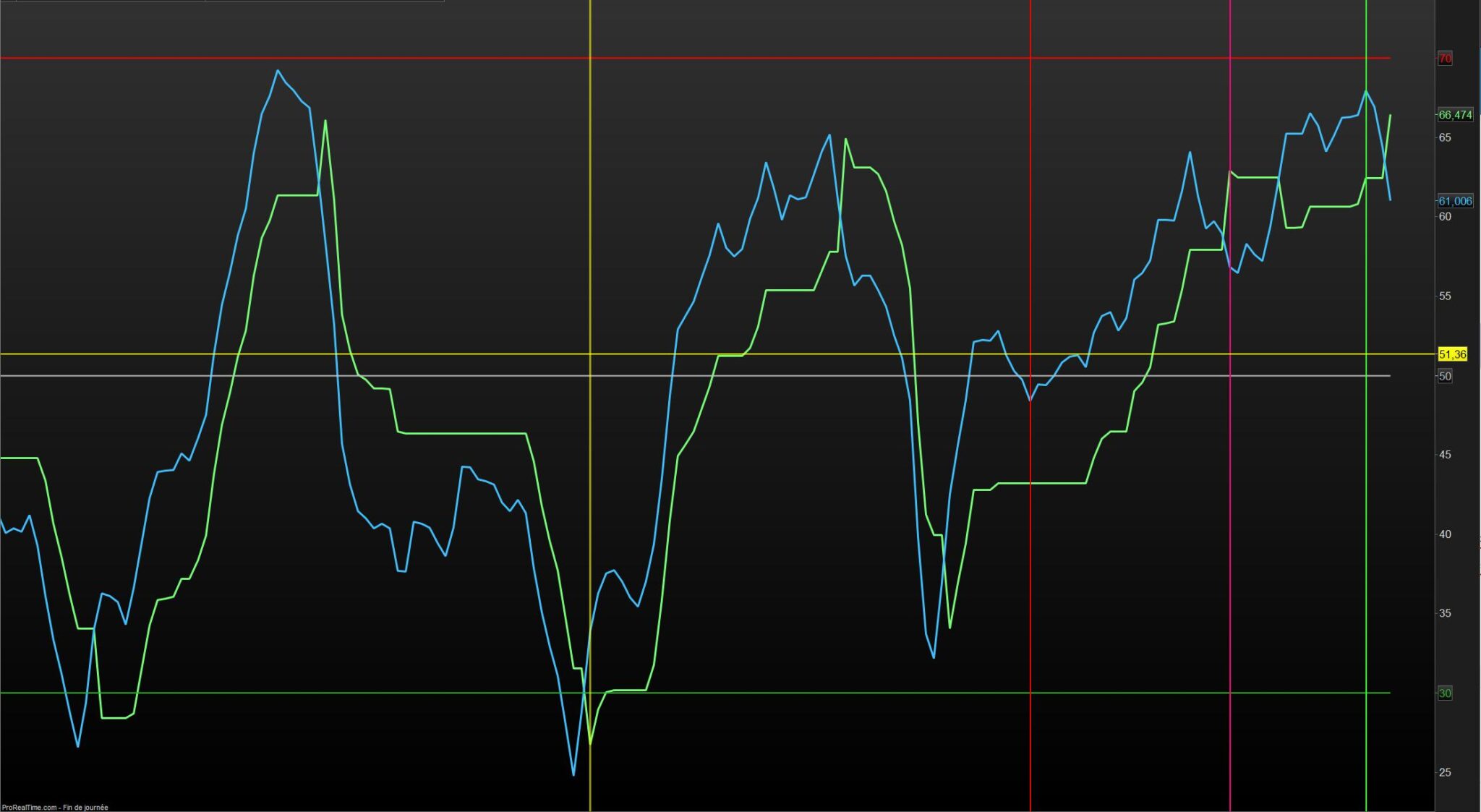
Bonjour à tous,
Je ressors un code des tiroirs de Nicolas , désolé je ne peux pas le mettre au bon format sur ce post car je n’ai pas le bouton qui va bien (même avec CTR+F5)
Est-il possible de le convertir pour qu’il apparaisse sur le graphe des prix en QQE on chart?
par avance merci.
// QQE indicator PRC
//11.10.2016 //Nicolas @ www.prorealcode.com //Sharing ProRealTime knowledge
WildersPeriod = RSIPeriod * 2 - 1
if barindex>WildersPeriod then
MyRsi = rsi[RSIPeriod](close)
RsiMa = exponentialaverage[SF](MyRsi)
AtrRsi = abs(RsiMa[1] - RsiMa)
MaAtrRsi = exponentialaverage[WildersPeriod](AtrRsi)
dar = exponentialaverage[WildersPeriod](MaAtrRsi) * QQE
trr=TrLevelSlow[1]
dv = trr
if RsiMA[0]<trr then
trr = RsiMA[0] + dar
if(RsiMA[1]<dv) then
if(trr>dv) then
trr=dv
endif
endif
elsif RsiMA[0]>trr then
trr = RsiMA[0] - dar
if(RsiMA[1]>dv) then
if(trr<dv) then
trr=dv
endif
endif
endif
TrLevelSlow=trr
endif
RETURN trr as "QQE" , RsiMA as "RsiMA", 50 as "level 50" , niveaubas as " niveau bas " , 100 - niveaubas as " niveau haut "
// parameters
// RSIPeriod = 14 erso = 12
// SF = 5
// QQE=4.236 = slow ATR ........... fast ATR = 2.618
// niveaubas = 30
//QQE ProRealTime indicator — or Quantitative Qualitative Estimation, is based on a rather complex calculation of the smoothed RSI indicators.
//The QQE indicator consists of a smoothed Relative Strength Index (RSI) indicator and two volatility-based trailing levels (fast and slow). The Fast Trailing Level (TL) and Slow TL are constructed by calculating the ATR of the smoothed RSI over n-periods and then further smoothing the ATR using an additional n-periods Wilders smoothing function. This smoothed ATR of RSI is then multiplied by the Fast and Slow ATR Multipliers to calculate the final Fast and Slow Trailing Levels.
La version ci-dessous color le fond du graphique en fonction du QQE:
//PRC_QQE | indicator
//11.10.2016
//Nicolas @ www.prorealcode.com
//Sharing ProRealTime knowledge
//--- parameters
RSIPeriod = 14
SF = 5
QQE=4.236
//---
WildersPeriod = RSIPeriod * 2 - 1
if barindex>WildersPeriod then
MyRsi = rsi[RSIPeriod](close)
RsiMa = exponentialaverage[SF](MyRsi)
AtrRsi = abs(RsiMa[1] - RsiMa)
MaAtrRsi = exponentialaverage[WildersPeriod](AtrRsi)
dar = exponentialaverage[WildersPeriod](MaAtrRsi) * QQE
trr=TrLevelSlow[1]
dv = trr
if RsiMA[0]<trr then
trr = RsiMA[0] + dar
if(RsiMA[1]<dv) then
if(trr>dv) then
trr=dv
endif
endif
elsif RsiMA[0]>trr then
trr = RsiMA[0] - dar
if(RsiMA[1]>dv) then
if(trr<dv) then
trr=dv
endif
endif
endif
TrLevelSlow=trr
if trr < 50 then
trend=-1
elsif trr > 50 then
trend=1
endif
if trr crosses under 70 then
trend=0
endif
if trend=1 then
backgroundcolor(0,200,100,50)
else
backgroundcolor("red",50)
endif
endif
RETURN //trr coloured(200,100,0) as "QQE" , RsiMA coloured(0,100,200) as "RsiMA", 50 as "level 50",70,30
Bonjour Nicolas,
merci pour le code , mon idée d’avoir le QQE sur les prix sous-entend de pouvoir “encadrer ” les prix par les deux courbes du QQE et
aussi de voir les divergences directement sur le graphe prix : les prix rien que les prix !
Alors si c’est possible ?
Bonne journée et bons trades.
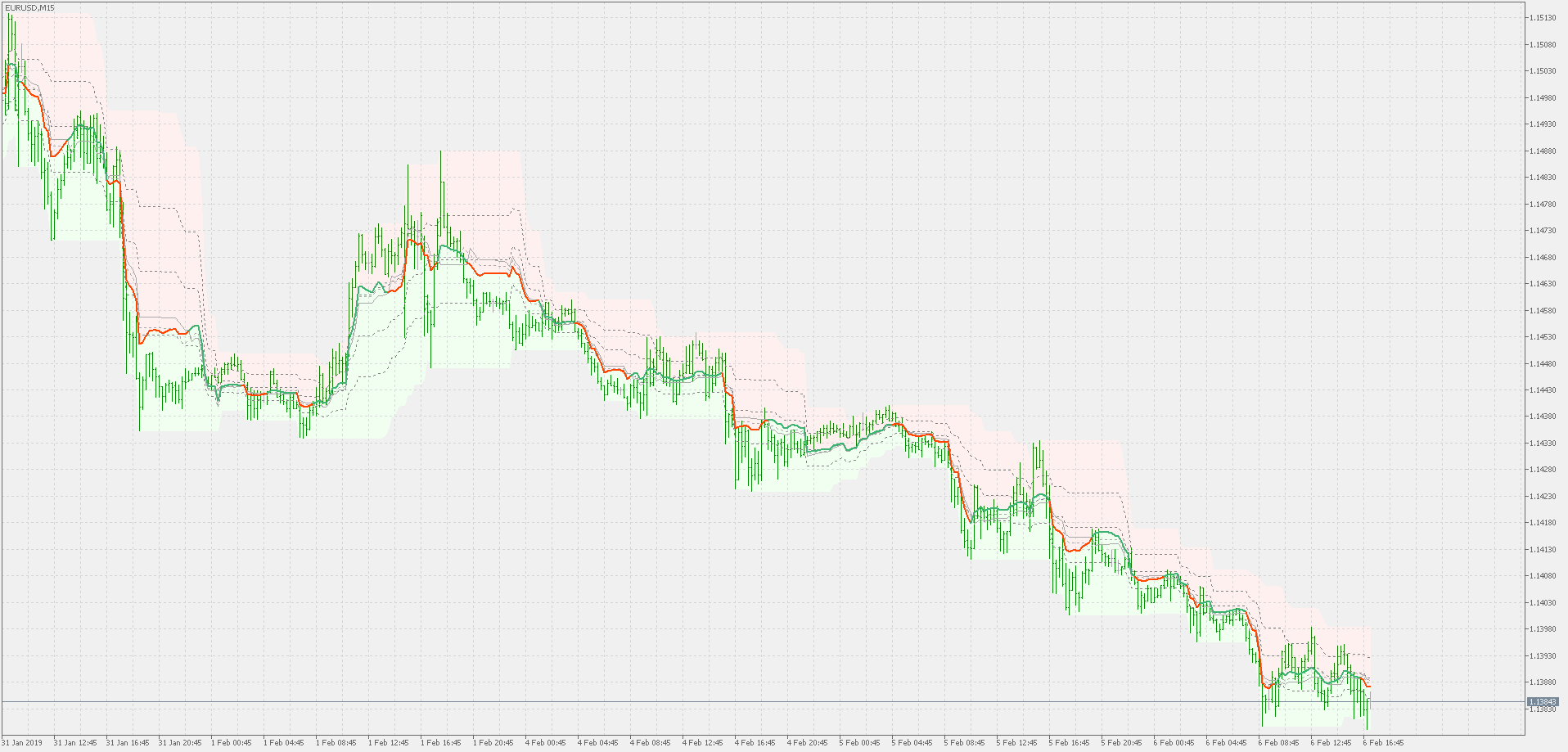
Le QQE n’encadrera pas le prix, le QQE encadre le RSI lissé qui est un oscillateur normalisé. Pour cela il faudrait reverse enginer l’indicateur pour qu’il s’adapte complément au prix, ci-joint une tentative de ce que à quoi ça ressemble sur le graphique du prix (issu d’un code d’une autre plateforme), comme tu peux le voir cela n’encadre rien du tout et à une pertinence douteuse.
Bon alors mauvaise intuition , on se contentera des croisements QQE et RSIma
merci pour ton retour
bon week-end