
ProOrder live entries differ from backtest entries…..
Viewing 8 posts - 16 through 23 (of 23 total)
  • Author
    Posts
  • #265757 quote
    LivJoJadeLivJoJade
    Participant
    Junior

    Hi JS

    Thanks again for your help with this. Your suggestion to use the diagnostic graphs has been useful, and I think we’ve narrowed the question down a little further.

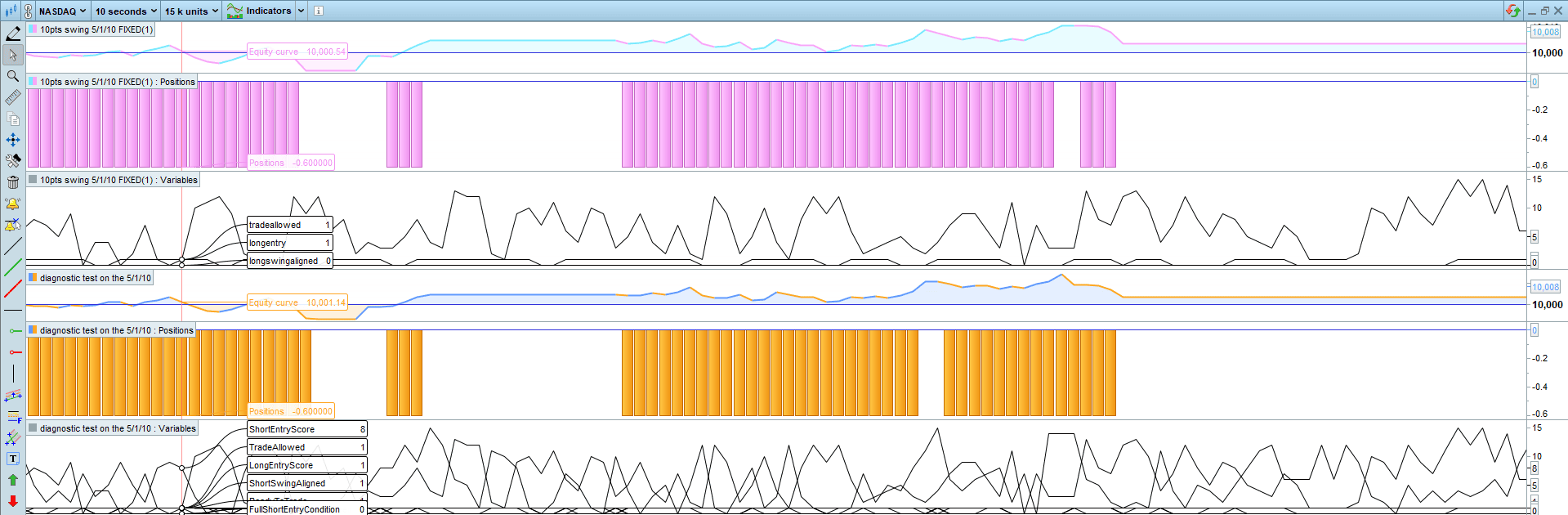
    I’ve now run a new diagnostic copy of the 5/1/10 strategy using the same parameters and 20 October 2026 date. The order list still matches the original backtest.

    I’ve attached the complete diagnostic script, the relevant backtest order report, the live order report, and the two graph screenshots around the trade in question.

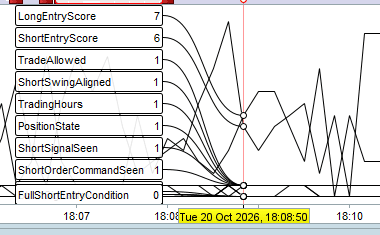
    I’ve added graphs for ShortSignalNow, FullShortEntryCondition, PositionState and ShortOrderCommandSeen to help us understand the strategy’s behaviour.

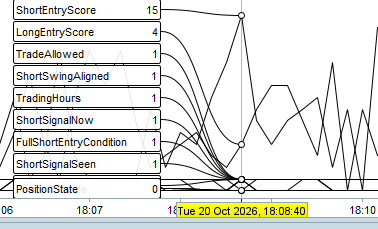
    The graphs show the following:

    • 18:08:40: ShortEntryScore = 15, ShortSignalNow = 1, FullShortEntryCondition = 1, ReadyToTrade = 0 and PositionState = 0.
    • 18:08:50: ShortEntryScore = 6, ShortSignalSeen = 1, ShortOrderCommandSeen = 1, ReadyToTrade = 0 and PositionState = 0.

    The backtest records the short entry at 18:08:50, whereas the live order report records the corresponding short entry at 18:10:40 — a difference of approximately 110 seconds.

    I appreciate that the graph values may not reveal the exact sequence of internal strategy evaluation and order processing, so I don’t want to jump to conclusions.

    Could I ask for your opinion on two points?

    1. Does this pattern look consistent with ProOrder evaluating the completed 18:08:40 bar and submitting the order for the next bar, despite ReadyToTrade plotting as zero? Or does it suggest that we should investigate the re-arming logic or another aspect of the code?
    2. Having seen the script and these results, is there another diagnostic test you would recommend to help establish why the live entry occurred approximately 110 seconds later?

    I’m keen to understand whether the discrepancy originates in the strategy’s signal evaluation, order processing, or execution conditions before considering any changes to the code or moving to another platform.

    I realise this is a fairly specific issue, and I appreciate the time you’ve already spent looking into it. Your suggestion to use the graph functions has given us a more concrete way to investigate, so thank you.

    Any thoughts or suggestions would be very welcome.


    Screenshot-2026-10-21-213239.png Screenshot-2026-10-21-213239.png Screenshot-2026-10-21-213215.png Screenshot-2026-10-21-213215.png Screenshot-2026-10-21-213254.png Screenshot-2026-10-21-213254.png
    #265760 quote
    JSJS
    Participant
    Master

    Hi,

    Even with the new parameters, there are still differences…

    For example, I have no trade at 18:08:50, and there are several other discrepancies as well…

    Scherm­afbeelding-2026-10-21-om-22.54.06.png Scherm­afbeelding-2026-10-21-om-22.54.06.png 10pts-swing-5110-FIXED-2.itf
    #265764 quote
    LivJoJadeLivJoJade
    Participant
    Junior

    this is the script I ran, what in your opinion is the reason for the discrepancy between them in order to get different results?

    Screenshot-2026-10-22-014110.png Screenshot-2026-10-22-014110.png diagnostic-test-5-1-10-on-20-10-26.itf
    #265765 quote
    JSJS
    Participant
    Master

    Hi,

    The differences persist, but I think I now understand what might be causing them…

    You appear to be using a DFB spread betting account (available to UK clients), whereas I use a CFD account…

    These are different products and their prices and trading conditions may not be directly comparable on a one-to-one basis…

    #265766 quote
    JSJS
    Participant
    Master

    Regarding the order of execution, the code is evaluated at the Close of the current bar, and a position is (if applicable) opened at the Open of the next bar…

    #265772 quote
    NicolasNicolas
    Keymaster
    Legend

    I’m a bit late to the party on this topic. A strategy developed in 10 seconds is very quick, and indeed, due to spread and slippage differences, significant variations can occur.

    Are the live tests done on a demo or real account?

    #265783 quote
    LivJoJadeLivJoJade
    Participant
    Junior

    Good afternoon to you both.

    JS you are correct, a UK DFB account is traded.

    Nicholas the live tests are done on a live autotrading system.


    So before posting my strategy script and live-versus-backtest results, I thought it would be helpful to explain how I develop and select the strategy I trade each session.

    I’m researching two multi-timeframe versions of a US Tech 100 (DFB) swing-based trading system in ProRealTime v12:

    • Strategy 1: 05/01/10 — 5-minute, 1-minute and 10-second timeframes.
    • Strategy 2: 10/02/20 — 10-minute, 2-minute and 20-second timeframes.

    Both use the same general approach to directional alignment and entry scoring, with a 12-point stop loss and a 10-point profit target.

    My pre-trading selection process

    Before each trading session, I optimise both strategies over six consecutive, overlapping one-hour windows. The windows move forward in ten-minute increments.

    For each strategy, I examine two separate sets of results:

    • Six GAIN-optimised results: the variable combinations selected to maximise points gained.
    • Six %WIN-optimised results: the combinations selected to maximise the percentage of winning trades.

    This gives me 12 optimisation results for each strategy.

    The three variables being optimised are:

    • A: Minimum entry score.
    • B: Minimum EMA spread.
    • C: Minimum EMA slope.

    I assess the results for consistency rather than simply choosing the best individual result or automatically favouring the latest window. I look for repeated variable combinations, stability between windows, changes in trade frequency, and whether the GAIN and %WIN results support the same settings.

    I also calculate weighted averages of the GAIN-optimised variables as an additional research reference. These are not automatically used for live trading: the final settings must be justified by the evidence, and any live selection must be clearly distinguished from the original optimisation results.

    What I’m trying to establish

    The objective is to identify which of the two strategies offers the strongest evidence for the next session, select defensible settings, and then compare the actual live results with ProBacktest.

    The strategies are still under development, so I’m not claiming that the selection process guarantees profitable results. I’m trying to make the process systematic, repeatable and evidence-based.

    My current concern is that live trading does not always appear to reproduce the entries shown in ProBacktest, even with the same strategy script and settings being used.

    I’ll post the script and corresponding results for the strategy selected for the next trading session tomorrow. I’d particularly welcome feedback on the reliability of the pre-trading process, as well as any technical explanation for differences between ProBacktest and live execution.

    Thanks for taking the time to look at this.


    Please find attached the script used for todays (22/10/26 17:00 – 19:30 UK time) trading session.


    10pts-swing-5110-FIXED-4.itf
    #265800 quote
    LivJoJadeLivJoJade
    Participant
    Junior

    Good afternoon to you both and anyone else who may be looking in.

    Please find attached:

    1. The exact strategy script used for the session by both.
    2. The live trading order list for 23 October 2026.
    3. The corresponding ProBacktest order list for the same strategy.


    I’ve compared the two order lists and identified several differences.

    1. Different numbers of trades

    • Live trading: 29 entries and 29 exits (58 order records).
    • ProBacktest: 28 entries and 28 exits (56 order records).


    The live system therefore executed one additional complete trade.

    2. An extra live trade early in the session

    At approximately 17:10, the sequences diverge:

    • The initial long entry occurred at 17:09:10 in both systems, although at slightly different prices.
    • The live position exited at 17:10:08, while the backtest exit was recorded at 17:11:00.
    • Live trading then entered another long at 17:10:50, at 29,119.5. I cannot find a corresponding entry in the ProBacktest order list.
    • That additional live position exited at 17:12:14, after which both systems recorded another long entry at 17:12:40.

    This is the clearest discrepancy I’d like to understand.

    3. Price and exit-time differences

    Even where entry timestamps match, the recorded prices sometimes differ. For example:

    • At 17:00:00, the live entry was 29,132.7 versus 29,131.4 in ProBacktest.
    • At 18:10:00, the live entry was 29,016.3 versus 29,018.9 in ProBacktest.
    • At 19:17:00, the live entry was 29,019.0 versus 29,019.2 in ProBacktest.

    Some exit timestamps also differ. The price differences vary in direction, so I’m reluctant to assume that spread or slippage alone explains everything.

    Questions

    I’d particularly appreciate advice on the following:

    1. What could allow ProOrder to take an additional entry that ProBacktest does not generate?
    2. Could differences in multi-timeframe indicator updates, bar-close confirmation, or order-processing timing explain these discrepancies?
    3. Could the position-state or rearming logic allow another entry in live trading before the backtest would permit one?
    4. What is the best way to diagnose this using the script and order lists, without changing the strategy logic prematurely?

    I’m not looking to optimise the strategy or change its parameters at this stage. I want to establish whether the discrepancy comes from signal generation, order handling, or execution.

    I’d appreciate any help identifying the cause from the attached script and actual order records.

    Many thanks.

    10pt-swing-10-2-20-FIXED-script-for-23-10-26.itf
Viewing 8 posts - 16 through 23 (of 23 total)
  • You must be logged in to reply to this topic.
ProRealAI ProRealAI New

Stuck on this ProBuilder code?

Describe what this topic is trying to build, in plain English, and ProRealAI writes the ProRealTime™ indicator, screener or system for you.

Available in 7 languages
Try ProRealAI

ProOrder live entries differ from backtest entries…..

ProOrder: Automated Strategies & Backtesting

New Reply
Author
author-avatar
LivJoJade @livjojade Participant
Summary

This topic contains 22 replies,
has 4 voices, and was last updated by LivJoJadeLivJoJade
1 minute ago.

Topic Details
Forum: ProOrder: Automated Strategies & Backtesting
Language: English
Started: 10/17/2026
Status: Active
Attachments: 13 files
ProRealCode ProRealCode
Loading...