ProRealCode - Trading & Coding with ProRealTime™
Hello, can someone please help converting this code?
I’m aware we don’t have multidimentional Arrays in PRT yet. I suspect, we can come over by splitting into multiple Arrays.
Thank you in advance
// This work is licensed under a Attribution-NonCommercial-ShareAlike 4.0 International (CC BY-NC-SA 4.0) https://creativecommons.org/licenses/by-nc-sa/4.0/
// © LuxAlgo
//@version=5
indicator("Polynomial Regression Extrapolation [LuxAlgo]"
, overlay = true
, max_lines_count = 500)
//------------------------------------------------------------------------------
//Settings
//-----------------------------------------------------------------------------{
length = input.int(100
, minval = 0)
extrapolate = input.int(10
, minval = 0)
degree = input.int(3, 'Polynomial Degree'
, minval = 0
, maxval = 8)
src = input(close)
lock = input(false, 'Lock Forecast')
//Style
up_css = input.color(#0cb51a, 'Upward Color'
, group = 'Style')
dn_css = input.color(#ff1100, 'Downward Color'
, group = 'Style')
ex_css = input.color(#ff5d00, 'Extrapolation Color'
, group = 'Style')
width = input(1, 'Width'
, group = 'Style')
//-----------------------------------------------------------------------------}
//Fill lines array
//-----------------------------------------------------------------------------{
var lines = array.new_line(0)
if barstate.isfirst
for i = -extrapolate to length-1
array.push(lines, line.new(na, na, na, na))
//-----------------------------------------------------------------------------}
//Get design matrix & partially solve system
//-----------------------------------------------------------------------------{
n = bar_index
var design = matrix.new<float>(0, 0)
var response = matrix.new<float>(0, 0)
if barstate.isfirst
for i = 0 to degree
column = array.new_float(0)
for j = 0 to length-1
array.push(column, math.pow(j,i))
matrix.add_col(design, i, column)
var a = matrix.inv(matrix.mult(matrix.transpose(design), design))
var b = matrix.mult(a, matrix.transpose(design))
//-----------------------------------------------------------------------------}
//Get response matrix and compute roling polynomial regression
//-----------------------------------------------------------------------------{
var pass = 1
var matrix<float> coefficients = na
var x = -extrapolate
var float forecast = na
if barstate.islast
if pass
prices = array.new_float(0)
for i = 0 to length-1
array.push(prices, src[i])
matrix.add_col(response, 0, prices)
coefficients := matrix.mult(b, response)
float y1 = na
idx = 0
for i = -extrapolate to length-1
y2 = 0.
for j = 0 to degree
y2 += math.pow(i, j)*matrix.get(coefficients, j, 0)
if idx == 0
forecast := y2
//------------------------------------------------------------------
//Set lines
//------------------------------------------------------------------
css = y2 < y1 ? up_css : dn_css
get_line = array.get(lines, idx)
line.set_xy1(get_line, n - i + 1, y1)
line.set_xy2(get_line, n - i, y2)
line.set_color(get_line, i <= 0 ? ex_css : css)
line.set_width(get_line, width)
y1 := y2
idx += 1
if lock
pass := 0
else
y2 = 0.
x -= 1
for j = 0 to degree
y2 += math.pow(x, j)*matrix.get(coefficients, j, 0)
forecast := y2
plot(pass == 0 ? forecast : na, 'Extrapolation'
, color = ex_css
, offset = extrapolate
, linewidth = width)
//-----------------------------------------------------------------------------}
If you want to come over multidimentional Arrays in PRT, the solution is not to split it into multiple Arrays, because this would mean changing the code of the script each time one or both size of the multidimentional Arrays will change… which is not possible!
In reality, coming over 2 dimensions arrays (in PRT) with only 1 dimension array is not a big deal. It has ben done for years since early stage of computer science. What you see on your screen can be compared to a 2 dimentional array (rows and columns of the screen) and it is simply stored in the memory of the computer in a one dimention array… It is possible as far as you know how much rows and columns you need to store in your 1 dimension array.
I did the conversion of the begining of Polynomial Regression Extrapolation by LuxAlgo. You can find it below.
The biggest deal here is to come over those built-in function for multidimentional Arrays that come with pine script.
For example “matrix.inv” calculate the inverse of a square matrix, which is not easy to code and will require several lines of code and take long time to calculate if it is not done in a built-in function…
defparam drawonlastbaronly = true
Maxlength = 500
long = Min(barindex,Min(Maxlength,length))
// degree = 0-8 Polynomial Degree
src = customclose
// lock = Lock Forecast
once init = 1
n = barindex
If init = 1 then
For k = 0 to degree*long-1 do
$design[k]=0
Next
For i = 0 to degree do
For j = 0 to long-1 do
P = pow(j,i)
$designT[i*long+j]= P
$design[j*degree+i]= P
Next
Next
//Matrix.mult
For i = 0 to degree do
For j = 0 to degree do
sum = 0
For k = 0 to long-1 do
sum=sum+$designT[i*long+k]*$design[k*degree+j]
Next
$produit[i*degree+j]=sum
Next
Next
init = 0
Endif
...
@LucasBest Bravo. It’s clear, you’re talented. How can I finish translating the remaining part so that I can get the full code working? Thanks
I am trying to found a way to code simply the calculation of the inverse of a square matrix.
If someone can help me to do so, it would be appreciate, because all i learned in school about matrix is very far now… 🙂
The rest of LuxAlgo pine script will be quit easy to translate then.
For example, in the link below the script in c++ for inverse matrix calculation…
https://www.tutorialspoint.com/cplusplus-program-to-find-inverse-of-a-graph-matrix
Lucas, can i suggest that you replace this inverse matrix by whatever pleases you to get over this step (for now until we find a solution) and continue the rest with an alternative option to this inverse matrix? Thanks
Impossible! It would be like cooking a sauerkraut without cabbage or a couscous without semolina…
We need this matrix inversion to calculate Matrix a, then Matrix b, and everything that come after!
Fair enough! Bravo anyway! France has talents.
will require several lines of code and take long time to calculate
like cooking a sauerkraut without cabbage
The latter can be overwon by a. growing the gabbage and b. ferment it. Yes, take many months for that indeed. The semolina needs further investigation.
Hey Peter,
this is funny, but it does not help me to code the inverse function of a matrix… 😉
defparam drawonlastbaronly = true
Maxlength = 500
long = Min(barindex,Min(Maxlength,length))
// degree = 0-8 Polynomial Degree
src = customclose
// lock = Lock Forecast
once init = 1
n = barindex
If init = 1 then
For k = 0 to degree*long-1 do
$design[k]=0
Next
For i = 0 to degree-1 do
For j = 0 to long-1 do
P = pow(j,i)
$designT[i*long+j]= P
$design[j*degree+i]= P
Next
Next
//Matrix.mult
For i = 0 to degree-1 do
For j = 0 to degree-1 do
sum = 0
For k = 0 to long-1 do
sum=sum+$designT[i*long+k]*$design[k*degree+j]
Next
$produit[i*degree+j]=sum
Next
Next
//Extracting Minors Matrix i,j
Minordegree = degree-1
For i = 0 to Minordegree do
For j = 0 to Minordegree do
m = 0
For k = 0 to degree*degree-1 do
If (j<>k mod degree) and (i<>floor(k/degree)) then
$Minor[m]=$produit[k]
m=m+1
Endif
Next
//Calculation Determinant
If Minordegree = 1 then
determinant = $Minor[1]
Elsif Minordegree = 2 then
determinant = $Minor[1]*$Minor[4]-$Minor[2]*$Minor[3]
Elsif Minordegree = 3 then
determinant = $Minor[1]*($Minor[5]*$Minor[9]-$Minor[6]*$Minor[8])-$Minor[2]*($Minor[4]*$Minor[9]-$Minor[6]*$Minor[7])+$Minor[3]*($Minor[4]*$Minor[8]-$Minor[5]*$Minor[7])
Endif
//Setting cofactor Matrix
$cofactor[i*degre+j]=pow(-1,i+j)*determinant
Next
Next
//Calculating overall determinant
determinant = 0
For k = 0 to degree-1 do
determinant = determinant + $produit[k]*$cofactor[k]
$Inverse[k] = 0
Next
//Setting Inverse Matrix
For i = 0 to degree-1 do
For j = 0 to degree-1 do
$Inverse[i+j*degree] = $cofactor[i*degree+j]*(1/determinant)
Next
Next
init = 0
Endif
Lucas, can i suggest that you replace this inverse matrix by whatever pleases you to get over this step (for now until we find a solution) and continue the rest with an alternative option to this inverse matrix? Thanks
Ok, i did not replace, but i found a solution for calculating the inverse of the matrix, until degree 4… Now i can finish and will found a solution later for inversing bigger square matrix
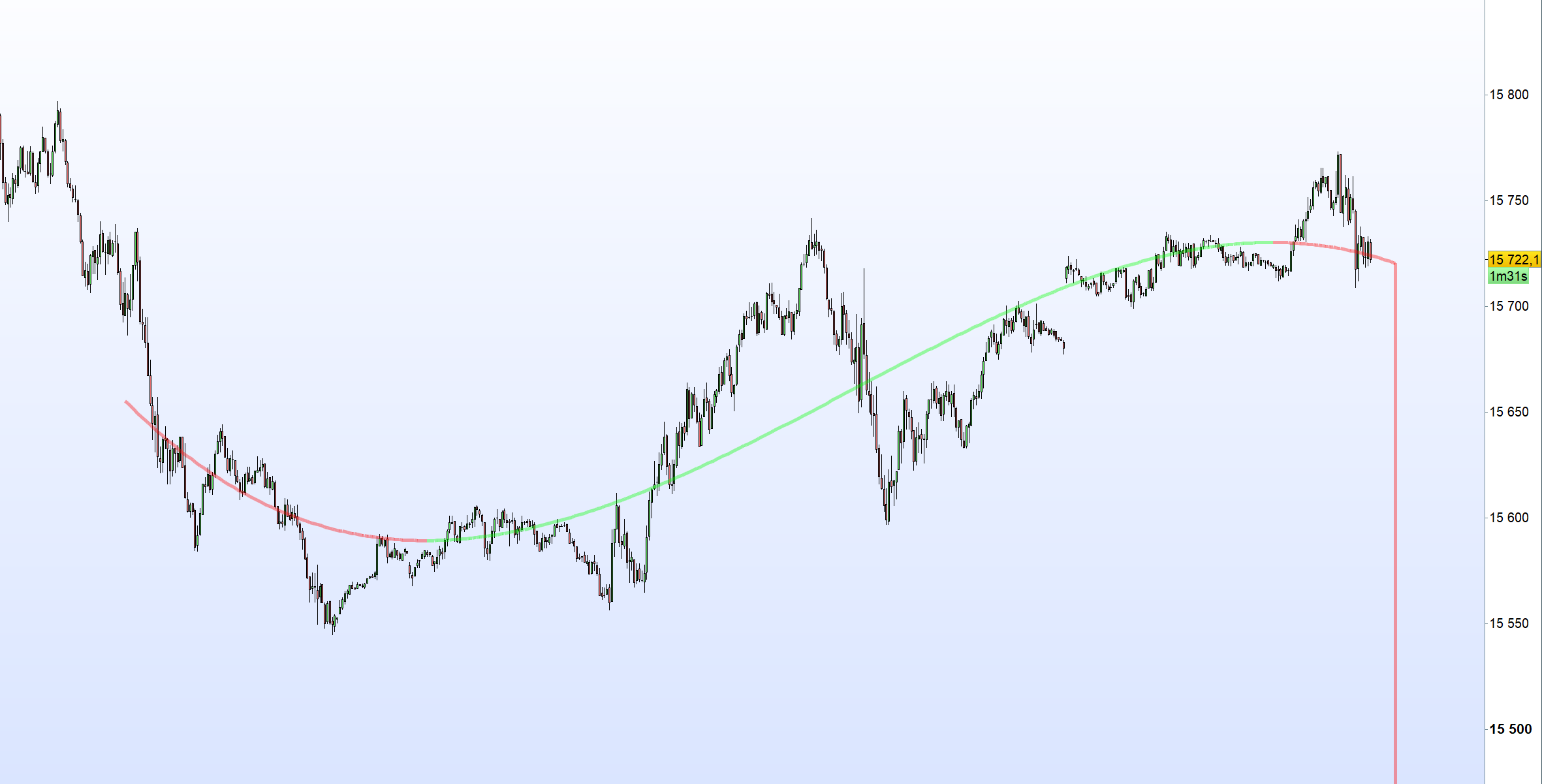
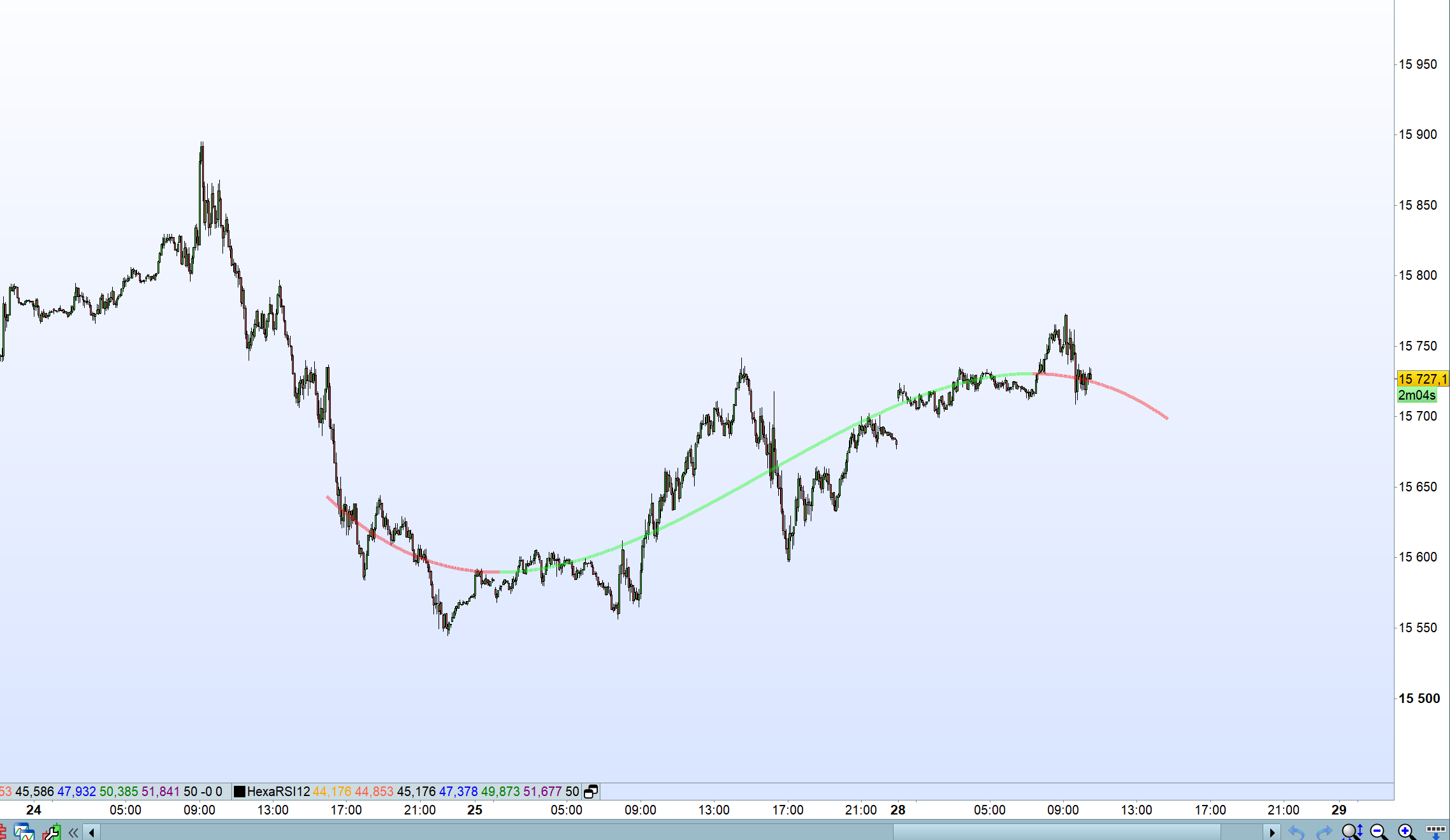
It is working now, but there is still some bugs…
defparam drawonlastbaronly = true
Maxlength = 500
long = Min(barindex,Min(Maxlength,length))
// degree = 0-8 Polynomial Degree
src = customclose
// lock = Lock Forecast
once init = 1
n = barindex
If init=1 and long=length then
For k = 0 to degree*long-1 do
$design[k]=0
Next
For i = 0 to degree-1 do
For j = 0 to long-1 do
P = pow(j,i)
$designT[i*long+j]= P
$design[j*degree+i]= P
Next
Next
//Matrix.mult
For i = 0 to degree-1 do
For j = 0 to degree-1 do
sum = 0
For k = 0 to long-1 do
sum=sum+$designT[i*long+k]*$design[k*degree+j]
Next
$produit[i*degree+j]=sum
Next
Next
//Extracting Minors Matrix i,j
Minordegree = degree-1
For i = 0 to Minordegree do
For j = 0 to Minordegree do
m = 0
For k = 0 to degree*degree-1 do
If (j<>k mod degree) and (i<>floor(k/degree)) then
$Minor[m]=$produit[k]
m=m+1
Endif
Next
//Calculation Determinant
If Minordegree = 1 then
determinant = $Minor[0]
Elsif Minordegree = 2 then
determinant = $Minor[0]*$Minor[3]-$Minor[1]*$Minor[2]
Elsif Minordegree = 3 then
determinant = $Minor[0]*($Minor[4]*$Minor[8]-$Minor[5]*$Minor[7])-$Minor[1]*($Minor[3]*$Minor[8]-$Minor[5]*$Minor[6])+$Minor[2]*($Minor[3]*$Minor[7]-$Minor[4]*$Minor[6])
Endif
//Setting cofactor Matrix
$cofactor[i*degree+j]=pow(-1,i+j)*determinant
Next
Next
//Calculating overall determinant
determinant = 0
For k = 0 to degree-1 do
determinant = determinant + $produit[k]*$cofactor[k]
Next
//Setting Inverse Matrix => $a
For k = 0 to degree*degree-1 do
$a[k]=0
Next
For i = 0 to degree-1 do
For j = 0 to degree-1 do
$a[i+j*degree] = $cofactor[i*degree+j]*(1/determinant)
Next
Next
For i = 0 to degree-1 do
For j = 0 to degree-1 do
$a[i+j*degree] = $cofactor[i*degree+j]*(1/determinant)
Next
Next
//Setting Mult matrice => $b
For i = 0 to degree-1 do
For j = 0 to long-1 do
sum = 0
For k = 0 to degree-1 do
sum=sum+$a[i*degree+k]*$designT[k*long+j]
Next
$b[i*long+j]=sum
Next
Next
init = 0
Endif
once pass = 1
once x = -1 * Extrapolate
once forecast = 0
If IsLastBarUpdate then
If pass = 1 then
For i = 0 to long-1 do
$response[i] = src[i]
Next
//Setting Mult matrice => $coefficients
For i = 0 to degree-1 do
j = 0
sum = 0
For k = 0 to long-1 do
sum=sum+$b[i*long+k]*$response[k]
Next
$coefficients[i]=sum
Next
once y1 = 0
idx = 0
For i = -Extrapolate to long-1 do
y2 = 0
for j = 0 to degree-1 do
y2 = y2+pow(i,j)*$coefficients[j]
Next
If idx = 0 then
forecast = y2
Endif
If y2 < y1 then
r = 10
g = 255
b = 10
else
r = 255
g = 10
b = 10
Endif
DRAWSEGMENT(n-i, y2, n-i+1, y1)style(line,5)coloured(r,g,b,100)
y1 = y2
idx = idx+1
If lock then
pass = 0
Endif
Next
else
y2 = 0
x = x -1
For j = 0 to degree do
y2 = y2+pow(x,j)*$coefficients[j]
Next
forecast = y2
Endif
If pass = 0 then
DRAWPOINT(n+extrapolate, forecast, 5)
Endif
Endif
Return
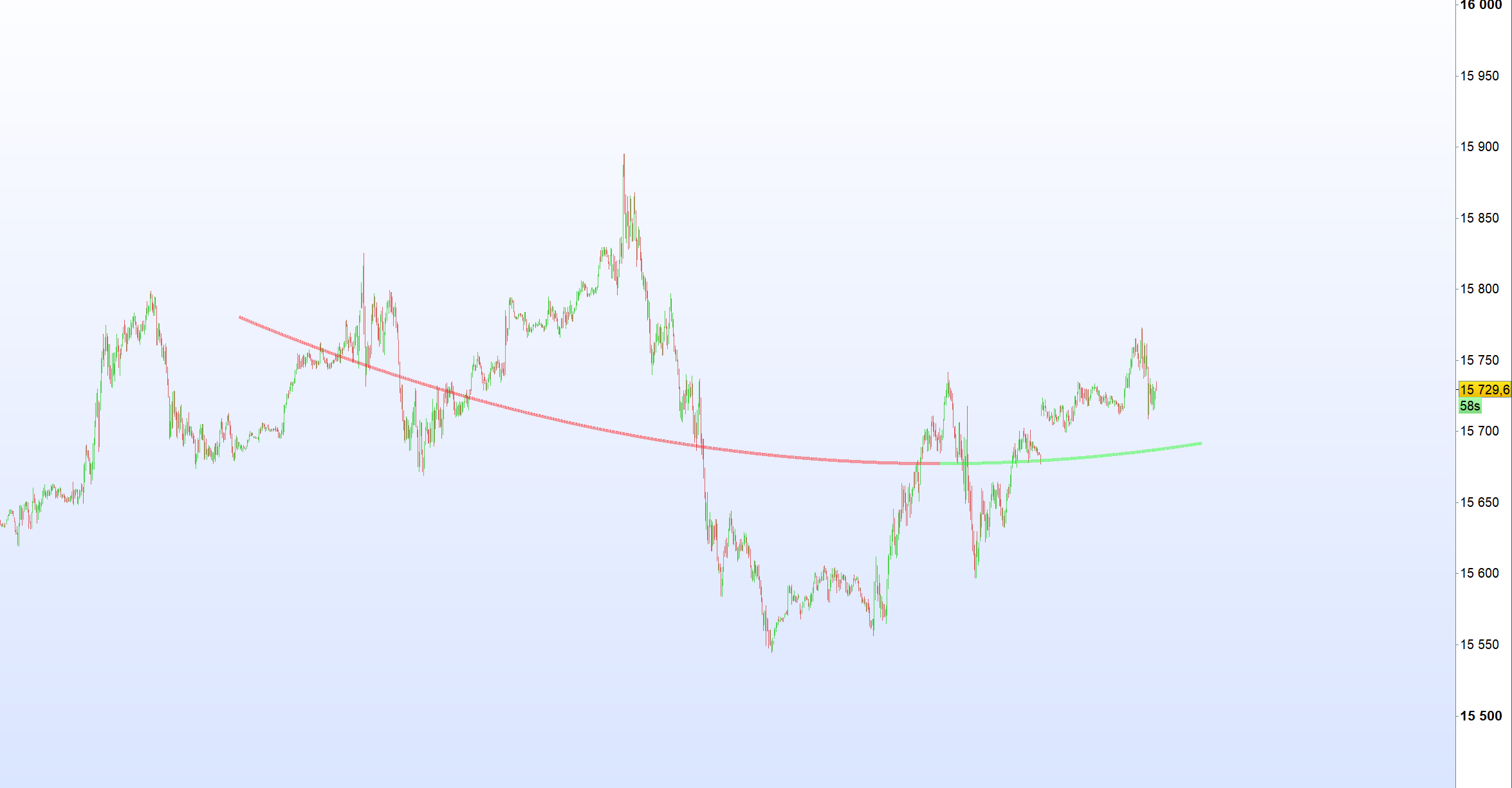
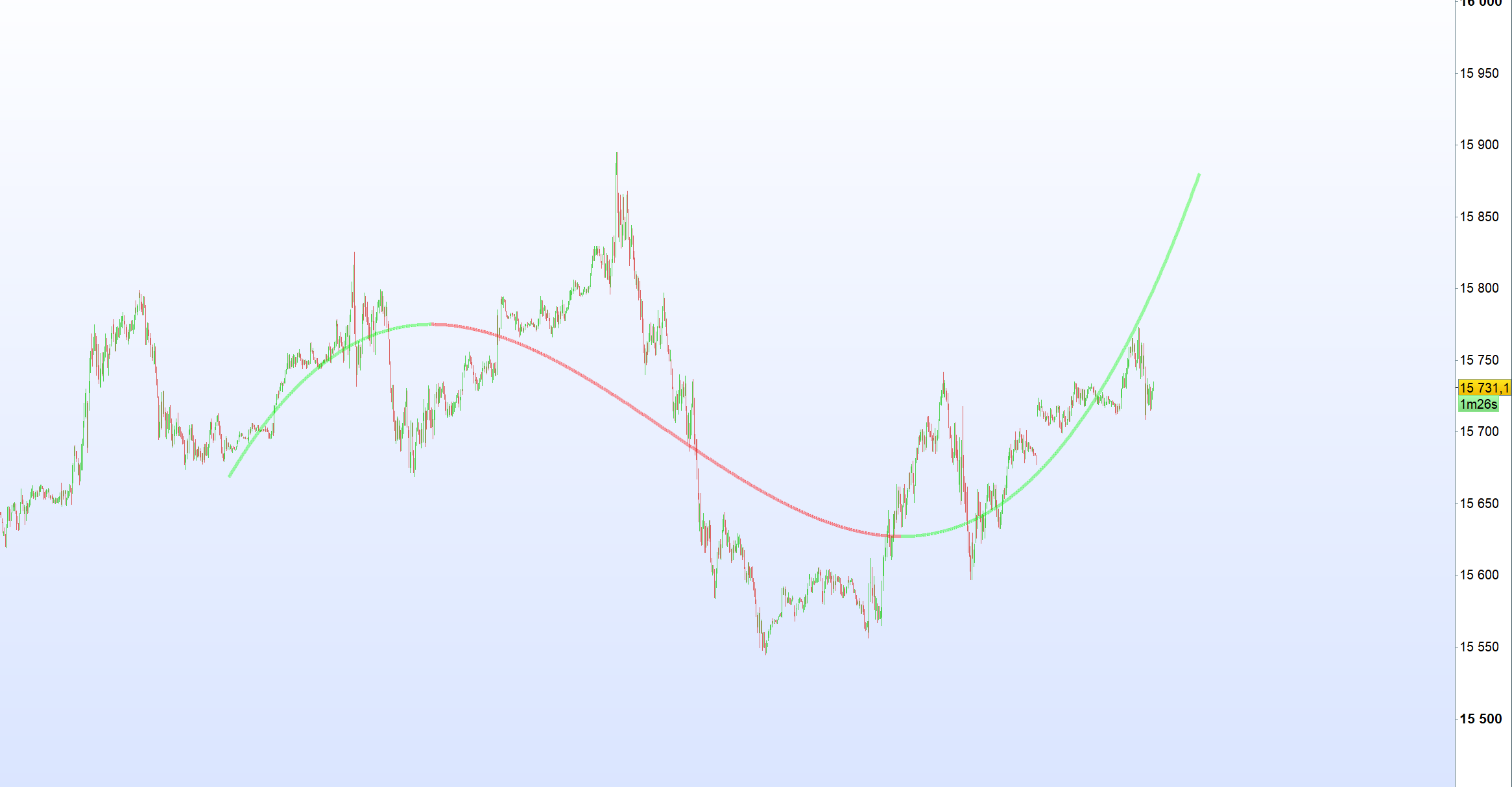
With 3 and 4 degree and a different lngth… forecast can be completly different while increasing/decreasing degree or length.
I think this kind of indicator, that repaint, and only shows what we want to see are completly useless for trading.
There is still some bugs/issues, but i add here the last itf i have. I will try to found the bugs later wheni will have time.
Bravo Lucas. Yes, it repaints like the Center of Gravity. But anyway, bravo for having solved such a complex mathematical/coding problem. We can have separate discussion on the relevance of Indicators in general for a Retail Trader. After a few yers of observation of the Futures markets (never trader Forex), the Indicators do offer very limited success for day trading. They might be uselful on higher timeframe, but up to 30 minutes, what matters is Order Flow and Price Action, which unless you have access to sophisticated tools and an army of quants and programmers can be a huge task for a Retail Trader. The HFT Algos use the information available in the DOM to grab a few ticks and play games of manipulation and spoofing. Merci encore!
Hi, I tried to put it on but it doesn’ show anything. Very strange!
Pine Scipt conversion – Polynomial Regression Extrapolation

This topic contains 22 replies,
has 6 voices, and was last updated by LucasBest

2 years, 6 months ago.
| Forum: | ProBuilder: Indicators & Custom Tools |
| Language: | English |
| Started: | 10/05/2022 |
| Status: | Active |
| Attachments: | 7 files |

The information collected on this form is stored in a computer file by ProRealCode to create and access your ProRealCode profile. This data is kept in a secure database for the duration of the member's membership. They will be kept as long as you use our services and will be automatically deleted after 3 years of inactivity. Your personal data is used to create your private profile on ProRealCode. This data is maintained by SAS ProRealCode, 407 rue Freycinet, 59151 Arleux, France. If you subscribe to our newsletters, your email address is provided to our service provider "MailChimp" located in the United States, with whom we have signed a confidentiality agreement. This company is also compliant with the EU/Swiss Privacy Shield, and the GDPR. For any request for correction or deletion concerning your data, you can directly contact the ProRealCode team by email at privacy@prorealcode.com If you would like to lodge a complaint regarding the use of your personal data, you can contact your data protection supervisory authority.