We have all seen how important the value of spread is in our back testing. Forget to back test with it and a strategy looks like the holy grail but then deduct several pips for every trade and it doesn’t look quite so good. One of the limitations of PRT back testing is the fixed spread value as I’m pretty sure the spread in 1985 was not the same size as it is today. So I was wondering if there was a better way to apply spread to our back testing.
I’ve been analysing the DJI daily chart today and I wrote an indicator to compare what happened if you went long after every break of a previous days high or break of a previous days low. There was also a simple only trade if bull market filter. In the indicator there is a simple deduction of a spread amount with every simulated trade.
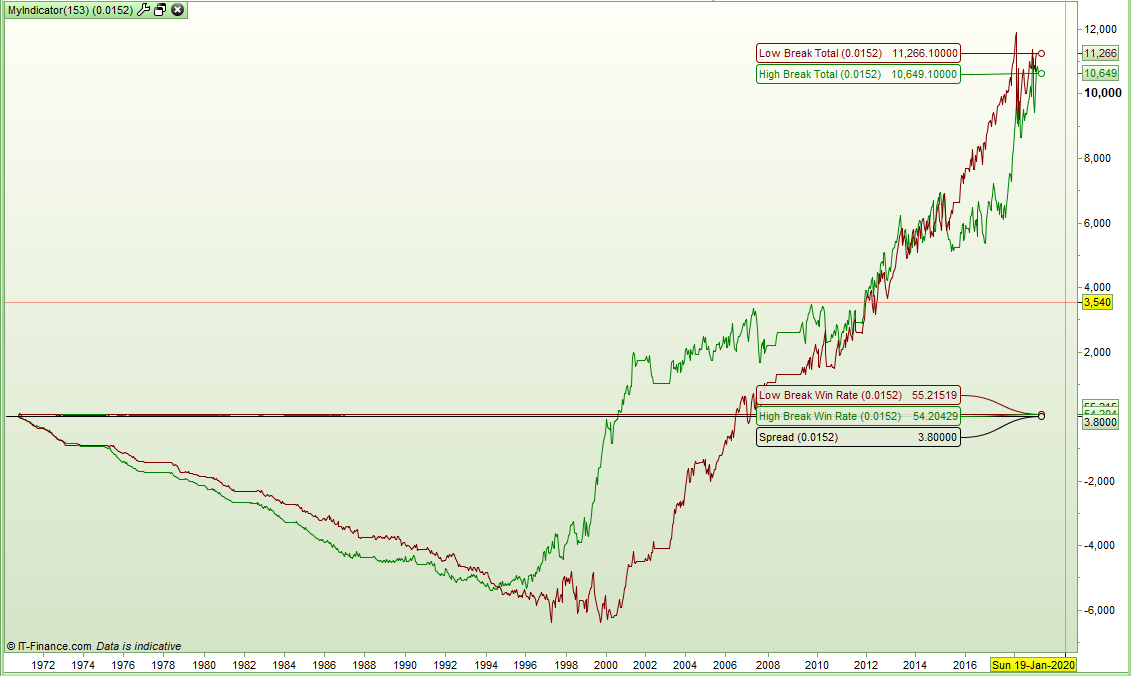
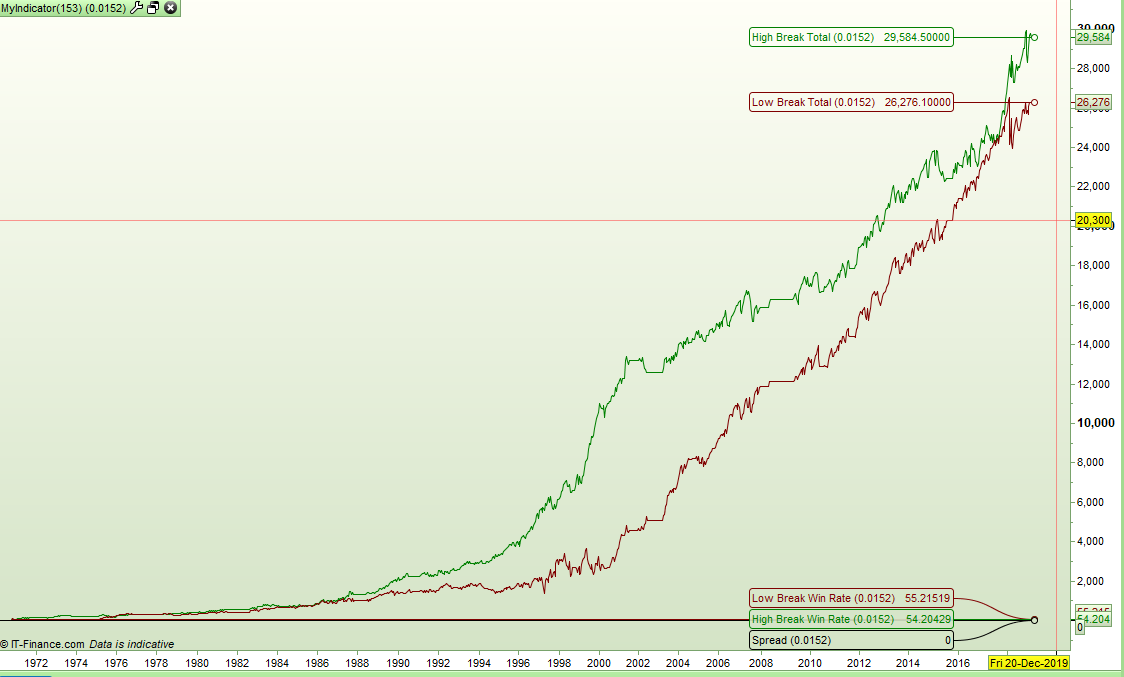
Here’s the holy grail baseline with zero spread:
[attachment file=90428]
Green line is going long after a high break and red is going long after a low break.
With a fixed spread of 3.8 the results looked like this:
[attachment file=90425]
We can see what a big effect the fixed spread is having in the non computer trading era right up to the mid 90’s. After then it all starts to turn more positive.
So I then thought I’d see what happens if we calculated our spread in the test for each trade as a percentage of the opening price as this might more closely simulate what value spread has actually been over the years. I’m guessing that spread has increased with price and with volatility. This simple calculation simulates the former at least.
spread = 0.01517 // % of price
myspread = (spread / 10000) * open
Currently the DJI spread at the end of day is 3.8 so that is 0.01517% of the current price of 25044.
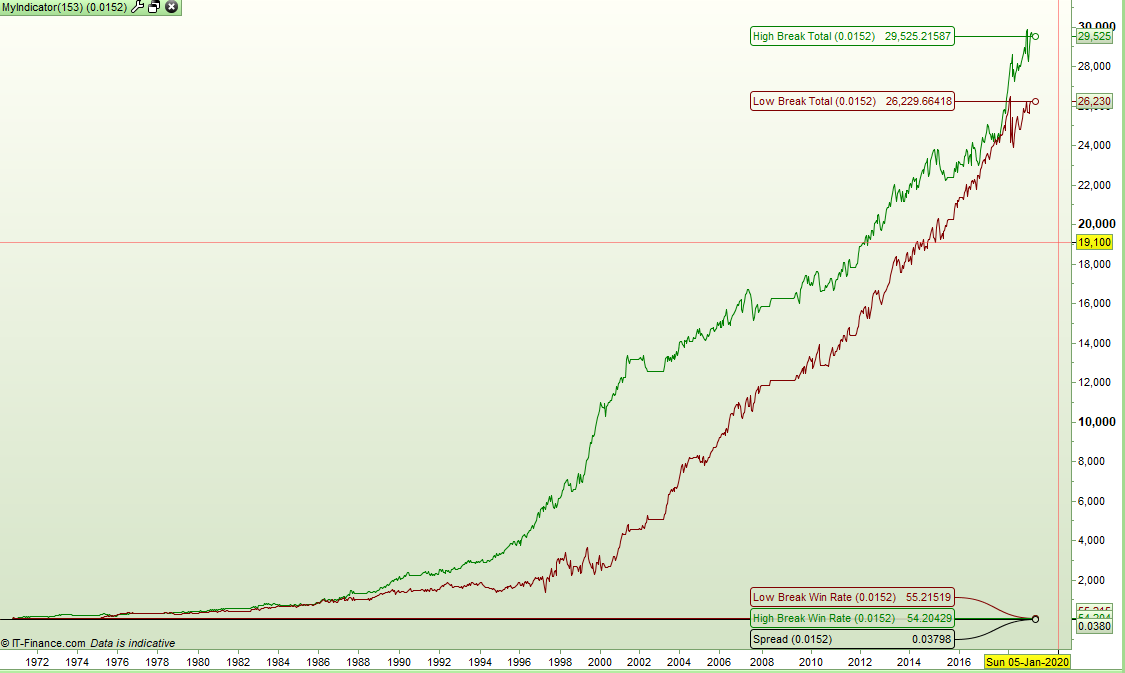
Here is the results with an ever modifying spread:
[attachment file=90426]
That is a much nicer set of equity curves! Maybe we have been throwing away good strategies just because a fixed spread makes them look horrible. Maybe we would do better to leave the PRT fixed spread value at zero and calculate our own spreads in our strategies to use in our back testing?
A rising index is possibly going to be easier to calculate varying spread on than an up and down forex pair where the spread is most likely more volatility based.
Does anyone have any other thoughts or ideas on this subject – maybe a way to incorporate volatility in the spread calculation? Maybe one day PRT could even incorporate a spread based on a calculation as an option for back testing alongside the fixed spread option.
Your thoughts?