Hello,
I tested by curiosity a strategy found in the last Kaufman Perry’s book, here is the rules :
It’s a intraday momentum divergence strategy, on equities, buying when the price is falling but a momentum indicator is rising from a low point. Opposite for sales.
The momentum is the 10-day RSI
The standard action is to sell and set a profit-target based on volatility. We can exit with a loss on a new price high or a momentum low; we can exit with a profit using a price profit target or a momentum high. That gives us natural exit rules without using a stop-loss.for buy signals, the opposite needs to occur. The price lows need to decline at a slower rate.
When the momentum of the highs is declining and the momentum of the lows are rising, we have the sell condition, and when the momentum of the lows is rising thile the momentum of the highs are falling, we can buy.
Buy signal :
- low(t) > low(t-1) > low(t-2). The lows of the price bar are rising.
- The RSI of the low prices is less than 20. The price is oversold
- The difference beteween the RSI of the high and RSI of the lows must be greater then 15. This assures that the high and lows are moving differently.
- We exit the long trade when the RSI of the high >=95
Separating by 15 points two momentum indicators descrease the number of trades but increases the percentage of profitable trades. Results on 2016, 5min Timeframe on SmallCap ETF : 29 shorts, 14 buys, 78%Winrates
You now got all. I allow myself to share this strategy, because, like many book’s strategy she is not complete. We don’t have every sells conditions and something disturb me in the rules : the RSI period.
Btw, i created this, note it’s only a draft and i maybe bad coded rules above:
DEFPARAM CumulateOrders = False // Cumul des positions désactivé
n = 1
//LOWS
c1a = low[0]>low[1] and low[1]>low[2]
c1v = high[0]<high[1] and high[1]>high[2]
//RSI
RSI1l = RSI[3](low)
RSI1h = RSI[3](high)
RSI1a = RSI1l <20
RSI2a = RSI1h - RSI1l > 15
RSI1v = RSI1h > 80
RSI2v = RSI1l - RSI1h > 15
c2a = RSI1a AND RSI2a
c2v = RSI1v AND RSI2v
CONDBUY = c1a AND C2a
CONDSELL = C1v and c2v
//ENTREE LONG
IF CONDBUY THEN
BUY N SHARES AT MARKET
ENDIF
//EXIT LONG
exit1 = RSI1h >95
IF Exit1 then
sell at market
ENDIF
//ENTREE SHORT
IF CONDSELL THEN
SELLSHORT N SHARES AT MARKET
ENDIF
//EXIT SHORT
exits = RSI1l <= 5
IF ExitS THEN
exitshort AT MARKET
ENDIF
Results on many stocks are interesting but the stratgy need more works.
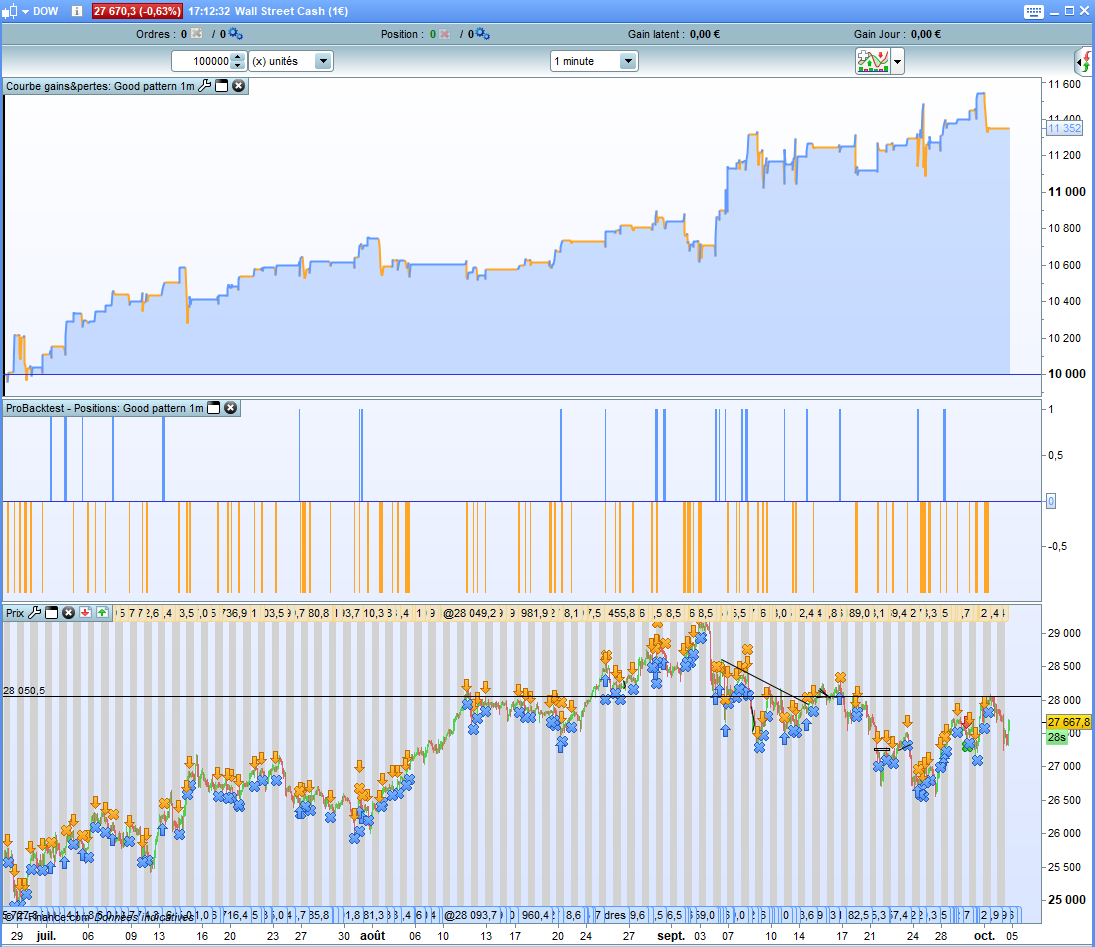
I see the attached backtest as “accident”. I took the code above, optimised c2a and c2v on 1min Dow. But it shows us that we can get something from this strategy. If u plan working on it, Kaufman is using 5min timeframes, not 1min as i did.
I’m pretty sure it could interest someone.