Bonjour,
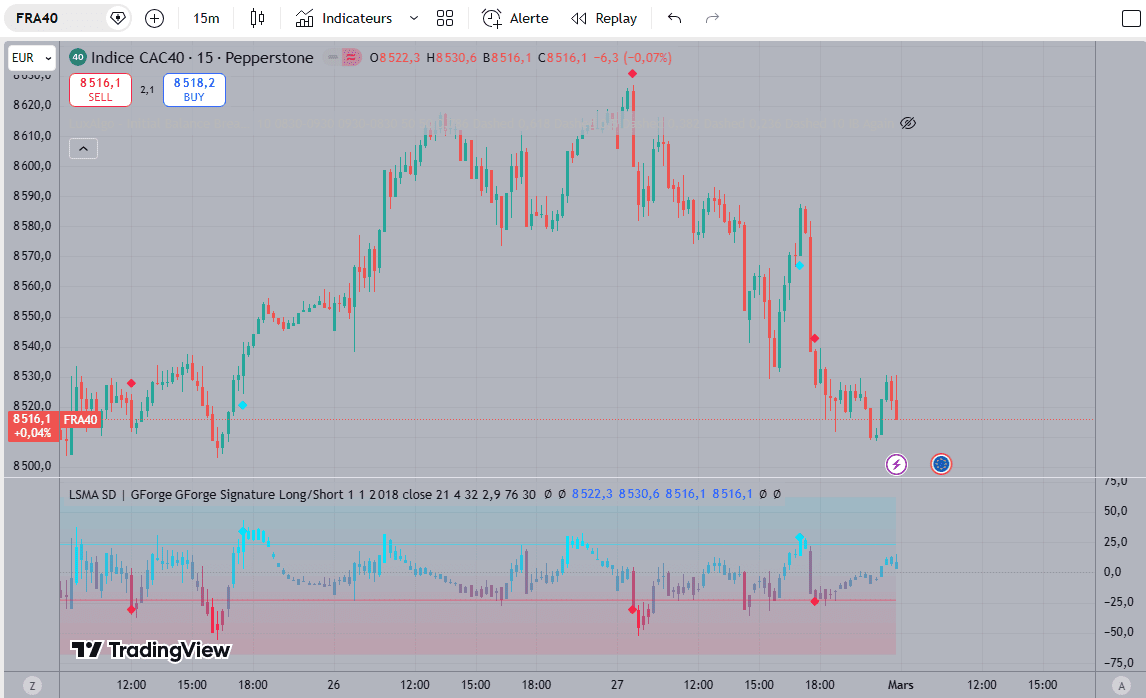
J’aurais besoin de convertir le code de cet indicateur de TradingView dont voici le code:
//@version=6
indicator(“LSMA SD | GForge”, overlay=false, max_labels_count=500)
// ╔═══════════════════════════════════════════════════════════════════════════╗
// ║ DISPLAY OPTIONS ║
// ╚═══════════════════════════════════════════════════════════════════════════╝
show_signals = input.bool(true, “Show Signal Markers”, tooltip=”Diamond markers on the oscillator when signals fire.”, group=”📊 Display Options”)
show_overlay_signals = input.bool(true, “Show Signals on Price Chart”, tooltip=”Diamond markers on the main price chart.”, group=”📊 Display Options”)
show_bar_color = input.bool(true, “Color Price Chart Bars”, tooltip=”Gradient candle coloring driven by oscillator position.”, group=”📊 Display Options”)
theme = input.string(“GForge Signature”, “Visual Theme”, options=[“GForge Signature”,”Quantum Blue”,”Plasma Fire”,”Deep Ocean”,”Royal Purple”,”Matrix Green”,”Sunset Gold”,”Arctic Ice”,”Dark Matter”,”Pearl White”], group=”🎨 Visual Settings”)
// ╔═══════════════════════════════════════════════════════════════════════════╗
// ║ STRATEGY SETTINGS ║
// ╚═══════════════════════════════════════════════════════════════════════════╝
trade_mode = input.string(“Long/Cash”, “Trading Mode”, options=[“Long/Short”,”Long/Cash”],
tooltip=”Long/Short: flips between long and short.nLong/Cash: exits to flat instead of shorting.”,
group=”⚙️ Strategy Settings”)
startDate = input.int(1, “Start Date”, minval=1, maxval=31, group=”📅 Backtest Date Range”)
startMonth = input.int(1, “Start Month”, minval=1, maxval=12, group=”📅 Backtest Date Range”)
startYear = input.int(2018, “Start Year”, minval=1800, maxval=2100, group=”📅 Backtest Date Range”)
in_date_range = time >= timestamp(syminfo.timezone, startYear, startMonth, startDate, 0, 0)
// ╔═══════════════════════════════════════════════════════════════════════════╗
// ║ INDICATOR PARAMETERS ║
// ╚═══════════════════════════════════════════════════════════════════════════╝
src = input(close, “Source”, tooltip=”Default hlc3 (typical price). Averages the full bar range into the regression, reducing end-of-session close distortion.”, group=”📈 LSMA·SD Settings”)
ls_len = input.int(21, “LSMA Length”, minval=10, maxval=300, tooltip=”Lookback for the least-squares regression line. Longer = smoother trend direction, slower to respond to new trends.”, group=”📈 LSMA·SD Settings”)
smooth_len = input.int(4, “Endpoint Smoothing”, minval=1, maxval=10, tooltip=”Short EMA over the raw LSMA output. Dampens window-edge snap artifacts without meaningful lag. 1 = off.”, group=”📈 LSMA·SD Settings”)
sd_len = input.int(32, “StdDev Length”, minval=5, maxval=300, tooltip=”Lookback for the StdDev band width. Can differ from LSMA length.”, group=”📈 LSMA·SD Settings”)
sd_mult = input.float(2.9, “StdDev Multiplier”, minval=0.5, maxval=5.0, step=0.1, tooltip=”Band width = StdDev × this. ±2.0 covers ~95% of price history by definition. No dynamic scaling.”, group=”📈 LSMA·SD Settings”)
// ╔═══════════════════════════════════════════════════════════════════════════╗
// ║ SIGNAL SETTINGS ║
// ╚═══════════════════════════════════════════════════════════════════════════╝
long_threshold = input.float(76, “Long Threshold”, minval=50, maxval=95, tooltip=”Crossover above this level triggers a long signal.”, group=”🎯 Signal Settings”)
short_threshold = input.float(30, “Short Threshold”, minval=5, maxval=80, tooltip=”Crossunder below this level triggers exit or short.”, group=”🎯 Signal Settings”)
// ╔═══════════════════════════════════════════════════════════════════════════╗
// ║ CORE CALCULATION ║
// ║ ║
// ║ LSMA: least-squares regression line over ls_len bars, smoothed with ║
// ║ a short EMA to remove window-edge snap artifacts. ║
// ║ ║
// ║ Fixed StdDev bands wrap the basis. Width responds only to actual ║
// ║ price volatility — no secondary scaling layer. ║
// ║ ║
// ║ Oscillator = price position within bands on a 0–100 scale. ║
// ║ Signals fire on threshold crossovers. ║
// ╚═══════════════════════════════════════════════════════════════════════════╝
float raw_lsma = ta.linreg(src, ls_len, 0)
float basis = ta.ema(raw_lsma, smooth_len)
float dev = sd_mult * ta.stdev(src, sd_len)
float upper = basis + dev
float lower = basis – dev
float band_rng = upper – lower
float osc = band_rng > 0 ? 100.0 * (src – lower) / band_rng : 50.0
// ╔═══════════════════════════════════════════════════════════════════════════╗
// ║ SIGNAL LOGIC ║
// ╚═══════════════════════════════════════════════════════════════════════════╝
bool sig_long = ta.crossover(osc, long_threshold)
bool sig_short = ta.crossunder(osc, short_threshold)
var bool is_long_state = true
var string signal_state = “long”
if sig_long and in_date_range
is_long_state := true
signal_state := “long”
else if sig_short and in_date_range
is_long_state := false
signal_state := trade_mode == “Long/Short” ? “short” : “cash”
bool long_signal = sig_long and in_date_range and signal_state[1] != “long”
bool short_signal = sig_short and in_date_range and signal_state[1] != “short” and trade_mode == “Long/Short”
bool cash_signal = sig_short and in_date_range and signal_state[1] != “cash” and trade_mode == “Long/Cash”
// ╔═══════════════════════════════════════════════════════════════════════════╗
// ║ LOWER PANEL — OSCILLATOR CANDLES + GRADIENT BACKGROUND ║
// ╚═══════════════════════════════════════════════════════════════════════════╝
float clamped_osc = math.max(0, math.min(100, osc))
float mid_point = (long_threshold + short_threshold) / 2
float norm_floor = -mid_point – 15
float norm_ceiling = (100 – mid_point) + 15
float band_step = (norm_ceiling – norm_floor) / 10
// Map each OHLC price into oscillator panel coordinates
float osc_O = band_rng > 0 ? math.max(norm_floor, math.min(norm_ceiling, 100 * (open – lower) / band_rng – mid_point)) : 0
float osc_H = band_rng > 0 ? math.max(norm_floor, math.min(norm_ceiling, 100 * (high – lower) / band_rng – mid_point)) : 0
float osc_L = band_rng > 0 ? math.max(norm_floor, math.min(norm_ceiling, 100 * (low – lower) / band_rng – mid_point)) : 0
float osc_C = band_rng > 0 ? math.max(norm_floor, math.min(norm_ceiling, 100 * (close – lower) / band_rng – mid_point)) : 0
color candle_col = color.from_gradient(clamped_osc, 0, 80, primary_dn, primary_up)
// 10-slice vertical gradient background
p_lv0 = plot(norm_floor, display=display.none, editable=false)
p_lv1 = plot(norm_floor + band_step, display=display.none, editable=false)
p_lv2 = plot(norm_floor + band_step * 2, display=display.none, editable=false)
p_lv3 = plot(norm_floor + band_step * 3, display=display.none, editable=false)
p_lv4 = plot(norm_floor + band_step * 4, display=display.none, editable=false)
p_lv5 = plot(norm_floor + band_step * 5, display=display.none, editable=false)
p_lv6 = plot(norm_floor + band_step * 6, display=display.none, editable=false)
p_lv7 = plot(norm_floor + band_step * 7, display=display.none, editable=false)
p_lv8 = plot(norm_floor + band_step * 8, display=display.none, editable=false)
p_lv9 = plot(norm_floor + band_step * 9, display=display.none, editable=false)
p_lv10 = plot(norm_ceiling, display=display.none, editable=false)
fill(p_lv0, p_lv1, color.new(color.from_gradient(0, 0, 100, primary_dn, primary_up), 88))
fill(p_lv1, p_lv2, color.new(color.from_gradient(10, 0, 100, primary_dn, primary_up), 88))
fill(p_lv2, p_lv3, color.new(color.from_gradient(20, 0, 100, primary_dn, primary_up), 88))
fill(p_lv3, p_lv4, color.new(color.from_gradient(30, 0, 100, primary_dn, primary_up), 88))
fill(p_lv4, p_lv5, color.new(color.from_gradient(40, 0, 100, primary_dn, primary_up), 90))
fill(p_lv5, p_lv6, color.new(color.from_gradient(50, 0, 100, primary_dn, primary_up), 92))
fill(p_lv6, p_lv7, color.new(color.from_gradient(60, 0, 100, primary_dn, primary_up), 90))
fill(p_lv7, p_lv8, color.new(color.from_gradient(70, 0, 100, primary_dn, primary_up), 88))
fill(p_lv8, p_lv9, color.new(color.from_gradient(80, 0, 100, primary_dn, primary_up), 88))
fill(p_lv9, p_lv10, color.new(color.from_gradient(90, 0, 100, primary_dn, primary_up), 88))
// Oscillator candles, threshold lines, centre reference
plotcandle(osc_O, osc_H, osc_L, osc_C, title=”Oscillator Candles”,
color=candle_col, bordercolor=candle_col, wickcolor=candle_col, display=display.pane)
plot(long_threshold – mid_point, “Long Threshold”, color=color.new(primary_up, 55), linewidth=1, display=display.pane)
plot(short_threshold – mid_point, “Short Threshold”, color=color.new(primary_dn, 55), linewidth=1, display=display.pane)
hline(0, “Centre”, color=color.new(color.gray, 60), linestyle=hline.style_dotted)
// Panel signal diamonds
plotshape(show_signals and long_signal ? osc_C : na,
title=”Long Signal”, style=shape.diamond, location=location.absolute, color=primary_up, size=size.tiny)
plotshape(show_signals and (short_signal or cash_signal) ? osc_C : na,
title=”Short Signal”, style=shape.diamond, location=location.absolute, color=primary_dn, size=size.tiny)
// ╔═══════════════════════════════════════════════════════════════════════════╗
// ║ MAIN CHART — BAR COLOR + SIGNALS ║
// ╚═══════════════════════════════════════════════════════════════════════════╝
bar_color = show_bar_color and in_date_range ?
color.from_gradient(clamped_osc, 0, 100, primary_dn, primary_up) : na
plotcandle(open, high, low, close, title=”Price Bars”,
color=bar_color, bordercolor=bar_color, wickcolor=bar_color, force_overlay=true)
plotshape(show_overlay_signals and long_signal ? low : na,
title=”Overlay Long”, style=shape.diamond,
location=location.belowbar, color=primary_up, size=size.tiny, force_overlay=true)
plotshape(show_overlay_signals and (short_signal or cash_signal) ? high : na,
title=”Overlay Short”, style=shape.diamond,
location=location.abovebar, color=primary_dn, size=size.tiny, force_overlay=true)
// ╔═══════════════════════════════════════════════════════════════════════════╗
// ║ ALERTS ║
// ╚═══════════════════════════════════════════════════════════════════════════╝
alertcondition(long_signal, “Long Signal”, “LSMA SD: Long entry”)
alertcondition(short_signal, “Short Signal”, “LSMA SD: Short entry”)
alertcondition(cash_signal, “Cash Signal”, “LSMA SD: Exit to cash”)