ModaParticipant
Senior
@nonetheless
Thanks you for your work. I have a beginner question, i’m trying to figure out what is the good way for optimization with WF.
My question is can i ask you what is your workflow in order to find good value when using WF optimization?

Example are you putting let’s say for a variable, a range of value and optimize it (WF) with single iteration or 7 iteration and jump to second variable….
or working by block of variables optimization…are you using only WF optimization or old optimization too?
Sorry for the noise and out of topic question but i really would like to find out the good way to do it, for now i’m struggling finding decent variable value after optimizing (WFE %>50).
I searched on the forum but didn’t find a precise answer…
@Moda it would be good to have a new Topic on WF as we haven’t had a discussion on it for a while?
Also a new Topic means that more folk would probably contribute, also more folk would benefit by being able to find the Topic on WF in the future.
Moda … if you agree to below then a Moderator would raise a new Topic for you.
Mods
Please place the above question on WF in a new Topic
ModaParticipant
Senior
@GraHal sure sounds great … not the place here
Thanks
Topic split from ‘Mother of Dragons’ topic as requested.
Hi Moda, this is how I do optimizations:
First I optimize over the maximum data, ie the full 200k to get a picture of how viable an idea is. If the number of variables is low, then i’ll run a 7x WF with max variance. If the result is good then I’ll look at the values for the most recent 1 or 2 sectors and use those in another back test over the full 200k. This gives OOS performance for the recent months, plus the data from before the IS period.
If the algo has a lot of variables then I skip the 7x WF and just do one 70-30 WF over 25% of the data (50k), then back test @200k. If it still looks good, I run it through the Robustness Tester which you can read about here:
Strategy Robustness Tester
If there are various sets of values that do well OOS then I pick the one that does best in the Robustness tester.
I would be v curious to know what method other people use to arrive at a final set of values.
If there are various sets of values that do well OOS then I pick the one that does best in the Robustness tester.
So you run the robustness tester several times with various fixed variable settings and then go with the most robust? If my understanding of what you wrote is correct then that is a very solid way of comparing different sets of values. It gives you a fighting chance that you have the most robust even if they are not the most profitable.
ModaParticipant
Senior
@nonetheless many thanks this is much more clear to me now
So you run the robustness tester several times with various fixed variable settings and then go with the most robust?
Yes, correct. Bloody time-consuming but seems to get results.
ModaParticipant
Senior
Thanks for pointing me the direction again…here some work
Need to work this a bit more!!
ModaParticipant
Senior
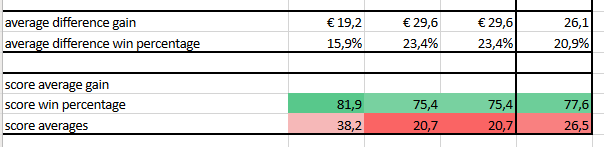
i’m curious how robust this will be…
There’s no fixed way to interpret these scores but to me that looks reasonably good. It’s always harder to get a good score for the average gain – rarely above 50 in my experience – and you’ve got a good number for the %win, so I’d say that’s a decent result.
i’m curious how robust this will be…
You should better check the robustness test that you did… usually this is not an usual distribution of values
not an usual distribution of values
if it’s 43.8 for average gain, 91.5 for %win and 67.6 average of the two? that looks quite normal to me.
which part do you find unusual?