






@Mauro Which timeframes do you prefer as signal transmitters?
@JS Unfortunately, I never understood how to use standard deviation as an entry or exit. I have a knowledge gap there. How exactly do you do that?
Hi phoentzs, normally the time frame I use most is 2 hours sometimes 4 hours but this only with US500 …. however I have algorithms running even with 15 minute time frames that fit well in a wallet and lower the drawdown. ..with the 5 minutes I operate only with US500.
Hello
Mauro T.
LinkParticipant
Senior
That depends on the configuration of your algorithms.
For the rest, the price turned around this week in the US, just a simple setback for now.
“Financial genius is a rising market and a short memory…”
JK Galbraith
😎😎😎
JSParticipant
Senior
@phoentzs I told you already in your topic “filter for too high volatility”
@JS I was even able to use it as a filter in my Algos. But directly as an entry signal … I haven’t understood that yet.
Hi nonetheless
Great topic, thanks for starting this thread. I have migrated away from lower time frame strategies, 1 and 2 minutes, to focus more on 15 minute time frames and beyond. I still run a few strategies on a 5 minute TF but will eventually migrate these to higher TFs. Whilst you may get a similar number of trades in a back test between lower and higher TFs, the higher TFs allow you to see how the strategy performed over a much longer period of time during real market stresses. In a previous life I used to run various stress test scenarios as part of our overall trading risk framework, it helps identify a range of potential pitfalls.
I am running 12 strategies, 6 are currently profitable on the month and offset the losses of the other 6 which are currently down. I attribute being net up on the month to having a diversified portfolio running different strategies (mostly breakout, momentum, mean reversion and price action). Performance across the indices (DJI, NASDAQ and DAX) and TF’s (5, 10 and 15) is fairly evenly distributed. I don’t use PRT for my US Equities or Options trading.
Agree with JS about the use of standard deviation as a entry filter, it can be very effective at helping to avoid entering choppy markets, save for mean reversion strategies where it can actually form part of the entry criteria. For exits I look to tighten trailing stops in volatile conditions.
Again, like the topic as well as peoples responses.
[attachment file=”181692″]
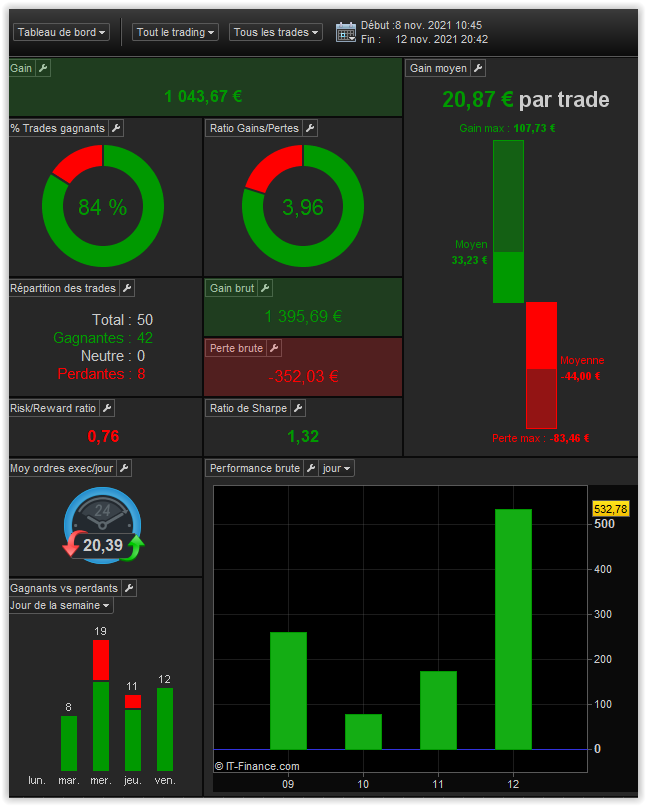
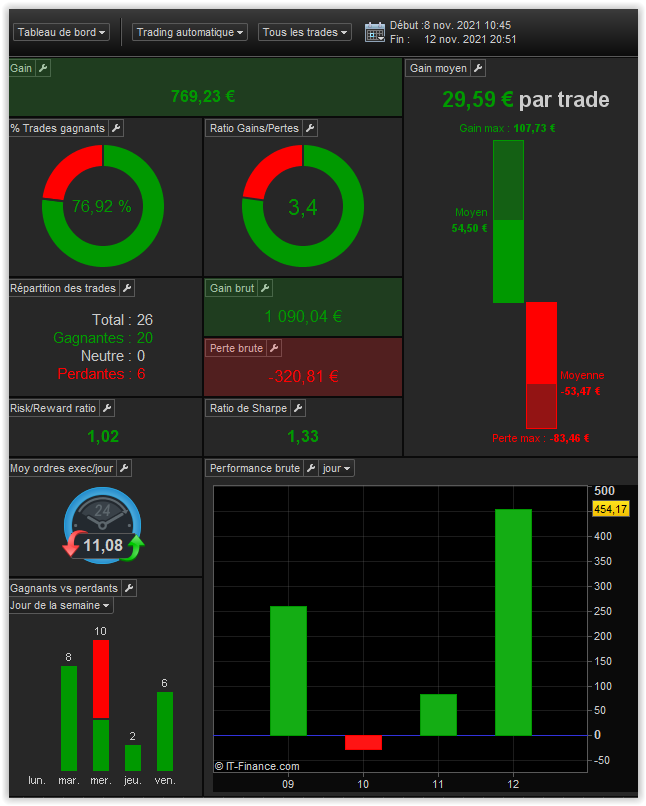
La semaine précédente a été bonne pour moi
J’utilise 8 bots, time frime 3 min & 15 min
Looking good, you’re obviously doing something right … but what, exactly?
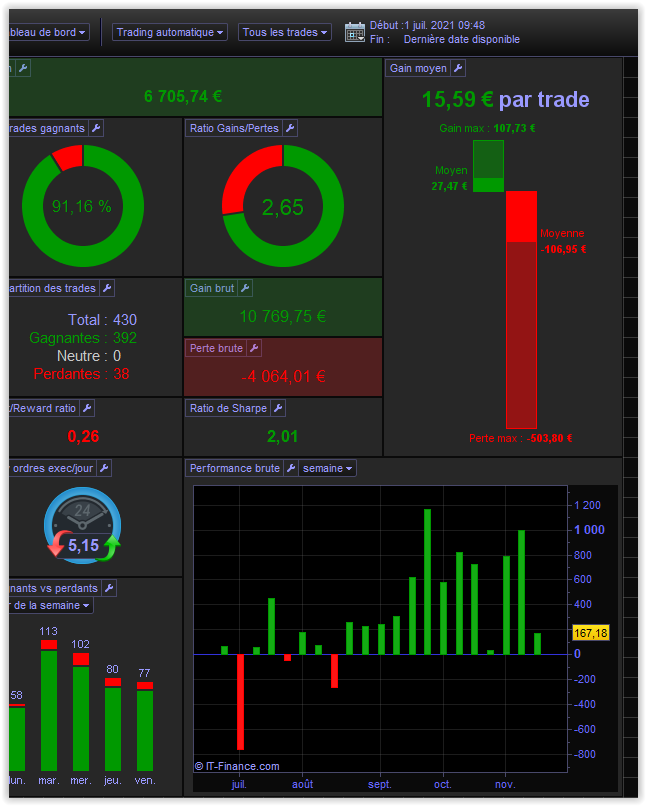
The bots mainly take positions in m3 or m15 with primary trends m15, h2, h4 and SL between 2 and 5%
Big risks (risk/reward ratio : 0.25) but it works since the beginning of the live in July
So maby it’s possible to win money with automatics trading. I will be sure in 1 year ;o)
the large SL % explains quite a lot – the position stays open until it comes good. but that will usually mean massive drawdown in the long term. And you’d have to be careful about position size to make sure you have the funds to carry it through the dips without a margin call.
Yes you are right
Money management is as important as stratégy
My demo algos did the same again last week … lost loads overall as a portfolio! 🙁
I desperately would love to know which Algo lost the most for last week, but there is no easy way to see this.
Only way I know is to drill down in the Detailed Report and set the profit and loss chart to ‘weeks’ and then check each Algo individually, make notes and then compare across the portfolio of Algos.
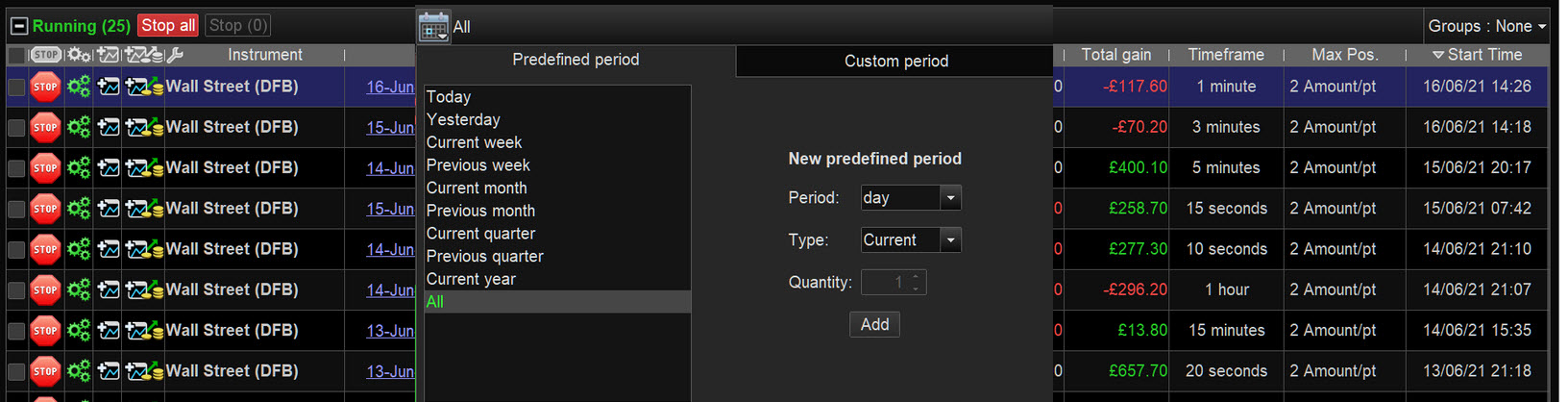
I put a Suggestion (in June 21) to PRT that they add a ‘period widget’ to the AutoTrading window as attached.
thanked this post