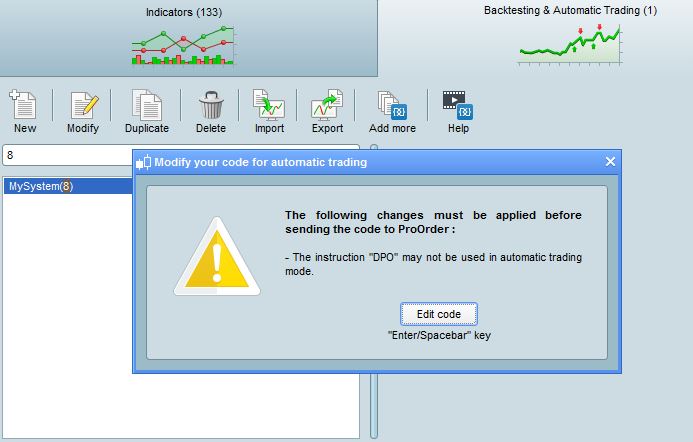
Bonsoir, quelle est la fonction “DPO” dans un code?
ex: h1=dpo[n](high)
Elle est refusée en automatisé.
Peut-on contourner cela par une astuce de programmation?
Merci.
Le DPO peut se calculer de 2 façons :
1/ avec les données du futur (ce qui n’est pas possible à récupérer pour le trading automatique)
2/ avec les données du passé (là oui on le peut mais il faudra utiliser la formule du DPO directement dans le code et non pas l’indicateur embarqué dans la plateforme).
Voici la formule du DPO :
// **** DPO of past moving average and not future ones :

p = 14

avg = average[p](customclose)
r = round(p/2) +1
b = customclose - avg[r]
myDPO = b

RETURN myDPO as "Detrented Price Oscillator of past datas", 0 coloured(10,10,255) as "0"
Bonjour, malgré mes nombreuses tentatives, je fais choux blanc.
Mon but est de rendre opérant les “DARVAS BOXES” en temps réel, et non pas en “statique”, et je n’arrive à intégrer le bout de code que tu m’as transmis ci-dessus dans le code original.
Merci pour ton aide, si cela est possible bien entendu.
rem from hk_lisse blog
k=55
once tth=undefined
once ttl=undefined
n=(k*2)-4
p=(n/2)-1
h1=dpo[n](high)
moyh=high-h1
hi=(moyh-moyh[1]+(high[p])/n)*n
hi=(round(hi*100))/100
l1=dpo[n](low)
moyl=low-l1
lo=(moyl-moyl[1]+(low[p])/n)*n
lo=(round(lo*100))/100
low1=(round(low*100))/100
high1=(round(high*100))/100

if barindex > 100 then
if box=1 and (high1>tth or low1<ttl) then
box=0
flag=0
endif
if box=0 and flag=0 and high1>=hi[46] and high1>=hi[45] and high1>=hi[44] then
th=high1
flag=1
endif
if box=0 and flag=1 then
for zz=0 to 44
if  hi[47-zz-1]>th or hi[47-zz-2]>th or hi[47-zz-3]>th then
flag=0
break
endif
if lo[47-zz]<lo[47-zz-1] and lo[47-zz]<lo[47-zz-2] and lo[47-zz]<lo[47-zz-3] then
box=1
tth=th
ttl=lo[47-zz]
break
endif
next
endif
else
tth=undefined
ttl=undefined
endif
if box=1 then
ba=ttl
else
ba=tth
endif
if box=1 then
col=1
else
col=-1
endif


return ba coloured by col , tth coloured by col,ttl coloured by col
Il suffit d’intégrer le code que j’ai donné dans ton indicateur et de faire référence à “myDPO” en lieu et place de “dpo” de ton code original.
Aaaaaaah……OK, suis-je bête.
Je m’y mets de suite, merci.
J’obtiens donc un début de code comme suit, mais il y a forcément quelque chose qui cloche, au niveau de “h1″ et ” l1″, par rapport au code de base?
Navré pour mon insistance, mais ce DARVAS me semble une excellente base de backtest, et j’aimerais vraiment arriver à quelque chose de tangible.
p = 55
avg = average[p](customclose)
r = round(p/2) +1
b = customclose - avg[r]
myDPO = b
k=55
once tth=undefined
once ttl=undefined
n=(k*2)-4
p=(n/2)-1
h1=mydpo
moyh=high-h1
hi=(moyh-moyh[1]+(high[p])/n)*n
hi=(round(hi*100))/100
l1=mydpo
moyl=low-l1
lo=(moyl-moyl[1]+(low[p])/n)*n
lo=(round(lo*100))/100
low1=(round(low*100))/100
high1=(round(high*100))/100
Je précise que ce n’est pas destiné à du trading auto, mais à la construction et l’utilisation d’un probacktest en temps réel.
Victorio je ne pense pas qu’il soit possible d’obtenir les mêmes box comme ça. Même si je suis d’accord avec le bout de code à insérer de Nicolas pour représenter le dpo avec les moyennes mobiles passées, il suffit d’afficher le dpo existant de PRT et de cocher tour à tour “utiliser les moyennes mobiles passées”/”utiliser les moyennes mobiles futures” pour voir que ça donne des dpo vraiment très différents. Et ensuite dans le code de Darvas box les différences dues au dpo se propagent comme une boule de neige en créant des différences encore plus grandes dans le calcul de hi et lo. Il en résulte des box très différentes.
Enfin, si je puis me permettre, dans l’insertion du bout de code de Nicolas sur le dpo, tu as un “customclose”, qui te laisse librement choisir en fenêtre de l’indicateur si tu veux l’appliquer à high , low, close, autre… Mais dans le code de Darvas box tu as 2 fois un calcul de dpo avec du high et avec du low. Or si tu laisses customclose comme tu l’as fait, et qu’après en fenêtre tu choisis high, tu vas calculer 2 fois en high (respectivement si tu choisis low tu vas calculer 2 fois en low), ça va créer des erreurs qui vont s’ajouter aux différences dues au mode de calcul des dpo. Donc tu dois adapter le code de Nicolas en traitant 2 calculs séparés de dpo, un avec high, et un autre avec low. En remplaçant le p de Nicolas par pprc pour pas confondre avec le p déjà pris dans le code de Darvas box et faciliter la lecture des 2 codes fusionnés, ça donnerait quelque chose comme ça:
rem from hk_lisse blog
k=48
once tth=undefined
once ttl=undefined
n=(k*2)-4
p=(n/2)-1

pprc=n
avg1 = average[pprc](high)
r = round(pprc/2) +1
myDPO1 = high - avg1[r]
avg2 = average[pprc](low)
myDPO2 = low - avg2[r]

h1=myDPO1
moyh=high-h1
hi=(moyh-moyh[1]+(high[p])/n)*n
hi=(round(hi*100))/100
l1=myDPO2
moyl=low-l1
lo=(moyl-moyl[1]+(low[p])/n)*n
lo=(round(lo*100))/100
low1=(round(low*100))/100
high1=(round(high*100))/100
etc…
en ayant mis ici pprc = n puisque le code de Darvas box utilisait les n périodes pour son calcul, mais j’ai laissé pprc en intermédiaire pour éventuellement jouer avec en mettant pprc = plus ou moins que n et voir bouger les tailles de box. Mais je pense que la conclusion sera de toute façon que quel que soit le réglage, les box sont beaucoup moins pertinentes, parce que les dpo sont trop différents au départ pour que mathématiquement on puisse retomber sur les mêmes box.
Merci Noobywan
Je suppose que tu m’as reconnu? ;o)
Je teste immédiatement ta proposition.
A+
 rama
ramaParticipant
Senior
I am t
once rr=1
mb=average[20](typicalprice)
k=48
n=(k*2)-4
p=(n/2)-1

h1=DPO[n](high)

moyh=high-h1
hi=(moyh-moyh[1]+(high[p])/n)*n
hi=(round(hi*100))/100
l1=dpo[n](low)

moyl=low-l1
lo=(moyl-moyl[1]+(low[p])/n)*n
lo=(round(lo*100))/100
clo1=dpo[n](close)

moyc=close-clo1
clot=(moyc-moyc[1]+(close[p])/n)*n
clot=(round(clot*100))/100
cond1=(high>high[1] and high>high[2])
cond2=(cond1 and high>hi[46]) and (barindex>bari or rr=-1)
if cond1 and cond2 then
flagg=1
targeth=high
targetl=lo[46]
else
flagg=0
signa=mb
endif
for zz=0 to 45
if clot[45-zz]<targetl and hi[45-zz]<=targeth and flagg=1  then
signa=high+(averagetruerange[20](close))*.5
rr=1
bari=barindex+zz+2
break
elsif     hi[45-zz]>targeth then
signa=mb
break
endif
next
condi=(low<low[1] and low<low[2]) and low<lo[46] and (barindex>bar or rr=1)
if condi then
fflag=1
target1=low
target2=hi[46]
else
fflag=0
siigna=mb
endif
for kk=0 to 45
if clot[45-kk]>target2 and lo[45-kk]>=target1 and fflag=1 then
siigna=low-(averagetruerange[20](close))*.5
rr=-1
bar=barindex+kk+2
break
elsif lo[45-kk]<target1 then
siigna=mb
break
endif
next
if barindex < 100 then
signa=undefined
siigna=undefined
endif
golong = (siigna < mb)
goshort = (signa > mb)*-1
return golong as  "LONG",goshort as "SHORT",0
I am trying to use the above indicator in my code I get the error attached. what need to be replaced for DPO