The distance of 2 moving averages … if both are on top of each other … can I somehow code them in percent?
For example:
SMA20> SMA200
And of that the distance in percent?
There you go:
PerCent = (Sma20 * 100 / Sma200) - 100
And how exactly can I use this calculated number for long or short entries? My idea is to only enter into trades when the two SMAs are not too far apart.
 JS
JSParticipant
Senior
If PerCent > x then => Buy
If PerCent < y then => SellShort
x for example 0.5%
y for example -0.5%
Crossing MA’s at x = 0 or y = 0
distance in percent?
Distance in percent of what … the faster average / SMA20?
So where SMA20 > SMA200 …
((SMA20-SMA200)/SMA20)*100
JSParticipant
Senior
Distance in percent of the Close
PerCent is the same as:
S1 = Average[20](Close)
S2 = Average[200](Close)
Dist = S1 – S2
DistPerc = (Dist / Close) * 100
I was always very good at math … I’m trying to understand which formula is better. I’ll just try it out. Thank you very much.
Hi. New to this forum. Such a great comunity.
My firt try with an algo. Inspiration from Phoentzs
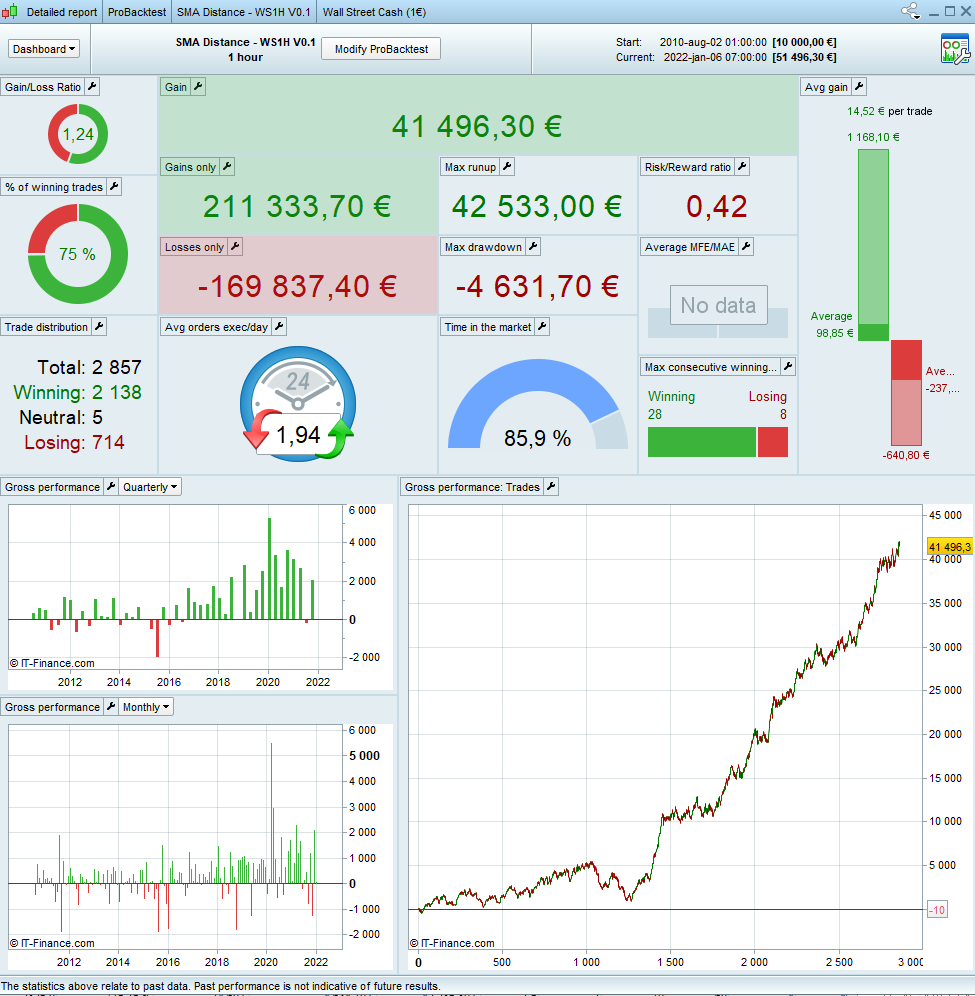
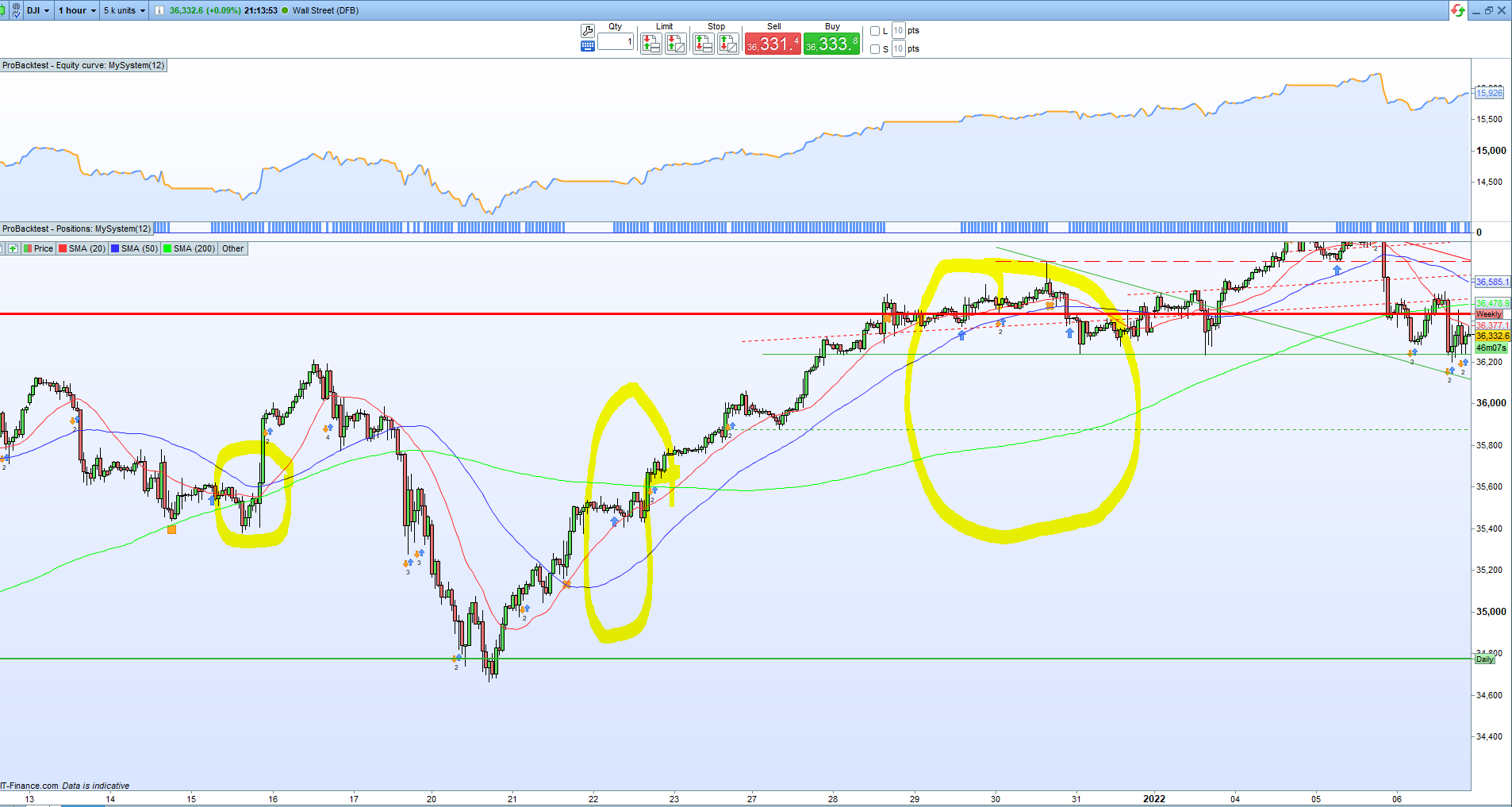
Is this someting to build on or what do u think, Too much time in market? How to improve thos without curvefitting?
// Wallstreet 1H - SMA Distance
// SnorreDK @ prorealcode.com
//2022-01-06

//To do - Better entrys - more standard filters?
//Try other trailing
//****************************************** **************************************

DEFPARAM CumulateOrders = False // Cumulating positions deactivated
ONCE sl = 1.5
ONCE sl2 = 1.0
ONCE A1 = 70.0
ONCE A2 = 60.0
ONCE tsm = 4.0
ONCE tst = 4.6
ONCE tst1 = 1.5
ONCE st = 0.28
ONCE A11 = 10.0
ONCE A22 = 20.0
ONCE y1 = -3.1
positionsize = 1

Timeframe(4h, updateonclose)
AA=RSI[14](close)


Timeframe(default)
CB2 = (AA<A1 and AA>A11) //4H RSI filter
CS2 = (AA<A2 and AA>A22)  //4H RSI filter


S1 = Average[20](Close)
S2 = Average[200](Close)
Dist = S1 - S2
DistPerc = (Dist / Close) * 100
CB1 = DistPerc > y1
CS1 = DistPerc < y1


If not (DayOfWeek = 2) then
If CB1 and CB2 and not shortonmarket then
BUY positionsize contracts AT MARKET
Endif

If CS1 and CS2 and not longonmarket then
SELLSHORT 1 CONTRACTS AT MARKET
Endif
endif


//****************************************************************************************
// trailing stop atr
once trailingstoptype     = 1    // trailing stop - 0 off, 1 on

once tsincrements = st          // typically between 0 and 0.25
once tsminatrdist = tsm         // typically between 1 and 4

once tsatrperiod    = 14         // ts atr parameter
once tsminstop      = 12         // ts minimum stop distance, set to IG min value

once tssensitivity        = 1    // [0]close;[1]high/low

if trailingstoptype then
if barindex=tradeindex then
trailingstoplong     = tst   // ts atr distance, typically between 4 and 10
trailingstopshort    = tst1   // ts atr distance, typically between 4 and 10
else
if longonmarket then
if tsnewsl>0 then
if trailingstoplong>tsminatrdist then
if tsnewsl>tsnewsl[1] then
trailingstoplong=trailingstoplong
else
trailingstoplong=trailingstoplong-tsincrements
endif
else
trailingstoplong=tsminatrdist
endif
endif
endif
if shortonmarket then
if tsnewsl>0 then
if trailingstopshort>tsminatrdist then
if tsnewsl<tsnewsl[1] then
trailingstopshort=trailingstopshort
else
trailingstopshort=trailingstopshort-tsincrements
endif
else
trailingstopshort=tsminatrdist
endif
endif
endif
endif
tsatr=averagetruerange[tsatrperiod]((close/10)*pipsize)/1000
//tsatr=averagetruerange[tsatrperiod]((close/1)*pipsize) // (forex)
tgl=round(tsatr*trailingstoplong)
tgs=round(tsatr*trailingstopshort)
if not onmarket or ((longonmarket and shortonmarket[1]) or (longonmarket[1] and shortonmarket)) then
tsmaxprice=0
tsminprice=close
tsnewsl=0
endif
if tssensitivity then
tssensitivitylong=high
tssensitivityshort=low
else
tssensitivitylong=close
tssensitivityshort=close
endif
if longonmarket then
tsmaxprice=max(tsmaxprice,tssensitivitylong)
if tsmaxprice-tradeprice(1)>=tgl*pointsize then
if tsmaxprice-tradeprice(1)>=tsminstop then
tsnewsl=tsmaxprice-tgl*pointsize
else
tsnewsl=tsmaxprice-tsminstop*pointsize
endif
endif
endif
if shortonmarket then
tsminprice=min(tsminprice,tssensitivityshort)
if tradeprice(1)-tsminprice>=tgs*pointsize then
if tradeprice(1)-tsminprice>=tsminstop then
tsnewsl=tsminprice+tgs*pointsize
else
tsnewsl=tsminprice+tsminstop*pointsize
endif
endif
endif
if longonmarket then
if tsnewsl>0 then
sell at tsnewsl stop
endif
if tsnewsl>0 then
if low crosses under tsnewsl then
sell at market // when stop is rejected
endif
endif
endif
if shortonmarket then
if tsnewsl>0 then
exitshort at tsnewsl stop
endif
if tsnewsl>0 then
if high crosses over tsnewsl then
exitshort at market // when stop is rejected
endif
endif
endif
endif

If shortonmarket then
SET STOP %loss SL2
endif
If Longonmarket then
SET STOP %loss SL
endif
Personally, I think it’s been on the market for a long time, maybe too long. I can see that the setup is modeled on my H4 breakout. This type of setup works very well for me. But my little timeframe is M1. At the moment I’m also working on a setup with RSI. But with RSI2 in the H4 as a reversal. Build it yourself with the timeframes like H4 breakout. But it is still in progress.
Sorry. My aproach with sma-distance doesnt make any sense.
MA20 and MA200 are close together buy signal ?, far apart buy signal ??
it’s because distperc never goes above 3 or below -3 so the condition is always true
I’ve put this type of calculation aside for now. Even if it would be nice to calculate it so easily, it somehow doesn’t work that way. I continue to use my classic pullbacks. So MACD pullback or RSI pullback in connection with the MAs. That works pretty well.
JSParticipant
Senior
S1 = Average[20](Close)
S2 = Average[200](Close)
Dist = S1 - S2
DistPerc = (Dist / Close) * 100
CB1 = DistPerc > y1
CS1 = DistPerc < y1
The distance between the MA’s can be positief or negatief and zero for the crossing of the MA’s
For a Long signal use DistPerc > “Positief Value” (for example yl = 0.5)
For a Short signal use DistPerc < "Negative Value" (for example ys = -0.5)
In your code there is only a negative value y1 = -3.1