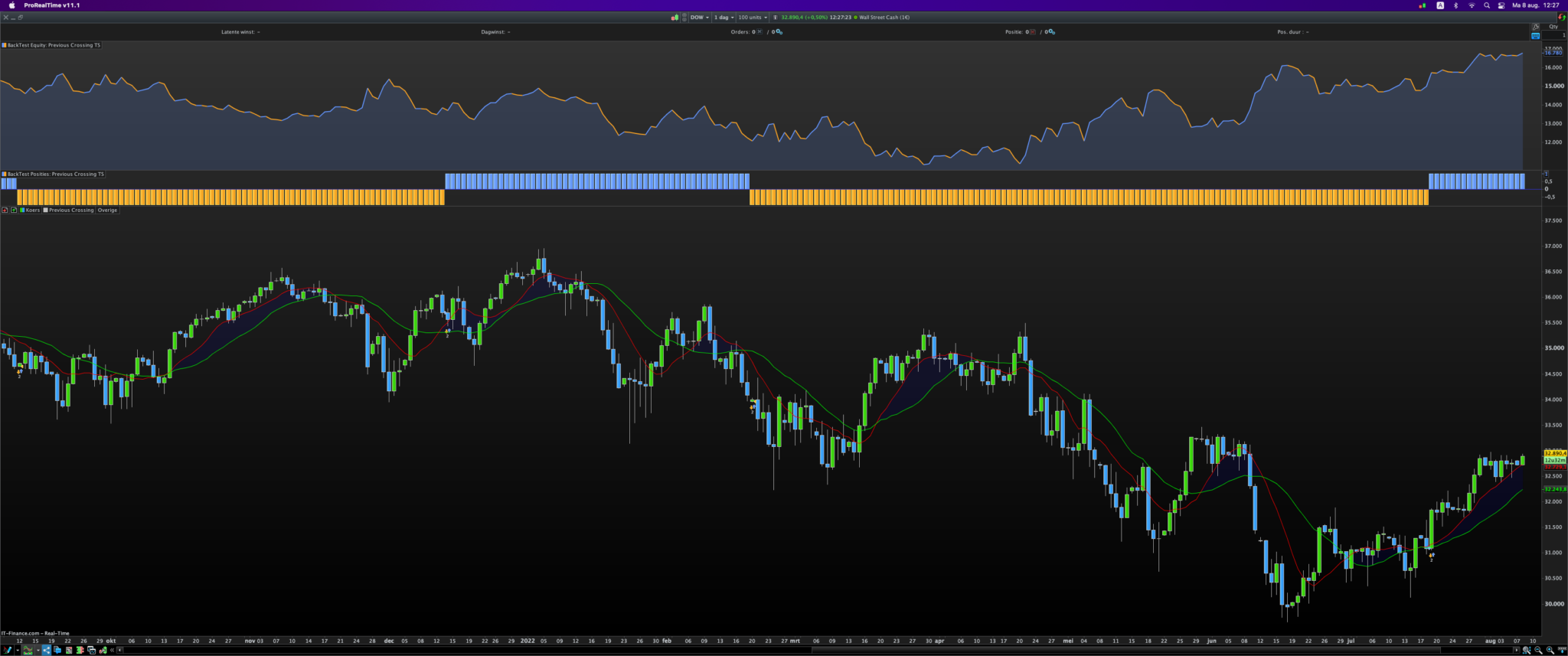
I have an indicator that has two MA-lines (line p and q), just like the MACD-line and its signal-line. I want to build a system that goes long when p crosses over q AND when this crossing is higher than the previous crossing (because then there is the change of nice rising pattern). Similar: go short when p crosses under q AND this crossing is lower than the previous crossing.
My knowlegde of programming is not enough. I tried this code but it is not working:
IF p CROSSES OVER q THEN
a = p
ENDIF
IF p CROSSES UNDER q THEN
b = p
ENDIF
//Conditions for long
c1 = (p CROSSES OVER q)
IF c1 AND a > a[1] THEN
BUY 1 SHARES AT MARKET
ENDIF
Who can help? Thanks!
 JS
JSParticipant
Veteran
Hi @Vogeltje
I have a comment about the “previous crossing”
For example, if the “FastMA crosses over SlowMA” then the “previous crossing” must always be “FastMA crosses under SlowMA”.
The “previous crossing” can therefore never be a confirmation of the current crossing but is always the opposite.
(A “Crosses Under” is always followed by a “Crosses Over” and this is always followed by a “Crosses Under”, and so on)
Not tested:
ONCE PrevOVER  = 0
ONCE PrevUNDER = 99999999
//Conditions for long
c1 = (p CROSSES OVER q)
IF c1 AND high > PrevOVER THEN
   BUY 1 SHARES AT MARKET
   PrevOVER = high
ENDIF
//Conditions for short
c2 = (p CROSSES UNDER q)
IF c2 AND low < PrevUNDER THEN
   SELLSHORT 1 SHARES AT MARKET
   PrevUNDER = low
ENDIF
JSParticipant
Veteran
DefParam CumulateOrders = False

LongCrossingPrice = 0
LongPrevCrossingPrice = 0

ShortCrossingPrice = 0
ShortPrevCrossingPrice = 0

FastMA = Average[10](Close)
SlowMA = Average[20](Close)

If FastMA Crosses Over SlowMA then
LongCrossingPrice = Close
For i = 1 to BarIndex[1]
If FastMA[i] Crosses Over SlowMA[i] then
LongPrevCrossingPrice = Close[i]
Break
EndIf
Next
EndIf

If LongCrossingPrice > LongPrevCrossingPrice then
Buy 1 contract at Market
EndIf

If FastMA Crosses Under SlowMA then
ShortCrossingPrice = Close
For i = 1 to BarIndex[1]
If FastMA[i] Crosses Under SlowMA[i] then
ShortPrevCrossingPrice = Close[i]
Break
EndIf
Next
EndIf

If ShortCrossingPrice < ShortPrevCrossingPrice then
SellShort 1 contract at Market
EndIf
This system is based on two of the same crossings so for example the last crossing was a “LONG crossing” (crosses over) and when this LONG crossing takes place higher than the previous “LONG crossing” then the system goes LONG and vice versa for SHORT…
Yes JS that is wright. I should have said: the positive crossing must be on a higher level than the previous positive crossing. Thank you.
Hello Roberto, Thanks for your work but your code is not working. The one JS built works.
Thanks a lot JS this code is working. But, there is a “but”. And that is that on every new day this systems acts on the very first crossing. By the start of a new day the system does not look at the previous crossing, which should be higher or lower. I have studied your code and I can understand a lot of it (I could not have figured it ou my self).
Is it possible that this mistake has to do with:
For i = 1 to BarIndex[1] ?
Does that start every day new? And can this be fixed?
Thanks!
JSParticipant
Veteran
Hi @Vogeltje
Nice that the code works…
How do you use this system?
Do you stop it every night or does it continue automatically?
Do you (manually) close positions?
Is the market you trade on a 24-hour market, or does it have a limited opening?
JSParticipant
Veteran
DefParam PreLoadBars = 1000
DefParam CumulateOrders = False

FastMA = Average[10](Close)
SlowMA = Average[20](Close)

If FastMA Crosses Over SlowMA then
LongCrossingPrice = Close
For i = 1 to BarIndex[1]
If FastMA[i] Crosses Over SlowMA[i] then
LongPrevCrossingPrice = Close[i]
Break
EndIf
Next
If LongCrossingPrice > LongPrevCrossingPrice then
Buy 1 contract at Market
EndIf
EndIf

If FastMA Crosses Under SlowMA then
ShortCrossingPrice = Close
For i = 1 to BarIndex[1]
If FastMA[i] Crosses Under SlowMA[i] then
ShortPrevCrossingPrice = Close[i]
Break
EndIf
Next
If ShortCrossingPrice < ShortPrevCrossingPrice then
SellShort 1 contract at Market
EndIf
EndIf
I think this will solve the problem…
Hi JS,
I use this only in backtesting at the moment. I try different intraday-timeframes like 15 min, 30 min, 1 hour.
I backtest over longer periods like 3 months.
I test on futures like miniDAX (closes 22.00 – 08.00) or miniNasdaq (closes 23.00 -00.00).
Thank you.
Does the new system replace the one before? I guess so and will try.
JSParticipant
Veteran
Hi
@Vogeltje
Yes, the “new” system (V2) replaces the previous system…
I have removed the lines that set the “CrossingPrice” to zero.
I have made sure that there are always enough bars present for the calculation (PreLoadBars = 1000)
I think this is going to solve the problem…
Yes JS I think tis is working….. but the results are much worse 🙂 🙂 But that is not your mistake…..
Few simple questions:
- why is good to remove the lines that set previous cross to zero?
- you write: FOR….. Break in the tutorial I see For… Else… Break I added Else but it makes no difference ( 🙂 )
- You end “”Break .. Endif… Next… Endif” is there a reason for this extra Next.. Endif?
JSParticipant
Veteran
Hi
@Vogeltje
You just must assume that the results are always bad … 😉
- The code is executed at the close of each bar, so after each bar the “CrossingPrice” and “PrevCrossingPrice” are set to zero.This is not desirable because when you compare them, one can still be at zero and then the comparison is always true.
- You can use “else” when you want to set a variable to zero or one, for example:
If ….then
Variable = 1
Else
Variable = 0
EndIf
- You are looking for the previous crossing with “For i=1 to BarIndex[1]”, when the “If … then” is not true then you end up after the “EndIf” and that is “Next”
When the “If… then” is true then you end up at “Break” and the “For … to” ended.
Hopefully a little clear.
Thanks JS, I must think hard about this. For me this is not easy stuff….