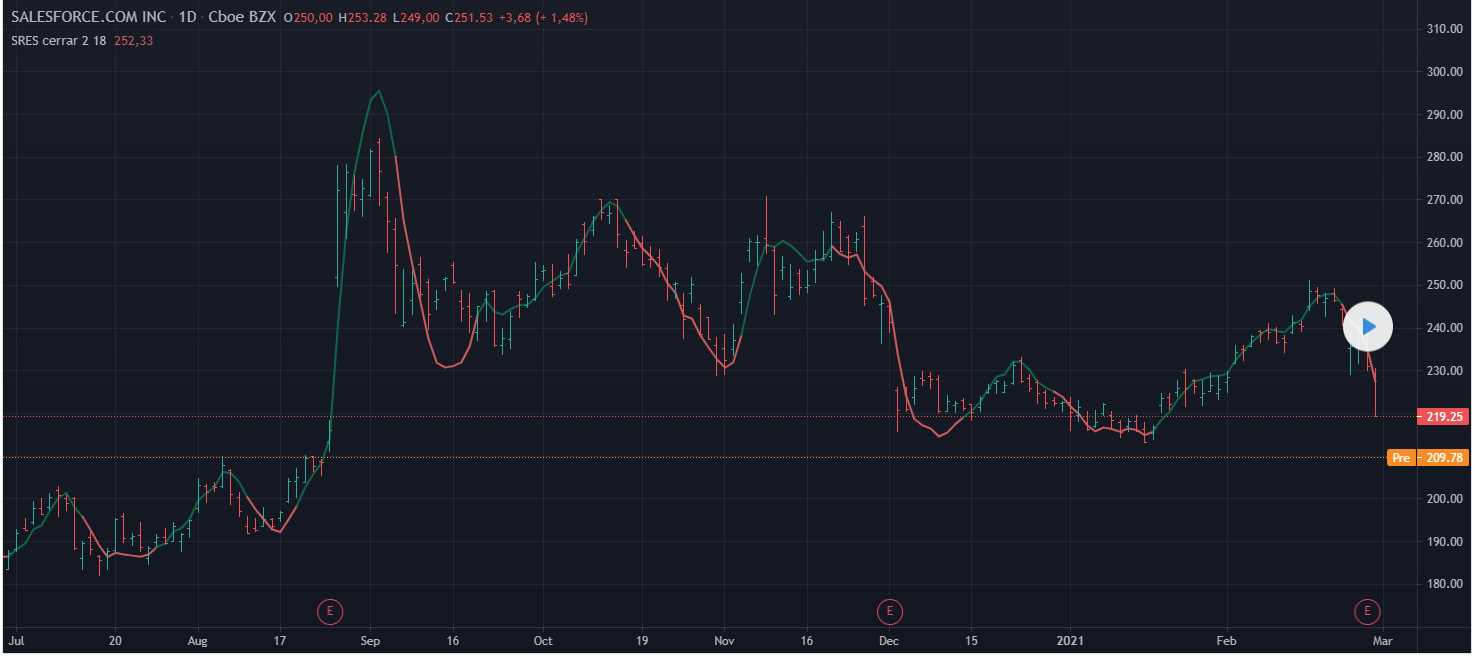
A ver si es posible convertir el indicador regresión móvil de Tradingview a PRT.
https://www.tradingview.com/script/0GhsW1KR-Moving-Regression/
La regresión móvil es una generalización de la media móvil y la regresión polinomial.
El procedimiento aproxima un número específico de puntos de datos anteriores con una función polinomial de un grado definido por el usuario. Luego, la interpolación polinómica del último punto de datos se usa para construir una serie de tiempo de regresión móvil.
// This source code is subject to the terms of the Mozilla Public License 2.0 at https://mozilla.org/MPL/2.0/
//
// Moving Regression
// © tbiktag
//
// MR is a generalization of moving average and polynomial regression.
// The procedure approximates a specified number of prior data points with
// a polynomial function of a user-defined degree.  Polynomial interpolation
// of the last data point is used to construct a MR time series.
// The color of the MR curve will be green if the local polynomial is predicted
// to move up in the next time step, and red otherwise.
//
//@version=4
//

study("Moving Regression", shorttitle = "MR", overlay=true)

matrix_get(_A,_i,_j,_nrows) =>
    // Get the value of the element of an implied 2d matrix
    //input:
    // _A :: array: pseudo 2d matrix _A = [[column_0],[column_1],...,[column_(n-1)]]
    // _i :: integer: row number
    // _j :: integer: column number
    // _nrows :: integer: number of rows in the implied 2d matrix
    array.get(_A,_i+_nrows*_j)

matrix_set(_A,_value,_i,_j,_nrows) =>
    // Set a value to the element of an implied 2d matrix
    //input:
    // _A :: array, changed on output: pseudo 2d matrix _A = [[column_0],[column_1],...,[column_(n-1)]]
    // _value :: float: the new value to be set
    // _i :: integer: row number
    // _j :: integer: column number
    // _nrows :: integer: number of rows in the implied 2d matrix
    array.set(_A,_i+_nrows*_j,_value)

transpose(_A,_nrows,_ncolumns) =>
    // Transpose an implied 2d matrix
    // input:
    // _A :: array: pseudo 2d matrix _A = [[column_0],[column_1],...,[column_(n-1)]]
    // _nrows :: integer: number of rows in _A
    // _ncolumns :: integer: number of columns in _A
    // output:
    // _AT :: array: pseudo 2d matrix with implied dimensions: _ncolums x _nrows
    var _AT = array.new_float(_nrows*_ncolumns,0)
    for i = 0 to _nrows-1
        for j = 0 to _ncolumns-1
            matrix_set(_AT, matrix_get(_A,i,j,_nrows),j,i,_ncolumns)
    _AT

multiply(_A,_B,_nrowsA,_ncolumnsA,_ncolumnsB) =>
    // Calculate scalar product of two matrices
    // input:
    // _A :: array: pseudo 2d matrix
    // _B :: array: pseudo 2d matrix
    // _nrowsA :: integer: number of rows in _A
    // _ncolumnsA :: integer: number of columns in _A
    // _ncolumnsB :: integer: number of columns in _B
    // output:
    // _C:: array: pseudo 2d matrix with implied dimensions _nrowsA x _ncolumnsB
    var _C = array.new_float(_nrowsA*_ncolumnsB,0)
    _nrowsB = _ncolumnsA
    float elementC= 0.0
    for i = 0 to _nrowsA-1
        for j = 0 to _ncolumnsB-1
            elementC := 0
            for k = 0 to _ncolumnsA-1
                elementC := elementC + matrix_get(_A,i,k,_nrowsA)*matrix_get(_B,k,j,_nrowsB)
            matrix_set(_C,elementC,i,j,_nrowsA)
    _C

vnorm(_X,_n) =>
    //Square norm of vector _X with size _n
    float _norm = 0.0
    for i = 0 to _n-1
        _norm := _norm + pow(array.get(_X,i),2)
    sqrt(_norm)

qr_diag(_A,_nrows,_ncolumns) =>
    //QR Decomposition with Modified Gram-Schmidt Algorithm (Column-Oriented)
    // input:
    // _A :: array: pseudo 2d matrix _A = [[column_0],[column_1],...,[column_(n-1)]]
    // _nrows :: integer: number of rows in _A
    // _ncolumns :: integer: number of columns in _A
    // output:
    // _Q: unitary matrix, implied dimenstions _nrows x _ncolumns
    // _R: upper triangular matrix, implied dimansions _ncolumns x _ncolumns
    var _Q = array.new_float(_nrows*_ncolumns,0)
    var _R = array.new_float(_ncolumns*_ncolumns,0)
    var _a = array.new_float(_nrows,0)
    var _q = array.new_float(_nrows,0)
    float _r = 0.0
    float _aux = 0.0
    //get first column of _A and its norm:
    for i = 0 to _nrows-1
        array.set(_a,i,matrix_get(_A,i,0,_nrows))
    _r := vnorm(_a,_nrows)
    //assign first diagonal element of R and first column of Q
    matrix_set(_R,_r,0,0,_ncolumns)
    for i = 0 to _nrows-1
        matrix_set(_Q,array.get(_a,i)/_r,i,0,_nrows)
    if _ncolumns != 1
        //repeat for the rest of the columns
        for k = 1 to _ncolumns-1
            for i = 0 to _nrows-1
                array.set(_a,i,matrix_get(_A,i,k,_nrows))
            for j = 0 to k-1
                //get R_jk as scalar product of Q_j column and A_k column:
                _r := 0
                for i = 0 to _nrows-1
                    _r := _r + matrix_get(_Q,i,j,_nrows)*array.get(_a,i)
                matrix_set(_R,_r,j,k,_ncolumns)
                //update vector _a
                for i = 0 to _nrows-1
                    _aux := array.get(_a,i) - _r*matrix_get(_Q,i,j,_nrows)
                    array.set(_a,i,_aux)
            //get diagonal R_kk and Q_k column
            _r := vnorm(_a,_nrows)
            matrix_set(_R,_r,k,k,_ncolumns)
            for i = 0 to _nrows-1
                matrix_set(_Q,array.get(_a,i)/_r,i,k,_nrows)
    [_Q,_R]

pinv(_A,_nrows,_ncolumns) =>
//Pseudoinverse of matrix _A calculated using QR decomposition
// Input:
// _A:: array: implied as a (_nrows x _ncolumns) matrix _A = [[column_0],[column_1],...,[column_(_ncolumns-1)]]
// Output:
// _Ainv:: array implied as a (_ncolumns x _nrows) matrix _A = [[row_0],[row_1],...,[row_(_nrows-1)]]
// ----
// First find the QR factorization of A: A = QR,
// where R is upper triangular matrix.
// Then _Ainv = R^-1*Q^T.
// ----
    [_Q,_R] = qr_diag(_A,_nrows,_ncolumns)
    _QT = transpose(_Q,_nrows,_ncolumns)
    // Calculate Rinv:
    var _Rinv = array.new_float(_ncolumns*_ncolumns,0)
    float _r = 0.0
    matrix_set(_Rinv,1/matrix_get(_R,0,0,_ncolumns),0,0,_ncolumns)
    if _ncolumns != 1
        for j = 1 to _ncolumns-1
            for i = 0 to j-1
                _r := 0.0
                for k = i to j-1
                    _r := _r + matrix_get(_Rinv,i,k,_ncolumns)*matrix_get(_R,k,j,_ncolumns)
                matrix_set(_Rinv,_r,i,j,_ncolumns)
            for k = 0 to j-1
                matrix_set(_Rinv,-matrix_get(_Rinv,k,j,_ncolumns)/matrix_get(_R,j,j,_ncolumns),k,j,_ncolumns)
            matrix_set(_Rinv,1/matrix_get(_R,j,j,_ncolumns),j,j,_ncolumns)
    //
    _Ainv = multiply(_Rinv,_QT,_ncolumns,_ncolumns,_nrows)
    _Ainv


/// --- main ---
src = input(title="Source", defval=close)
degree = input(title="Local Polynomial Degree", type = input.integer, defval=2, minval = 0)
window = input(title="Length (must be larger than degree)", type = input.integer, defval=18, minval = 2)
isforecast = input(title="Predict Trend Direction", type = input.bool, defval=true)


// Vandermonde matrix with implied dimensions (window x degree+1)
// Linear form: J = [ [z]^0, [z]^1, ... [z]^degree], with z = [ (1-window)/2 to (window-1)/2 ]
J = array.new_float(window*(degree+1),0)
for i = 0 to window-1
    for j = 0 to degree
        matrix_set(J,pow(i,j),i,j,window)

// Vector of raw datapoints:
Y_raw = array.new_float(window,na)
for j = 0 to window-1
    array.set(Y_raw,j,src[window-1-j])

// Calculate polynomial coefficients which minimize the loss function
C = pinv(J,window,degree+1)
a_coef = multiply(C,Y_raw,degree+1,window,1)
// For smoothing, approximate the last point (i.e. z=window-1) by a0
float Y = 0.0
for i = 0 to degree
    Y := Y + array.get(a_coef,i)*pow(window-1,i)

// Trend Direction Forecast
float Y_f = 0.0
for i = 0 to degree
    Y_f := Y_f + array.get(a_coef,i)*pow(window,i)
var plt_color = color.navy
if Y_f > Y and isforecast
    plt_color := #006548
else if Y_f < Y and isforecast
    plt_color := #CD5C5C

plot(Y,title='Smoothed',color=plt_color,linewidth=2)