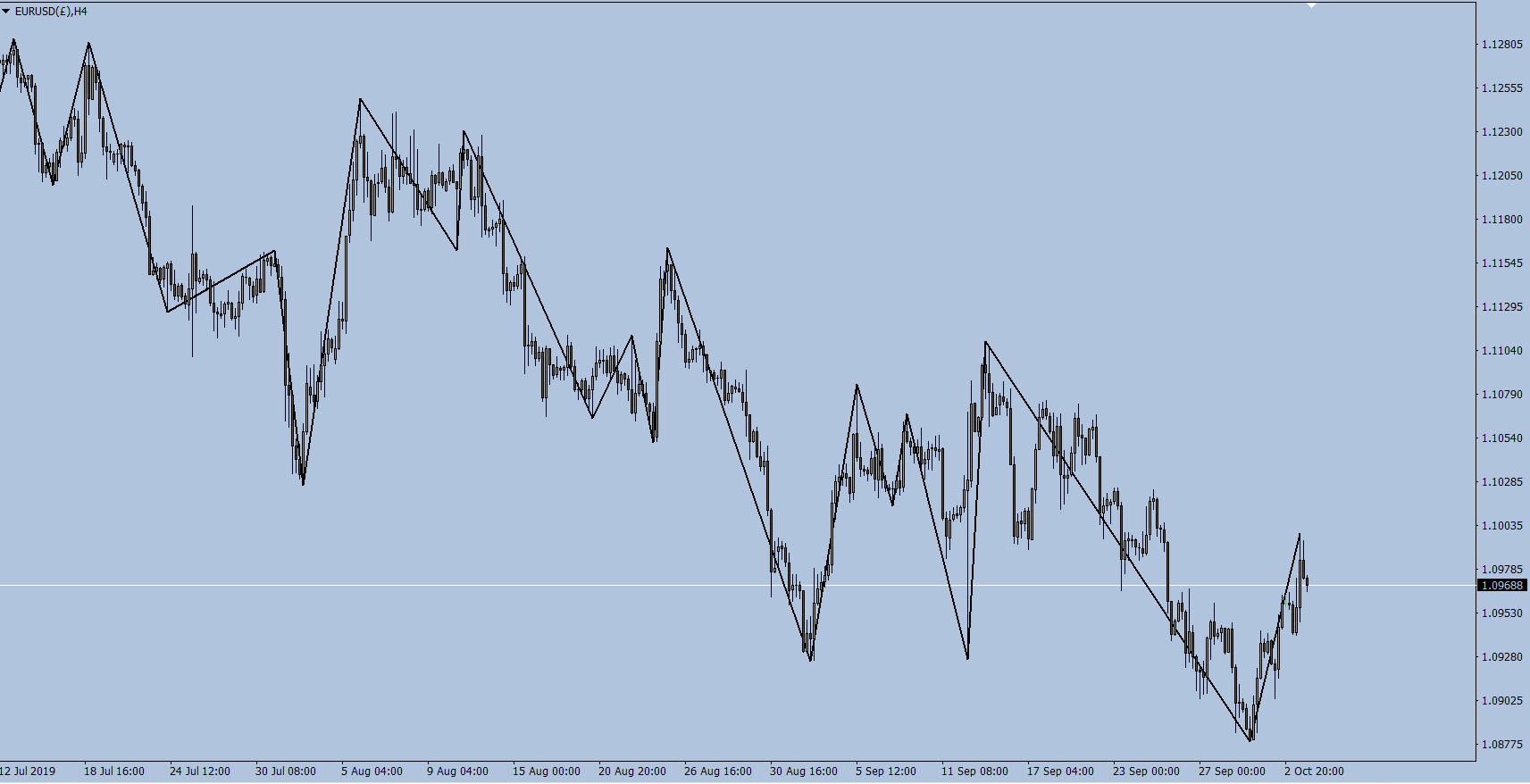
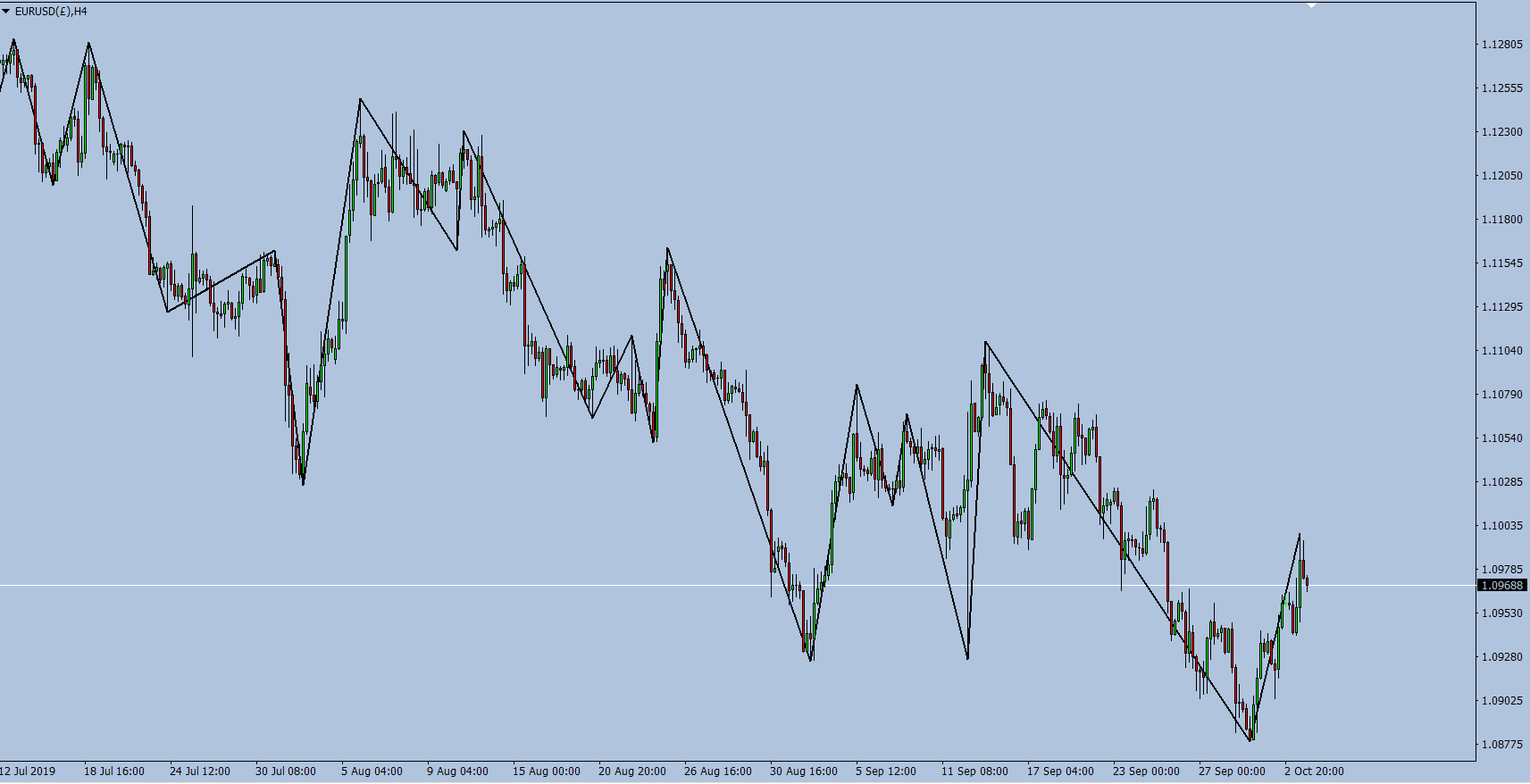
This is a standard MT4 ZigZag indicator. This indicator identifies the highs and lows (depending on the setting) within any given timeframe by removing the noise. This indicator can be used for swing trading. The Code is given below,
//+——————————————————————+
//| ZigZag.mq4 |
//| Copyright 2006-2014, MetaQuotes Software Corp. |
//| http://www.mql4.com |
//+——————————————————————+
#property copyright “2006-2014, MetaQuotes Software Corp.”
#property link “http://www.mql4.com”
#property strict
#property indicator_chart_window
#property indicator_buffers 1
#property indicator_color1 Red
//—- indicator parameters
input int InpDepth=12; // Depth
input int InpDeviation=5; // Deviation
input int InpBackstep=3; // Backstep
//—- indicator buffers
double ExtZigzagBuffer[];
double ExtHighBuffer[];
double ExtLowBuffer[];
//— globals
int ExtLevel=3; // recounting’s depth of extremums
//+——————————————————————+
//| Custom indicator initialization function |
//+——————————————————————+
int OnInit()
{
if(InpBackstep>=InpDepth)
{
Print(“Backstep cannot be greater or equal to Depth”);
return(INIT_FAILED);
}
//— 2 additional buffers
IndicatorBuffers(3);
//—- drawing settings
SetIndexStyle(0,DRAW_SECTION);
//—- indicator buffers
SetIndexBuffer(0,ExtZigzagBuffer);
SetIndexBuffer(1,ExtHighBuffer);
SetIndexBuffer(2,ExtLowBuffer);
SetIndexEmptyValue(0,0.0);
//—- indicator short name
IndicatorShortName(“ZigZag(“+string(InpDepth)+”,”+string(InpDeviation)+”,”+string(InpBackstep)+”)”);
//—- initialization done
return(INIT_SUCCEEDED);
}
//+——————————————————————+
//| |
//+——————————————————————+
int OnCalculate(const int rates_total,
const int prev_calculated,
const datetime &time[],
const double &open[],
const double &high[],
const double &low[],
const double &close[],
const long& tick_volume[],
const long& volume[],
const int& spread[])
{
int i,limit,counterZ,whatlookfor=0;
int back,pos,lasthighpos=0,lastlowpos=0;
double extremum;
double curlow=0.0,curhigh=0.0,lasthigh=0.0,lastlow=0.0;
//— check for history and inputs
if(rates_total<InpDepth || InpBackstep>=InpDepth)
return(0);
//— first calculations
if(prev_calculated==0)
limit=InitializeAll();
else
{
//— find first extremum in the depth ExtLevel or 100 last bars
i=counterZ=0;
while(counterZ<ExtLevel && i<100)
{
if(ExtZigzagBuffer[i]!=0.0)
counterZ++;
i++;
}
//— no extremum found – recounting all from begin
if(counterZ==0)
limit=InitializeAll();
else
{
//— set start position to found extremum position
limit=i-1;
//— what kind of extremum?
if(ExtLowBuffer[i]!=0.0)
{
//— low extremum
curlow=ExtLowBuffer[i];
//— will look for the next high extremum
whatlookfor=1;
}
else
{
//— high extremum
curhigh=ExtHighBuffer[i];
//— will look for the next low extremum
whatlookfor=-1;
}
//— clear the rest data
for(i=limit-1; i>=0; i–)
{
ExtZigzagBuffer[i]=0.0;
ExtLowBuffer[i]=0.0;
ExtHighBuffer[i]=0.0;
}
}
}
//— main loop
for(i=limit; i>=0; i–)
{
//— find lowest low in depth of bars
extremum=low[iLowest(NULL,0,MODE_LOW,InpDepth,i)];
//— this lowest has been found previously
if(extremum==lastlow)
extremum=0.0;
else
{
//— new last low
lastlow=extremum;
//— discard extremum if current low is too high
if(low[i]-extremum>InpDeviation*Point)
extremum=0.0;
else
{
//— clear previous extremums in backstep bars
for(back=1; back<=InpBackstep; back++)
{
pos=i+back;
if(ExtLowBuffer[pos]!=0 && ExtLowBuffer[pos]>extremum)
ExtLowBuffer[pos]=0.0;
}
}
}
//— found extremum is current low
if(low[i]==extremum)
ExtLowBuffer[i]=extremum;
else
ExtLowBuffer[i]=0.0;
//— find highest high in depth of bars
extremum=high[iHighest(NULL,0,MODE_HIGH,InpDepth,i)];
//— this highest has been found previously
if(extremum==lasthigh)
extremum=0.0;
else
{
//— new last high
lasthigh=extremum;
//— discard extremum if current high is too low
if(extremum-high[i]>InpDeviation*Point)
extremum=0.0;
else
{
//— clear previous extremums in backstep bars
for(back=1; back<=InpBackstep; back++)
{
pos=i+back;
if(ExtHighBuffer[pos]!=0 && ExtHighBuffer[pos]<extremum)
ExtHighBuffer[pos]=0.0;
}
}
}
//— found extremum is current high
if(high[i]==extremum)
ExtHighBuffer[i]=extremum;
else
ExtHighBuffer[i]=0.0;
}
//— final cutting
if(whatlookfor==0)
{
lastlow=0.0;
lasthigh=0.0;
}
else
{
lastlow=curlow;
lasthigh=curhigh;
}
for(i=limit; i>=0; i–)
{
switch(whatlookfor)
{
case 0: // look for peak or lawn
if(lastlow==0.0 && lasthigh==0.0)
{
if(ExtHighBuffer[i]!=0.0)
{
lasthigh=High[i];
lasthighpos=i;
whatlookfor=-1;
ExtZigzagBuffer[i]=lasthigh;
}
if(ExtLowBuffer[i]!=0.0)
{
lastlow=Low[i];
lastlowpos=i;
whatlookfor=1;
ExtZigzagBuffer[i]=lastlow;
}
}
break;
case 1: // look for peak
if(ExtLowBuffer[i]!=0.0 && ExtLowBuffer[i]<lastlow && ExtHighBuffer[i]==0.0)
{
ExtZigzagBuffer[lastlowpos]=0.0;
lastlowpos=i;
lastlow=ExtLowBuffer[i];
ExtZigzagBuffer[i]=lastlow;
}
if(ExtHighBuffer[i]!=0.0 && ExtLowBuffer[i]==0.0)
{
lasthigh=ExtHighBuffer[i];
lasthighpos=i;
ExtZigzagBuffer[i]=lasthigh;
whatlookfor=-1;
}
break;
case -1: // look for lawn
if(ExtHighBuffer[i]!=0.0 && ExtHighBuffer[i]>lasthigh && ExtLowBuffer[i]==0.0)
{
ExtZigzagBuffer[lasthighpos]=0.0;
lasthighpos=i;
lasthigh=ExtHighBuffer[i];
ExtZigzagBuffer[i]=lasthigh;
}
if(ExtLowBuffer[i]!=0.0 && ExtHighBuffer[i]==0.0)
{
lastlow=ExtLowBuffer[i];
lastlowpos=i;
ExtZigzagBuffer[i]=lastlow;
whatlookfor=1;
}
break;
}
}
//— done
return(rates_total);
}
//+——————————————————————+
//| |
//+——————————————————————+
int InitializeAll()
{
ArrayInitialize(ExtZigzagBuffer,0.0);
ArrayInitialize(ExtHighBuffer,0.0);
ArrayInitialize(ExtLowBuffer,0.0);
//— first counting position
return(Bars-InpDepth);
}
//+——————————————————————+