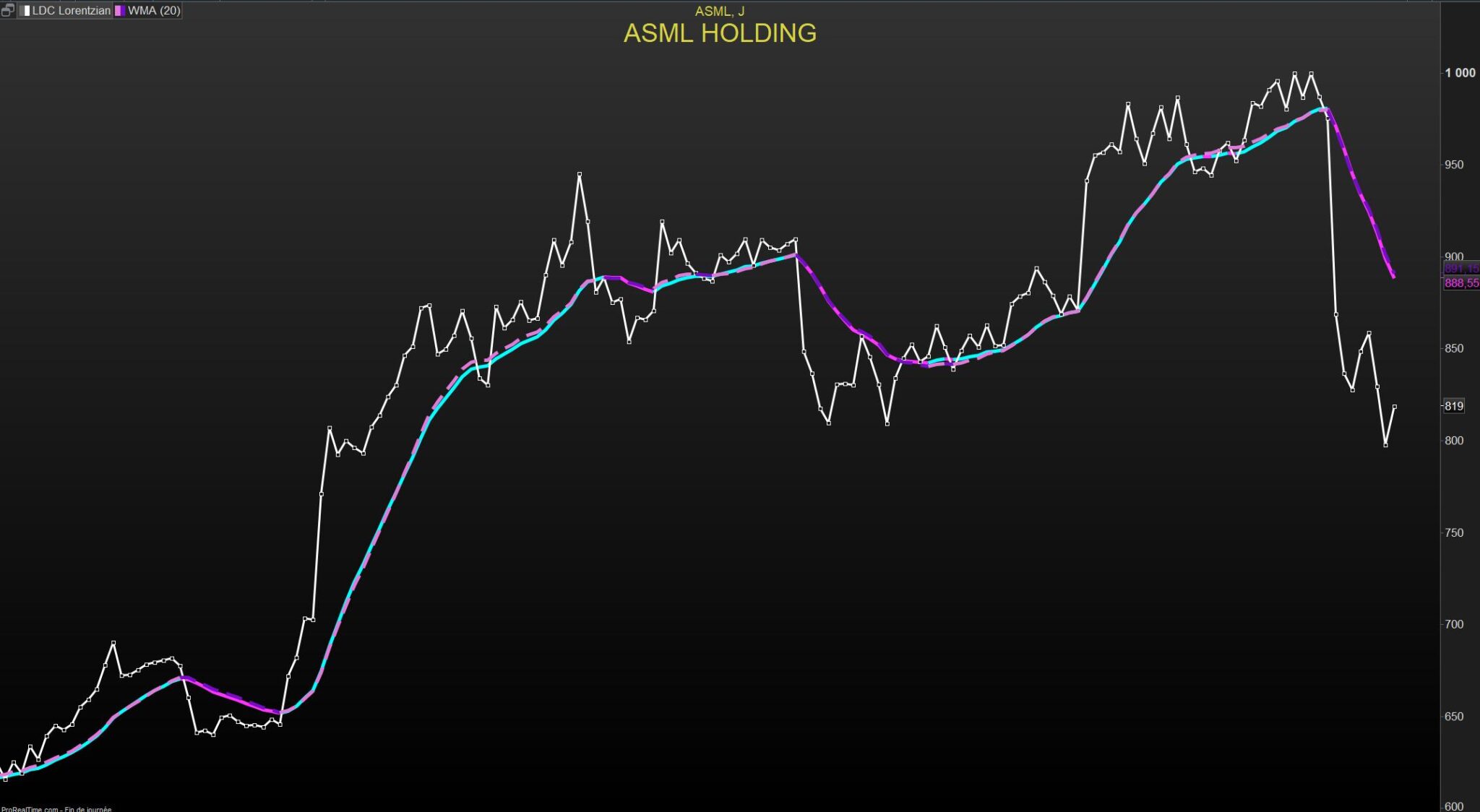
Hoy he han hecho referencia en el foro a este indicador así que aquí va una actualización. He incluido filtros de tendencia adicionales.
// ============================================================
// PRC_Machine Learning: Lorentzian Classification [@jdehorty]
// version = 1
// 09.02.2026
// Iván González @ www.prorealcode.com
// Sharing ProRealTime knowledge
// ============================================================
defparam calculateonlastbars = 1000
// ============================================================
// ==== PARÁMETROS GENERALES ====
// ============================================================
neighborsCount = 8   // Número de vecinos K
maxBarsBack = 700    // Ventana histórica
featureCount = 5     // Features para distancia

// Filtros EMA/SMA (0=desactivado, 1=activado)
useEmaFilter = 0
emaPeriod = 200
useSmaFilter = 0
smaPeriod = 200

// Filtros ML (0=desactivado, 1=activado)
useVolatilityFilter = 1  // ATR reciente > ATR histórico
useRegimeFilter = 1      // Detección trending/ranging con KLMF
regimeThreshold = -0.1   // Umbral régimen (-10 a 10, default -0.1)
useAdxFilter = 0         // ADX > umbral
adxThreshold = 20        // Umbral ADX (0-100)

// Kernel Regression
useKernelFilter = 1
useKernelSmoothing = 0  // 0=rate of change, 1=crossover yhat2/yhat1
lookbackWindow = 8
relWeight = 8
regLevel = 25
kLag = 2

// ============================================================
// ==== CÁLCULO DE FEATURES (NORMALIZADAS) ====
// ============================================================
// Feature 1: RSI(14) normalizado
f1raw = RSI[14](close)
f1lo = lowest[maxBarsBack](f1raw)
f1hi = highest[maxBarsBack](f1raw)
f1 = (f1raw - f1lo) / max(0.0001, f1hi - f1lo)

// Feature 2: Wave Trend(10,11) normalizado
ap = (high + low + close) / 3
esa = average[10,1](ap)
d1 = average[10,1](abs(ap - esa))
ci = (ap - esa) / (0.015 * d1)
f2raw = average[11,1](ci)
f2lo = lowest[maxBarsBack](f2raw)
f2hi = highest[maxBarsBack](f2raw)
f2 = (f2raw - f2lo) / max(0.0001, f2hi - f2lo)

// Feature 3: CCI(20) normalizado
f3raw = CCI[20](close)
f3lo = lowest[maxBarsBack](f3raw)
f3hi = highest[maxBarsBack](f3raw)
f3 = (f3raw - f3lo) / max(0.0001, f3hi - f3lo)

// Feature 4: ADX(20) normalizado
f4raw = ADX[20]
f4lo = lowest[maxBarsBack](f4raw)
f4hi = highest[maxBarsBack](f4raw)
f4 = (f4raw - f4lo) / max(0.0001, f4hi - f4lo)

// Feature 5: RSI(9) normalizado
f5raw = RSI[9](close)
f5lo = lowest[maxBarsBack](f5raw)
f5hi = highest[maxBarsBack](f5raw)
f5 = (f5raw - f5lo) / max(0.0001, f5hi - f5lo)

// ============================================================
// ==== NEXT BAR CLASSIFICATION (Training Labels) ====
// ============================================================
src = close
IF src[4] < src[0] THEN
   yTrainSeries = -1
ELSIF src[4] > src[0] THEN
   yTrainSeries = 1
ELSE
   yTrainSeries = 0
ENDIF

// ============================================================
// ==== CORE ML LOGIC: KNN con Distancia Lorentziana ====
// ============================================================
lastDistance = -1.0
mySize = min(maxBarsBack - 1, barindex - 1)
sizeLoop = min(maxBarsBack - 1, mySize)

IF barindex >= maxBarsBack THEN
   nn = 0
   FOR i = 0 TO sizeLoop DO
      d = LOG(1 + ABS(f1 - f1[i])) + LOG(1 + ABS(f2 - f2[i])) + LOG(1 + ABS(f3 - f3[i])) + LOG(1 + ABS(f4 - f4[i])) + LOG(1 + ABS(f5 - f5[i]))
      IF d >= lastDistance AND (i MOD 4) <> 0 THEN
         lastDistance = d
         nn = nn + 1
         $distances[nn] = d
         $predictions[nn] = round(yTrainSeries[i])
         IF nn > neighborsCount THEN
            lastDistance = $distances[round(neighborsCount * 3 / 4)]
            FOR k = 1 TO nn - 1 DO
               $distances[k] = $distances[k + 1]
               $predictions[k] = $predictions[k + 1]
            NEXT
            $distances[nn] = 0
            $predictions[nn] = 0
            nn = nn - 1
         ENDIF
      ENDIF
   NEXT
   prediction = 0
   FOR j = 1 TO nn DO
      prediction = prediction + $predictions[j]
   NEXT
ENDIF

// ============================================================
// ==== FILTROS ML ====
// ============================================================

// --- 1. Filtro de Volatilidad ---

IF useVolatilityFilter THEN
   recentAtr = averagetruerange[1]
   historicalAtr = averagetruerange[10]
   filterVolatility = (recentAtr > historicalAtr)
ELSE
   filterVolatility = 1
ENDIF

// --- 2. Filtro de Régimen (KLMF - Kaufman Adaptive) ---

ohlc4src = (open + high + low + close) / 4
IF (high - low) <> 0 THEN
   value1 = 0.2 * (ohlc4src - ohlc4src[1]) + 0.8 * value1[1]
   value2 = 0.1 * (high - low) + 0.8 * value2[1]
ENDIF
IF value2 <> 0 THEN
   omega = abs(value1 / value2)
ELSE
   omega = 0
ENDIF
alphaK = (-1 * POW(omega, 2) + SQRT(POW(omega, 4) + 16 * POW(omega, 2))) / 8
klmf = alphaK * ohlc4src + (1 - alphaK) * klmf[1]
curveSlope = abs(klmf - klmf[1])
avgSlope = average[200,1](curveSlope)

IF useRegimeFilter THEN
   IF avgSlope <> 0 THEN
      normalizedSlope = (curveSlope - avgSlope) / avgSlope
      filterRegime = (normalizedSlope >= regimeThreshold)
   ELSE
      filterRegime = 1
   ENDIF
ELSE
   filterRegime = 1
ENDIF

// --- 3. Filtro ADX ---

IF useAdxFilter THEN
   adxVal = ADX[14]
   filterAdx = (adxVal > adxThreshold)
ELSE
   filterAdx = 1
ENDIF

// --- Combinación de todos los filtros ---
filterAll = filterVolatility AND filterRegime AND filterAdx

// ============================================================
// ==== FILTROS DE PREDICCIÓN ====
// ============================================================

// --- EMA Trend Filter ---
IF useEmaFilter THEN
   isEmaUptrend = (close > average[emaPeriod,1](close))
   isEmaDowntrend = (close < average[emaPeriod,1](close))
ELSE
   isEmaUptrend = 1
   isEmaDowntrend = 1
ENDIF

// --- SMA Trend Filter ---
IF useSmaFilter THEN
   isSmaUptrend = (close > average[smaPeriod](close))
   isSmaDowntrend = (close < average[smaPeriod](close))
ELSE
   isSmaUptrend = 1
   isSmaDowntrend = 1
ENDIF

// --- Signal GATED por filterAll ---

IF prediction > 0 AND filterAll THEN
   signal = 1
ELSIF prediction < 0 AND filterAll THEN
   signal = -1
ENDIF

// --- Bar-Count Filter ---
IF signal <> signal[1] THEN
   barsHeld = 0
ELSE
   barsHeld = barsHeld + 1
ENDIF
isHeldFourBars = (barsHeld = 4)
isHeldLessThanFourBars = (barsHeld > 0 AND barsHeld < 4)

// --- Fractal Filters ---
isDifferentSignalType = (signal <> signal[1])
isEarlySignalFlip = isDifferentSignalType AND ((signal[1] <> signal[2]) OR (signal[2] <> signal[3]) OR (signal[3] <> signal[4]))

isBuySignal = (signal = 1) AND isEmaUptrend AND isSmaUptrend
isSellSignal = (signal = -1) AND isEmaDowntrend AND isSmaDowntrend
isNewBuySignal = isDifferentSignalType AND isBuySignal
isNewSellSignal = isDifferentSignalType AND isSellSignal

// ============================================================
// ==== KERNEL REGRESSION (Nadaraya-Watson) ====
// ============================================================

// --- Rational Quadratic Kernel (yhat1) ---
currentWeight1 = 0
cumulativeWeight1 = 0
FOR i = 0 TO lookbackWindow + regLevel DO
   y = src[i]
   w1 = POW(1 + (POW(i, 2) / (POW(lookbackWindow, 2) * 2 * relWeight)), -relWeight)
   currentWeight1 = currentWeight1 + y * w1
   cumulativeWeight1 = cumulativeWeight1 + w1
NEXT
yhat1 = currentWeight1 / cumulativeWeight1

// --- Gaussian Kernel (yhat2) ---
currentWeight2 = 0
cumulativeWeight2 = 0
gaussWindow = max(1, lookbackWindow - kLag)
FOR i = 0 TO gaussWindow + regLevel DO
   y = src[i]
   w2 = EXP(-POW(i, 2) / (2 * POW(gaussWindow, 2)))
   currentWeight2 = currentWeight2 + y * w2
   cumulativeWeight2 = cumulativeWeight2 + w2
NEXT
yhat2 = currentWeight2 / cumulativeWeight2

// --- Kernel Rates of Change ---
wasBearishRate = (yhat1[2] > yhat1[1])
wasBullishRate = (yhat1[2] < yhat1[1])
isBearishRate = (yhat1[1] > yhat1)
isBullishRate = (yhat1[1] < yhat1)
isBearishChange = isBearishRate AND wasBullishRate
isBullishChange = isBullishRate AND wasBearishRate

// --- Kernel Crossovers ---
isBullishSmooth = (yhat2 >= yhat1)
isBearishSmooth = (yhat2 <= yhat1)

// --- Aplicar filtro kernel según modo ---
IF useKernelFilter THEN
   IF useKernelSmoothing THEN
      isBullish = isBullishSmooth
      isBearish = isBearishSmooth
   ELSE
      isBullish = isBullishRate
      isBearish = isBearishRate
   ENDIF
ELSE
   isBullish = 1
   isBearish = 1
ENDIF

// --- Kernel color ---
IF useKernelSmoothing THEN
   IF isBullishSmooth THEN
      cr = 0
      cg = 153
      cb = 136
   ELSE
      cr = 204
      cg = 51
      cb = 17
   ENDIF
ELSE
   IF isBullishRate THEN
      cr = 0
      cg = 153
      cb = 136
   ELSE
      cr = 204
      cg = 51
      cb = 17
   ENDIF
ENDIF

// ============================================================
// ==== ENTRY CONDITIONS ====
// ============================================================
startLongTrade = isNewBuySignal AND isBullish AND isEmaUptrend AND isSmaUptrend
startShortTrade = isNewSellSignal AND isBearish AND isEmaDowntrend AND isSmaDowntrend

// ============================================================
// ==== DISPLAY ====
// ============================================================
myRange = high - low

// Transparencia basada en fuerza de predicción (clamped 30-255)
IF prediction <> 0 THEN
   maxPred = max(1, highest[300](abs(prediction)))
   alphaVal = min(255, max(30, round(abs(prediction) / maxPred * 255)))
ELSE
   alphaVal = 80
ENDIF

IF startLongTrade THEN
   drawarrowup(barindex, low - myRange) coloured(0, 153, 136, alphaVal)
   drawtext("#prediction#", barindex, low - 1.5 * myRange) coloured(0, 153, 136)
ELSIF startShortTrade THEN
   drawarrowdown(barindex, high + myRange) coloured(204, 51, 17, alphaVal)
   drawtext("#prediction#", barindex, high + 1.5 * myRange) coloured(204, 51, 17)
ENDIF

// ============================================================
RETURN yhat1 AS "Kernel Estimate" style(line, 2) coloured(cr, cg, cb)