Conversion de l’indicateur The Echo Forecast par AlgoLux de tradingview

Viewing 7 posts - 1 through 7 (of 7 total)

  • Author
    Posts
  • #212644 quote
    majide
    Participant
    New

    // This work is licensed under a Attribution-NonCommercial-ShareAlike 4.0 International (CC BY-NC-SA 4.0) https://creativecommons.org/licenses/by-nc-sa/4.0/
    // © LuxAlgo

    //@version=4
    study(“The Echo Forecast [LUX]”,”ECHO [LuxAlgo]”,overlay=true,max_bars_back=1000,max_lines_count=200)
    length = input(50,’Evaluation Window’,minval=0,maxval=200)
    fcast = input(50,’Forecast Window’,minval=1,maxval=200)

    fmode = input(‘Similarity’,’Forecast Mode’,options=[‘Similarity’,’Dissimilarity’])
    cmode = input(‘Cumulative’,’Forecast Construction’,options=[‘Cumulative’,’Mean’,’Linreg’])
    src = input(close)

    fcast_col = input(#2157f3,’Forecast Style’,inline=’fcast_style’,group=’Style’)
    fcast_style = input(‘· · ·’,”,options=[‘──’,’- – -‘,’· · ·’],inline=’fcast_style’,group=’Style’)

    show_area = input(true,’Show Area’,inline=’areas’,group=’Style’)
    fcast_area = input(color.new(#ff5d00,50),”,inline=’areas’,group=’Style’)
    corr_area = input(color.new(#0cb51a,50),”,inline=’areas’,group=’Style’)
    eval_area = input(color.new(color.gray,50),”,inline=’areas’,group=’Style’)
    //—-
    var lines = array.new_line(0)
    if barstate.isfirst
    for i = 0 to fcast-1
    array.push(lines,line.new(na,na,na,na))
    //—-
    n = bar_index
    d = change(src)

    top = highest(src,length+fcast*2)
    btm = lowest(src,length+fcast*2)

    if barstate.islast
    float val = na
    k = 0
    A = array.new_float(0)
    X = array.new_int(0)
    for i = 0 to fcast*2+length
    array.push(A,src[i])
    if cmode == ‘Linreg’
    array.push(X,n[i])

    a = array.slice(A,0,fcast-1)
    for i = 0 to length-1
    b = array.slice(A,fcast+i,fcast*2+i-1)
    r = array.covariance(a,b)/(array.stdev(a)*array.stdev(b))
    if fmode == ‘Similarity’
    val := r >= nz(val,r) ? r : val
    else
    val := r <= nz(val,r) ? r : val
    k := val == r ? i : k

    prev = src
    current = src

    for i = 0 to fcast-1
    e = d[fcast+k+(fcast-i-1)]
    if cmode == ‘Mean’
    current := array.avg(a) + e
    else if cmode == ‘Linreg’
    a = array.slice(A,0,fcast)
    x = array.slice(X,0,fcast)
    alpha = array.covariance(a,x)/array.variance(x)
    beta = array.avg(a) – alpha*array.avg(x)
    current := alpha*(n+i+1) + beta + e
    else
    current += e

    l = array.get(lines,i)
    line.set_xy1(l,n+i,prev)
    line.set_xy2(l,n+i+1,current)
    line.set_color(l,fcast_col)

    if fcast_style == ‘- – -‘
    line.set_style(l,line.style_dashed)
    else if fcast_style == ‘· · ·’
    line.set_style(l,line.style_dotted)

    prev := current

    if show_area
    box.delete(box.new(n-length-fcast*2+1,top,n-fcast+1,btm,
    border_color=na,
    bgcolor=eval_area)[1])
    box.delete(box.new(n-fcast+1,top,n,btm,
    border_color=na,
    bgcolor=fcast_area)[1])
    box.delete(box.new(n-k-fcast*2+1,btm,n-k-fcast,top,
    border_color=na,
    bgcolor=corr_area)[1])

    #212645 quote
    majide
    Participant
    New

    // This work is licensed under a Attribution-NonCommercial-ShareAlike 4.0 International (CC BY-NC-SA 4.0) https://creativecommons.org/licenses/by-nc-sa/4.0/
    // © LuxAlgo

    //@version=4
    study(“The Echo Forecast [LUX]”,”ECHO [LuxAlgo]”,overlay=true,max_bars_back=1000,max_lines_count=200)
    length = input(50,’Evaluation Window’,minval=0,maxval=200)
    fcast = input(50,’Forecast Window’,minval=1,maxval=200)

    fmode = input(‘Similarity’,’Forecast Mode’,options=[‘Similarity’,’Dissimilarity’])
    cmode = input(‘Cumulative’,’Forecast Construction’,options=[‘Cumulative’,’Mean’,’Linreg’])
    src = input(close)

    fcast_col = input(#2157f3,’Forecast Style’,inline=’fcast_style’,group=’Style’)
    fcast_style = input(‘· · ·’,”,options=[‘──’,’- – -‘,’· · ·’],inline=’fcast_style’,group=’Style’)

    show_area = input(true,’Show Area’,inline=’areas’,group=’Style’)
    fcast_area = input(color.new(#ff5d00,50),”,inline=’areas’,group=’Style’)
    corr_area = input(color.new(#0cb51a,50),”,inline=’areas’,group=’Style’)
    eval_area = input(color.new(color.gray,50),”,inline=’areas’,group=’Style’)
    //—-
    var lines = array.new_line(0)
    if barstate.isfirst
    for i = 0 to fcast-1
    array.push(lines,line.new(na,na,na,na))
    //—-
    n = bar_index
    d = change(src)

    top = highest(src,length+fcast*2)
    btm = lowest(src,length+fcast*2)

    if barstate.islast
    float val = na
    k = 0
    A = array.new_float(0)
    X = array.new_int(0)
    for i = 0 to fcast*2+length
    array.push(A,src[i])
    if cmode == ‘Linreg’
    array.push(X,n[i])

    a = array.slice(A,0,fcast-1)
    for i = 0 to length-1
    b = array.slice(A,fcast+i,fcast*2+i-1)
    r = array.covariance(a,b)/(array.stdev(a)*array.stdev(b))
    if fmode == ‘Similarity’
    val := r >= nz(val,r) ? r : val
    else
    val := r <= nz(val,r) ? r : val
    k := val == r ? i : k

    prev = src
    current = src

    for i = 0 to fcast-1
    e = d[fcast+k+(fcast-i-1)]
    if cmode == ‘Mean’
    current := array.avg(a) + e
    else if cmode == ‘Linreg’
    a = array.slice(A,0,fcast)
    x = array.slice(X,0,fcast)
    alpha = array.covariance(a,x)/array.variance(x)
    beta = array.avg(a) – alpha*array.avg(x)
    current := alpha*(n+i+1) + beta + e
    else
    current += e

    l = array.get(lines,i)
    line.set_xy1(l,n+i,prev)
    line.set_xy2(l,n+i+1,current)
    line.set_color(l,fcast_col)

    if fcast_style == ‘- – -‘
    line.set_style(l,line.style_dashed)
    else if fcast_style == ‘· · ·’
    line.set_style(l,line.style_dotted)

    prev := current

    if show_area
    box.delete(box.new(n-length-fcast*2+1,top,n-fcast+1,btm,
    border_color=na,
    bgcolor=eval_area)[1])
    box.delete(box.new(n-fcast+1,top,n,btm,
    border_color=na,
    bgcolor=fcast_area)[1])
    box.delete(box.new(n-k-fcast*2+1,btm,n-k-fcast,top,
    border_color=na,
    bgcolor=corr_area)[1])

    #212704 quote
    Nicolas
    Keymaster
    Master

    Bonjour, moi machine.

    Merci de ne pas double poster.

    Description de l’indicateur et images requis.

    STOP.

    EN ATTENTE INSTRUCTION.

    #212743 quote
    majide
    Participant
    New

    Bonjour,

    Désolé pour le post en double (faute de frappe).

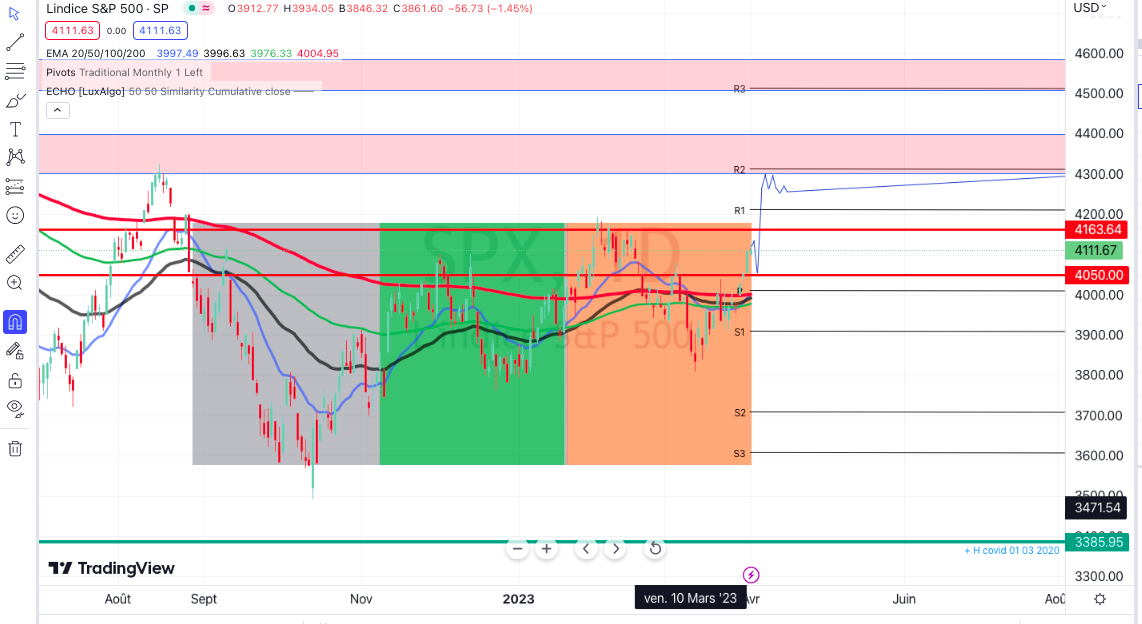
    L’indicateur The-Echo-Forecast-LUxAlgo extrapole l’évolution des cours des dernières séances pour calculer l’évolution prochaine des cours. C’est un indicateur TradingView gratuit dont le code entier est contenu dans le document pdf ci-joint.

    Je souhaiterai pouvoir l’utiliser dans ProRealTime mais les traductions que j’ai faites du langage Pine en langage Probuilder ne fonctionnent pas.

    Merci pour votre réponse et pour votre aide,

    Cordialement,

    Majide

    The-Echo-Forecast-LUxAlgo-1.pdf
    #212746 quote
    majide
    Participant
    New

    Et voici une image :


    Merci

    ECHO.png ECHO.png
    #212914 quote
    Nicolas
    Keymaster
    Master

    Je vois, je pense que cela a déjà été demandé. Malheuresement sans le support des fonctions en ProBuilder, il sera très difficile de le reproduire. L’ajout des fonctions est à l’étude, il faudra encore plusieurs mois je pense avant que cela arrive.

    #212941 quote
    majide
    Participant
    New

    Bonjour,

    Je vous remercie pour votre réponse.

    Bien à vous,

    Majide

Viewing 7 posts - 1 through 7 (of 7 total)
  • You must be logged in to reply to this topic.

Conversion de l’indicateur The Echo Forecast par AlgoLux de tradingview


ProBuilder : Indicateurs & Outils Personnalisés

New Reply
Author
author-avatar
majide @majide Participant
Summary

This topic contains 6 replies,
has 2 voices, and was last updated by majide

2 years, 11 months ago.

Topic Details
Forum: ProBuilder : Indicateurs & Outils Personnalisés
Language: French
Started: 04/01/2023
Status: Active
Attachments: 2 files
Logo Logo
Loading...