The martingale is a money management strategy, where you increase the size of positions every time you lose, in order to make the gains exceed the past looses.
This is a well-known strategy, and very risky. The classic martingale doubles the bet with every loss, the stop loss is equal to the take profit.
So we put successively to progressively losses : n = 1, then 2, then 4, 8, 16, 32, 64.128, 256, 512, 1024, 2048, etc.
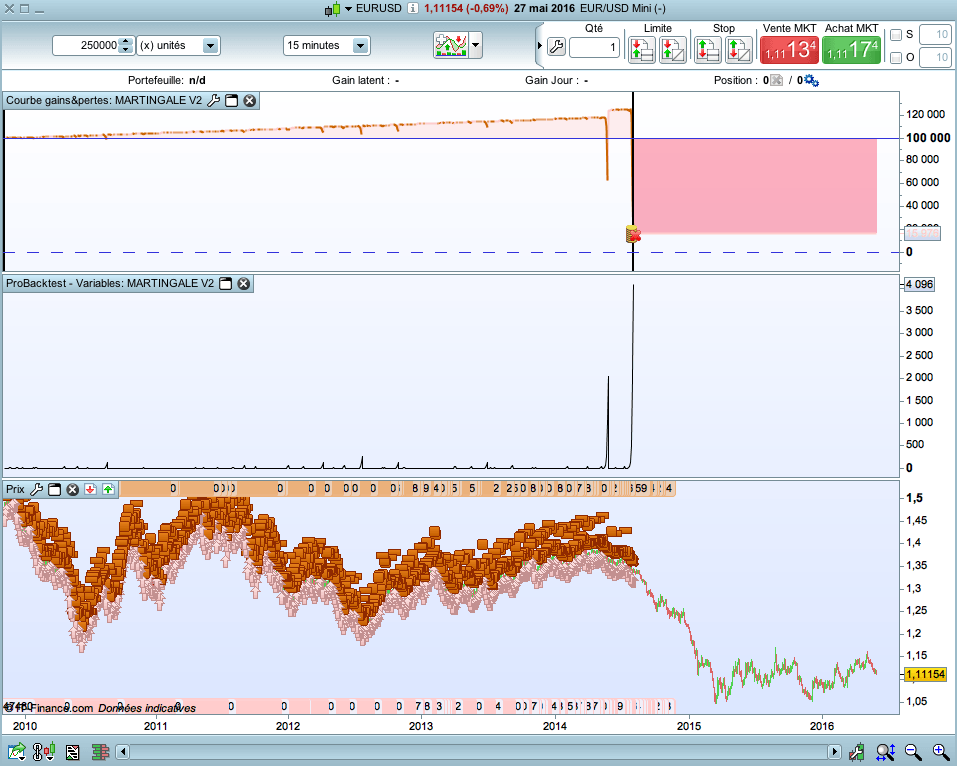
Here is a typical example of a capital increase of curve with a strategy that follows a martingale.
There seems to win in the long run, but as you see you have to bet more and more each time you loose (betting n = 1024 !)
Let’s look closer in losing trade. The strategy shows the increase in size of contracts to a nearly fatal level (n = 1024). In the picture I did set 100.000 capital instead of 10.000, or we should have already lost all.
And what would happen if we launched the strategy with a capital x10 times?
We should have passed the first crash. But soon, with the same catastrophic scenario we lose EVERYTHING.
CONCLUSION:
The martingale is good… when you have a INFINITE money ! So it’s mathematically losing over the long term. For 5, 10 or 20 consecutive losing trades, it may be extremely rare… but it finally happens one day.
It can happen tomorrow or in 5, 10, 50 or 500 years. I prefer to lose 10 trades in a row with 1% risk per trade (10% of capital, I am in still in the race !), than attempting a martingale and constantly be very worried because I can loose my capital at any time.
Of course, the strategy that I did use is very bad… but even with a better strategy it is still risky.
I think that if you really have a high winning ratio strategy, it could be useful… still risky, but it is worth using it on a small capital.
Defparam cumulateorders = false
Once n = 1
IF time = 090000 THEN
// MARTINGALE
IF PositionPerf(1) <0 THEN
n = n*2
ELSIF PositionPerf(1)>=0THEN
n =1
ENDIF
// ENTREE
buy n shares at market
ENDIF
set stop loss 0.0030
set target profit 0.0030
Graph n // pour visualiser la taille de "n"