Hi all,
I hope you are fine, since the last time.
Here is a simple strategy using 3 trend indicators :
– a moving average
– Bollinger bands
– the chikou of Ichimoku
The rules are simple :
LONG if :
– close > the simple moving average
– close crosses over the upper Bollinger limit
– chikou crosses over the upper Bollinger
SHORT if : inverted conditions
For closing the trades :
– 1st option : you are always in position, you go long or short, that’s all
– 2nd option : you close the trade earlier, if the close crosses under the upper Bollinger
As this stratety uses 3 trend indicators, it’s obvious that it’s performing well with trending markets.
The results are better with optimized variables :
– period of the Bollinger (B)
– standard deviation of the Bollinger (D)
– period of the moving average (M)
Results are quite good on some stocks / index / forex pairs. It works best on high timeframes, but can be efficient on smaller timeframes.
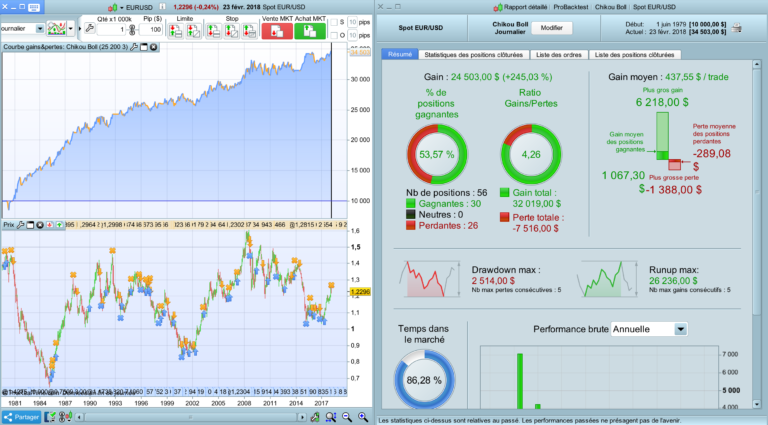
The screenshot shows the result on EUR/USD, daily timeframe (with optimized variables, and the 2nd option for closing the trades)
Nice profit factor > 4,2
Of course, you can say (and you should be right) that it could be overoptimized.
But this strategy shows that it can work well on most of the markets tested.
You can test and adapt it, I’m sure that some other work can make it a very profitable strategy.
Best regards
[crayon-5a944891b42cc359504274/]
Thank you for sharing, but I do not understand why you take time to post strategies that you know to be well overoptimized ???
It’s actually very simple to find performances with ratios higher than 4 as you stipulate using the optimizer platform … There is now the tool of Walk Forward, it should be used for you to understand what it serves and that it represents the basis of any strategy development if it is used optimization.
I know it’s not easy when you start 🙂 Good luck!
Hi, I moved the post in forums to discuss about the optimization, but it seems that the code has disappeared during the process. Sorry, could you please post it again? Thanks.
Here it is,
Best regards
Defparam cumulateorders = false
// Taille des positions
n = 1
// VARIABLES
//B : période de la Bollinger
//D : déviation standard
//M : valeur de la moyenne mobile
BollUp = Average[B](close)+D*std[B](close[26])
BollDown = Average[B](close)-D*std[B](close[26])
MM = average[M](close)
// LONG
IF close crosses over BollUp and close > MM THEN
buy n shares at market
ENDIF
// SORTIE OPTIONNELLE
IF close crosses under Average[B](close)+D*std[B](close) THEN
sell at market
ENDIF
// SHORT
IF close crosses under BollDown and close < MM THEN
sellshort n shares at market
ENDIF
// SORTIE OPTIONNELLE
IF close crosses over Average[B](close)-D*std[B](close) THEN
exitshort at market
ENDIF
Oops, it doesn’t like when I set the colors…
Here it is :
Defparam cumulateorders = false
// Taille des positions
n = 1
// VARIABLES
//B : période de la Bollinger
//D : déviation standard
//M : valeur de la moyenne mobile
BollUp = Average[B](close)+D*std[B](close[26])
BollDown = Average[B](close)-D*std[B](close[26])
MM = average[M](close)
// LONG
IF close crosses over BollUp and close > MM THEN
buy n shares at market
ENDIF
// SORTIE OPTIONNELLE
IF close crosses under Average[B](close)+D*std[B](close) THEN
sell at market
ENDIF
// SHORT
IF close crosses under BollDown and close < MM THEN
sellshort n shares at market
ENDIF
// SORTIE OPTIONNELLE
IF close crosses over Average[B](close)-D*std[B](close) THEN
exitshort at market
ENDIF
Works fine – thanks for sharing!