Can anyone code John Ehler's Empirical Mode Decomposition

Viewing 10 posts - 1 through 10 (of 10 total)
  • Author
    Posts
  • #22354 quote
    Bard
    Participant
    Master

    Hi, Is anyone able to covert this Empirical Mode Decomposition easy language code to PRT?  Thanks in advance.

    it’s a “novel approach for cycle and trend mode detection.” https://www.mesasoftware.com/papers/EmpiricalModeDecomposition.pdf

    BandPass Filter Code:
    Inputs: Price((H+L)/2),
    Period(20), delta(.1);
    Vars:
    gamma(0),
    alpha(0), beta(0), BP(0);
    beta = Cosine(360 / Period);
    gamma = 1 / Cosine(720*delta / Period);
    alpha = gamma - SquareRoot(gamma*gamma - 1);
    BP = .5*(1 - alpha)*(Price - Price[2]) + beta*(1 + alpha)*BP[1] - alpha*BP[2];
    Plot1(BP); Plot2(0);
    Code to Extract the Trend:
    Inputs:
    Price((H+L)/2),
    Period(20), Delta(.1);
    Vars:
    gamma(0),
    alpha(0), beta(0), BP(0), Trend(0);
    beta = Cosine(360 / Period);
    gamma = 1 / Cosine(720*delta / Period);
    alpha = gamma - SquareRoot(gamma*gamma - 1);
    BP = .5*(1 - alpha)*(Price - Price[2]) + beta*(1 + alpha)*BP[1] - alpha*BP[2]; Trend = Average(BP, 2*Period);
    Plot1(Trend); Plot2(0);
    
    Code for the Empirical Mode Decomposition:
    Inputs: Price((H+L)/2),
    Period(20), delta(.5), Fraction(.1);
    Vars:
    alpha(0),
    beta(0), gamma(0), //delta(.4), BP(0),
    I(0), Mean(0), Peak(0), Valley(0), AvgPeak(0), AvgValley(0);
    beta = Cosine(360 / Period);
    gamma = 1 / Cosine(720*delta / Period);
    alpha = gamma - SquareRoot(gamma*gamma - 1);
    BP = .5*(1 - alpha)*(Price - Price[2]) + beta*(1 + alpha)*BP[1] - alpha*BP[2]; Mean = Average(BP, 2*Period);
    Peak = Peak[1];
    Valley = Valley[1];
    If BP[1] > BP and BP[1] > BP[2] Then Peak = BP[1];
    If BP[1] < BP and BP[1] < BP[2] Then Valley = BP[1];
    AvgPeak = Average(Peak, 50); AvgValley = Average(Valley, 50);
    Plot1(Mean); Plot2(Fraction*AvgPeak); Plot6(Fraction*AvgValley);
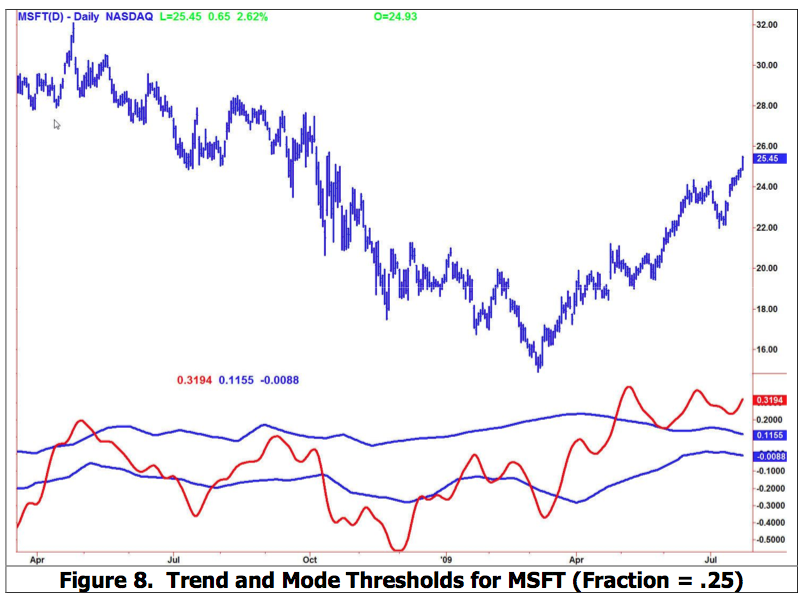
    Screen-Shot-2017-01-24-at-18.39.02.png Screen-Shot-2017-01-24-at-18.39.02.png
    #22482 quote
    Nicolas
    Keymaster
    Master

    “novel approach” .. since when? May I ask you some explanation about this? Don’t know why, but this kind of oscillator with bands reminds me of something coded earlier and I’m almost certain it was about Ehler too..

    Seems that I’ll jump into this project too. I will look at this as soon as possible. If you don’t get news by next Monday, please ring me here 🙂

    #22483 quote
    Nicolas
    Keymaster
    Master
    #22745 quote
    Bard
    Participant
    Master

    It’s “novel” in John Ehler’s “universe,” and for anyone else who likes trigonometry and can’t decipher his Superband Pass code… (-:

    Cycle Mode:

    “We begin by thinking of cycle mode in terms of frequency or its inverse, periodicity. Since the markets are fractal; daily, weekly, and intraday charts are pretty much indistinguishable when time scales are removed. Thus it is useful to think of the cycle period in terms of its bar count. For example, a 20 bar cycle using daily data corresponds to a cycle period of approximately one month.

    When viewed as a waveform, slow-varying price trends constitute the waveform’s low frequency components and day-to-day fluctuations (noise) constitute the high frequency components. The non-zero mean of filtered trending data changes relatively slowly compared to the cycle period (zero mean data). Therefore, if we measure the mean (or more approximately, the average (see blue horizontal lines)) of the cycle, this slow variation is a true reflection of the trend.

    Trend Mode:

    Market data is seldom as well behaved as we technicians would prefer. For example, an uptrend is marked by higher swing highs and higher swing lows. This means that our ideal sine wave generated by the phasor cannot be used without modification because a waveform with higher highs and higher lows will necessarily have a non-zero mean.

    However, the non-zero mean of filtered trending data changes relatively slowly compared to the cycle period. Therefore, if we measure the mean (or more approximately, the average) of the cycle, this slow variation is a true reflection of the trend.

    So we now have a method to empirically decompose the market data into a cycle component and a trend component. The cycle component is extracted by bandpass filtering the data. The trend component is extracted by averaging the bandpass filtered data over the most recent two cycle periods (to get smoothing without too much lag).”

    #24449 quote
    Bard
    Participant
    Master

    Hi Nicolas, if you manage to get the time this could be worth adding to the Ehler’s indicators? I don’t know how it’ll compare to the Bandpass Filter?

    Also re: the Universal Supersmoother Oscillator, I have an Ehler’s MESA Period indicator to get cycle period lengths eg for a 1 hour or 10 min chart for example. Is that value suitable to enter as the frequency for the Bandedge in the Univ. Osc.? When it is used (usually values around 20 to 30) it never performs as well on backtests as say a 100 or 150 bandedge setting?

    Often I see very good results on the 10 min chart and 4 hours for the Univ. Osc. but not on the hour chart despite changing the bandedge and the 20/80% cut off values?

    Also when you get good results with the Bandedge/cut off values (without doing a full optimisation, i.e. just trying various settings e.g. change Bandedge from 100 to 150 and filter from 0.8 to 0.9), you can get the system to work over certain random periods of time like a month from 3 total months or for a week (using a 10 min chart) or even over years (using a day chart) but not 0ver the entire period that’s available to test (not ideal as you ”burn” the data in the sense that it’s now optimised). I can randomly pick many single week long periods at a time over a three month period (10 min chart) and they will be profitable 9 x’s out of 10 but just not over the entire period. I was hoping this Empirical Mode Decomposition indicator could be used in conjunction with the Univ. Osc.

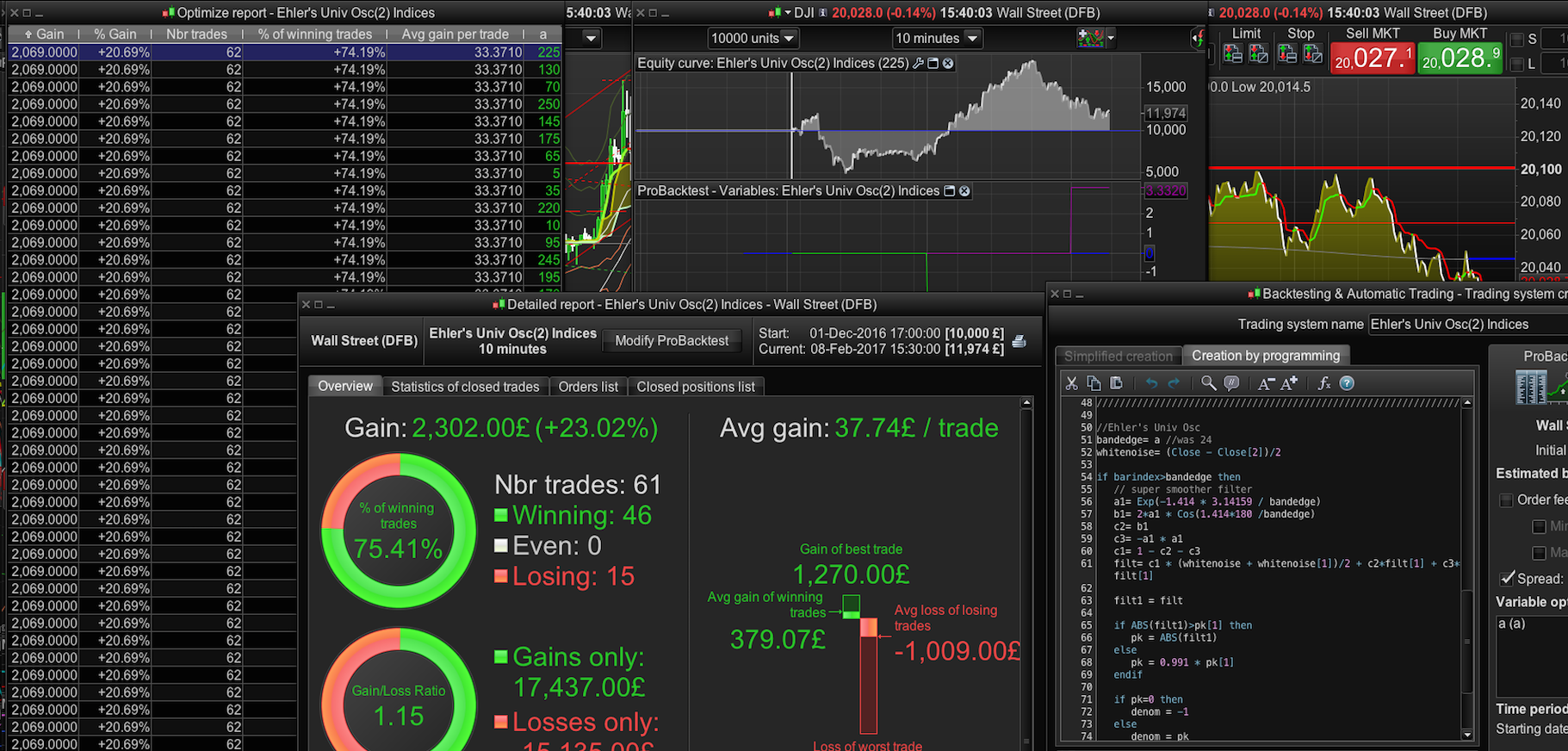
    Also when I did a full optimisation (by adding the indicator code to the system code) for bandedge 5 to 150 in steps of 5, it returned the same maximum gain (20.69% pls see screen) for  every different bandedge value?

    Is the Walk Forward analysis the only way to go to test this phenomena where it’s profitable in many random sample periods but not over the entire period? Shouldn’t we just optimise to the latest current market conditions anyway?

    p.s. I cannot see the post I made in the forums two or three days ago about the Clenlow ATR Plunger? Subject Heading: “This looks interesting..“ and it has 4 charts. It’s not in the “my topics” in my account on here?


    Be interested to hear your thoughts,

    Cheers

    Brad

    Screen-Shot-2017-02-08-at-21.21.00.png Screen-Shot-2017-02-08-at-21.21.00.png
    #25213 quote
    Nicolas
    Keymaster
    Master

    Hi Bard, I’ll try to get back on this interesting codes/topic later next week.

    About your “Clenlow ATR Plunger” : I did not see any topics named like this recently!  If it’s not in your topics list, it is not posted!

    Bard thanked this post
    #25707 quote
    DAK
    Participant
    Average

    I would also be interested in this indicator as I tried some time ago to code the Empirical Mode Decomposition but never really managed to. I’m still a beginner in programming.

    Having seen some examples I think it could be a very valuable indicator.

    Looking forward to Nicolas’ reply…

    #25735 quote
    Nicolas
    Keymaster
    Master

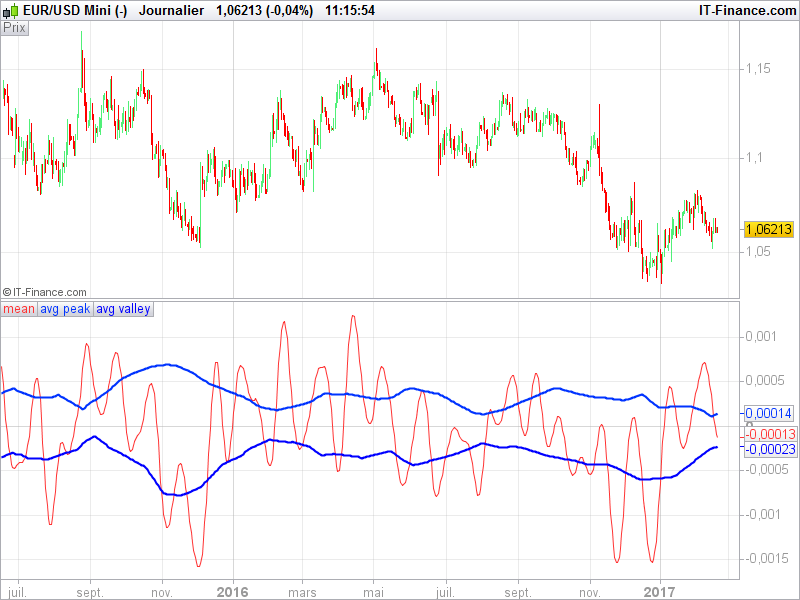
    Please find below the empirical mode decomposition indicator code:

    //PRC_EmpiricalModeDecomposition | indicator
    //20.02.2017
    //Nicolas @ www.prorealcode.com
    //Sharing ProRealTime knowledge
    //converted from EasyLanguage code
    
    Price = medianprice
    Period=20
    delta=.1
    Fraction=.25
    
    if barindex>Period then
    beta = Cos(360 / Period)
    gamma = 1 / Cos(720*delta / Period)
    alpha = gamma - SqRt(gamma*gamma - 1)
    BP = .5*(1 - alpha)*(Price - Price[2]) + beta*(1 + alpha)*BP[1] - alpha*BP[2]
    Mean = Average[Period*2](BP)
    Peak = Peak[1]
    Valley = Valley[1]
    If BP[1] > BP and BP[1] > BP[2] Then 
    Peak = BP[1]
    endif
    If BP[1] < BP and BP[1] < BP[2] Then 
    Valley = BP[1]
    endif
    AvgPeak = Average[50](Peak)
    AvgValley = Average[50](Valley)
    endif
    
    return Mean as "mean", Fraction*AvgPeak as "avg peak", Fraction*AvgValley as "avg valley"
    

    If it’s ok for you, I’ll add it into the library for everyone’s benefit.

    DAK and Bard thanked this post
    empirical-mode-decomposition.png empirical-mode-decomposition.png
    #25738 quote
    Nicolas
    Keymaster
    Master

    @bard

    You get the same results for each optimised periods of “a”, because this variable is surely forced to another value into the strategy’s code. It’s a common mistake we all make..

    Bard thanked this post
    #26044 quote
    Bard
    Participant
    Master

    Did you mean that by adding the indicator code into the system code, that the indicator optimised “a” is not being optimised properly? What value is “a” being forced to and how?

    Cheers again Nicolas for the coding, I’ll take a look at the Empirical Mode Decomposition this week or next.
    Bard

Viewing 10 posts - 1 through 10 (of 10 total)

  • You must be logged in to reply to this topic.

Can anyone code John Ehler's Empirical Mode Decomposition


ProOrder: Automated Strategies & Backtesting

New Reply
Author
author-avatar
Bard @brad Participant
Summary

This topic contains 9 replies,
has 3 voices, and was last updated by Bard

8 years, 11 months ago.

Topic Details
Forum: ProOrder: Automated Strategies & Backtesting
Language: English
Started: 01/24/2017
Status: Active
Attachments: No files
Logo Logo
Loading...