Would you typically use fixed or trailing stops here? And if trailing, do you have a setting that consistently gives the best results? I struggle with trailing to be honest… always seem to give back too much profit from my chosen exit.
of course it means I miss some runners but i guess you cant have it all.
 Zigo
ZigoParticipant
Master
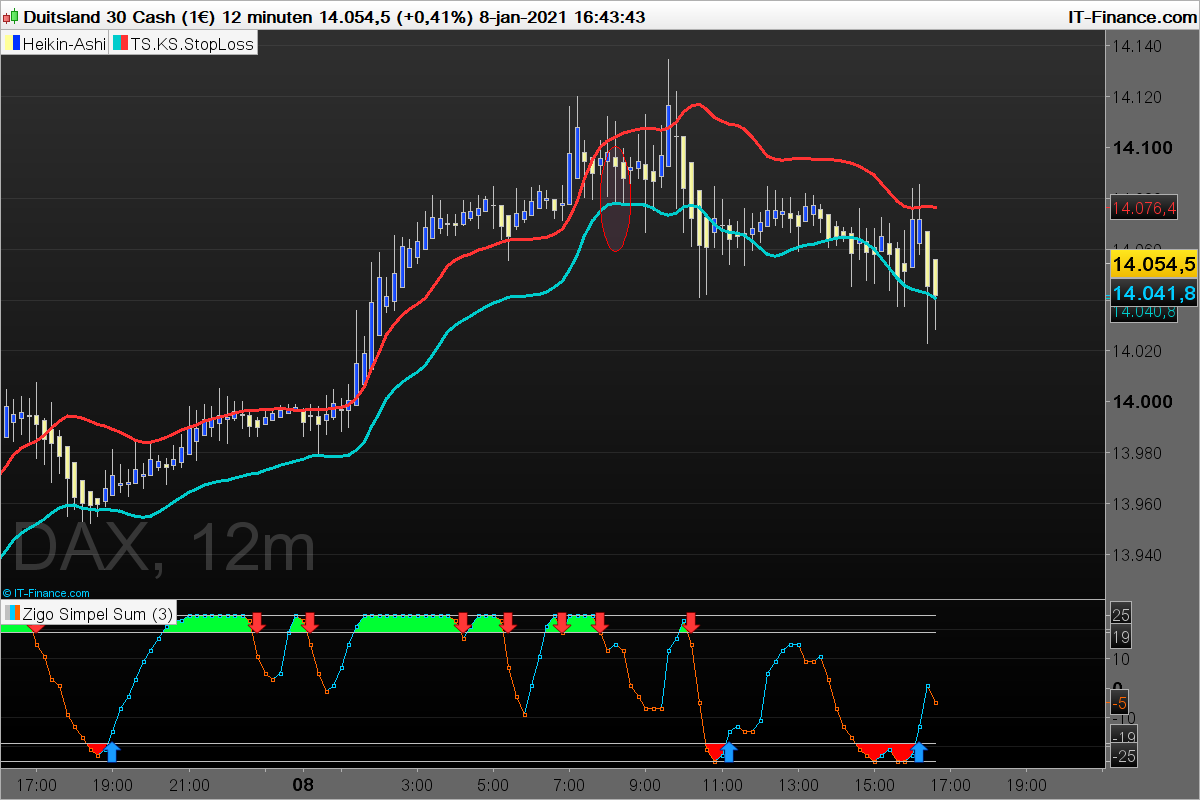
A stop loss that gives good results, is based on parameters from the Ichimoku Indicator and ATR,
//Zigo
//Berekening stoploss//

c1=(highest[9](high)+lowest[9](low))/2
C2= (highest[26](high)+lowest[26](low))/2
c3=(c1+c2)/2
//Dynamic stop for Long positionsx
//Dynamic stop for Short positions
stlong=TriangularAverage[5](c3- 0.89*AverageTrueRange[14](close))
stshort=TriangularAverage[5](c3+0.89*AverageTrueRange[14](close))
Return stLong as"StopLong", Stshort as "StopShort"
don’t tell anyone,
Hey Zigo
Used the code on page 1, set RSIp to 14, put it in an indicator and its blank for me. any ideas? PRT 11.1
cheers
ZigoParticipant
Master
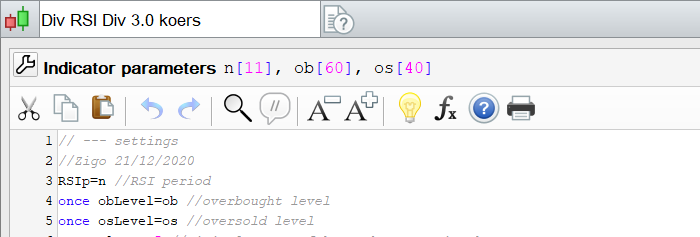
Maybe, you have to identify n, ob, os. (See attachment)
ZigoParticipant
Master
You can do it with “once n= … ,” once ob = 60, once os = 40 for example.
You can do it with “once n= … ,” once ob = 60, once os = 40 for example.
That sorted it, thank you.
A stop loss that gives good results, is based on parameters from the Ichimoku Indicator and ATR,
Hey Zigo 😉
these stops are interesting…. but way too tight for my strategy.. im currently building a reversal strat and using fixed SLs of around 60 pips – with TP…… using your RSI code above! seems to work well, but i’m looking for something more dynamic than a fixed SL.
DAX, 1 min timeframe… any ideas?
ZigoParticipant
Master
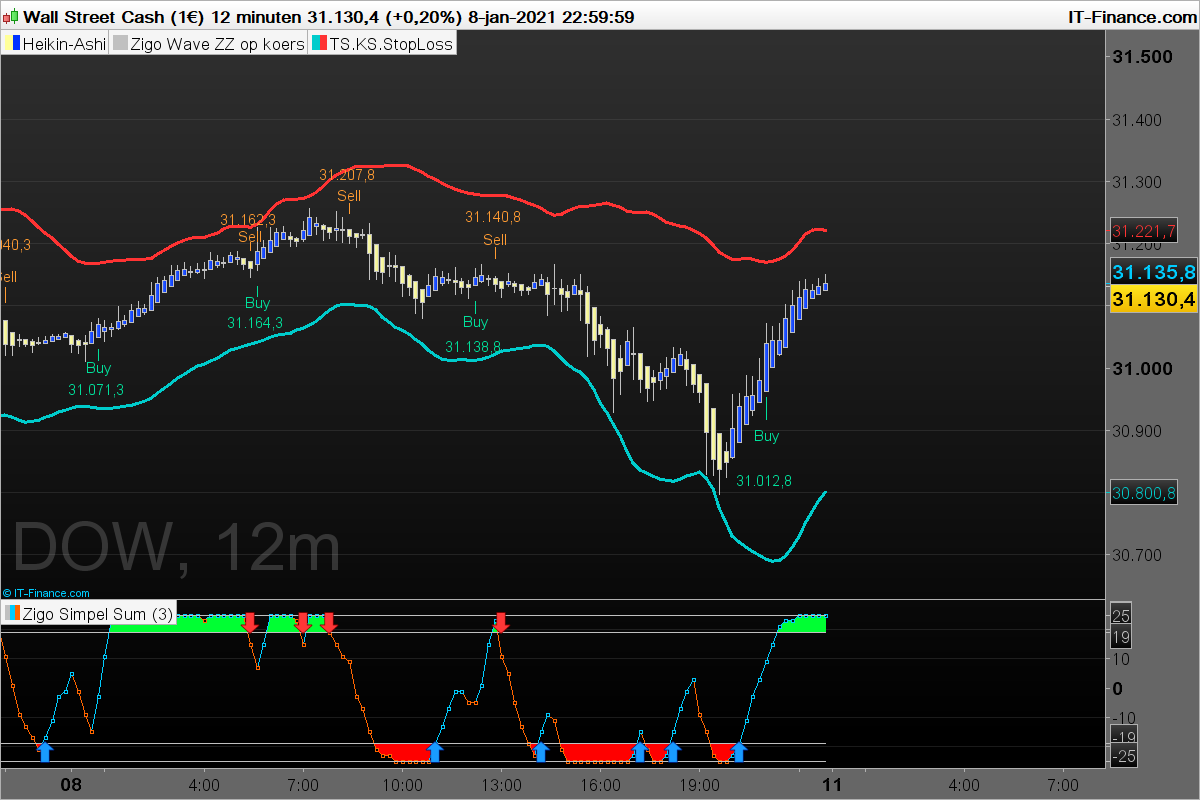
You prefer this? (a= 4.23)
stlong=TriangularAverage[5](c3- a*AverageTrueRange[14](close))
stshort=TriangularAverage[5](c3+ a*AverageTrueRange[14](close)
Line 10 and line 11 in the indicator: 0.89 is changed as variable and becomes “a”
ZigoParticipant
Master
Target Indicator.
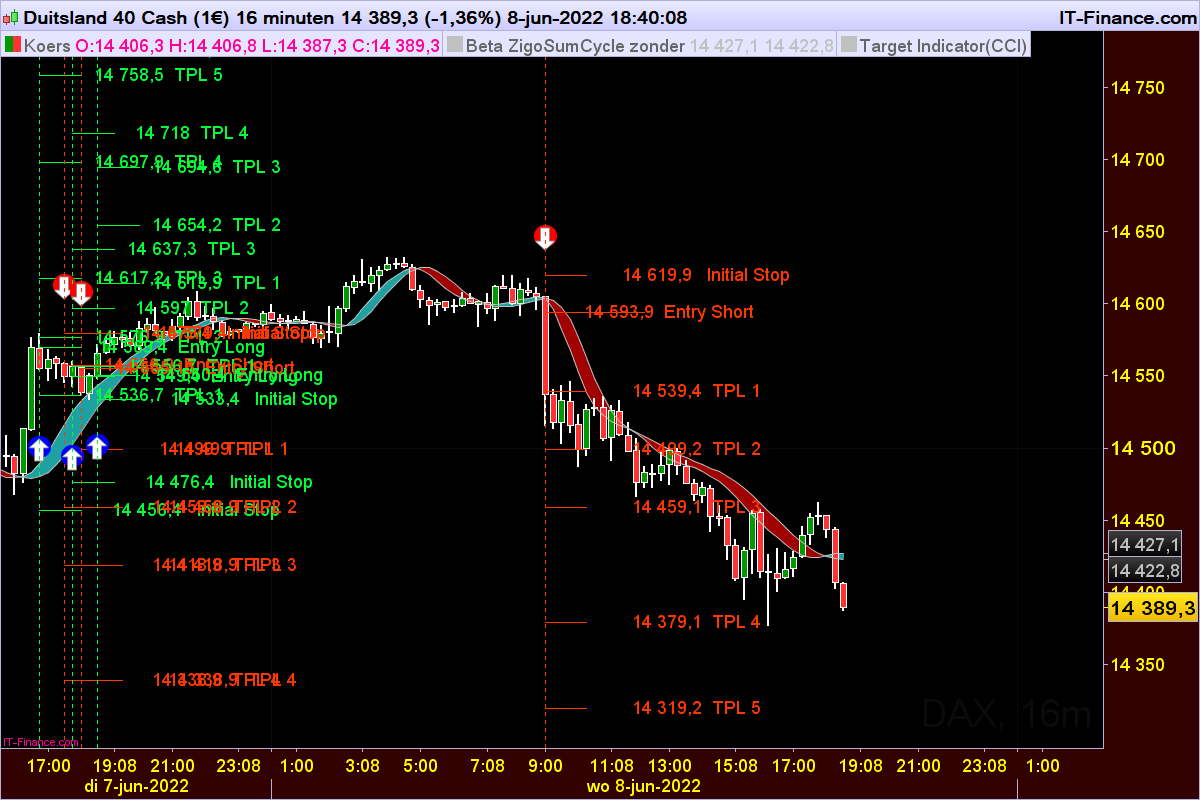
Target Indicator aims to deliver one or more well-founded and visible targets.
Example:
RSI crossing above 30 for a long position or an RSI crossing below 70 for a short position.
CCI above 100 or CCI below -100Ø
Crossing of the signal line with the MACD line
Any classic indicator or a self-developed indicator, or a combination of the two is able to be linked to the TargetIndicator, with each signal of those indicators or combinations the TargetIndicator will generate price targets.
These price targets are calculated from the moment a signal of purchase or a signal of sale is given.
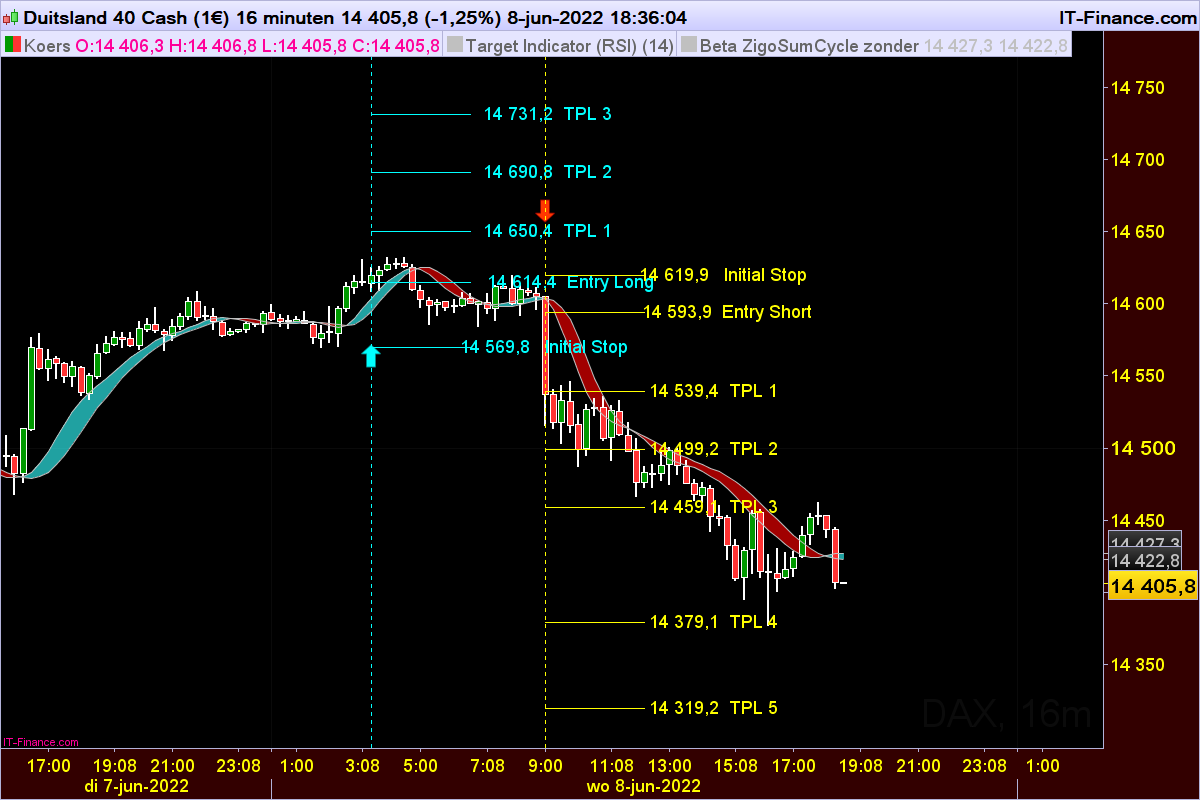
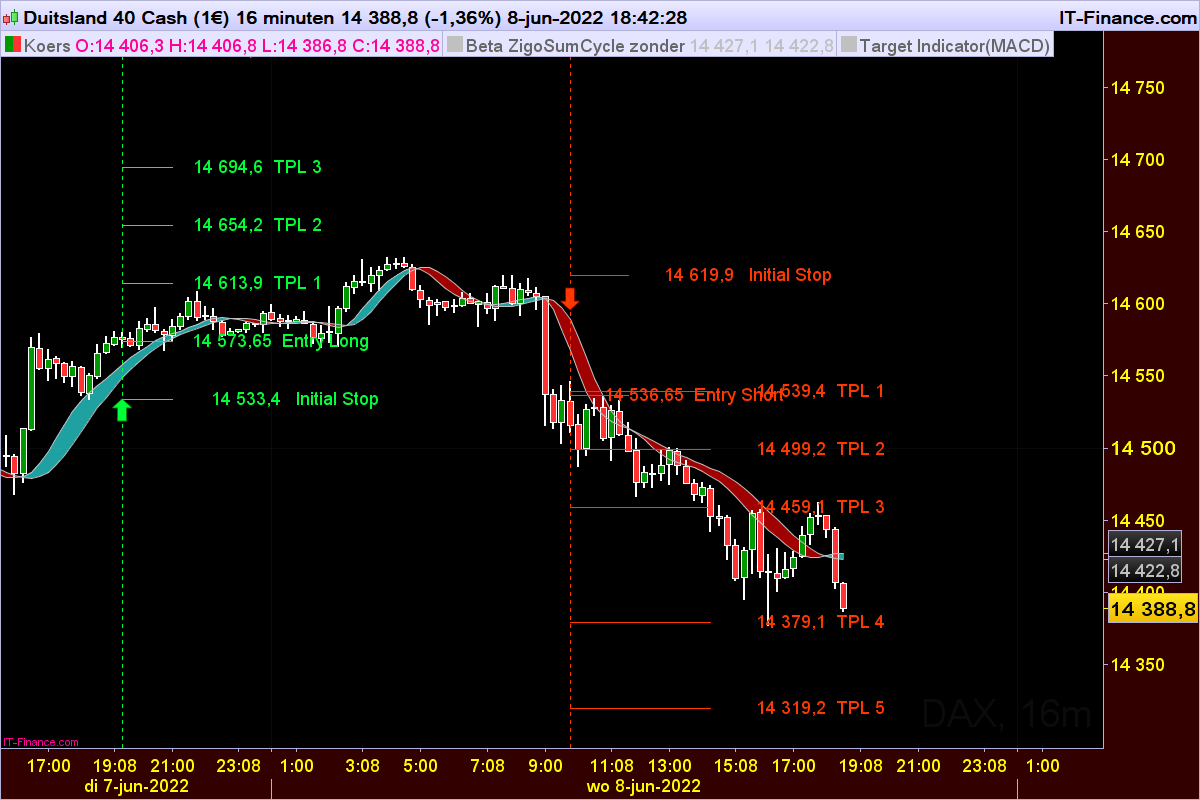
The TargetIndicator immediately indicates the “entry” the “stoploss” and 5 price targets. These values are sometimes already visible when forming the candle.
On the basis of some practical examples, it is explained how it works. In addition to these examples, the TargetIndicator can be used on most of the classic trend indicators as well as on various oscillator indicators. TargetIndicator can also be used for combinations of conditions. Three classic indicators are each linked separately to the TargetIndicator, the RSI, CCI and the MACD.
All three classic Indicators show alternating signals. After a signal up, a signal comes down. The different linked indicators are shown below.
Not all signals are usable as will become clear later.
[attachment file=”DAX-16-minuten(MACD).png”]
Target Indicator.
Target Indicator aims to deliver one or more well-founded and visible targets.
Example:
Ø RSI crossing above 30 for a long position or an RSI crossing below 70 for a short position.
Ø CCI above 100 or CCI below -100
Ø Crossing of the signal line with the MACD line
Any classic indicator or a self-developed indicator, or a combination of the two is able to be linked to the TargetIndicator, with each signal of those indicators or combinations the TargetIndicator will generate price targets.
These price targets are calculated from the moment a signal of purchase or a signal of sale is given.
The TargetIndicator immediately indicates the “entry” the “stoploss” and 5 price targets. These values are sometimes already visible when forming the candle.
On the basis of some practical examples, it is explained how it works. In addition to these examples, the TargetIndicator can be used on most of the classic trend indicators as well as on various oscillator indicators. TargetIndicator can also be used for combinations of conditions. Three classic indicators are each linked separately to the TargetIndicator, the RSI, CCI and the MACD.
All three classic Indicators show alternating signals. After a signal up, a signal comes down. The different linked indicators are shown below.
Not all signals are usable as will become clear later.
[attachment file=”194933″]
Target Indicator.
Target Indicator aims to deliver one or more well-founded and visible targets.
Example:
Ø RSI crossing above 30 for a long position or an RSI crossing below 70 for a short position.
Ø CCI above 100 or CCI below -100
Ø Crossing of the signal line with the MACD line
Any classic indicator or a self-developed indicator, or a combination of the two is able to be linked to the TargetIndicator, with each signal of those indicators or combinations the TargetIndicator will generate price targets.
These price targets are calculated from the moment a signal of purchase or a signal of sale is given.
The TargetIndicator immediately indicates the “entry” the “stoploss” and 5 price targets. These values are sometimes already visible when forming the candle.
On the basis of some practical examples, it is explained how it works. In addition to these examples, the TargetIndicator can be used on most of the classic trend indicators as well as on various oscillator indicators. TargetIndicator can also be used for combinations of conditions. Three classic indicators are each linked separately to the TargetIndicator, the RSI, CCI and the MACD.
All three classic Indicators show alternating signals. After a signal up, a signal comes down. The different linked indicators are shown below.
Not all signals are usable as will become clear later.
ZigoParticipant
Master
Sorry for repeating the text.