Hello Nicolas
did you realize this indicators who draw oblique trend lines and oscillator??
I tried at that moment but I did not manage to obtain something satisfactory in the time that I had been imparted to this task … Too many good topics and good ideas to explore and only so little time 😐
I do not doubt that with a little time you’ll get there, we’ll wait for you.
congratulations
Madrosat
@Nicolas, I would like us to revisit this strategy. I have noticed that it has performed well since I posted my last version on 11 September, adding 33 new trades with a win rate of 63.64% and a Gain/Loss Ratio of 2.71 and a Gain to Drawdown ratio of 3.39.
I still need some help graphing the trend lines.
If you could identify at least 2 points of the trendline in your code, we could plot it easily. If you can separate all the trading stuff from the trendline calculation in your code, I could help for sure.
Hi Nicolas
Okay so here is the part of the code that calculates the trend.
The first point of the trend line is obviously the last swing high/low (FractalH or FractalL) and the bar position being FractalP
The second point would be the last high/low that results in the MaxAngle to be greater than the last value it held.
//Calculate Fractal (Swing Point)

once FracH = 0 //initialize fractal count
once FracL = 0 //initialize fractal count

For i = 0 to 4 Do
If high[2] > high[i] Then //look for high fractal with 2 lower highs on either side
FracH = FracH + 1
EndIf
If low[2] < low[i] Then //look for low fractal with 2 higher lows on either side
FracL = FracL + 1
EndIf
Next

If FracH = 4 Then //High Fractal Identified
If Bear = 0 and Bull = 0 Then
Bear = 1 //Initialize first trend direction
EndIf
FractalH = high[2] //High Fractal Price Level
FractalP = barindex - 2 //High Fractal Bar Position
EndIf
If FracL = 4 Then //Low Fractal Identified
If Bear = 0 and Bull = 0 Then
Bull = 1 //Initialize first trend direction
EndIf
FractalL = low[2] //Low Fractal Price Level
FractalP = barindex - 2 //Low Fractal Bar Position
EndIf

FracH = 0 //reset fractal count
FracL = 0 //reset fractal count

//Calculate trendline using widest angle from extreme of last fractal to curent extreme (Trigonometry Function)

If Bear = 1 Then //Down trend
Height = FractalH - high //Calcululate height between high fractal and high of current bar
HeightB = FractalH - close //Calcululate height between high fractal and close of current bar (used to determine trend violation)
ElsIf Bull = 1 Then //Up trend
Height = Low - FractalL //Calcululate height between low fractal and low of current bar
HeightB = close - FractalL //Calcululate height between high fractal and close of current bar (used to determine trend violation)
EndIf

If barindex - 2 = FractalP Then //Initialize angle using high of last bar of fractal set
MaxAngle = Tan(2/Height) //Initial value of the angle between the fractal and the last high
EndIf

once Trendbreak = 0

If barindex - 2 > FractalP Then //If current bar greater than end of fractal set:
If Bear = 1 Then //For Down Trend
If (Tan((barindex-FractalP)/Height) > MaxAngle) and (((close < open) or (close < close[1]))) Then
MaxAngle = Tan((barindex-FractalP)/Height) //calculate new max trend if down trend rules are valid
Trendbreak = 0 //No Trend Violation Present
EndIf
If Trendbreak = 0 and (Tan((barindex-FractalP)/HeightB) > MaxAngle) and close > open Then
TrendBreak = 1 //Trend violation potentially present, wait for confirmation on close of next bar
ElsIf Trendbreak = 1 and (Tan(((barindex-1)-FractalP)/HeightB) > MaxAngle) and close > close[1] Then
Trendbreak = 2 //Trend violation confirmed, there was a close outside the trend line (close angle > trend)
EndIf
ElsIf Bull = 1 Then //For Up Trend
If (Tan((barindex-FractalP)/Height) > MaxAngle) and (((close > open) or (close > close[1]))) Then
MaxAngle = Tan((barindex-FractalP)/Height) //calculate new max trend if up trend rules are valid
Trendbreak = 0 //No Trend Violation Present
EndIf
If Trendbreak = 0 and (Tan((barindex-FractalP)/HeightB) > MaxAngle) and close < open Then
TrendBreak = 1 //Trend violation potentially present, wait for confirmation on close of next bar
ElsIf Trendbreak = 1 and (Tan(((barindex-1)-FractalP)/HeightB) > MaxAngle) and close < close[1] Then
Trendbreak = 2 //Trend violation confirmed, there was a close outside the trend line (close angle < trend)
EndIf
EndIf
EndIf
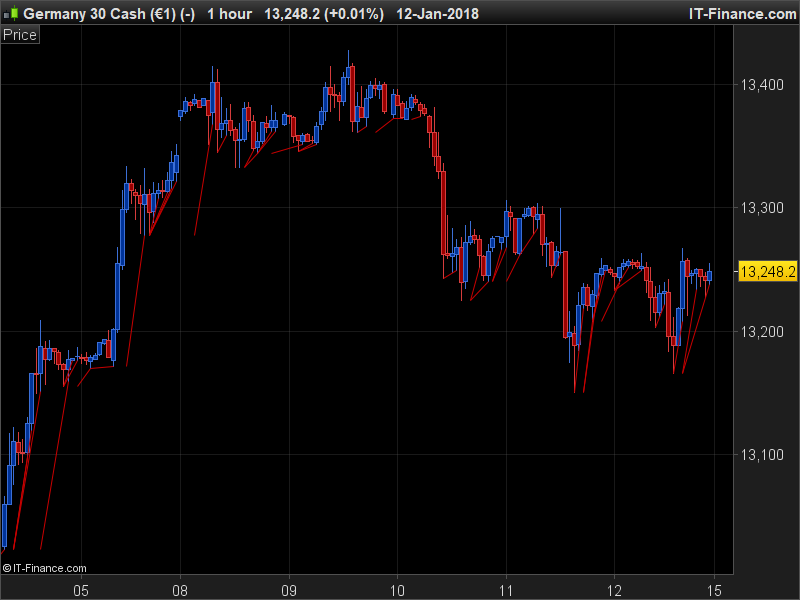
Something like this? (made only the support lines)
defparam calculateonlastbars=1000

//Calculate Fractal (Swing Point)

once FracH = 0 //initialize fractal count
once FracL = 0 //initialize fractal count

For i = 0 to 4 Do
If high[2] > high[i] Then //look for high fractal with 2 lower highs on either side
FracH = FracH + 1
EndIf
If low[2] < low[i] Then //look for low fractal with 2 higher lows on either side
FracL = FracL + 1
EndIf
Next

If FracH = 4 Then //High Fractal Identified
If Bear = 0 and Bull = 0 Then
Bear = 1 //Initialize first trend direction
EndIf
FractalH = high[2] //High Fractal Price Level
FractalP = barindex - 2 //High Fractal Bar Position
EndIf
If FracL = 4 Then //Low Fractal Identified
If Bear = 0 and Bull = 0 Then
Bull = 1 //Initialize first trend direction
EndIf
FractalL = low[2] //Low Fractal Price Level
FractalP = barindex - 2 //Low Fractal Bar Position
EndIf

FracH = 0 //reset fractal count
FracL = 0 //reset fractal count

//Calculate trendline using widest angle from extreme of last fractal to curent extreme (Trigonometry Function)

If Bear = 1 Then //Down trend
Height = FractalH - high //Calcululate height between high fractal and high of current bar
HeightB = FractalH - close //Calcululate height between high fractal and close of current bar (used to determine trend violation)
ElsIf Bull = 1 Then //Up trend
Height = Low - FractalL //Calcululate height between low fractal and low of current bar
HeightB = close - FractalL //Calcululate height between high fractal and close of current bar (used to determine trend violation)
EndIf

If barindex - 2 = FractalP Then //Initialize angle using high of last bar of fractal set
MaxAngle = Tan(2/Height) //Initial value of the angle between the fractal and the last high
EndIf

once Trendbreak = 0

If barindex - 2 > FractalP Then //If current bar greater than end of fractal set:
If Bear = 1 Then //For Down Trend
If (Tan((barindex-FractalP)/Height) > MaxAngle) and (((close < open) or (close < close[1]))) Then
MaxAngle = Tan((barindex-FractalP)/Height) //calculate new max trend if down trend rules are valid
Trendbreak = 0 //No Trend Violation Present
EndIf
If Trendbreak = 0 and (Tan((barindex-FractalP)/HeightB) > MaxAngle) and close > open Then
TrendBreak = 1 //Trend violation potentially present, wait for confirmation on close of next bar
ElsIf Trendbreak = 1 and (Tan(((barindex-1)-FractalP)/HeightB) > MaxAngle) and close > close[1] Then
Trendbreak = 2 //Trend violation confirmed, there was a close outside the trend line (close angle > trend)
EndIf
ElsIf Bull = 1 Then //For Up Trend
If (Tan((barindex-FractalP)/Height) > MaxAngle) and (((close > open) or (close > close[1]))) Then
MaxAngle = Tan((barindex-FractalP)/Height) //calculate new max trend if up trend rules are valid
Trendbreak = 0 //No Trend Violation Present
EndIf
If Trendbreak = 0 and (Tan((barindex-FractalP)/HeightB) > MaxAngle) and close < open Then
TrendBreak = 1 //Trend violation potentially present, wait for confirmation on close of next bar
ElsIf Trendbreak = 1 and (Tan(((barindex-1)-FractalP)/HeightB) > MaxAngle) and close < close[1] Then
Trendbreak = 2 //Trend violation confirmed, there was a close outside the trend line (close angle < trend)
EndIf
EndIf
EndIf

if bull and maxangle>maxangle[1] then
drawsegment(barindex,low,fractalP,fractalL) coloured(200,0,0)
endif

return //fractalH,fractalL, MaxAngle
If “MaxAngle” is superior to the last one and it’s a bull trend, draw a new segment (not a complete line to have a clear chart).
Dear Juan,
will you please post your latest version. This is very interesting. I noticed the part of the code that you have reposted is slightly different form the one posted last year. I know slight difference in a code could be the difference between losing and winning!
Many thanks.
@Nicolas, thank you for the indicator.
It is difficult to say whether or not it looks correct as I can imagine there to be many new lines being drawn constantly.
However the rules is basically as follows:
Once a swing high/low is identified with 2 lower highs/higher lows on either side;
- Draw an initial line from the high/low of the swing point to the high/low of the 2nd shoulder which should technically be the lowest/highest of the 2 shoulders. This gives the initial value for MaxAngle.
- Now after every new bar the angle between the high/low of the swing point and the latest high/low will be calculated and compared to the current value being held by MaxAngle. If the new angle is greater it means a high/low outside the diagonal line is present. To determine whether this constitutes a break, we recalculate the angle using the close. If the close also falls outside the trend line a potential break is present and we will wait for the next candle stick to confirm. If the close does not fall outside the trend line, then the trend remains intact and the high/low will be used to update the new MaxAngle value.
- If a new swing high/low is present, this will be used as the new point from which the trend line is calculated.
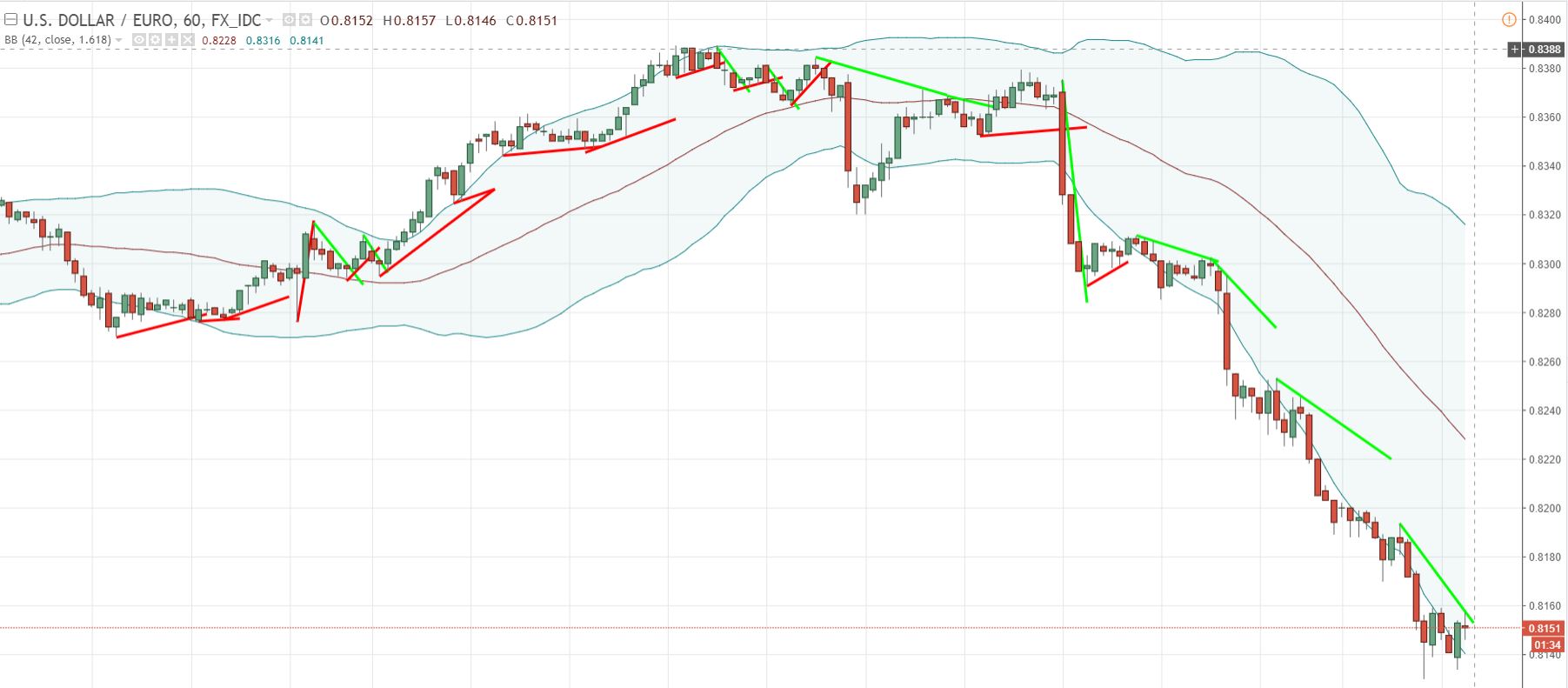
Would basically look something like this:
Juan, you can use the line equation. like this:
If the line equation is y=mx+b and the coordinates of a point is (x0,y0) then compare y0 and mxo+b, for example if y0>mxo+b then the point is above the line, etc.
x0 is bar index and y0 is price.
in case needed, equation of a line passing two points
y − y1 = m(x − x1)
m= y2-y1/x2-x1 y is price,m is bar index
thus forget the angle business all together
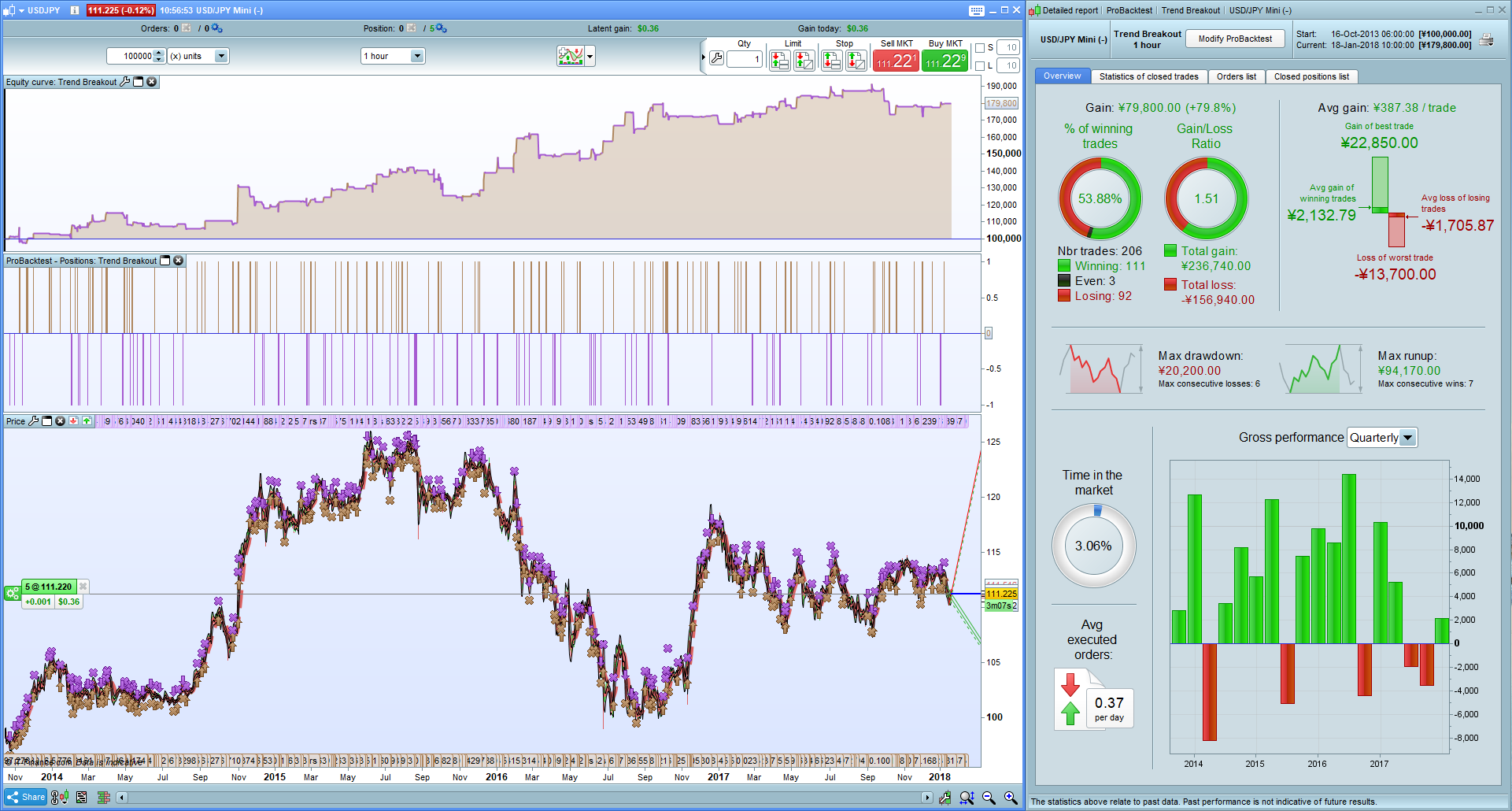
I ran this puppy on USDJPY and were quite surprised by the results (see attached), especially considering that I used the EURUSD during optimization and testing:
@Golha Here is the latest version of the code:
//Stategy: Trend Breakout
//Author: Juan Jacobs (Jd3gjacobs@gmail.com)
//Market: Neutral
//Timezone: UTC +2
//Timeframe: 1Hr but not 'completely' timeframe dependant

Defparam cumulateorders = False

If hour < 3 or hour >= 20 then //market hours EURUSD: 8-23 USDJPY: 3-20 AUDUSD: 5-20
possize = 0
If longonmarket Then
sell at market
ElsIf shortonmarket Then
exitshort at market
EndIf
Bear = 0
Bull = 0
Trendbreak = 0
Else
possize = 1 //position contract size
EndIf

// Heuristics Algorithm Start

once OPT = 1

If OPT < 2 and onmarket then
OPT = 0
ElsIf countofposition = 0 Then
OPT = 1
EndIF

If OPT = 0 Then
optimize = optimize + 1
OPT = 2
EndIf

////////////////////////////////////////

//GRAPH periods AS "Periods"

once periods = 2.5
Increment = 0.05
MaxIncrement = 6
Reps = 6 //Number of trades to use for analysis
once PIncPos = 1 //Positive Increment Position
once NIncPos = 1 //Neative Increment Position
once Optimize = 0 ////Initialize Heuristicks Engine Counter (Must be Incremented at Position Start or Exit)
once Mode = 1 //Switches between negative and positive increments
once WinCountB = 0 //Initialize Best Win Count
once StratAvgB = 0 //Initialize Best Avg Strategy Profit

If Optimize = Reps Then
WinCountA = 0 //Initialize current Win Count
StratAvgA = 0 //Initialize current Avg Strategy Profit

For i = 1 to Reps Do
If positionperf(i) > 0 Then
WinCountA = WinCountA + 1 //Increment Current WinCount
EndIf
StratAvgA = StratAvgA + positionperf(i)
Next
StratAvgA = StratAvgA/Reps //Calculate Current Avg Strategy Profit

If StratAvgA >= StratAvgB Then
StratAvgB = StratAvgA //Update Best Strategy Profit
BestA = Periods
EndIf

If WinCountA >= WinCountB Then
WinCountB = WinCountA  //Update Best Win Count
BestB = Periods
EndIf

If WinCountA > WinCountB and StratAvgA > StratAvgB Then
Mode = 0
ElsIf WinCountA < WinCountB and StratAvgA < StratAvgB and Mode = 1 Then
Periods = Periods - (Increment*NIncPos)
NIncPos = NIncPos + 1
Mode = 2
ElsIf WinCountA >= WinCountB or StratAvgA >= StratAvgB and Mode = 1 Then
Periods = Periods + (Increment*PIncPos)
PIncPos = PIncPos + 1
Mode = 1
ElsIf WinCountA < WinCountB and StratAvgA < StratAvgB and Mode = 2 Then
Periods = Periods + (Increment*PIncPos)
PIncPos = PIncPos + 1
Mode = 1
ElsIf WinCountA > WinCountB or StratAvgA > StratAvgB and Mode = 2 Then
Periods = Periods - (Increment*NIncPos)
NIncPos = NIncPos + 1
Mode = 2
EndIf

If NIncPos > MaxIncrement or PIncPos > MaxIncrement Then
If BestA = BestB Then
Periods = BestA
Else
Periods = (BestA+BestB)/2
EndIf
NIncPos = 1
PIncPos = 1
EndIF

Optimize = 0
EndIf

// Heuristics Algorithm End

If Trendbreak = 0 Then //No potential trendbreaks have been identified

//Calculate Fractal

FracH = 0 //initialize fractal count
FracL = 0 //initialize fractal count

For i = 0 to 4 Do
If high[2] > high[i] Then //look for high fractal with 2 lower highs on either side
FracH = FracH + 1
EndIf
If low[2] < low[i] Then //look for low fractal with 2 higher lows on either side
FracL = FracL + 1
EndIf
Next

If FracH = 4 Then //High Fractal Identified
If Bear = 0 and Bull = 0 Then
Bear = 1 //Initialize first trend direction
EndIf
FractalH = high[2] //High Fractal Price Level
LFractalH = low[2] //Low of High Fractal
If Bear = 1 Then
FractalP = barindex - 2 //High Fractal Bar Position
EndIf
ElsIf FracL = 4 Then //Low Fractal Identified
If Bear = 0 and Bull = 0 Then
Bull = 1 //Initialize first trend direction
EndIf
FractalL = low[2] //Low Fractal Price Level
HFractalL = high[2] //High of Low Fractal
If Bull = 1 Then
FractalP = barindex - 2 //Low Fractal Bar Position
EndIf
EndIf

//Calculate trendline using widest angle from extreme of last fractal to curent extreme (Trigonometry Function)

If barindex = FractalP + 2 Then //Initialize angle using greatest candle after fractal candle
If Bear = 1 Then
MaxAngleA = Tan(1/(FractalH - high[0])) //Initial value of the angle between the fractal and the 1st high after fractal high
MaxAngleB = Tan(1/(FractalH - high[1])) //Initial value of the angle between the fractal and the 2nd high after fractal high
MaxAngle = MAX(MaxAngleA,MaxAngleB)
ElsIf Bull = 1 Then
MaxAngleA = Tan(1/(low[0]-FractalL)) //Initial value of the angle between the fractal and the 1st low after fractal low
MaxAngleB = Tan(1/(low[1]-FractalL)) //Initial value of the angle between the fractal and the 2nd low after fractal low
MaxAngle = MAX(MaxAngleA,MaxAngleB)
EndIf
EndIf

EndIf

If Bear = 1 Then //Down trend
Height = abs(FractalH - high) //Calcululate height between high fractal and high of current bar
HeightB = abs(FractalH - close) //Calcululate height between high fractal and close of current bar (used to determine trend violation)
HeightC = abs(FractalH - close[1]) //Calcululate height between high fractal and close of current bar (used to determine trend violation)
ElsIf Bull = 1 Then //Up trend
Height = abs(Low - FractalL) //Calcululate height between low fractal and low of current bar
HeightB = abs(close - FractalL) //Calcululate height between high fractal and close of current bar (used to determine trend violation)
HeightC = abs(close[1] - FractalL) //Calcululate height between high fractal and close of current bar (used to determine trend violation)
EndIf

If barindex > FractalP + 2 Then //If current bar greater than end of fractal set:
If Bear = 1 Then //For Down Trend
If Trendbreak = 1 and close >= close[1] Then
Trendbreak = 2 //Trend violation confirmed, there was a close outside the trend line (close angle > trend)
BreakoutP = Barindex //Breakout position
OrderLevel = LFractalH + (AverageTrueRange[22](close)*periods) //Enter into long position at specified price level
PreviousLow = FractalL //Lowest[15](low)//Level to re-initate preious trend
ElsIf Trendbreak = 1 and Tan((barindex-FractalP)/HeightC) > TAngle Then
MaxAngle = TAngle //New max trend as trend break was invalidated
Trendbreak = 0
EndIf
If Trendbreak = 0 and (Tan((barindex-FractalP)/Height) < MaxAngle) and (Tan((barindex-FractalP)/HeightB) > MaxAngle) Then
MaxAngle = Tan((barindex-FractalP)/Height) //calculate new max trend if down trend rules are valid
ElsIf Trendbreak = 0 and (Tan((barindex-FractalP)/Height) < MaxAngle) and (Tan((barindex-FractalP)/HeightB) < MaxAngle) Then
TrendBreak = 1 //Trend violation potentially present, wait for confirmation on close of next bar
TAngle = Tan((barindex-FractalP)/Height) //Save temporary angle to use if trend violation invalidated
EndIF
ElsIf Bull = 1 Then //For Up Trend
If Trendbreak = 1 and close <= close[1] Then
Trendbreak = 2 //Trend violation confirmed, there was a close outside the trend line (close angle < trend)
BreakoutP = Barindex //Breakout position
OrderLevel = HFractalL - (AverageTrueRange[22](close)*periods) //Enter into short position at specified price level
PreviousHigh = FractalH // Highest[15](high) //Level to re-initiate previous trend
ElsIf Trendbreak = 1 and Tan((barindex-FractalP)/HeightC) > TAngle Then
MaxAngle = TAngle //New max trend as trend break was invalidated
Trendbreak = 0
EndIf
If Trendbreak = 0 and (Tan((barindex-FractalP)/Height) < MaxAngle) and (Tan((barindex-FractalP)/HeightB) > MaxAngle) Then
MaxAngle = Tan((barindex-FractalP)/Height) //calculate new max trend if up trend rules are valid
ElsIf Trendbreak = 0 and (Tan((barindex-FractalP)/Height) < MaxAngle) and (Tan((barindex-FractalP)/HeightB) < MaxAngle) Then
TrendBreak = 1 //Trend violation potentially present, wait for confirmation on close of next bar
TAngle = Tan((barindex-FractalP)/Height) //Save temporary angle to use if trend violation invalidated
EndIf
EndIf
EndIf

If Trendbreak = 2 Then //Trend violation is confirmed:

If Bear = 1 and close > PreviousLow Then
Buy possize contract at OrderLevel stop
ElsIf Bull = 1 and close < PreviousHigh Then
Sellshort possize contract at OrderLevel stop
EndIf

If barindex >= BreakoutP Then
If Bear = 1 and longonmarket Then //If position is opened counter last trend, reset variables and initialize new trend
Trendbreak = 0
Bear = 0
Bull = 1
ElsIf Bear = 1 and close < PreviousLow Then //New trend invalidated and previous trend resumed
Trendbreak = 0
ElsIf Bull = 1 and shortonmarket Then //If position is opened counter last trend, reset variables and initialize new trend
Trendbreak = 0
Bear = 1
Bull = 0
ElsIf Bull = 1 and close > PreviousHigh Then //New trend invalidated and previous trend resumed
Trendbreak = 0
EndIf
EndIf
EndIf

//Trade Management (Note that Trend Direction need to be reset with exits's)

Deviations = 1.618
period = 42

PRICE  = LOG(customclose)
alpha  = 2/(PERIOD+1)

if barindex < PERIOD then
EWMA = AVERAGE[3](PRICE)
else
EWMA = alpha * PRICE + (1-alpha)*EWMA
endif

error = PRICE - EWMA
dev   = SQUARE(error)
if barindex < PERIODS+1 then
var  = dev
else
var   = alpha * dev + (1-alpha) * var
endif
ESD   = SQRT(var)

BollU = EXP(EWMA + (DEVIATIONS*ESD))
BollL = EXP(EWMA - (DEVIATIONS*ESD))

RS2 = ROUND(RSI[2](close))

PSH = Highest[100](high)[1]
PSL = Lowest[100](low)[1]

If longonmarket and ((close[1] > BollU and close < BollU) or (high[1] > BollU and high < BollU) or (close > PSH or close < PSL)) Then
LE = 1
ElsIf shortonmarket and ((close[1] < BollL and close > BollL) or (low[1] < BollL and low > BollL) or (close < PSL or close > PSH)) Then
SE = 1
EndIf

If longonmarket and LE = 1 and RS2 >= 85 and close < BollU Then
Sell at market
Bear = 0
Bull = 0
ElsIf shortonmarket and SE = 1 and RS2 <= 15 and close > BollL Then
Exitshort at market
Bear = 0
Bull = 0
EndIf
@JuanJ I find this strategy really interesting! However, I am struggling to make Money Management work with this. None of the MM code I can find here seems to work. I have made sure to change positionsize to possize but it still doesn’t work, there seem to be something in your code that overrides it but I cannot figure out what. Any help would be massively appreciated.
Do you run this still live?
I seem to get interesting backtest results with this also:
period = period2 * AverageTrueRange[periodv]
(period2 and periodv to be optimised)