 Stef
StefParticipant
Average
How do I translate this to Probuilder language:
cagr=((equity/startcapital)^(1/nryears))-1
PRT does not like the “^” (power of) symbol.
Regards
I’m sorry, I spent almost 2 hours doing maths formulas to solve the MathPow being not available in math instructions of the platform.. Didn’t solve the formula because of the fractionnal exponent. Seems that I could calculate something if the ‘nryears’ is below 3 but not above.
I have just sent a request to PRT dev team to add the MathPow possibility in the language, as it is not the first time i’m stuck with this! 🙁
If any math genius come here, I’ll be glad to have his opinion 🙂
Ok, I guess I’ve become a PRC-addict, even when I’m away from my trading station I feel the need to come and read what happened since last visit, haha
Assuming nryears is an integer, how about a recursive approach, for which the number of iterations would depend on the required precision in the end by the user?
Let’s say to simplify the formula writing that A=equity/startcapital and n=nryears
and let’s name B = (equity/startcapital)^(1/nryears) = A^(1/n)
so B^n = A = B * B^(n-1)
B = A / B ^(n-1)
and if I use i to rank the iterations from 1 to maximum i desired for sufficient precision and {} for index:
B{rank i+1} = ( B{rank i} + B{rank i} ) / 2
B{rank i+1} = ( B{rank i} + A / (B{rank i} ^(n-1) ) / 2
and a code with 2 loops to use the formula:
something like:
B=1

for i=1 to 10 //(try 20 and 30 and... to see how much is enough for required accuracy in the end)

previousB=B

den=B

for j=2 to nryears-1
den=den*B
next

B=(previousB + (equity/startcapital)/den)/2

next

cagr=B-1
However, I can’t launch prt and test it from here, so it’s probably bugged as I often need to make changes to first writing before getting it right… Also, I have never tried a loop inside a loop in PRT before, don’t know if it can handle it.
StefParticipant
Average
@Nicolas, I could not solve it either. But, I did come up with the following “indicator” – that can be added to the end of any strategy backtesting code.
// yearly and monthly returns
once startcapital=100000 // initial capital amount
once yearstartcap=startcapital // set initial capital for 1st year
once mstartcap=startcapital // set initial capital for 1st month

if day<day[1] and month=1 then // new year
endcapital=startcapital+strategyprofit // ending capital for the year (previous year)
prof=endcapital-yearstartcap // profit for the year (previous year)
yearstartcap=endcapital // set starting capital for the new year
yearreturn=(prof/startcapital)*100 // yearly return as percentage (previous year)
endif

if day<day[1] and month>month[1] then // new month
mendcapital=startcapital+strategyprofit // ending capital for the month (previous month)
mprof=mendcapital-mstartcap // profit for the month (previous month)
mstartcap=mendcapital // set starting capital for the new month
mreturn=(mprof/startcapital)*100 // monthly return as percentage (previous month)
endif


graph 0 coloured(0,0,255) // graph zero line
graph yearreturn coloured(0,200,0) as "Yearly Return %" // graph yearly return (prev year)
graph mreturn coloured(154,0,154) as "Monthly Return %" // graph monthly return (prev month)
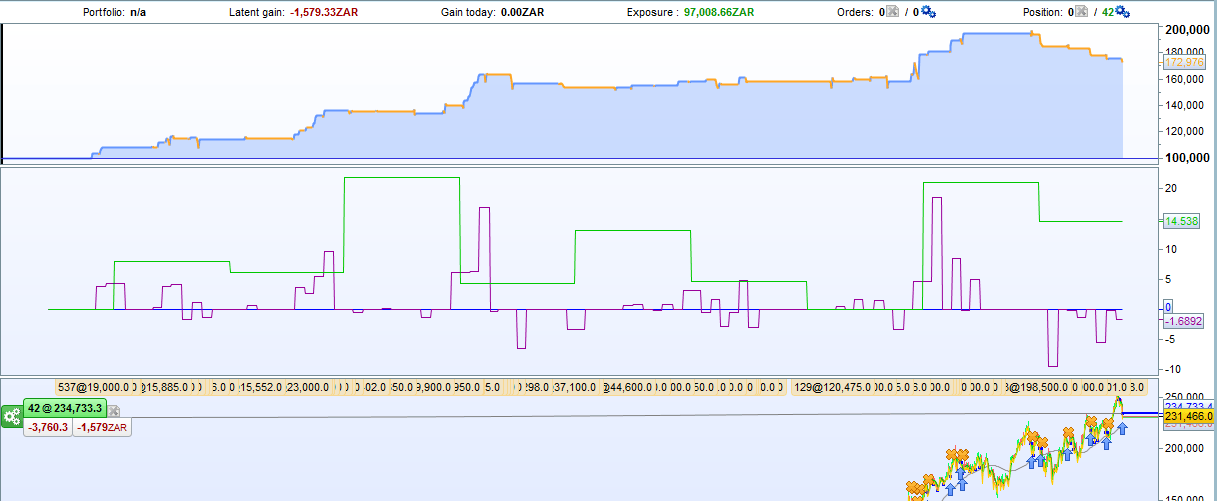
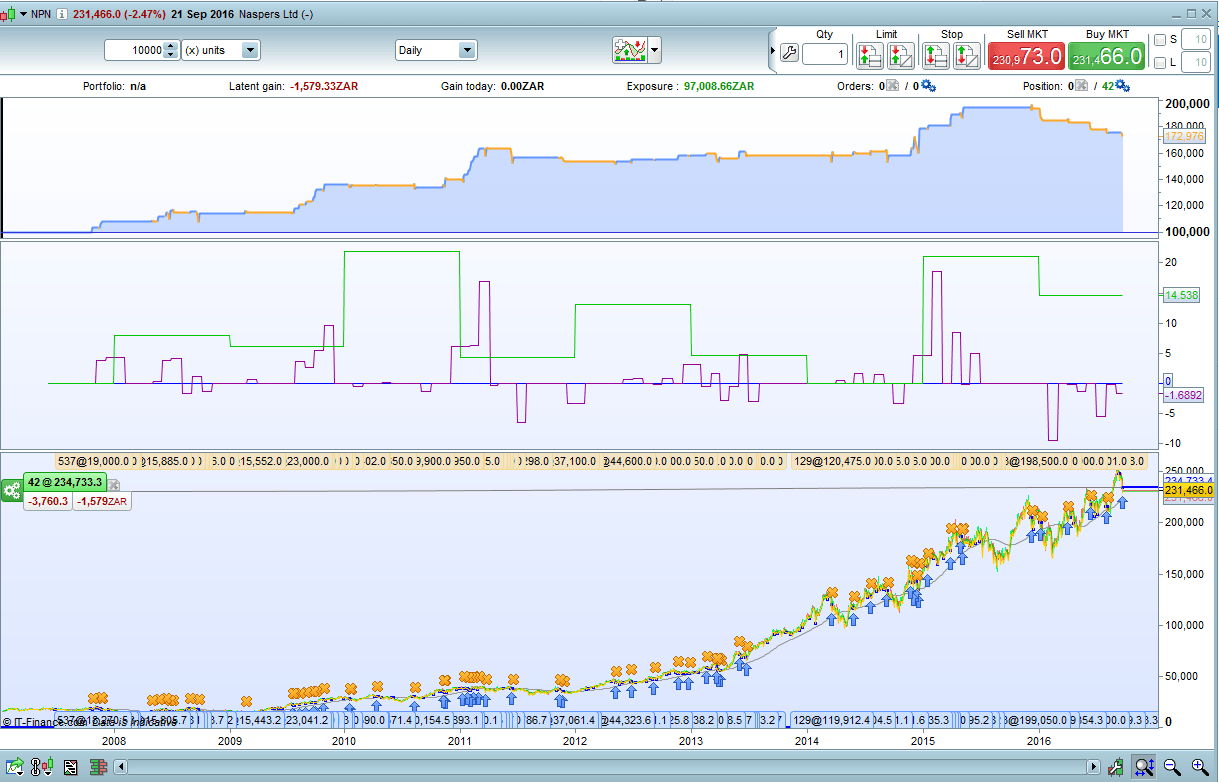
It calculates yearly and monthly returns, and looks like this (see attachment).
I would appreciate any comments or suggestions for improvements.
Regards
Stef
StefParticipant
Average
@Noobywan. Tx, will try it.
@Noobywan
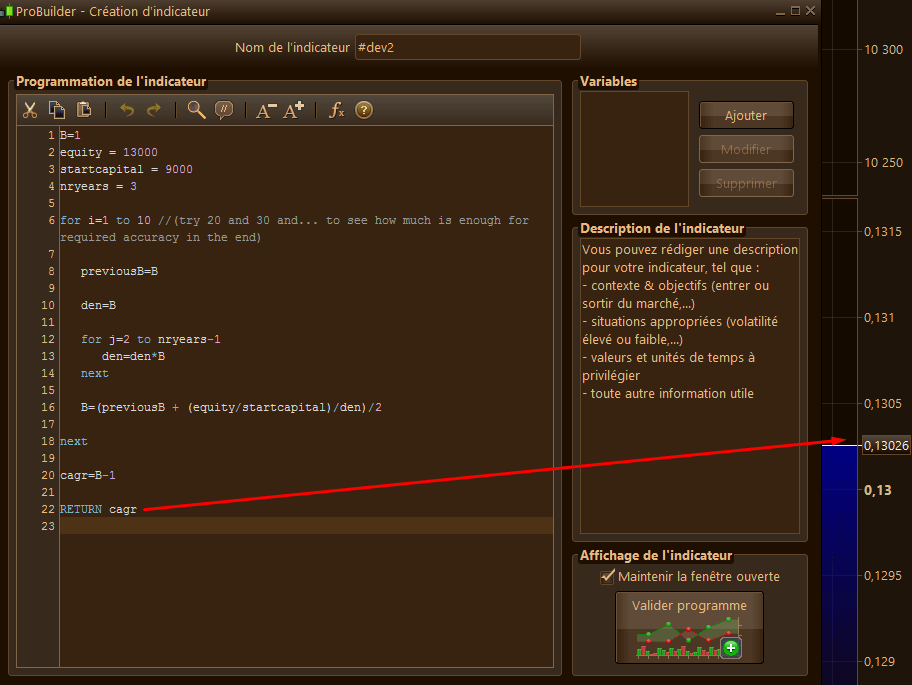
Your code is good. It successfully returned the good value for the Wikipedia example attached.
Here is the code with the same value:
B=1
equity = 13000
startcapital = 9000
nryears = 3

for i=1 to 10 //(try 20 and 30 and... to see how much is enough for required accuracy in the end)

previousB=B

den=B

for j=2 to nryears-1
den=den*B
next

B=(previousB + (equity/startcapital)/den)/2

next

cagr=B-1

RETURN cagr
Well done! Fractional exponent gimme headache yesterday, you desserve a beer again! 🙂 Maybe I’ll add a post in the Blog in your own name.
@Stef
You add the code about monthly and yearly returns in the Library, but I don’t see any code of ITF file attached to your post. Could you please, gimme here? Thanks.
No problem for blog post if you think it can be useful to compensate for the lack of mathpow, with or without my name doesn’t matter, I don’t own the rights to recursivity
I am going to write a “carte de fidélité – bières” with squares to stamp the beers on, in case some day I happen to drive near your headquarters 😉
Ahaha noobywan, you just have changed my mood from dark to hilarious, thanks a lot. Always got beers at Nicolas’HQ, no worries 😂
codeforpower = exp(5*log(2)) // result = 32 = 2^5
codeforlogarithm = log(32) / log (2) // result = 5