Hello
Investors and scalpers are stupid!
You knowingly or unknowingly use large numbers for the entry and stop.
You can take advantage of that.
This is a range trading strategy by defining the big ranges eg. 1.30 – 1.40 or 100 – 200 or 300-400 etc.
It would be desirable to work together to optimize the system.
I am not so sure about the realistic of it… maybe someone can also test it with tick-data
Hello
Investors and scalpers are stupid!
You knowingly or unknowingly use large numbers for the entry and stop.
You can take advantage of that.
This is a range trading strategy by defining the big ranges eg. 1.30 – 1.40 or 100 – 200 or 300-400 etc.
It would be desirable to work together to optimize the system.
What Timeframe and Instrument is your screenshot … you have cut these off.
well i use it for CL in 1 min chart for scalping. my ranges are very small – like 25, 50 …
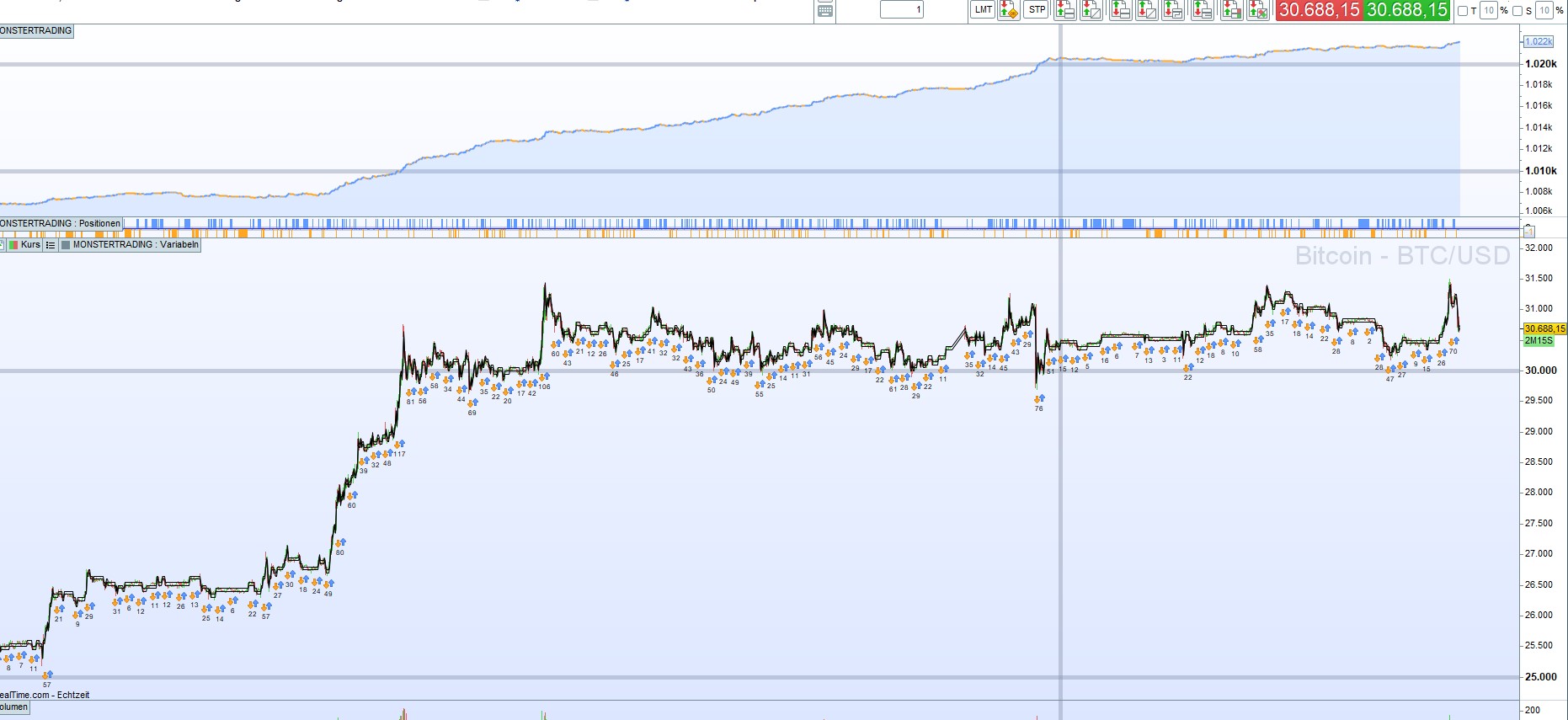
but you can use it for every market .. they should moving , like bitcoin ( screenshoot)… for slow markets you can try to use it with limits not with stops ( like in the programm )
it would also work on higher timeframes for example YM
her you can use 100 as range or 1000
i think it is the only way to get real 2:1 trades.
if 1 support is strong – then the finish is the next number
use big numbers for to read the chart.
you also can take a look in the orderbook or footprint… large traders can´t hide there possions .. ( for example – high volume )
and on every market — on tops or floors — there are running stops (it does not depends in witch thimeframe ). if they are not comming —- the trend is over.
for me this is only a try to do a algo…
interessting would be for me to do the algo on stocks… but it does not work ( i use *pointsize ) – this does not work
JSParticipant
Senior
Hi,
I tried your code with the Apple share and it works well…
Why do you think “PointSize” wouldn’t work properly…?
when i try it on apple – the ranges are +100 and -100 .. maybe you have try it on a cfd ?
i am on prorealtime.com to try it …
but the backtest looks good 🙂