







Volatility breakout indicator
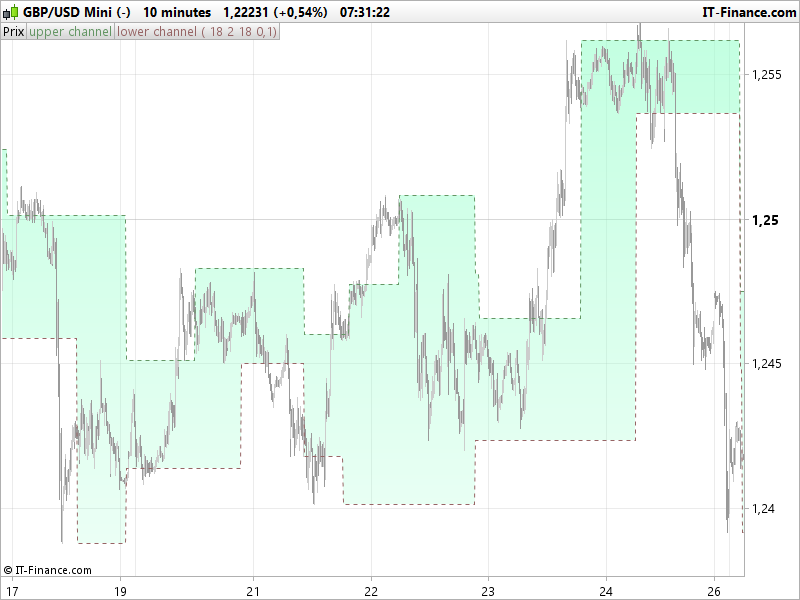
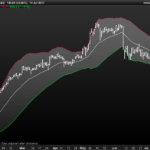
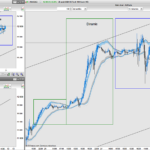
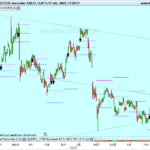
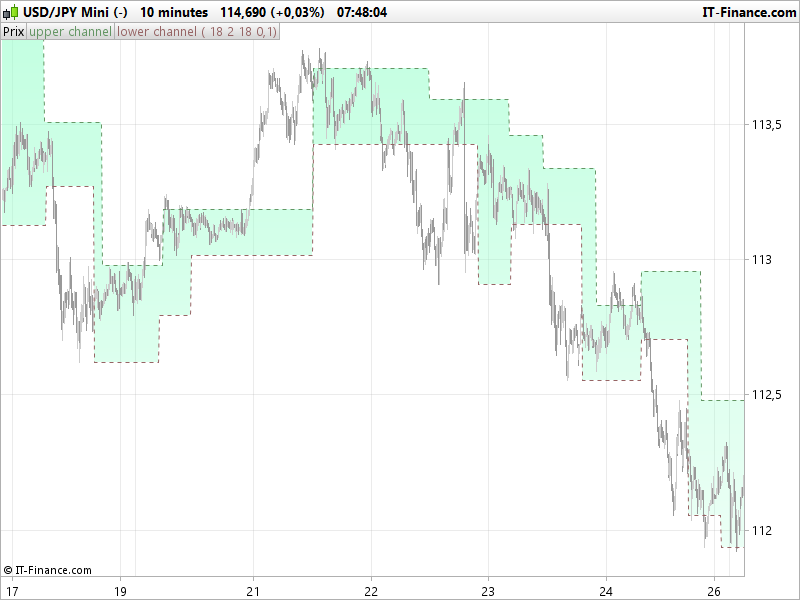
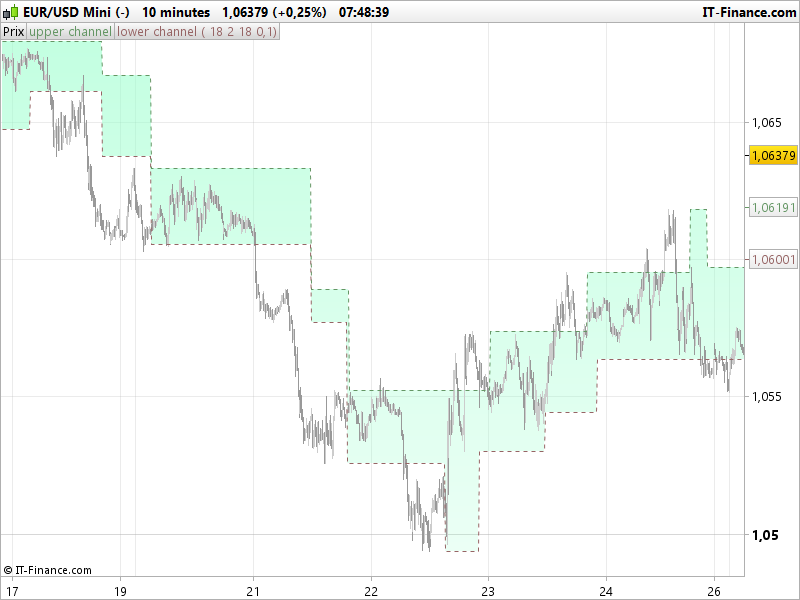
The Volatility Cycle Breakout indicator draws range boxes overlaid on the price chart. The upper and lower side of the boxes are made from recent Fractals. New boxes will be drawn only if the volatility is weak and if the new fractals discovered are far enough from the current upper and lower ones.
The volatility cycle is extracted from Bollinger Bands (InpBandsPeriod=18 is the bands period). Original indicator is here: Volatility Cycle
Fractals lookback periods can be adapted to catch new fractals far in the history or near of the current price (cp=10).
The “change” variable is the percent variation needed to change the support and resistance levels of the boxes (0.1% seems to work fine for intraday timeframes on forex pairs for instance). This setting is important because it will reduce the noises of “moving boxes” each time new Fractals are discovered, specially when price is ranging. It results perfect range boxes on price to play mean reversion strategy when price is not moving enough to make real breakout.
Original concept (modified since) come from a topic in French forum.
All ideas are welcome and could result in new good indicators, don’t hesitate to post them in forums!
//PRC_Volatility Cycle Breakout | indicator
//03.10.2017
//Nicolas @ www.prorealcode.com
//Sharing ProRealTime knowledge

//--- parameters
//InpBandsPeriod=18      // Period
//Smooth=2               // Smoothness
//cp=10                  // Fractals periods
//change=0.1             // Percent change to modify the upper/lower channel
//--- end of parameters

//Cycle
StdDev = std[InpBandsPeriod](close)
highindex = highest[InpBandsPeriod](StdDev)[1]
lowindex = lowest[InpBandsPeriod](StdDev)[1]

if barindex>InpBandsPeriod then
 VolDer = (StdDev-highindex)/(highindex-lowindex)
 VolSmooth = average[Smooth](VolDer)

 if VolSmooth>0 then
  VolSmooth = 0
 elsif VolSmooth<-1.0 then
  VolSmooth = -1.0
 endif
endif

//fractals
if high[cp] >= highest[2*cp+1](high) then
 LH = 1
else
 LH = 0
endif

if low[cp] <= lowest[2*cp+1](low)  then
 LL = -1
else
 LL = 0
endif

if LH = 1 then
 TOPy = high[cp]
endif

if LL = -1 then
 BOTy = low[cp]
endif

//channel
if VolSmooth = -1.0 then //no volatility
 if abs(TOPy-upperchannel)/close>change/100 then
  upperchannel = TOPy
 endif
 if abs(BOTy-lowerchannel)/close>change/100 then
  lowerchannel = BOTy
 endif
endif

RETURN upperchannel coloured(100,150,100) style(dottedline) as "upper channel", lowerchannel coloured(150,100,100) style(dottedline) as "lower channel"
Comments
You must be logged in to post a comment.



Thank you Nicolas,
I have copied your nice indicator, but it shows in the lower part of the chart instead of overlapping the price chart.
What am I missing?
Many thanks
Francesco


Hi Nicolas,
thanks a lot for you contribution here. I never learned scripting, so I am dependend on guys like you who share their work, so thanks again. I would like to know if its´complicated to code something similar to Bollinger Bands, but formed out of two moving averages. It would be great if the colour of the sma or ema "cloud" could change, once the moving averages cross. I am a long time dreamer of such a cloud in the price field, where I can chose ema or sma and the number of them (20,50,34, whatever). Or does such indicator already exist in PRT? I searched a lot but could not find anything.
Hi Nicolas, this is an interesting strategy. For long position, I assume entry when prices crosses over the upper band. For exit, do you recommend prices crosses under the upper band, or prices crosses under the lower band? What's your thoughts?