




Multiple Logistic Regression indicator
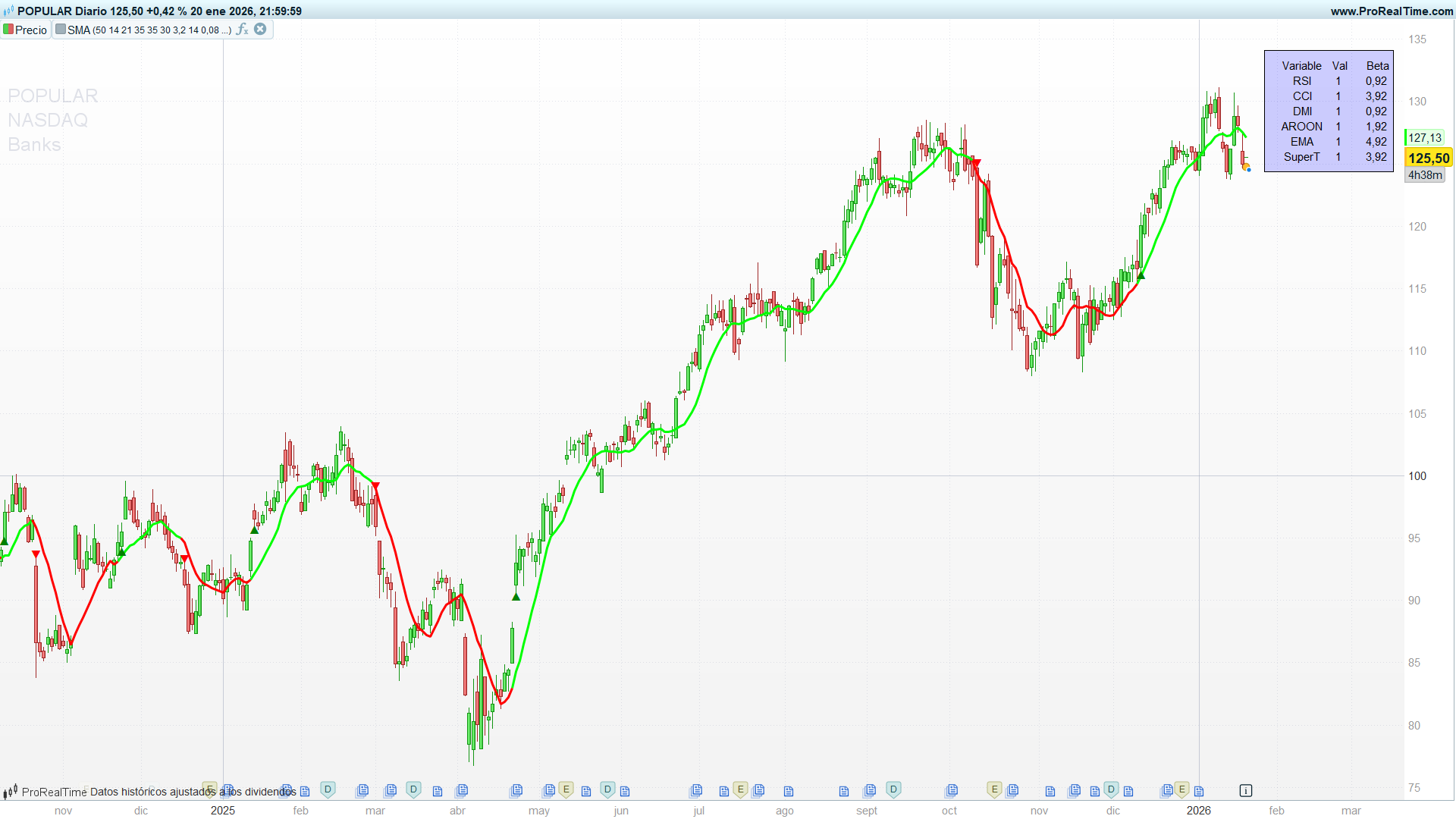
Introduction to Multiple Logistic Regression
In traditional technical analysis, we usually look at an indicator and wait for a fixed level (like RSI > 70). Logistic Regression is different. It is a statistical model used to determine the probability of an event occurring (e.g., “Is the price likely to go up?”).
Because this is a Multiple regression, it looks at six different indicators simultaneously, weighs their importance, and outputs a single value between 0 and 1.
- Value > 0.5: Bullish probability.
- Value < 0.5: Bearish probability.
How it Works: The Logic Breakdown
The code is divided into four main logical phases: Feature Calculation, Normalization, The Probability Engine, and The Learning Phase.
1. The Features (Inputs)
The model uses six “features” to understand the market:
- RSI: Momentum2.
- CCI: Trend strength and overbought/oversold levels.
- DMI: Directional movement (DI+ vs DI-).
- Aroon: Trend detection and age.
- EMAs: Moving average crossovers for trend direction.
- Supertrend: A volatility-based trend follower.
2. Normalization (The Binary State)
Machine Learning models work best with simplified data. The code takes the indicators above and converts them into 1 (Bullish) or -1 (Bearish). For example:
if rsivalue > 50 then
   x1=1
else
   x1=-1
endif
This transforms complex curves into a set of binary votes.
3. The Probability Engine (The Sigmoid Function)
This is the mathematical heart of the indicator. It calculates a weighted sum of all normalized inputs (z) and passes them through the Sigmoid Function:
p = 1/ (1 + e^(-(beta0 + beta1x1 + beta2x2 …)))
This formula “squashes” any input value into a range between 0 and 1. The result p represents the raw probability of the current trend.
4. Gradient Descent: How it “Learns”
Unlike a standard indicator, this code calculates a Loss Function. It compares its prediction (p) against what is actually happening in the price (using a Z-score of the Close).
myloss = (-y) * log(p) - (1-y) * log(1-p)
If the model is “wrong” (high loss), it uses Gradient Descent to adjust the weights (Betas) of each indicator.
- Learning Rate (lr): This controls how fast the model changes its mind. A value of 0.08 means it adapts slowly and smoothly to avoid market noise.
- Adjusted Betas: The values b1 through b6 are the “learned” weights. If the RSI has been a reliable predictor lately, its Beta will increase.
Reading the Dashboard
One of the most powerful features of this script is the On-Chart Data Table.
- Variable Column: The name of the indicator.
- Val Column: The current normalized state (1 or -1).
- Beta Column: The weight the model is currently giving to that indicator.
- High Beta: The model relies heavily on this indicator.
- Low Beta: The model is ignoring this indicator because it has been inaccurate recently.
Configuration & Parameters
- length = 50. The period used for the Z-score (the “truth” the model learns from).
- lr = 0.08. Learning Rate. Higher values make the model adapt faster but more erratically
- .b1 – b6 Variable. The initial “guess” weights for each indicator.
- Factor/ATR 3.2 / 2 Parameters for the internal Supertrend calculation.
Probuilder Code
DEFPARAM DRAWONLASTBARONLY =TRUE
//--------------------------------------------------------------//
//PRC_Multiple Logistic Regression
//version = 0
//14.05.24
//Iván González @ www.prorealcode.com
//Sharing ProRealTime knowledge
//-------------------------------------------------------------//
//-----Inputs--------------------------------------------------//
length=50 //Z score length
rsilength=35 //rsi
ccilength=45 //cc1
dmilength=35 //dmi
arlength=35 //aroon
emalength=30 //exponential average
factor=3.2 //factor for supertrend
atrperiod=2 //atr period
b0=1
b1=1//rsi
b2=4//cci
b3=1//dmi
b4=2//aroon
b5=5//ema
b6=4//supertrend
lr=0.08//step of learning
//-------------------------------------------------------------//
//-----INDICATORS----------------------------------------------//
//-----RSI
rsivalue=rsi[rsilength](close)
//-----CCI
ccivalue=cci[ccilength]((high+low+close)/3)
//-----DMI and DPI
plus=DIplus[dmilength](close)
minus=DIminus[dmilength](close)
//-----AROON
upper=AroonUp[arlength]
lower=AroonDown[arlength]
//-----EMAs
ema1=average[emalength,1](close)
ema2=average[emalength-10,1](close)
//-----SUPERTREND
atr = averagetruerange[atrperiod](close)
src=(high+low)/2
up = src - factor*atr
up1 = up[1]
if close[1] > up1 then
   up = max(up,up1)
else
   up = up
endif

dn = src + factor*atr
dn1 = dn[1]
if close[1] < dn1 then
   dn = min(dn,dn1)
else
   dn = dn
endif

once direction = 1

if direction = -1 and close > dn1 then
   direction = 1
elsif direction = 1 and close < up1 then
   direction = -1
else
   direction = direction
endif

if direction = 1 then
   st = up
else
   st = dn
endif
//-------------------------------------------------------------//
//-----Normalized indicators-----------------------------------//
//-----Normalized close
basis=average[length](close)
zscore=(close-basis)/std[length](close)
if zscore > 0 then
   y=1
else
   y=-1
endif
//-----Normalized RSI
if rsivalue > 50 then
   x1=1
else
   x1=-1
endif
//-----Normalized CCI
if ccivalue crosses over 100 then
   x2=1
elsif ccivalue crosses under -100 then
   x2=-1
endif
//-----Normalized DMI
if plus > minus then
   x3=1
else
   x3=-1
endif
//-----Normalized Aroon
if upper > lower then
   x4=1
else
   x4=-1
endif
//-----Normalized ema
if ema1 > ema2 then
   x5=-1
else
   x5=1
endif
//-----Normalized Supertrend
x6=direction*(1)
//-------------------------------------------------------------//
//-----MULTIPLE LOGISTIC REGRESSION----------------------------//
//-----Pre Multiple Logic Regression
p=1/(1+exp(-(b0+b1*x1+b2*x2+b3*x3+b4*x4+b5*x5+b6*x6)))
//-----Loss
myloss=(-y)*log(p)-(1-y)*log(1-p)
//-----Adjusting model weights using gradient descent
b11=b1-lr*(p+myloss)*x1
b22=b2-lr*(p+myloss)*x2
b33=b3-lr*(p+myloss)*x3
b44=b4-lr*(p+myloss)*x4
b55=b5-lr*(p+myloss)*x5
b66=b6-lr*(p+myloss)*x6
//-----Multiple Logic Regression With adjusted weights based on loss function
lreg=1/(1+exp(-(b0+b11*x1+b22*x2+b33*x3+b44*x4+b55*x5+b66*x6)))
//-------------------------------------------------------------//
//-----PLOT----------------------------------------------------//
//-----Color
if lreg>=0.5 then
   r=0
   g=255
else
   r=255
   g=0
endif
//-----SMA
sma=average[10](close)
//-------------------------------------------------------------//
//-----SIGNALS-------------------------------------------------//
if lreg crosses over 0.5 then
   $crossupx[z+1]=barindex
   $crossup[z+1]=low
   z=z+1
elsif lreg crosses under 0.5 then
   $crossdnx[t+1]=barindex
   $crossdn[t+1]=high
   t=t+1
endif
for i=0 to z do
   drawtext("▲",$crossupx[i],$crossup[i])coloured("green")
next
for j=0 to t do
   drawtext("▼",$crossdnx[j],$crossdn[j])coloured("red")
next
//-------------------------------------------------------------//
//-----TABLE---------------------------------------------------//
//-----Variable
drawtext("Variable",-200,-60)anchor(topRIGHT ,XSHIFT ,YSHIFT )
drawtext("RSI",-200,-80)anchor(topRIGHT ,XSHIFT ,YSHIFT )
drawtext("CCI",-200,-100)anchor(topRIGHT ,XSHIFT ,YSHIFT )
drawtext("DMI",-200,-120)anchor(topRIGHT ,XSHIFT ,YSHIFT )
drawtext("AROON",-200,-140)anchor(topRIGHT ,XSHIFT ,YSHIFT )
drawtext("EMA",-200,-160)anchor(topRIGHT ,XSHIFT ,YSHIFT )
drawtext("SuperT",-200,-180)anchor(topRIGHT ,XSHIFT ,YSHIFT )
//-----Val
drawtext("Val",-150,-60)anchor(topRIGHT ,XSHIFT ,YSHIFT )
drawtext("#x1#",-150,-80)anchor(topRIGHT ,XSHIFT ,YSHIFT )
drawtext("#x2#",-150,-100)anchor(topRIGHT ,XSHIFT ,YSHIFT )
drawtext("#x3#",-150,-120)anchor(topRIGHT ,XSHIFT ,YSHIFT )
drawtext("#x4#",-150,-140)anchor(topRIGHT ,XSHIFT ,YSHIFT )
drawtext("#x5#",-150,-160)anchor(topRIGHT ,XSHIFT ,YSHIFT )
drawtext("#x6#",-150,-180)anchor(topRIGHT ,XSHIFT ,YSHIFT )
//-----Beta
drawtext("Beta",-100,-60)anchor(topRIGHT ,XSHIFT ,YSHIFT )
drawtext("#b11#",-100,-80)anchor(topRIGHT ,XSHIFT ,YSHIFT )
drawtext("#b22#",-100,-100)anchor(topRIGHT ,XSHIFT ,YSHIFT )
drawtext("#b33#",-100,-120)anchor(topRIGHT ,XSHIFT ,YSHIFT )
drawtext("#b44#",-100,-140)anchor(topRIGHT ,XSHIFT ,YSHIFT )
drawtext("#b55#",-100,-160)anchor(topRIGHT ,XSHIFT ,YSHIFT )
drawtext("#b66#",-100,-180)anchor(topRIGHT ,XSHIFT ,YSHIFT )
//-----Rectangle
drawrectangle(-250,-200,-80,-40)anchor(topRIGHT ,XSHIFT ,YSHIFT )fillcolor("blue",50)
//-------------------------------------------------------------//
return sma as "SMA"coloured(r,g,0)style(line,3)

