




More from ProRealCode
ProRealCode - Trading & Coding with ProRealTime™



Jurik DMX Histogram Indicator
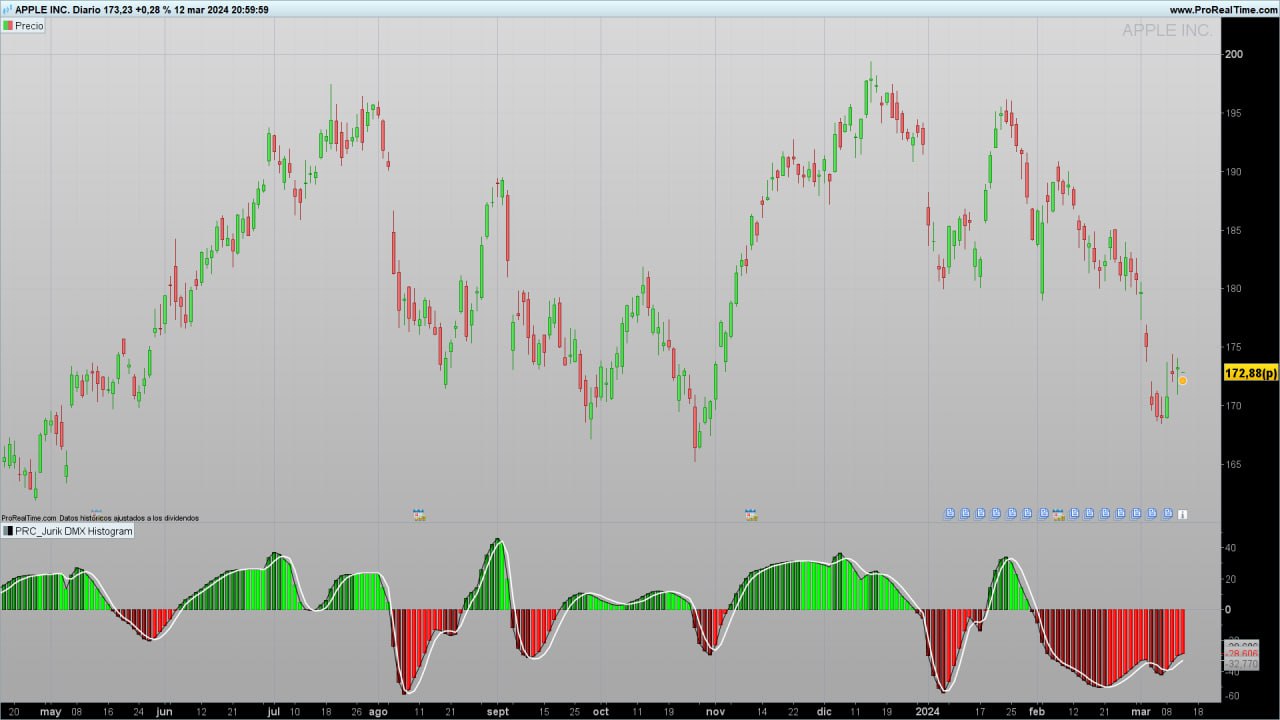
The Jurik DMX indicator is an advanced tool used in technical analysis to measure the direction of market movement and the strength of a trend. Based on Jurik technology, developed by Jurik Research, known for its ability to reduce noise in market data, the Jurik DMX offers smoother and more accurate signals compared to other traditional indicators like the ADX (Average Directional Index). This article will explore how the Jurik DMX works, how to configure it, and how to interpret its signals within the context of the ProRealTime platform.
Fundamentals of the Jurik DMX Indicator
The Jurik DMX is an advanced version of the directional movement indicator (DMX), utilizing Jurik smoothing technology to provide a more accurate and less noisy measure of the direction and strength of a trend in financial markets. While the traditional ADX indicator can be prone to generating false signals due to market volatility, the Jurik DMX smooths out these fluctuations, allowing traders to more clearly identify true trends.
Jurik technology is especially valued for its ability to minimize signal lag while maintaining a high degree of responsiveness to market changes. This is achieved through advanced mathematical algorithms that dynamically adjust smoothing parameters according to market conditions.
Compared to other directional indicators, the Jurik DMX stands out for:
- Noise Reduction: Jurik technology filters out minor fluctuations that can generate false signals in other indicators.
- More Accurate Signals: By smoothing data without significantly delaying the signal, the Jurik DMX allows for a more precise reading of market conditions.
- Versatility: It is applicable across different markets and timeframes, from intraday to long-term analysis.
These benefits make the Jurik DMX a powerful tool for traders seeking to improve their trend analysis and reduce the likelihood of making decisions based on erroneous signals.
Calculation and Logic of the Indicator
The Jurik DMX is an indicator that combines several advanced mathematical components to offer a precise measure of the market’s directional movement. Below is an explanation of the logic behind its calculation and the role of the main variables used in its code.
Main Variables and Parameters
- siglen: Signal smoothing length, controls the level of smoothing applied to the signal generated by the indicator.
- phs (Phase): Jurik phase adjustment, allows the signal to be shifted forward or backward without altering its smoothing.
- len: Length used to calculate the indicator, affects the sensitivity of the Jurik DMX to market movements.
- avglen: Average length used for calculating smoothed volume, a key component in normalizing directional movement data.
Jurik DMX Calculation Workflow
-
Calculation of PlusDM and MinusDM:
- The code first determines the positive (PlusDM) and negative (MinusDM) directions based on the price movements between the current and previous bars.
- These directional measures are used to identify the strength of upward and downward movements in the market.
-
Calculation of TRUR (True Range Unsmoothed):
- TRUR is calculated using a smoothed average of the market’s true ranges.
- Jurik smoothing is applied to dynamically adjust for volatility, allowing the indicator to better respond to changing market conditions.
-
Smoothing of PlusDM and MinusDM with Jurik:
- The code applies Jurik smoothing technology to both PlusDM and MinusDM, resulting in two smoothed values that more accurately reflect the market’s directional strength.
- These values are normalized by dividing by TRUR.
-
Calculation of the Trigger Signal:
- The difference between the smoothed PlusDM and MinusDM is used to generate the trigger signal, which indicates the market’s prevailing direction.
-
Signal Generation:
- The final signal is smoothed again using Jurik technology, ensuring it is as accurate as possible with minimal lag.
- This signal can be compared with the trigger signal to identify buying or selling opportunities.
This focus on advanced smoothing allows the Jurik DMX to provide clear and reliable signals, reducing the influence of minor fluctuations and helping traders identify the real trends in the market.
Indicator Configuration
The configuration of the Jurik DMX indicator is crucial for adapting it to different market conditions and trading styles. Below are the main parameters that can be adjusted, along with recommendations on how to optimize them for the best results.
Configurable Parameters
-
siglen (Signal Smoothing Length):
- Description: This parameter controls the amount of smoothing applied to the signal generated by the indicator. A shorter length will make the indicator more sensitive to market movements, while a longer length will smooth the signal more, reducing noise.
- Default Value: 5
- Recommendation: Use a lower value in volatile markets or for intraday trading where capturing quick movements is necessary. A higher value is preferable on longer-term charts where the goal is to capture broader trends.
-
phs (Phase):
- Description: Phase adjustment allows the signal to be shifted forward or backward without affecting the smoothing. This is useful for better aligning the indicator’s signals with market trends.
- Default Value: 0
- Recommendation: Keep the value at 0 for most cases. Adjust to negative values to anticipate signals or positive values to confirm them in more volatile markets.
-
len (Indicator Length):
- Description: This parameter determines the period used to calculate the Jurik DMX indicator. A longer length makes the indicator less sensitive to daily fluctuations, while a shorter length makes it more reactive.
- Default Value: 32
- Recommendation: For long-term trading, use a higher value to capture more sustained trends. In shorter timeframes, a lower value will allow you to react more quickly to market changes.
-
avglen (Average Length):
- Description: Controls the length used to calculate smoothed volume, which is crucial for normalizing PlusDM and MinusDM data.
- Default Value: 65
- Recommendation: This parameter is key to adjusting how the indicator responds to market volatility. A higher value will smooth out volume fluctuations more, while a lower value will make the indicator respond more quickly to sudden changes in volume.
With the proper configuration, the Jurik DMX indicator becomes a versatile tool that can adapt to various trading strategies, offering clear and reliable signals across a wide range of market conditions.
Signal Interpretation
The Jurik DMX is a powerful indicator that can offer clear signals about the direction and strength of a trend. However, it is important to understand how to interpret these signals correctly to maximize their effectiveness in trading. Below are the main signals generated by the Jurik DMX and how to use them in the context of technical analysis.
Buy and Sell Signals
-
Buy Signal:
- Condition: The “Histo DMX” (DMX histogram) crosses above the “Signal” line.
- Interpretation: When the DMX histogram crosses above the signal line, it indicates that the market’s directional strength is increasing in an uptrend. This is a signal to consider taking a long position.
- Additional Confirmation: It is recommended to confirm this signal with other indicators, such as a moving average crossover or an oscillator like the RSI, to increase the reliability of the signal.
-
Sell Signal:
- Condition: The “Histo DMX” crosses below the “Signal” line.
- Interpretation: A crossover of the histogram below the signal line indicates that the market’s directional strength is weakening, suggesting a potential reversal towards a downtrend. This is a signal to consider selling or exiting a long position.
- Additional Confirmation: As with buy signals, it is useful to use other indicators or price action analysis to confirm the signal before taking action.
Divergence Signals
-
Bullish Divergence:
- Condition: The price reaches new lows while the “Histo DMX” forms higher lows.
- Interpretation: This divergence indicates that although the price is falling, the strength of the downtrend is diminishing, which could precede a bullish reversal.
-
Bearish Divergence:
- Condition: The price reaches new highs while the “Histo DMX” forms lower highs.
- Interpretation: Here, despite the price continuing to rise, the strength of the uptrend is diminishing, which could indicate an upcoming bearish reversal.
Combining with Other Indicators
The Jurik DMX can be even more powerful when combined with other technical indicators. Common approaches include:
- Moving Averages: Using moving average crossovers alongside the Jurik DMX can help confirm trend direction.
- Volume Indicators: Volume is an important component in validating Jurik DMX signals. An increase in volume along with a DMX signal generally indicates a stronger signal.
- Oscillators: Indicators like RSI or MACD can provide additional confirmation when they align with Jurik DMX signals.
Conclusion
The Jurik DMX is an advanced indicator that can provide a significant advantage in technical analysis due to its ability to smooth market data and reduce noise. Unlike other traditional directional indicators, the Jurik DMX uses advanced smoothing technology to offer more accurate and reliable signals, helping traders identify true trends and minimize the risk of false signals.
Proper configuration of the Jurik DMX is crucial for adapting it to different market conditions, whether used for intraday or long-term trading. Additionally, the correct interpretation of its signals, especially when combined with other indicators, can significantly enhance the accuracy and effectiveness of a trading strategy.
By implementing the Jurik DMX in ProRealTime, traders can benefit from a powerful tool that allows them to make informed and potentially more profitable decisions. With the flexibility to adapt to various strategies, this indicator is a valuable addition for any serious trader looking to improve their technical analysis.
Jurik DMX Indicator Code
Below is the complete code for the Jurik DMX indicator in ProBuilder. You can copy and paste this code directly into the ProRealTime platform and adjust the parameters as needed.
//PRC_Jurik DMX Histogram
//version = 0
//13.03.24
//Iván González @ www.prorealcode.com
//Sharing ProRealTime knowledge
/////////////////////////////////////////////////////////////////////
///inputs////////////////////////////////////
siglen = 5 // Signal Smoothing length
phs = 0 //Jurik Phase
len = 32 //Length
////////////////////////////////////////////
len = MAX(len, 1)
len1 = max(log(sqrt(0.5*(len-1)))/log(2)+2,0)
Pow1 = max(len1-2,0.5)
avglen = 65
//////PlusDM and MinusDM////////////////////
if barindex=0 then
up = high
down = high
else
up = high-high[1]
down = -(low-low[1])
endif
if up > down and up > 0 then
plusDM = up
else
plusDM = 0
endif
if down > up and down > 0 then
minusDM = down
else
minusDM = 0
endif
////////////////////////////////
//TRUR - JURIK AVERAGE
IF BarIndex < avglen+1 THEN
Filt0tr = tr
Filt1tr = tr
trur = tr
bsmaxtr = 0
bsmintr = 0
vsumtr = 0
avoltytr = 0
ELSE
del1tr = tr-bsmaxtr[1]
del2tr = tr-bsmintr[1]
div = 1/(10+10*(min(max(len-10,0),100))/100)
if abs(del1tr)>abs(del2tr) then
voltytr = abs(del1tr)
else
voltytr = abs(del2tr)
endif
vsumtr = vsumtr[1]+div*(voltytr-voltytr[10])

tempavgtr = average[avglen](vsumtr)

y= barindex+1
if (y <= avglen+1) then
avoltytr = avoltytr[1]+2*(vsumtr-avoltytr[1])/(avglen+1)
else
avoltytr = tempavgtr
endif

if avoltytr > 0 then
dvoltytr = voltytr/avoltytr
else
dvoltytr = 0
endif

if dvoltytr > pow(len1,1/pow1) then
dvoltytr = pow(len1,1/pow1)
else
dvoltytr = dvoltytr
endif

if dvoltytr < 1 then
dvoltytr= 1
else
dvoltytr = dvoltytr
endif

pow2tr = pow(dvoltytr,pow1)
len2 = sqrt(0.5*(len-1))*len1
kvtr = pow(len2/(len2+1),sqrt(pow2tr))

if del1tr > 0 then
bsmaxtr = tr
else
bsmaxtr = tr - kvtr*del1tr
endif

if del2tr < 0 then
bsmintr = tr
else
bsmintr = tr - kvtr*del2tr
endif

if phs < -100 then
phaseratio = 0.5
elsif phs > 100 then
phaseratio = 2.5
else
phaseratio =phs/100+1.5
endif

beta = 0.45 * (len - 1) / (0.45 * (len - 1) + 2)
alphatr = pow(beta,pow2tr)

Filt0tr = (1 - alphatr) * tr + alphatr * Filt0tr[1]
Det0tr = (tr - Filt0tr[0]) * (1 - beta) + beta * Det0tr[1]
Filt1tr = Filt0tr[0] + phaseratio * Det0tr[0]
Det1tr = (Filt1tr[0] - trur[1]) * ((1 - alphatr) * (1 - alphatr)) + (alphatr * alphatr) * Det1tr[1]
trur = trur[1] + Det1tr[0]
ENDIF
/////Plus
IF BarIndex < avglen+1 THEN
Filt0pl = 0
Filt1pl = 0
jurikPlus = 0
bsmaxpl = 0
bsminpl = 0
vsumpl = 0
avoltypl = 0
ELSE
del1pl = plusDM-bsmaxpl[1]
del2pl = plusDM-bsminpl[1]
div = 1/(10+10*(min(max(len-10,0),100))/100)
if abs(del1pl)>abs(del2pl) then
voltypl = abs(del1pl)
else
voltypl = abs(del2pl)
endif
vsumpl = vsumpl[1]+div*(voltypl-voltypl[10])

tempavgpl = average[avglen](vsumpl)

y= barindex+1
if (y <= avglen+1) then
avoltypl = avoltypl[1]+2*(vsumpl-avoltypl[1])/(avglen+1)
else
avoltypl = tempavgpl
endif

if avoltypl > 0 then
dvoltypl = voltypl/avoltypl
else
dvoltypl = 0
endif

if dvoltypl > pow(len1,1/pow1) then
dvoltypl = pow(len1,1/pow1)
else
dvoltypl = dvoltypl
endif

if dvoltypl < 1 then
dvoltypl= 1
else
dvoltypl = dvoltypl
endif

pow2pl = pow(dvoltypl,pow1)
len2 = sqrt(0.5*(len-1))*len1
kvpl = pow(len2/(len2+1),sqrt(pow2pl))

if del1pl > 0 then
bsmaxpl = plusDM
else
bsmaxpl = plusDM - kvpl*del1pl
endif

if del2pl < 0 then
bsminpl = plusDM
else
bsminpl = plusDM - kvpl*del2pl
endif

if phs < -100 then
phaseratio = 0.5
elsif phs > 100 then
phaseratio = 2.5
else
phaseratio =phs/100+1.5
endif

beta = 0.45 * (len - 1) / (0.45 * (len - 1) + 2)
alphapl = pow(beta,pow2pl)

Filt0pl = (1 - alphapl) * plusDM + alphapl * Filt0pl[1]
Det0pl = (plusDM - Filt0pl[0]) * (1 - beta) + beta * Det0pl[1]
Filt1pl = Filt0pl[0] + phaseratio * Det0pl[0]
Det1pl = (Filt1pl[0] - jurikPlus[1]) * ((1 - alphapl) * (1 - alphapl)) + (alphapl * alphapl) * Det1pl[1]
jurikPlus = jurikPlus[1] + Det1pl[0]
ENDIF

plus = (100*jurikPlus/trur)

///////////////////////////////////////////////
/////minus
IF BarIndex < avglen+1 THEN
Filt0mn = 0
Filt1mn = 0
jurikMinus = 0
bsmaxmn = 0
bsminmn = 0
vsummn = 0
avoltymn = 0
ELSE
del1mn = minusDM-bsmaxmn[1]
del2mn = minusDM-bsminmn[1]
div = 1/(10+10*(min(max(len-10,0),100))/100)
if abs(del1mn)>abs(del2mn) then
voltymn = abs(del1mn)
else
voltymn = abs(del2mn)
endif
vsummn = vsummn[1]+div*(voltymn-voltymn[10])

tempavgmn = average[avglen](vsummn)

y= barindex+1
if (y <= avglen+1) then
avoltymn = avoltymn[1]+2*(vsummn-avoltymn[1])/(avglen+1)
else
avoltymn = tempavgmn
endif

if avoltymn > 0 then
dvoltymn = voltymn/avoltymn
else
dvoltymn = 0
endif

if dvoltymn > pow(len1,1/pow1) then
dvoltymn = pow(len1,1/pow1)
else
dvoltymn = dvoltymn
endif

if dvoltymn < 1 then
dvoltymn= 1
else
dvoltymn = dvoltymn
endif

pow2mn = pow(dvoltymn,pow1)
len2 = sqrt(0.5*(len-1))*len1
kvmn = pow(len2/(len2+1),sqrt(pow2mn))

if del1mn > 0 then
bsmaxmn = minusDM
else
bsmaxmn = minusDM - kvmn*del1mn
endif

if del2mn < 0 then
bsminmn = minusDM
else
bsminmn = minusDM - kvmn*del2mn
endif

if phs < -100 then
phaseratio = 0.5
elsif phs > 100 then
phaseratio = 2.5
else
phaseratio =phs/100+1.5
endif

beta = 0.45 * (len - 1) / (0.45 * (len - 1) + 2)
alphamn = pow(beta,pow2mn)

Filt0mn = (1 - alphamn) * minusDM + alphamn * Filt0mn[1]
Det0mn = (minusDM - Filt0mn[0]) * (1 - beta) + beta * Det0mn[1]
Filt1mn = Filt0mn[0] + phaseratio * Det0mn[0]
Det1mn = (Filt1mn[0] - jurikMinus[1]) * ((1 - alphamn) * (1 - alphamn)) + (alphamn * alphamn) * Det1mn[1]
jurikMinus = jurikMinus[1] + Det1mn[0]
ENDIF

minus = 100*jurikMinus/trur

/////////////////////////////////////////////////////////////
////////Trigger
trigger = plus-minus
///////////////////////////////////////////////////////////
///////signal
siglen = MAX(siglen, 1)
len1 = max(log(sqrt(0.5*(siglen-1)))/log(2)+2,0)
Pow1 = max(len1-2,0.5)
avglen = 65
IF BarIndex < avglen+1 THEN
Filt0 = 0
Filt1 = 0
signal = 0
bsmax = 0
bsmin = 0
vsum = 0
avolty = 0
ELSE
del1 = trigger-bsmax[1]
del2 = trigger-bsmin[1]
div = 1/(10+10*(min(max(siglen-10,0),100))/100)
if abs(del1)>abs(del2) then
volty = abs(del1)
else
volty = abs(del2)
endif
vsum = vsum[1]+div*(volty-volty[10])

tempavg = average[avglen](vsum)

y= barindex+1
if (y <= avglen+1) then
avolty = avolty[1]+2*(vsum-avolty[1])/(avglen+1)
else
avolty = tempavg
endif

if avolty > 0 then
dvolty = volty/avolty
else
dvolty = 0
endif

if dvolty > pow(len1,1/pow1) then
dvolty = pow(len1,1/pow1)
else
dvolty = dvolty
endif

if dvolty < 1 then
dvolty= 1
else
dvolty = dvolty
endif

pow2 = pow(dvolty,pow1)
len2 = sqrt(0.5*(siglen-1))*len1
kv = pow(len2/(len2+1),sqrt(pow2))

if del1 > 0 then
bsmax = trigger
else
bsmax = trigger - kv*del1
endif

if del2 < 0 then
bsmin = trigger
else
bsmin = trigger - kv*del2
endif

if phs < -100 then
phaseratio = 0.5
elsif phs > 100 then
phaseratio = 2.5
else
phaseratio =phs/100+1.5
endif

beta = 0.45 * (siglen - 1) / (0.45 * (siglen - 1) + 2)
alpha = pow(beta,pow2)

Filt0 = (1 - alpha) * trigger + alpha * Filt0[1]
Det0 = (trigger - Filt0[0]) * (1 - beta) + beta * Det0[1]
Filt1 = Filt0[0] + phaseratio * Det0[0]
Det1 = (Filt1[0] - signal[1]) * ((1 - alpha) * (1 - alpha)) + (alpha * alpha) * Det1[1]
signal = signal[1] + Det1[0]
ENDIF
/////////////////////////////////////////////////////
/////color
if trigger >=0 and trigger>=signal then
r=0
g=120
elsif trigger >=0 and trigger<signal then
r=0
g=255
elsif trigger <0 and trigger<signal then
r=120
g=0
else
r=255
g=0
endif

return trigger as "Histo DMX"coloured(r,g,0)style(histogram),trigger as "DMX" style(line), signal as "Signal"coloured("white")style(line,2)