




John Ehlers Sinewave
August 26, 2018, 11:58 AM
Indicators
4 Comments
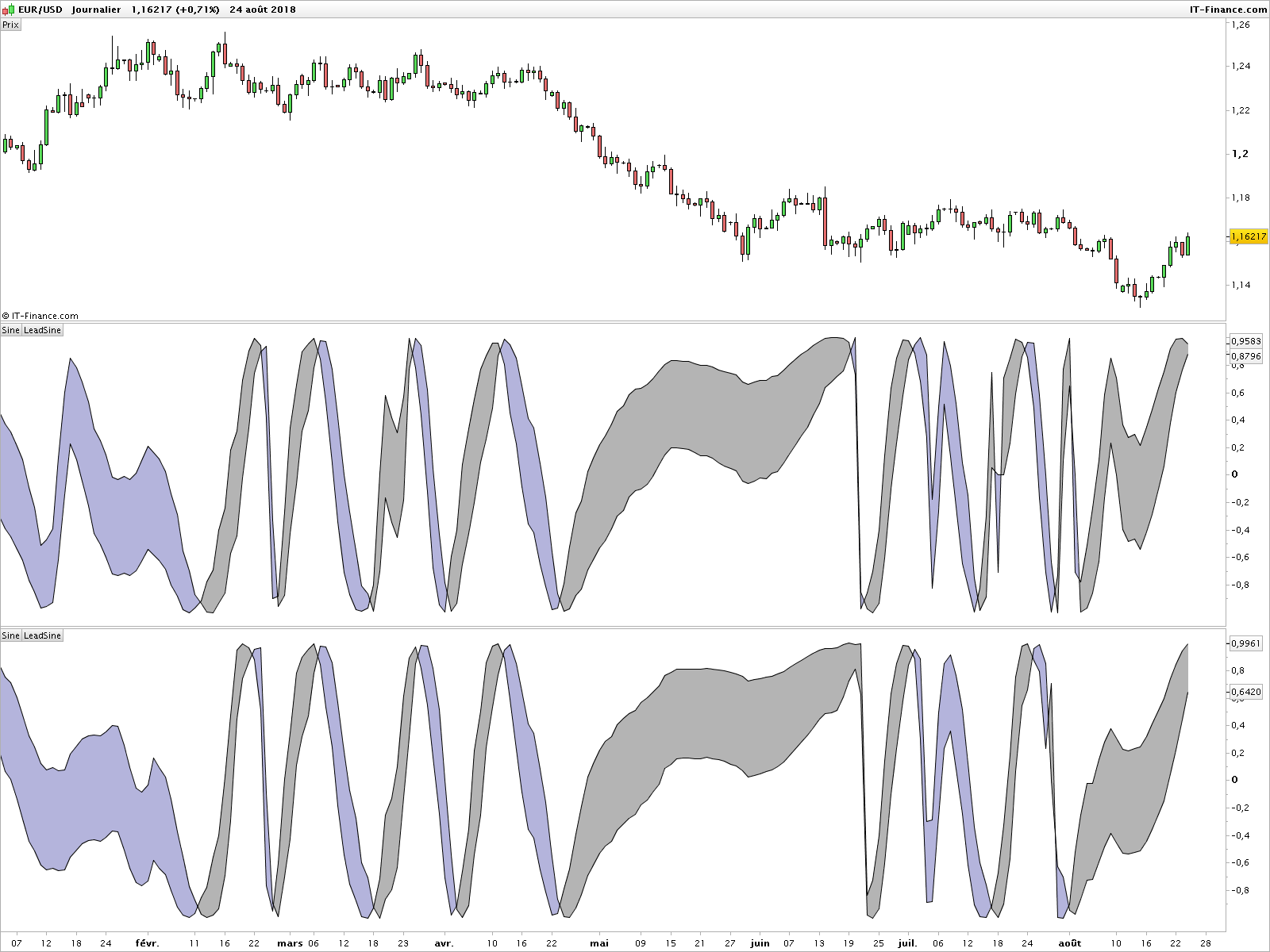
This is an implementation of John Ehlers’ Sinewave Indicator, as described in Market Mode Strategies (1999-10-19).
This is a different and earlier version of the Sinewave Indicator, from what is described in John Ehlers’ books Rocket Science for Traders (2001-07-20) and Cybernetic Analysis for Stocks and Futures (2004-03-29). However, this is the most popular version of the algorithm and seems to achieve better results.
// The Sinewave Indicator
// Market Mode Strategies
// 1999-10-19 John F. Ehlers
// http://www.jamesgoulding.com/Research_II/Ehlers/Ehlers%20(Market%20Mode%20Strategies).doc

Price = (high+low)/2
Imult = 0.635
Qmult = 0.338

If BarIndex > 6 then

	// Detrend Price
	Value3 = Price - Price[7]

	// Compute InPhase and Quadrature components
 	Inphase = 1.25*(Value3[4]  - Imult*Value3[2]) + Imult*InPhase[3]
	Quadrature = Value3[2] - Qmult*Value3 + Qmult*Quadrature[2]

	// Use ArcTangent to compute the current phase
	If ABS(InPhase + InPhase[1]) > 0 then
		a = ABS((Quadrature+Quadrature[1]) / (InPhase+InPhase[1]))
		Phase = ATAN(a)
	Endif

	// Resolve the ArcTangent ambiguity
	If InPhase < 0 and Quadrature > 0 then
		Phase = 180 - Phase
	Endif
	If InPhase < 0 and Quadrature < 0 then
		Phase = 180 + Phase
	Endif
	If InPhase > 0 and Quadrature < 0 then
		Phase = 360 - Phase
	Endif

	// Compute a differential phase, resolve phase wraparound, and limit delta phase errors
	DeltaPhase = Phase[1] - Phase
	If Phase[1] < 90 and Phase > 270 then
		DeltaPhase = 360 + Phase[1] - Phase
	Endif
	If DeltaPhase < 1 then
		DeltaPhase = 1
	Endif
	If DeltaPhase > 60 then
		DeltaPhase = 60
	Endif

	// Sum DeltaPhases to reach 360 degrees. The sum is the instantaneous period.
	InstPeriod = 0
	Value4 = 0
	For count = 0 to 40 do
		Value4 = Value4 + DeltaPhase[count]
		If Value4 > 360 and InstPeriod = 0 then
			InstPeriod = count
		Endif
	Next

	// Resolve Instantaneous Period errors and smooth
	If InstPeriod = 0 then
		InstPeriod = InstPeriod[1]
	Endif
	Value5 = .25*InstPeriod + .75*Value5[1]

	// Compute Dominant Cycle Phase, Sine of the Phase Angle, and Leadsine
	Period = ROUND(Value5)
	RealPart = 0
	ImagPart = 0
	For count = 0 to Period - 1
		RealPart = RealPart + SIN(360 * count / Period) * (Price[count])
		ImagPart = ImagPart + COS(360 * count / Period) * (Price[count])
	Next
	If ABS(ImagPart) > 0.001 then
		DCPhase = ATAN(RealPart / ImagPart)
	Endif
	If ABS(ImagPart) <= 0.001 then
		DCPhase = 90 * SGN(RealPart)
	Endif
	DCPhase = DCPhase + 90
	If ImagPart < 0 then
		DCPhase = DCPhase + 180
	Endif
	If DCPhase > 315 then
		DCPhase = DCPhase - 360
	Endif

Endif

Return Sin(DCPhase) as "Sine", Sin(DCPhase+45) as "LeadSine"
A more recent formula of Hilbert Transform, described in Squelch those Whipsaws (2000-24-03), can be used, by replacing the beginning of the code with:
If BarIndex > 5 then

	// Compute InPhase and Quadrature components
	Value1 = Price - Price[6]
	Value2 = Value1[3]
	Value3 = .75*(Value1 - Value1[6]) + .25*(Value1[2] - Value1[4])
	InPhase = .33*Value2 + .67*InPhase[1]
	Quadrature = .2*Value3 + .8*Quadrature[1]
The attached screenshot shows the Sinewave Indicator using original description (top) of and the alternative Hilbert Transform formula (bottom).
Download
Filename:
John-Ehlers-Sinewave.itf
Downloads:
210
Senior
Code artist, my biography is a blank page waiting to be scripted. Imagine a bio so awesome it hasn't been coded yet.
Author’s Profile


Loading...