Initial Balance Auction Intelligence
Introduction
The Initial Balance is the high and the low of the first part of the session — classically the first hour. It is one of the oldest ideas in market profile, and it survives because it is the cheapest available summary of what the market agreed on before the day had an opinion.
What most tools do with it is draw two lines and mark the break. That is the least informative thing you can do with it, because a break is a single instant and the Initial Balance is not about instants. The question a market profile reader is actually asking is what happened next: did price close outside and stay outside, or did it stick a wick through and come straight back? Did it come back to the edge and hold, or come back through it? Did it try both sides and fail at both?
Those are five different days, and a breakout arrow cannot tell them apart.
Initial Balance Auction Intelligence, designed by dgtrd, is built around that second question. It slices the rest of the session into fixed auction windows and, at the close of each one, classifies what that window did with the two edges. The result is a state machine with eleven states and a running commentary in the corner of the chart, rather than a signal.
The Initial Balance
The opening window is defined by two clock times and tracked bar by bar: the highest high becomes IBH, the lowest low becomes IBL, and the midpoint IBM sits between them. Once the window closes, the three levels freeze and extend across the rest of the session until the next one starts.
Optionally the tool projects six more levels — at 0.5, 1.0 and 1.5 times the width of the Initial Balance, above IBH and below IBL. These are reference levels for range extension, not targets. A session that expands a full Initial Balance width beyond its own edge is a measurably different session from one that expands a quarter of it, and having the levels drawn saves you from measuring by eye.
The width itself is worth reading before anything else happens. A narrow Initial Balance means the opening auction settled fast, and a narrow one usually gets broken; a wide one means the market spent the first hour disagreeing loudly, and the rest of the day often stays inside it. The tool does not score this for you, but it draws it clearly enough to read.
The Auction Window
After the Initial Balance completes, the session is cut into windows of a fixed length — 5, 10, 15 or 30 minutes, 30 by default. Each window accumulates its own open, high, low and close, exactly as if it were a single candle of that duration, and it is evaluated once, when it closes.
This is the design decision that makes the whole thing work. Evaluating on every bar would produce a stream of contradictory readings as price wobbles around IBH; evaluating on a completed window forces the market to commit. A window that pokes above IBH and closes back inside has said something specific, and it can only say it once its close exists.
The consequence is a one-bar delay, and it is an honest one. The decision is taken on the first bar of the new window using only data from the window that just ended, and the mark it produces is drawn on the last bar of that finished window. Nothing that happens after can move it. The single exception is the Probing Above / Probing Below state, which reads the live bar and is labelled (live) in the panel precisely so you do not mistake it for a confirmed reading.
The Eleven States
The classification of each completed window is short enough to hold in your head.
Balanced — price is inside the Initial Balance and nothing has resolved.
Probing Above and Probing Below — price is currently outside one edge but no window has closed to confirm it. This is the live, tentative state.
Accepted Above and Accepted Below — a window closed beyond the edge. The auction has moved outside the Initial Balance. This is the state that arms a retest.
Failed Above and Failed Below — a window traded beyond the edge, by its open or by its extreme, and closed back inside. The excursion happened and was refused. This is the classic failed auction, and in profile terms it is a stronger statement than a break, because someone had to be there to reject it.
Two-Sided Auction — both edges were tested and neither held. Either both failures happened in the same window, or one happened after the other. The market has rejected the highs and the lows of the opening range, which is the signature of a rotational day.
Continuation — after an acceptance, price came back to the accepted edge, touched it, and the window still closed on the right side of it. The retest held.
Rejection — the same retest, but the window closed back through the level. The acceptance is undone.
Note how the retest logic behaves after a hold: it does not disarm. A held retest immediately arms the next one, so a session that trends can produce several Continuation marks in a row, one per touch of the edge that keeps working.
Conviction: Not Every Event Is Worth the Same
Every confirmed event is scored out of 100, from three independent pieces.
Where the window closed inside its own range is worth 40 points. This is the close location value: a window that closed on its high after probing above IBH is a very different animal from one that closed mid-range after doing the same thing. The score is taken in the direction that supports the reading, so a failure below IBL scores high when the window closed near its own high.
How far the window travelled outside the Initial Balance is worth 30 points, measured as a fraction of the Initial Balance width and capped at one full width. This is what separates a two-tick poke from a genuine excursion, and normalising it by the width of the range is what makes the number comparable between a quiet session and a violent one.
The retest is worth the remaining 30. A held retest scores the full amount; a failed one scores zero; an event that has not been retested yet is given 15 as a provisional value.
That score, plus a small bonus for how many windows the state has survived, becomes the Quality reading: Weak, Developing, Established or Strong. Note that a brand new acceptance cannot be Strong — the maturity bonus does not exist yet, by design. An acceptance has to survive to earn the label.
Failures are scored on a different scale, because what matters about a failure is not where it closed but how far it got before being rejected. An excursion of less than 0.3 Initial Balance widths is Weak, up to 0.7 Moderate, up to 1.2 High, and beyond that Violent. A Violent failure — price extended more than a full range width beyond the edge and still came back inside — is the single most informative event this tool produces.
Pressure Is Not Bias
The panel reports both, and they are allowed to disagree. That is the point.
Bias is the direction of the current event and nothing else. An Accepted Above reads Bullish; a Failed Above reads Bearish Pressure; a Two-Sided Auction reads Conflicted. It changes every time the state changes.
Pressure is a running total for the whole session, bounded to the range minus 100 to plus 100. An acceptance adds or subtracts 30, a failed auction 15 the other way, a held retest 20 with the trend, a rejected retest 20 against it. It does not decay and it resets only at the start of the next Initial Balance.
So a session that accepted above, held one retest, then failed twice on the way back down will show a Bearish bias — the last event was a failure — sitting on top of a still-positive Pressure, because the day as a whole has produced more upside evidence than downside. That disagreement is information. A Bearish bias on strongly positive Pressure is a pullback; the same bias on negative Pressure is a trend.
One thing Pressure is not: it is not order flow, it is not volume, and it is not a probability. It is a tally of auction events, weighted by how much each one is worth.
The Panel
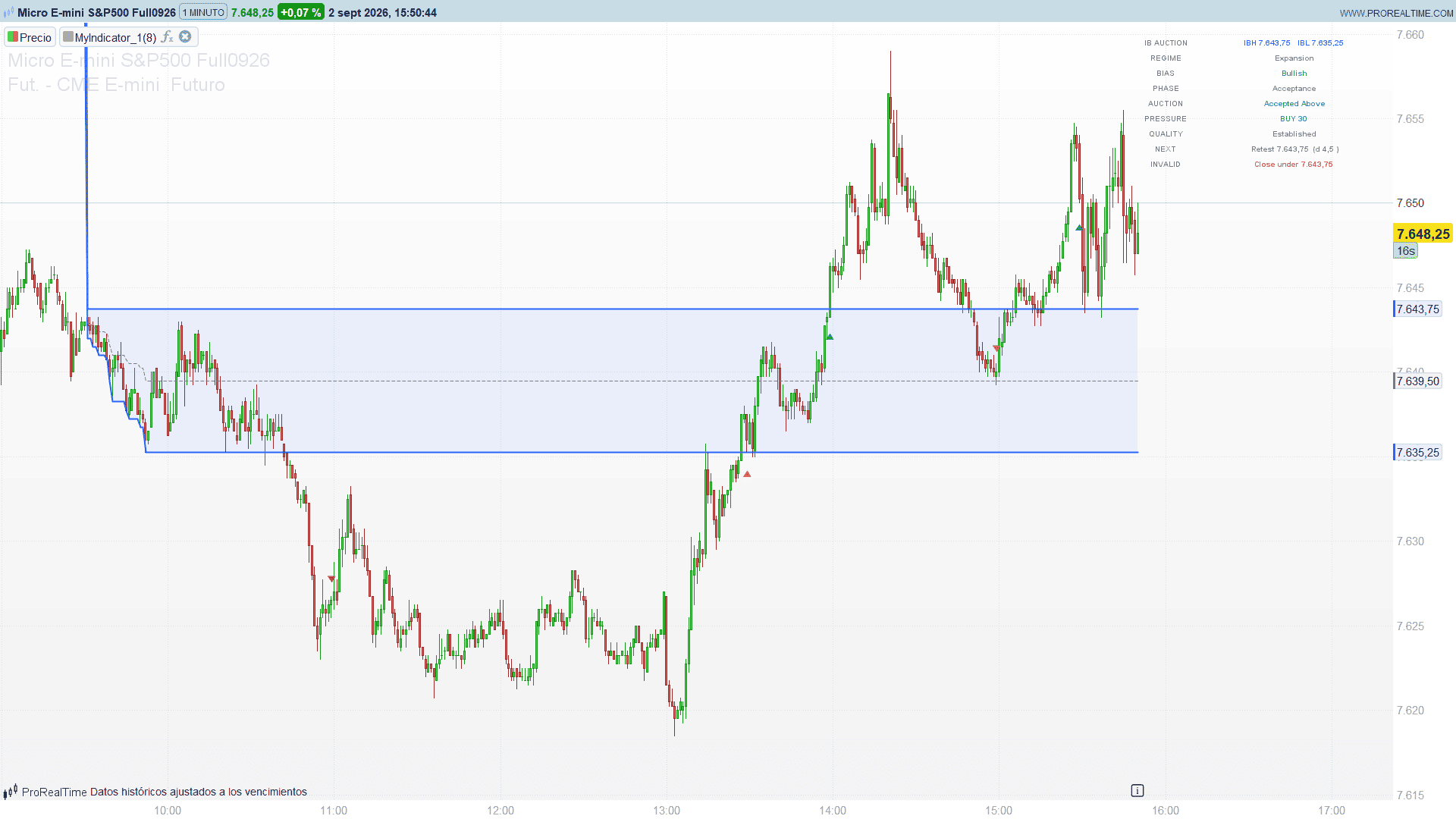
Nine rows in the top right corner, updated on the last bar.
The header carries the two levels that matter, IBH and IBL. Then REGIME (Balanced, Rotational, Expansion, Failed Expansion or Trend Auction), BIAS, PHASE (the lifecycle: Balance, Probe, Acceptance, Retest, Expansion, Exhaustion), AUCTION (the raw state, with the (live) suffix when it is tentative), PRESSURE, QUALITY, NEXT and INVALID.
The last two are the operationally useful pair. NEXT says what has to happen for the reading to advance — a close over a specific price, a retest of a specific level with the current distance to it, or simply waiting. INVALID says what price kills the current reading. Both print actual numbers, not the names of the levels, so you can work from the panel without measuring anything.
The panel position is exposed as four inputs rather than being hard-coded, because how far a text row extends before it meets the price scale depends on your screen and on how many digits your instrument prints. If a row gets clipped, move the whole panel left with dashX and dashCol.
One Deliberate Silence
There is a moment where the tool refuses to speak, and it is worth explaining because it looks like a missing signal.
At the instant the Initial Balance completes, no auction window of this session has closed yet. There is nothing to evaluate — the window buffer at that point still holds the last window of the previous session, and comparing yesterday’s closing half hour against today’s opening range produces a confident, completely meaningless reading. So the state machine stays in Balanced and waits for the first genuine window of the day to finish.
The same guard forces a fresh window to open at the exact bar the Initial Balance ends, rather than waiting for the next wall clock boundary. Without it, an opening range that does not line up with the auction grid — say a 45 minute range with 30 minute windows — would produce a first window made half of bars from inside the Initial Balance and half from outside. With the defaults the two coincide and nothing changes; with an unusual opening range it matters.
The Code
//----------------------------------------------
//PRC_Initial Balance Auction Intelligence by DGT
//version = 1
//02.09.2026
//Ivan Gonzalez @ www.prorealcode.com
//Concept and design: dgtrd (DGT)
//Sharing ProRealTime knowledge
//----------------------------------------------
// Overlay indicator. Marks the Initial Balance of the session (high, low and
// midpoint of an opening time window), projects reference levels at 0.5x, 1x
// and 1.5x its range, and then runs a state machine over fixed post-IB auction
// windows that classifies what the market does with those two edges:
// acceptance, failure, two-sided rotation, retest held or retest rejected.
// A corner panel reports regime, bias, phase, cumulative pressure, quality of
// the last confirmed event and what invalidates the current read.
//----------------------------------------------
DEFPARAM DRAWONLASTBARONLY = TRUE
// === 1. INITIAL BALANCE WINDOW ===
// Both times are HHMMSS and are read in the time YOUR platform displays.
// ProRealTime has no timezone conversion, so set them to the window you
// actually want on the chart you are looking at. Overnight windows are
// supported (ibStart > ibEnd).
ibStart = 090000 // start of the initial balance window, included
ibEnd = 103000 // end of the initial balance window, excluded
showMid = 1 // 1 = plot the initial balance midpoint
showFill = 1 // 1 = shade the initial balance
showProj = 0 // 1 = plot the 0.5x / 1x / 1.5x range projections
// === 2. AUCTION INTELLIGENCE ===
auctionMin = 30 // auction window length in minutes: 5, 10, 15 or 30
showMarks = 1 // 1 = draw the auction event marks on the price
showBoxes = 0 // 1 = shade the auction windows that interact with the IB
showPanel = 1 // 1 = draw the auction intelligence panel
maxMk = 90 // how many event marks are kept on the chart
maxBx = 60 // how many shaded auction windows are kept on the chart
// === 3. PANEL PLACEMENT (pixels from the top right corner) ===
dashX = -380 // label column
dashCol = 170 // horizontal offset of the value column
dashY = -25 // first row
rowH = 20 // row height
dashDec = 2 // decimals used when the panel prints a price
// === 4. COLOURS ===
ibR = 41 // initial balance lines
ibG = 98
ibB = 255
midR = 120 // midpoint, labels and neutral readings
midG = 123
midB = 134
bullR = 0 // bullish acceptance / continuation
bullG = 137
bullB = 123
bearR = 229 // bearish acceptance / continuation
bearG = 57
bearB = 53
warnR = 230 // failed auctions, rejections and projections
warnG = 81
warnB = 0
//----------------------------------------------
// DERIVED CONSTANTS
//----------------------------------------------
pxDec = 100
IF dashDec = 0 THEN
pxDec = 1
ELSIF dashDec = 1 THEN
pxDec = 10
ELSIF dashDec = 3 THEN
pxDec = 1000
ELSIF dashDec = 4 THEN
pxDec = 10000
ELSIF dashDec >= 5 THEN
pxDec = 100000
ENDIF
// Ring buffers carry one slot more than their useful capacity. With the market
// open the live bar is recomputed on every tick and arrays do not rewind, so a
// write coming from a tick that was later discarded must never fall inside the
// read window.
mkRing = maxMk + 1
bxRing = maxBx + 1
// The auction engine needs intraday bars that fit inside an auction window.
tfSec = gettimeframe
tfOK = 0
IF tfSec >= 60 AND tfSec <= 1800 AND tfSec <= auctionMin * 60 THEN
tfOK = 1
ENDIF
//----------------------------------------------
// SESSION ENGINE AND INITIAL BALANCE
//----------------------------------------------
// opentime is the OPENING time of the bar, which is the anchor that decides
// whether a bar belongs to the session window.
tNow = opentime
inIB = 0
IF ibStart < ibEnd THEN
IF tNow >= ibStart AND tNow < ibEnd THEN
inIB = 1
ENDIF
ELSE
IF tNow >= ibStart OR tNow < ibEnd THEN
inIB = 1
ENDIF
ENDIF
IF tfOK = 0 THEN
inIB = 0
ENDIF
ONCE prevIn = 0
ibNew = 0
ibDone = 0
IF inIB = 1 AND prevIn = 0 THEN
ibNew = 1
ENDIF
IF inIB = 0 AND prevIn = 1 THEN
ibDone = 1
ENDIF
prevIn = inIB
ONCE ibh = 0
ONCE ibl = 0
ONCE ibValid = 0
IF ibNew = 1 THEN
ibh = high
ibl = low
ibValid = 1
ELSIF inIB = 1 AND ibValid = 1 THEN
ibh = max(high, ibh)
ibl = min(low, ibl)
ENDIF
ibMid = (ibh + ibl) / 2
ibW = ibh - ibl
ONCE ibCompl = 0
IF ibNew = 1 THEN
ibCompl = 0
ENDIF
IF ibDone = 1 THEN
ibCompl = 1
ENDIF
// Plotted levels. The first bar of a new window is left empty on purpose so
// the previous session ends where it ended instead of being joined to the new
// one by a vertical line. Both series go blank together, so the shading is cut
// there too instead of bridging the gap.
IF ibValid = 1 AND ibNew = 0 THEN
ibhLine = ibh
iblLine = ibl
ELSE
ibhLine = undefined
iblLine = undefined
ENDIF
IF ibValid = 1 AND ibNew = 0 AND showMid = 1 THEN
ibmLine = ibMid
ELSE
ibmLine = undefined
ENDIF
IF showProj = 1 AND ibCompl = 1 THEN
pUp1 = ibh + 0.5 * ibW
pUp2 = ibh + 1.0 * ibW
pUp3 = ibh + 1.5 * ibW
pDn1 = ibl - 0.5 * ibW
pDn2 = ibl - 1.0 * ibW
pDn3 = ibl - 1.5 * ibW
ELSE
pUp1 = undefined
pUp2 = undefined
pUp3 = undefined
pDn1 = undefined
pDn2 = undefined
pDn3 = undefined
ENDIF
IF showFill = 1 THEN
fillA = 20
ELSE
fillA = 0
ENDIF
COLORBETWEEN(ibhLine, iblLine, ibR, ibG, ibB, fillA)
//----------------------------------------------
// AUCTION WINDOW CLOCK
//----------------------------------------------
// Auction windows sit on a wall clock grid. The end of the initial balance is
// forced to open a window as well, so the first evaluated auction never mixes
// bars taken from inside the IB with bars taken from outside it.
hhX = floor(tNow / 10000)
mmX = floor(tNow / 100) - hhX * 100
minDay = hhX * 60 + mmX
winId = floor(minDay / auctionMin)
ONCE prevWin = -1
qChg = 0
IF winId <> prevWin OR ibDone = 1 THEN
qChg = 1
ENDIF
prevWin = winId
ONCE qOpen = 0
ONCE qHigh = 0
ONCE qLow = 0
ONCE qClose = 0
ONCE qStart = 0
ONCE qReady = 0
IF ibNew = 1 THEN
qReady = 0
ENDIF
// The state machine reads the window that has just been completed, which is
// the value these variables held on the previous bar. qValid says whether that
// window belongs to THIS session: it is read before the reset below, which is
// what sets qReady.
smRun = 0
IF ibCompl = 1 AND qChg = 1 THEN
smRun = 1
ENDIF
qValid = qReady
IF ibCompl = 1 AND qChg = 1 THEN
qOpen = open
qHigh = high
qLow = low
qClose = close
qStart = barindex
qReady = 1
ELSIF ibCompl = 1 THEN
qHigh = max(high, qHigh)
qLow = min(low, qLow)
qClose = close
ENDIF
qO = qOpen[1]
qH = qHigh[1]
qL = qLow[1]
qC = qClose[1]
//----------------------------------------------
// AUCTION STATE MACHINE
//----------------------------------------------
// stAuc 0 Building IB 1 Balanced 2 Probing Above
// 3 Probing Below 4 Accepted Above 5 Accepted Below
// 6 Failed Above 7 Failed Below 8 Two-Sided Auction
// 9 Continuation 10 Rejection
// accSide 0 none, 1 above, 2 below
ONCE stAuc = 0
ONCE failAb = 0
ONCE failBl = 0
ONCE accSide = 0
ONCE awaitRt = 0
ONCE retestLvl = 0
ONCE convScore = 0
ONCE convValid = 0
ONCE convAcc = 0
ONCE convExt = 0
ONCE convRet = 0
ONCE candles = 0
ONCE hadCont = 0
ONCE failExc = 0
ONCE failExcOK = 0
ONCE press = 0
IF ibNew = 1 THEN
stAuc = 0
failAb = 0
failBl = 0
accSide = 0
awaitRt = 0
retestLvl = 0
convScore = 0
convValid = 0
convAcc = 0
convExt = 0
convRet = 0
candles = 0
hadCont = 0
failExc = 0
failExcOK = 0
press = 0
ENDIF
IF ibDone = 1 THEN
stAuc = 1
ENDIF
// Transition flags. They must be cleared on every bar or the marks and the
// pressure accumulator would fire again on bars where nothing happened.
becAA = 0
becAB = 0
becFA = 0
becFB = 0
becTS = 0
becCO = 0
becRJ = 0
// Live, unconfirmed excursion outside the initial balance.
IF ibCompl = 1 AND (stAuc = 1 OR stAuc = 6 OR stAuc = 7 OR stAuc = 8) THEN
IF high > ibh THEN
stAuc = 2
ELSIF low < ibl THEN
stAuc = 3
ENDIF
ENDIF
IF smRun = 1 THEN
stBefore = stAuc
convFires = 0
probeUp = 0
scoreHi = 0
isRetest = 0
// qValid = 0 on the very first evaluation after the initial balance closes,
// because no auction window of this session has completed yet. Reading the
// window buffer there would compare the LAST WINDOW OF THE PREVIOUS SESSION
// against today's IB levels.
failBelow = 0
IF qValid = 1 AND (qO < ibl OR qL < ibl) AND qC > ibl AND qC < ibh THEN
failBelow = 1
ENDIF
failAbove = 0
IF qValid = 1 AND (qO > ibh OR qH > ibh) AND qC > ibl AND qC < ibh THEN
failAbove = 1
ENDIF
bullAcc = 0
IF qValid = 1 AND qC > ibh THEN
bullAcc = 1
ENDIF
bearAcc = 0
IF qValid = 1 AND qC < ibl THEN
bearAcc = 1
ENDIF
IF awaitRt = 1 THEN
// While a retest is pending nothing else can be evaluated: an untouched
// level simply leaves the state where it was.
touched = 0
IF qValid = 1 AND accSide = 1 AND qL <= retestLvl THEN
touched = 1
ENDIF
IF qValid = 1 AND accSide = 2 AND qH >= retestLvl THEN
touched = 1
ENDIF
IF touched = 1 THEN
holds = 0
IF accSide = 1 AND qC > retestLvl THEN
holds = 1
ENDIF
IF accSide = 2 AND qC < retestLvl THEN
holds = 1
ENDIF
convFires = 1
isRetest = 1
IF holds = 1 THEN
stAuc = 9
convRet = 30
awaitRt = 1
ELSE
stAuc = 10
convRet = 0
awaitRt = 0
ENDIF
IF accSide = 1 THEN
scoreHi = holds
ELSE
scoreHi = 1 - holds
ENDIF
ENDIF
ELSIF failBelow = 1 AND failAbove = 1 THEN
failAb = 1
failBl = 1
stAuc = 8
convFires = 1
isRetest = 1
convRet = 15
upEx = qH - ibh
dnEx = ibl - qL
IF dnEx > upEx THEN
scoreHi = 1
ELSE
scoreHi = 0
ENDIF
ELSIF failBelow = 1 THEN
failBl = 1
IF failAb = 1 THEN
stAuc = 8
ELSE
stAuc = 7
ENDIF
convFires = 1
probeUp = 0
scoreHi = 1
ELSIF failAbove = 1 THEN
failAb = 1
IF failBl = 1 THEN
stAuc = 8
ELSE
stAuc = 6
ENDIF
convFires = 1
probeUp = 1
scoreHi = 0
ELSIF bullAcc = 1 THEN
accSide = 1
awaitRt = 1
retestLvl = ibh
stAuc = 4
convFires = 1
probeUp = 1
scoreHi = 1
ELSIF bearAcc = 1 THEN
accSide = 2
awaitRt = 1
retestLvl = ibl
stAuc = 5
convFires = 1
probeUp = 0
scoreHi = 0
ENDIF
// Conviction = where the window closed inside its own range (40 points),
// how far it travelled outside the IB (30 points) and the retest (30).
IF convFires = 1 THEN
qRng = qH - qL
IF qRng > 0 THEN
clv = (qC - qL) / qRng * 100
ELSE
clv = 50
ENDIF
IF scoreHi = 1 THEN
convAcc = clv * 0.4
ELSE
convAcc = (100 - clv) * 0.4
ENDIF
IF isRetest = 0 THEN
IF probeUp = 1 THEN
excur = qH - ibh
ELSE
excur = ibl - qL
ENDIF
IF ibW > 0 THEN
excRat = max(excur / ibW, 0)
convExt = min(excRat, 1) * 30
ELSE
excRat = 0
convExt = 15
ENDIF
convRet = 15
IF failBelow = 1 OR failAbove = 1 THEN
failExc = excRat
IF ibW > 0 THEN
failExcOK = 1
ELSE
failExcOK = 0
ENDIF
ENDIF
ELSE
convExt = 15
ENDIF
convScore = convAcc + convExt + convRet
convValid = 1
ENDIF
IF stAuc <> stBefore THEN
candles = 1
ELSE
candles = candles + 1
ENDIF
IF stAuc = 4 AND stBefore <> 4 THEN
becAA = 1
ENDIF
IF stAuc = 5 AND stBefore <> 5 THEN
becAB = 1
ENDIF
IF stAuc = 6 AND stBefore <> 6 THEN
becFA = 1
ENDIF
IF stAuc = 7 AND stBefore <> 7 THEN
becFB = 1
ENDIF
IF stAuc = 8 AND stBefore <> 8 THEN
becTS = 1
ENDIF
IF stAuc = 9 AND stBefore <> 9 THEN
becCO = 1
ENDIF
IF stAuc = 10 AND stBefore <> 10 THEN
becRJ = 1
ENDIF
IF stAuc = 9 THEN
hadCont = 1
ENDIF
// Only one transition flag can be set on a given window, so clamping once
// at the end is identical to clamping after every increment.
IF becAA = 1 THEN
press = press + 30
ENDIF
IF becAB = 1 THEN
press = press - 30
ENDIF
IF becFA = 1 THEN
press = press - 15
ENDIF
IF becFB = 1 THEN
press = press + 15
ENDIF
IF becCO = 1 THEN
IF accSide = 1 THEN
press = press + 20
ELSE
press = press - 20
ENDIF
ENDIF
IF becRJ = 1 THEN
IF accSide = 1 THEN
press = press - 20
ELSE
press = press + 20
ENDIF
ENDIF
press = max(-100, min(100, press))
ENDIF
//----------------------------------------------
// EVENT CAPTURE
//----------------------------------------------
// Everything that ends up on the chart is stored here and painted once, on the
// last bar. That is what lets a live panel and a history of event marks live in
// the same indicator: DRAWONLASTBARONLY clears the previous pass without
// erasing the marks, because they are repainted from the buffer every time.
ONCE nMk = 0
ONCE nBx = 0
// mkType 1 accepted above 2 accepted below 3 two-sided
// 4 failed above 5 failed below
// 6 continuation up 7 continuation down
// 8 rejection from above 9 rejection from below
IF showMarks = 1 AND smRun = 1 THEN
mkType = 0
IF becAA = 1 THEN
mkType = 1
ELSIF becAB = 1 THEN
mkType = 2
ELSIF becTS = 1 THEN
mkType = 3
ELSIF becFA = 1 THEN
mkType = 4
ELSIF becFB = 1 THEN
mkType = 5
ELSIF becCO = 1 THEN
IF accSide = 1 THEN
mkType = 6
ELSE
mkType = 7
ENDIF
ELSIF becRJ = 1 THEN
IF accSide = 1 THEN
mkType = 8
ELSE
mkType = 9
ENDIF
ENDIF
IF mkType > 0 THEN
// The decision uses the window that closed on the previous bar, so the
// mark is anchored on that bar and its Y is frozen here. Reading high or
// low inside the repaint would line every mark up with the last candle.
offs = averagetruerange[14] * 0.6
IF mkType = 1 OR mkType = 5 OR mkType = 6 OR mkType = 9 THEN
mkYc = low[1] - offs
ELSE
mkYc = high[1] + offs
ENDIF
mkSlot = nMk MOD mkRing
$mkX[mkSlot] = barindex - 1
$mkY[mkSlot] = mkYc
$mkK[mkSlot] = mkType
nMk = nMk + 1
ENDIF
ENDIF
// Auction windows that traded through IBH or IBL.
IF showBoxes = 1 AND smRun = 1 AND qValid = 1 THEN
touchIB = 0
IF (qH >= ibh AND qL <= ibh) OR (qH >= ibl AND qL <= ibl) THEN
touchIB = 1
ENDIF
IF touchIB = 1 THEN
bxSlot = nBx MOD bxRing
$bxX1[bxSlot] = qStart[1]
$bxX2[bxSlot] = barindex - 1
$bxHi[bxSlot] = qH
$bxLo[bxSlot] = qL
$bxOp[bxSlot] = qO
$bxCl[bxSlot] = qC
nBx = nBx + 1
ENDIF
ENDIF
//----------------------------------------------
// PANEL READINGS
//----------------------------------------------
// Every panel reading is resolved into a numeric code here, and turned into
// text further down by one DRAWTEXT branch per possible value.
// REGIME: -1 "-" 0 Balanced 1 Rotational 2 Expansion 3 Failed Expansion 4 Trend
regCode = 0
IF stAuc = 9 THEN
regCode = 4
ELSIF stAuc = 10 THEN
regCode = 3
ELSIF stAuc = 4 OR stAuc = 5 THEN
regCode = 2
ELSIF stAuc = 8 THEN
regCode = 1
ELSIF failAb = 1 AND failBl = 1 THEN
regCode = 1
ELSIF stAuc = 6 OR stAuc = 7 THEN
regCode = 1
ENDIF
IF stAuc = 0 THEN
regCode = -1
ENDIF
// BIAS: -1 "-" 0 Balanced 1 Bullish 2 Bearish 3 Bull Pressure 4 Bear Pressure
// 5 Conflicted
biasCode = 0
IF stAuc = 4 THEN
biasCode = 1
ELSIF stAuc = 5 THEN
biasCode = 2
ELSIF stAuc = 6 THEN
biasCode = 4
ELSIF stAuc = 7 THEN
biasCode = 3
ELSIF stAuc = 8 THEN
biasCode = 5
ELSIF stAuc = 9 THEN
IF accSide = 1 THEN
biasCode = 1
ELSE
biasCode = 2
ENDIF
ELSIF stAuc = 10 THEN
IF accSide = 1 THEN
biasCode = 2
ELSE
biasCode = 1
ENDIF
ENDIF
IF stAuc = 0 THEN
biasCode = -1
ENDIF
// A retest that is being touched right now, on the live bar.
liveRetest = 0
IF ibCompl = 1 AND awaitRt = 1 THEN
IF accSide = 1 AND low <= retestLvl THEN
liveRetest = 1
ENDIF
IF accSide = 2 AND high >= retestLvl THEN
liveRetest = 1
ENDIF
ENDIF
// PHASE: -1 "-" 0 Balance 1 Rotation 2 Probe 3 Acceptance 4 Expansion
// 5 Retest 6 Exhaustion
phCode = 0
IF liveRetest = 1 THEN
phCode = 5
ELSIF stAuc = 8 THEN
phCode = 1
ELSIF stAuc = 2 OR stAuc = 3 OR stAuc = 6 OR stAuc = 7 THEN
phCode = 2
ELSIF stAuc = 4 OR stAuc = 5 THEN
phCode = 3
ELSIF stAuc = 9 THEN
phCode = 4
ELSIF stAuc = 10 THEN
IF hadCont = 1 THEN
phCode = 6
ELSE
phCode = 5
ENDIF
ENDIF
IF stAuc = 0 THEN
phCode = -1
ENDIF
// QUALITY: -1 "-" 0 Weak 1 Developing 2 Established 3 Strong 4 Moderate
// 5 High 6 Violent
aqCode = -1
IF convValid = 1 THEN
aqScore = convScore + min(candles * 5, 20)
IF candles <= 1 THEN
IF aqScore < 40 THEN
aqCode = 0
ELSIF aqScore < 65 THEN
aqCode = 1
ELSE
aqCode = 2
ENDIF
ELSE
IF aqScore < 40 THEN
aqCode = 0
ELSIF aqScore < 65 THEN
aqCode = 1
ELSIF aqScore < 85 THEN
aqCode = 2
ELSE
aqCode = 3
ENDIF
ENDIF
ENDIF
fqCode = -1
IF failExcOK = 1 THEN
IF failExc < 0.3 THEN
fqCode = 0
ELSIF failExc < 0.7 THEN
fqCode = 4
ELSIF failExc < 1.2 THEN
fqCode = 5
ELSE
fqCode = 6
ENDIF
ENDIF
qualCode = -1
IF stAuc = 4 OR stAuc = 5 OR stAuc = 9 THEN
qualCode = aqCode
ELSIF stAuc = 6 OR stAuc = 7 OR stAuc = 8 OR stAuc = 10 THEN
qualCode = fqCode
ENDIF
// INVALIDATION: 0 "-" 1 close under IBH 2 close over IBL 3 close over IBH
// 4 close under IBL 5 acceptance on either side
invCode = 0
IF stAuc = 4 THEN
invCode = 1
ELSIF stAuc = 5 THEN
invCode = 2
ELSIF stAuc = 6 THEN
invCode = 3
ELSIF stAuc = 7 THEN
invCode = 4
ELSIF stAuc = 8 THEN
invCode = 5
ELSIF stAuc = 9 THEN
IF accSide = 1 THEN
invCode = 1
ELSE
invCode = 2
ENDIF
ELSIF stAuc = 10 THEN
IF accSide = 1 THEN
invCode = 3
ELSE
invCode = 4
ENDIF
ENDIF
// NEXT: 0 await event 1 await IB 2 await probe 3 close over IBH
// 4 close under IBL 5 re-auction 6 await acceptance 10 pending retest
nxCode = 0
IF awaitRt = 1 THEN
nxCode = 10
ELSIF stAuc = 0 THEN
nxCode = 1
ELSIF stAuc = 1 THEN
nxCode = 2
ELSIF stAuc = 2 THEN
nxCode = 3
ELSIF stAuc = 3 THEN
nxCode = 4
ELSIF stAuc = 6 OR stAuc = 7 OR stAuc = 10 THEN
nxCode = 5
ELSIF stAuc = 8 THEN
nxCode = 6
ENDIF
ibhTxt = round(ibh * pxDec) / pxDec
iblTxt = round(ibl * pxDec) / pxDec
rtTxt = round(retestLvl * pxDec) / pxDec
dRtTxt = round(abs(close - retestLvl) * pxDec) / pxDec
IF invCode = 1 OR invCode = 3 THEN
invTxt = ibhTxt
ELSE
invTxt = iblTxt
ENDIF
prsTxt = round(abs(press))
//----------------------------------------------
// RENDER
//----------------------------------------------
IF islastbarupdate THEN
IF showBoxes = 1 THEN
nBxD = min(nBx, maxBx)
IF nBxD > 0 THEN
stBox = (nBx - nBxD) MOD bxRing
FOR iBox = 0 TO nBxD - 1 DO
sBox = (stBox + iBox) MOD bxRing
IF $bxCl[sBox] > $bxOp[sBox] THEN
bxR = bullR
bxG = bullG
bxB = bullB
ELSE
bxR = bearR
bxG = bearG
bxB = bearB
ENDIF
DRAWRECTANGLE($bxX1[sBox], $bxLo[sBox], $bxX2[sBox], $bxHi[sBox]) COLOURED(bxR, bxG, bxB, 0) FILLCOLOR(bxR, bxG, bxB, 30)
DRAWRECTANGLE($bxX1[sBox], min($bxOp[sBox], $bxCl[sBox]), $bxX2[sBox], max($bxOp[sBox], $bxCl[sBox])) COLOURED(bxR, bxG, bxB, 0) FILLCOLOR(bxR, bxG, bxB, 60)
NEXT
ENDIF
ENDIF
IF showMarks = 1 THEN
nMkD = min(nMk, maxMk)
IF nMkD > 0 THEN
stMrk = (nMk - nMkD) MOD mkRing
FOR iMrk = 0 TO nMkD - 1 DO
sMrk = (stMrk + iMrk) MOD mkRing
kMrk = $mkK[sMrk]
IF kMrk = 1 THEN
DRAWTEXT("▲", $mkX[sMrk], $mkY[sMrk], SansSerif, Bold, 12) COLOURED(bullR, bullG, bullB)
ELSIF kMrk = 2 THEN
DRAWTEXT("▼", $mkX[sMrk], $mkY[sMrk], SansSerif, Bold, 12) COLOURED(bearR, bearG, bearB)
ELSIF kMrk = 3 THEN
DRAWTEXT("■", $mkX[sMrk], $mkY[sMrk], SansSerif, Bold, 11) COLOURED(midR, midG, midB)
ELSIF kMrk = 4 OR kMrk = 5 THEN
DRAWTEXT("✕", $mkX[sMrk], $mkY[sMrk], SansSerif, Bold, 12) COLOURED(warnR, warnG, warnB)
ELSIF kMrk = 6 THEN
DRAWTEXT("●", $mkX[sMrk], $mkY[sMrk], SansSerif, Bold, 12) COLOURED(bullR, bullG, bullB)
ELSIF kMrk = 7 THEN
DRAWTEXT("●", $mkX[sMrk], $mkY[sMrk], SansSerif, Bold, 12) COLOURED(bearR, bearG, bearB)
ELSIF kMrk = 8 THEN
DRAWTEXT("▼", $mkX[sMrk], $mkY[sMrk], SansSerif, Bold, 12) COLOURED(warnR, warnG, warnB)
ELSIF kMrk = 9 THEN
DRAWTEXT("▲", $mkX[sMrk], $mkY[sMrk], SansSerif, Bold, 12) COLOURED(warnR, warnG, warnB)
ENDIF
NEXT
ENDIF
ENDIF
IF showPanel = 1 THEN
vx = dashX + dashCol
y1 = dashY
y2 = dashY - rowH
y3 = dashY - rowH * 2
y4 = dashY - rowH * 3
y5 = dashY - rowH * 4
y6 = dashY - rowH * 5
y7 = dashY - rowH * 6
y8 = dashY - rowH * 7
y9 = dashY - rowH * 8
IF tfOK = 0 THEN
DRAWTEXT("IB AUCTION", dashX, y1, SansSerif, Bold, 10) COLOURED(warnR, warnG, warnB) ANCHOR(topright, xshift, yshift)
DRAWTEXT("Needs an intraday timeframe", vx, y2, SansSerif, Standard, 10) COLOURED(warnR, warnG, warnB) ANCHOR(topright, xshift, yshift)
DRAWTEXT("no larger than the auction window", vx, y3, SansSerif, Standard, 10) COLOURED(warnR, warnG, warnB) ANCHOR(topright, xshift, yshift)
ELSE
DRAWTEXT("IB AUCTION", dashX, y1, SansSerif, Bold, 10) COLOURED(midR, midG, midB) ANCHOR(topright, xshift, yshift)
DRAWTEXT("IBH #ibhTxt# IBL #iblTxt#", vx, y1, SansSerif, Standard, 10) COLOURED(ibR, ibG, ibB) ANCHOR(topright, xshift, yshift)
DRAWTEXT("REGIME", dashX, y2, SansSerif, Standard, 10) COLOURED(midR, midG, midB) ANCHOR(topright, xshift, yshift)
IF regCode = -1 THEN
DRAWTEXT("-", vx, y2, SansSerif, Bold, 10) COLOURED(midR, midG, midB) ANCHOR(topright, xshift, yshift)
ELSIF regCode = 0 THEN
DRAWTEXT("Balanced", vx, y2, SansSerif, Bold, 10) COLOURED(midR, midG, midB) ANCHOR(topright, xshift, yshift)
ELSIF regCode = 1 THEN
DRAWTEXT("Rotational", vx, y2, SansSerif, Bold, 10) COLOURED(midR, midG, midB) ANCHOR(topright, xshift, yshift)
ELSIF regCode = 2 THEN
DRAWTEXT("Expansion", vx, y2, SansSerif, Bold, 10) COLOURED(midR, midG, midB) ANCHOR(topright, xshift, yshift)
ELSIF regCode = 3 THEN
DRAWTEXT("Failed Expansion", vx, y2, SansSerif, Bold, 10) COLOURED(warnR, warnG, warnB) ANCHOR(topright, xshift, yshift)
ELSE
DRAWTEXT("Trend Auction", vx, y2, SansSerif, Bold, 10) COLOURED(midR, midG, midB) ANCHOR(topright, xshift, yshift)
ENDIF
IF biasCode = 1 THEN
bcR = bullR
bcG = bullG
bcB = bullB
ELSIF biasCode = 2 THEN
bcR = bearR
bcG = bearG
bcB = bearB
ELSIF biasCode = 3 OR biasCode = 4 THEN
bcR = warnR
bcG = warnG
bcB = warnB
ELSE
bcR = midR
bcG = midG
bcB = midB
ENDIF
DRAWTEXT("BIAS", dashX, y3, SansSerif, Standard, 10) COLOURED(midR, midG, midB) ANCHOR(topright, xshift, yshift)
IF biasCode = -1 THEN
DRAWTEXT("-", vx, y3, SansSerif, Bold, 10) COLOURED(bcR, bcG, bcB) ANCHOR(topright, xshift, yshift)
ELSIF biasCode = 0 THEN
DRAWTEXT("Balanced", vx, y3, SansSerif, Bold, 10) COLOURED(bcR, bcG, bcB) ANCHOR(topright, xshift, yshift)
ELSIF biasCode = 1 THEN
DRAWTEXT("Bullish", vx, y3, SansSerif, Bold, 10) COLOURED(bcR, bcG, bcB) ANCHOR(topright, xshift, yshift)
ELSIF biasCode = 2 THEN
DRAWTEXT("Bearish", vx, y3, SansSerif, Bold, 10) COLOURED(bcR, bcG, bcB) ANCHOR(topright, xshift, yshift)
ELSIF biasCode = 3 THEN
DRAWTEXT("Bull Pressure", vx, y3, SansSerif, Bold, 10) COLOURED(bcR, bcG, bcB) ANCHOR(topright, xshift, yshift)
ELSIF biasCode = 4 THEN
DRAWTEXT("Bear Pressure", vx, y3, SansSerif, Bold, 10) COLOURED(bcR, bcG, bcB) ANCHOR(topright, xshift, yshift)
ELSE
DRAWTEXT("Conflicted", vx, y3, SansSerif, Bold, 10) COLOURED(bcR, bcG, bcB) ANCHOR(topright, xshift, yshift)
ENDIF
DRAWTEXT("PHASE", dashX, y4, SansSerif, Standard, 10) COLOURED(midR, midG, midB) ANCHOR(topright, xshift, yshift)
IF phCode = -1 THEN
DRAWTEXT("-", vx, y4, SansSerif, Bold, 10) COLOURED(midR, midG, midB) ANCHOR(topright, xshift, yshift)
ELSIF phCode = 0 THEN
DRAWTEXT("Balance", vx, y4, SansSerif, Bold, 10) COLOURED(midR, midG, midB) ANCHOR(topright, xshift, yshift)
ELSIF phCode = 1 THEN
DRAWTEXT("Rotation", vx, y4, SansSerif, Bold, 10) COLOURED(midR, midG, midB) ANCHOR(topright, xshift, yshift)
ELSIF phCode = 2 THEN
DRAWTEXT("Probe", vx, y4, SansSerif, Bold, 10) COLOURED(midR, midG, midB) ANCHOR(topright, xshift, yshift)
ELSIF phCode = 3 THEN
DRAWTEXT("Acceptance", vx, y4, SansSerif, Bold, 10) COLOURED(midR, midG, midB) ANCHOR(topright, xshift, yshift)
ELSIF phCode = 4 THEN
DRAWTEXT("Expansion", vx, y4, SansSerif, Bold, 10) COLOURED(midR, midG, midB) ANCHOR(topright, xshift, yshift)
ELSIF phCode = 5 THEN
DRAWTEXT("Retest", vx, y4, SansSerif, Bold, 10) COLOURED(midR, midG, midB) ANCHOR(topright, xshift, yshift)
ELSE
DRAWTEXT("Exhaustion", vx, y4, SansSerif, Bold, 10) COLOURED(warnR, warnG, warnB) ANCHOR(topright, xshift, yshift)
ENDIF
DRAWTEXT("AUCTION", dashX, y5, SansSerif, Standard, 10) COLOURED(midR, midG, midB) ANCHOR(topright, xshift, yshift)
IF stAuc = 0 THEN
DRAWTEXT("Building IB", vx, y5, SansSerif, Bold, 10) COLOURED(midR, midG, midB) ANCHOR(topright, xshift, yshift)
ELSIF stAuc = 1 THEN
DRAWTEXT("Balanced", vx, y5, SansSerif, Bold, 10) COLOURED(midR, midG, midB) ANCHOR(topright, xshift, yshift)
ELSIF stAuc = 2 THEN
DRAWTEXT("Probing Above (live)", vx, y5, SansSerif, Bold, 10) COLOURED(midR, midG, midB) ANCHOR(topright, xshift, yshift)
ELSIF stAuc = 3 THEN
DRAWTEXT("Probing Below (live)", vx, y5, SansSerif, Bold, 10) COLOURED(midR, midG, midB) ANCHOR(topright, xshift, yshift)
ELSIF stAuc = 4 THEN
DRAWTEXT("Accepted Above", vx, y5, SansSerif, Bold, 10) COLOURED(bullR, bullG, bullB) ANCHOR(topright, xshift, yshift)
ELSIF stAuc = 5 THEN
DRAWTEXT("Accepted Below", vx, y5, SansSerif, Bold, 10) COLOURED(bearR, bearG, bearB) ANCHOR(topright, xshift, yshift)
ELSIF stAuc = 6 THEN
DRAWTEXT("Failed Above", vx, y5, SansSerif, Bold, 10) COLOURED(warnR, warnG, warnB) ANCHOR(topright, xshift, yshift)
ELSIF stAuc = 7 THEN
DRAWTEXT("Failed Below", vx, y5, SansSerif, Bold, 10) COLOURED(warnR, warnG, warnB) ANCHOR(topright, xshift, yshift)
ELSIF stAuc = 8 THEN
DRAWTEXT("Two-Sided", vx, y5, SansSerif, Bold, 10) COLOURED(midR, midG, midB) ANCHOR(topright, xshift, yshift)
ELSIF stAuc = 9 THEN
DRAWTEXT("Continuation", vx, y5, SansSerif, Bold, 10) COLOURED(bcR, bcG, bcB) ANCHOR(topright, xshift, yshift)
ELSE
DRAWTEXT("Rejection", vx, y5, SansSerif, Bold, 10) COLOURED(warnR, warnG, warnB) ANCHOR(topright, xshift, yshift)
ENDIF
IF press > 10 THEN
pcR = bullR
pcG = bullG
pcB = bullB
ELSIF press < -10 THEN
pcR = bearR
pcG = bearG
pcB = bearB
ELSE
pcR = midR
pcG = midG
pcB = midB
ENDIF
DRAWTEXT("PRESSURE", dashX, y6, SansSerif, Standard, 10) COLOURED(midR, midG, midB) ANCHOR(topright, xshift, yshift)
IF stAuc = 0 THEN
DRAWTEXT("-", vx, y6, SansSerif, Bold, 10) COLOURED(pcR, pcG, pcB) ANCHOR(topright, xshift, yshift)
ELSIF press > 10 THEN
DRAWTEXT("BUY #prsTxt#", vx, y6, SansSerif, Bold, 10) COLOURED(pcR, pcG, pcB) ANCHOR(topright, xshift, yshift)
ELSIF press < -10 THEN
DRAWTEXT("SELL #prsTxt#", vx, y6, SansSerif, Bold, 10) COLOURED(pcR, pcG, pcB) ANCHOR(topright, xshift, yshift)
ELSE
DRAWTEXT("NEUTRAL", vx, y6, SansSerif, Bold, 10) COLOURED(pcR, pcG, pcB) ANCHOR(topright, xshift, yshift)
ENDIF
DRAWTEXT("QUALITY", dashX, y7, SansSerif, Standard, 10) COLOURED(midR, midG, midB) ANCHOR(topright, xshift, yshift)
IF qualCode = -1 THEN
DRAWTEXT("-", vx, y7, SansSerif, Bold, 10) COLOURED(midR, midG, midB) ANCHOR(topright, xshift, yshift)
ELSIF qualCode = 0 THEN
DRAWTEXT("Weak", vx, y7, SansSerif, Bold, 10) COLOURED(midR, midG, midB) ANCHOR(topright, xshift, yshift)
ELSIF qualCode = 1 THEN
DRAWTEXT("Developing", vx, y7, SansSerif, Bold, 10) COLOURED(midR, midG, midB) ANCHOR(topright, xshift, yshift)
ELSIF qualCode = 2 THEN
DRAWTEXT("Established", vx, y7, SansSerif, Bold, 10) COLOURED(midR, midG, midB) ANCHOR(topright, xshift, yshift)
ELSIF qualCode = 3 THEN
DRAWTEXT("Strong", vx, y7, SansSerif, Bold, 10) COLOURED(midR, midG, midB) ANCHOR(topright, xshift, yshift)
ELSIF qualCode = 4 THEN
DRAWTEXT("Moderate", vx, y7, SansSerif, Bold, 10) COLOURED(midR, midG, midB) ANCHOR(topright, xshift, yshift)
ELSIF qualCode = 5 THEN
DRAWTEXT("High", vx, y7, SansSerif, Bold, 10) COLOURED(midR, midG, midB) ANCHOR(topright, xshift, yshift)
ELSE
DRAWTEXT("Violent", vx, y7, SansSerif, Bold, 10) COLOURED(warnR, warnG, warnB) ANCHOR(topright, xshift, yshift)
ENDIF
DRAWTEXT("NEXT", dashX, y8, SansSerif, Standard, 10) COLOURED(midR, midG, midB) ANCHOR(topright, xshift, yshift)
IF nxCode = 10 THEN
DRAWTEXT("Retest #rtTxt# (d #dRtTxt#)", vx, y8, SansSerif, Bold, 10) COLOURED(midR, midG, midB) ANCHOR(topright, xshift, yshift)
ELSIF nxCode = 1 THEN
DRAWTEXT("Await IB", vx, y8, SansSerif, Bold, 10) COLOURED(midR, midG, midB) ANCHOR(topright, xshift, yshift)
ELSIF nxCode = 2 THEN
DRAWTEXT("Await probe", vx, y8, SansSerif, Bold, 10) COLOURED(midR, midG, midB) ANCHOR(topright, xshift, yshift)
ELSIF nxCode = 3 THEN
DRAWTEXT("Close over #ibhTxt#", vx, y8, SansSerif, Bold, 10) COLOURED(midR, midG, midB) ANCHOR(topright, xshift, yshift)
ELSIF nxCode = 4 THEN
DRAWTEXT("Close under #iblTxt#", vx, y8, SansSerif, Bold, 10) COLOURED(midR, midG, midB) ANCHOR(topright, xshift, yshift)
ELSIF nxCode = 5 THEN
DRAWTEXT("Re-auction", vx, y8, SansSerif, Bold, 10) COLOURED(midR, midG, midB) ANCHOR(topright, xshift, yshift)
ELSIF nxCode = 6 THEN
DRAWTEXT("Await acceptance", vx, y8, SansSerif, Bold, 10) COLOURED(midR, midG, midB) ANCHOR(topright, xshift, yshift)
ELSE
DRAWTEXT("Await event", vx, y8, SansSerif, Bold, 10) COLOURED(midR, midG, midB) ANCHOR(topright, xshift, yshift)
ENDIF
DRAWTEXT("INVALID", dashX, y9, SansSerif, Standard, 10) COLOURED(midR, midG, midB) ANCHOR(topright, xshift, yshift)
IF invCode = 0 THEN
DRAWTEXT("-", vx, y9, SansSerif, Bold, 10) COLOURED(midR, midG, midB) ANCHOR(topright, xshift, yshift)
ELSIF invCode = 1 OR invCode = 4 THEN
DRAWTEXT("Close under #invTxt#", vx, y9, SansSerif, Bold, 10) COLOURED(warnR, warnG, warnB) ANCHOR(topright, xshift, yshift)
ELSIF invCode = 2 OR invCode = 3 THEN
DRAWTEXT("Close over #invTxt#", vx, y9, SansSerif, Bold, 10) COLOURED(warnR, warnG, warnB) ANCHOR(topright, xshift, yshift)
ELSE
DRAWTEXT("Acceptance either side", vx, y9, SansSerif, Bold, 10) COLOURED(warnR, warnG, warnB) ANCHOR(topright, xshift, yshift)
ENDIF
ENDIF
ENDIF
ENDIF
RETURN ibhLine AS "IBH" COLOURED(ibR, ibG, ibB) STYLE(line, 2), iblLine AS "IBL" COLOURED(ibR, ibG, ibB) STYLE(line, 2), ibmLine AS "IBM" COLOURED(midR, midG, midB) STYLE(dottedline, 1), pUp1 AS "IB +0.5R" COLOURED(warnR, warnG, warnB) STYLE(dottedline, 1), pUp2 AS "IB +1.0R" COLOURED(warnR, warnG, warnB) STYLE(dottedline, 1), pUp3 AS "IB +1.5R" COLOURED(warnR, warnG, warnB) STYLE(dottedline, 1), pDn1 AS "IB -0.5R" COLOURED(warnR, warnG, warnB) STYLE(dottedline, 1), pDn2 AS "IB -1.0R" COLOURED(warnR, warnG, warnB) STYLE(dottedline, 1), pDn3 AS "IB -1.5R" COLOURED(warnR, warnG, warnB) STYLE(dottedline, 1)
Settings
ibStart (093000) and ibEnd (103000) — the opening window, in HHMMSS, read in the time your platform displays. This is the single most important setting and the easiest one to get wrong: if your broker shows a US index in European time, the New York open is not at 09:30 on your chart. Set them to the window you actually see. Overnight windows work: if ibStart is greater than ibEnd the window wraps across midnight.
auctionMin (30) — the length of each auction window in minutes. Thirty is the practical default: it confirms slowly enough to mean something and fast enough to be useful. Dropping to 5 gives many more events of much lower individual quality, which is occasionally what you want on a fast instrument and usually is not. The chart timeframe must fit inside the window.
showMid (1), showFill (1) — the midpoint line and the shading of the range.
showProj (0) — the six projection levels at 0.5, 1 and 1.5 range widths. Off by default because they clutter a chart that already has three lines on it; turn them on when you are working a day that has clearly left the range.
showMarks (1) — the event marks on the price. A triangle for acceptance, a cross for a failed auction, a square for a two-sided auction, a dot for a held retest, and an inverted triangle in the failure colour for a rejected one.
showBoxes (0) — shades every completed auction window that traded through IBH or IBL. It is the most literal way to see the tool working, and it is off by default because on a long history it is a lot of drawing.
maxMk (90) and maxBx (60) — how many marks and shaded windows are kept on the chart. Lower them if the chart feels heavy.
dashX (-380), dashCol (170), dashY (-25), rowH (20) — panel geometry in pixels from the top right corner. dashX places the label column, dashCol is the offset to the value column, dashY the first row and rowH the row spacing.
dashDec (2) — how many decimals the panel prints for prices. Raise it on forex, drop it to 0 on an index future.
Colours — ibR/G/B for the Initial Balance lines, midR/G/B for the midpoint and neutral text, bullR/G/B and bearR/G/B for directional readings and warnR/G/B for failures, rejections and projections. They are mid-tones rather than saturated primaries so that they hold their contrast on both a white and a dark chart.
Notes and Limitations
It needs an intraday timeframe that fits inside an auction window. Below 1 minute or above 30 the tool switches off and the panel says so. With 30 minute windows, anything from 1 to 30 minutes works; with 5 minute windows you need a 5 minute chart or faster.
The clock is your platform’s clock. There is no timezone conversion anywhere in the tool, which is a feature as much as a limitation: what you set is what you see. It does mean that if you change broker, or if your platform switches between winter and summer time differently from the exchange, you have to revisit ibStart and ibEnd.
A session with no bars inside the window is skipped. On a holiday half day, or on an instrument that has not started trading when the window opens, no new Initial Balance forms and the previous session’s levels stay on the chart. That is usually what you want; it is worth knowing it is what happens.
Acceptance is a close, not a touch. This is what makes the readings stable and it is also why the tool will sometimes look slow. Price can spend twenty minutes above IBH and the state will still read Probing Above until a window closes there. If you want the earlier read, shorten auctionMin — and accept that you are buying speed with confirmation.
The state machine describes, it does not predict. Every reading in the panel is a statement about what has already happened. Trend Auction does not mean the trend continues; it means the retest of an accepted edge has held so far, and INVALID tells you the price at which that stops being true. Read it as a running description of the auction, which is what it is.
Pressure never decays. An acceptance from the first window of the afternoon still counts as much at the close as it did at the time. Over a long session that makes Pressure a genuine session-level summary, but it also means an early violent event can hold the reading in one direction for hours. The Bias row exists to tell you what is happening now.
Conclusion
The transferable idea here is the auction window itself. Almost every opening range tool evaluates on the bar — the bar that closes above the level, the bar that breaks it — and the bar is an arbitrary unit that has nothing to do with how the auction actually works. Grouping bars into fixed windows and forcing a single classification per window costs very little code and removes most of the noise, because it makes the market commit before it is allowed to speak.
The second idea worth taking is the separation of the last event from the running total. Any state machine can tell you where it is. Keeping a bounded tally of everything that got you there, and displaying it next to the current state so that the two can visibly disagree, turns a classifier into something you can actually reason with.
Concept and design by dgtrd (DGT).